

Staying informed about U.S. immigration policies and processing updates is crucial for anyone seeking to live and work in the United States. For many immigrants, the Employment Authorization Document (EAD), often called a work permit, is the key to financial stability and building a new life. Recent updates from U.S. Citizenship and Immigration Services (USCIS) regarding EAD applications and renewals have brought both challenges and opportunities. At Imigrar, we are dedicated to helping families in Orlando and across the nation navigate these complex changes, ensuring you understand your rights and options.
Need Help? Our Orlando immigration team is ready to assist. Call +1 786-791-3106 for a free consultation, or message us online. Se Habla Español.
The reporting that sparked this guide
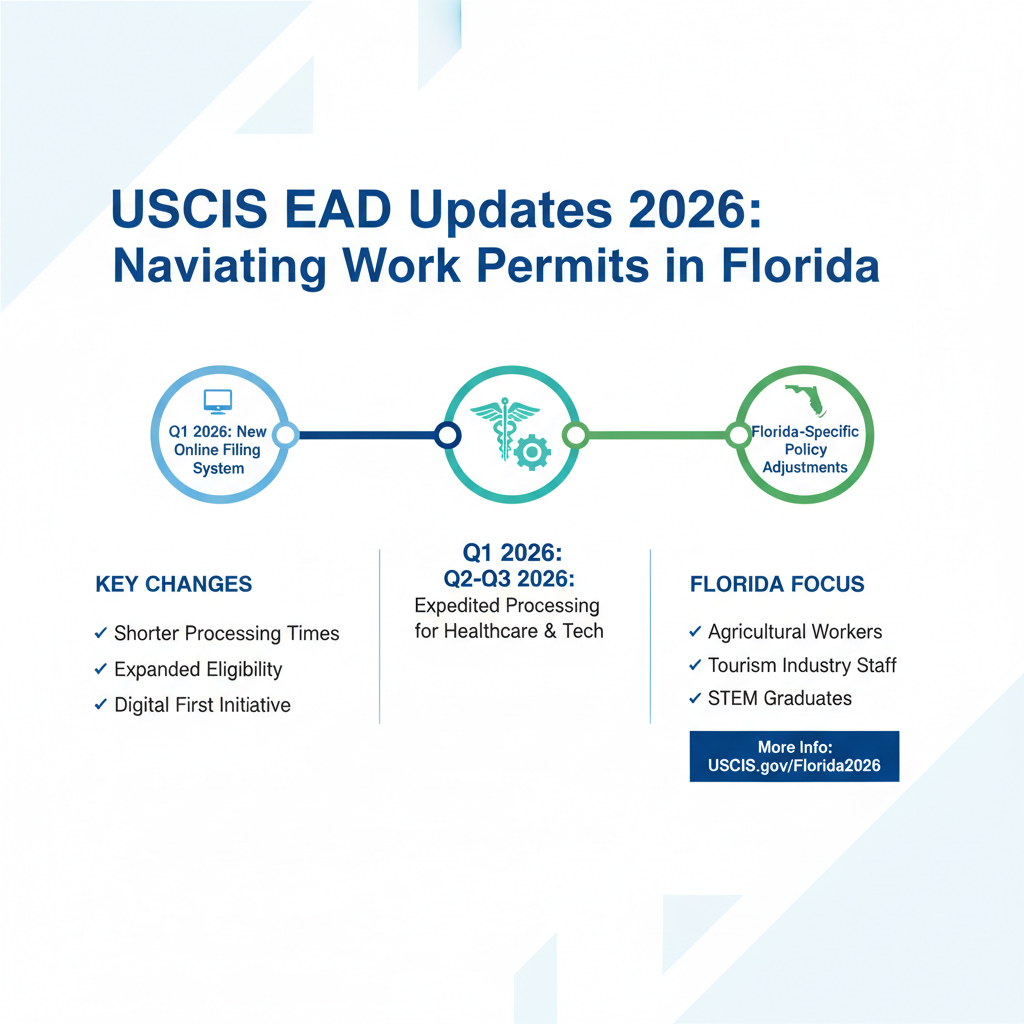
The information and guidance in this comprehensive article are inspired by ongoing reports and official announcements from USCIS regarding their efforts to streamline processes, reduce backlogs, and provide clarity on Employment Authorization Document processing. While there isn't one single "breaking news" report that encapsulates all these changes, the constant evolution of USCIS policies, particularly concerning EADs, warrants a detailed, up-to-date guide for those impacted. We continuously monitor official sources to bring you the most accurate and actionable advice.
Employment Authorization Document Processing (USCIS)
What This News Means for Immigrants in Orlando and Across Florida
The landscape of immigration processing is constantly shifting, and recent USCIS announcements and operational adjustments concerning Employment Authorization Documents (EADs) are particularly relevant for immigrants across Florida. These updates primarily aim to address longstanding processing delays, which have caused significant stress and uncertainty for many individuals and families.
Why this news is showing up now
For several years, USCIS has grappled with immense backlogs across various application types, including Form I-765, Application for Employment Authorization. These backlogs were exacerbated by increased application volumes, resource limitations, and operational changes during recent global events. In response to widespread advocacy from immigration attorneys, community organizations, and affected individuals, USCIS has implemented a series of initiatives to improve efficiency. These efforts include:
- Temporary Final Rules: In some categories, USCIS has issued temporary rules to extend the validity period of certain EADs and to provide automatic extensions for EAD renewals beyond the standard 180 days, sometimes up to 540 days. While these are often temporary, they reflect an ongoing commitment to mitigating the impact of delays.
- Increased Staffing and Technology: Investments in hiring additional personnel and upgrading technological infrastructure are underway to process applications more quickly.
- Policy Adjustments: USCIS has been exploring and implementing policy changes to streamline adjudication processes for certain EAD categories, particularly for those with pending Adjustment of Status applications or asylum claims.
- Public Engagement: USCIS regularly updates its processing times website and engages with stakeholders to communicate progress and explain new policies.
These ongoing efforts are what constitute the "news"—a continuous drive by USCIS to improve a critical service that affects millions of lives. The goal is to reduce processing times and provide greater predictability for applicants.
How it can affect Florida residents
Florida, with its large and diverse immigrant population, is significantly impacted by these EAD processing updates. Whether you are living in Orlando, Miami, Tampa, or anywhere along the I-4 corridor, the ability to work legally is fundamental. Here’s how these changes can affect you:
- Reduced Uncertainty: If USCIS successfully reduces processing times, Florida residents will experience less anxiety about job security, maintaining income, and planning their futures. Shorter wait times mean you can start or continue working sooner.
- Employment Continuity: For those renewing their EADs, potential automatic extensions or faster processing can prevent gaps in employment, which is vital for families relying on steady income. This is especially critical in competitive job markets like Orlando's.
- Economic Stability: The ability for immigrants to work legally contributes significantly to Florida's economy. Faster EAD processing means more individuals can enter or remain in the workforce, supporting local businesses and communities.
- Impact on Local USCIS Offices: While most EAD applications are processed at USCIS Service Centers, local field offices like the Orlando USCIS Field Office may still be involved in biometrics appointments or interviews for related underlying applications (e.g., Form I-485, Adjustment of Status), which can indirectly affect EAD timelines.
- Navigating Complexity: Even with improvements, the system remains complex. Understanding specific eligibility categories, application requirements, and how to track your case is paramount. For Central Florida residents, having access to knowledgeable legal counsel is invaluable to navigate these nuances and ensure applications are filed correctly and efficiently.
At Imigrar, we understand the unique challenges faced by immigrants in Florida. Our team is committed to keeping you informed about these updates and providing expert guidance to ensure your EAD application or renewal is handled with precision and care, so you can continue to "Keep Families Together."
Is your EAD application taking too long? Don't face delays alone. Contact Imigrar for personalized advice. Call +1 786-791-3106 or reach out online. Se Habla Español.
What Employment Authorization Documents (EADs) Are (and Why They Matter)
The Employment Authorization Document, or EAD, is one of the most vital documents for many immigrants in the United States. It's a key that unlocks the ability to work legally, providing financial independence and stability. Understanding what an EAD is and why it matters is the first step in securing your future in the U.S.
A plain-English definition
Simply put, an Employment Authorization Document (EAD) is a permit issued by USCIS that grants non-citizens legal permission to work in the United States. It's a physical card, similar to a driver's license, that proves you are authorized to be employed. Unlike a green card (which grants permanent residency and work authorization), an EAD is typically issued for a specific period, usually one or two years, and must be renewed.
Many different categories of non-citizens are eligible for an EAD. It's not a visa itself, but rather a benefit granted to individuals who are already in the U.S. under certain circumstances or who have applied for a specific immigration benefit that allows for work authorization while their main application is pending.
Key terms you need to know
Navigating immigration processes requires understanding specific terminology. Here are some key terms related to EADs:
- Form I-765: This is the official USCIS form, "Application for Employment Authorization," that you must submit to apply for an EAD. This form is central to the entire process.
- USCIS: U.S. Citizenship and Immigration Services. This is the government agency responsible for processing immigration benefits, including EADs. You can find official information and forms on the USCIS official website.
- EAD Category: This refers to the specific eligibility category under which you are applying for an EAD. There are many categories, each with its own requirements. Examples include:
- (c)(9) Pending Adjustment of Status: For individuals who have filed Form I-485 to adjust their status to a lawful permanent resident (green card holder).
- (c)(8) Asylum Seeker: For individuals who have filed for asylum and their application has been pending for at least 150 days.
- (c)(33) DACA: For recipients of the Deferred Action for Childhood Arrivals program.
- (c)(3) (i), (ii), (iii) F-1 OPT/STEM OPT: For certain F-1 students seeking Optional Practical Training or STEM Optional Practical Training after graduation.
- (a)(10) Withholding of Removal: For individuals granted withholding of removal.
- Automatic EAD Extension: In certain categories, if you file for an EAD renewal before your current EAD expires, your work authorization may automatically extend for a period (e.g., 180 or 540 days) while your renewal application is pending. This allows you to continue working legally without a gap.
- Biometrics Appointment: A scheduled appointment at a USCIS Application Support Center (ASC) to capture your fingerprints, photograph, and signature. This is often required for identity verification and background checks.
- Request for Evidence (RFE): A letter from USCIS requesting additional documents or information to support your application. Responding promptly and completely to an RFE is crucial.
- Processing Times: The estimated time it takes for USCIS to process an application from the date of receipt. You can check current processing times on the USCIS Processing Times page.
Understanding these terms is critical for anyone navigating the EAD application or renewal process. An EAD is more than just a card; it's a bridge to opportunity, allowing individuals to support themselves and their families, pursue careers, and contribute to their communities, including those right here in Orlando and throughout Florida. At Imigrar, we are committed to helping you understand every step and term, ensuring a clear path forward.
Current Immigration Law: The Foundation for Work Authorization
The ability to obtain an Employment Authorization Document (EAD) is rooted deeply in U.S. immigration law, specifically the Immigration and Nationality Act (INA) and its associated regulations. While the process can seem complex, understanding the legal framework provides clarity on eligibility and requirements. It’s important to remember that an EAD is a benefit that stems from an underlying immigration status or application.
Federal requirements
The authority to grant employment authorization to non-citizens comes from various sections of the Immigration and Nationality Act. While specific eligibility categories are detailed in 8 CFR § 274a.12, the overarching federal requirements dictate who can apply for an EAD and under what conditions. The primary federal requirements include:
- Lawful Presence: Generally, applicants must be lawfully present in the United States or be in a specific immigration status that permits them to apply for work authorization. For example, individuals granted asylum, those with pending Adjustment of Status applications, or certain nonimmigrants (like F-1 students on OPT) are considered to be in a status that allows for EAD eligibility.
- Proper Filing: All EAD applications must be filed using the most current version of Form I-765, Application for Employment Authorization, along with all required supporting documentation and the correct filing fee (or an approved fee waiver). Failure to do so can lead to delays or rejection. You can always find the latest forms on the USCIS Forms page.
- Specific Eligibility Category: As mentioned, applicants must fall into one of the many specific EAD eligibility categories outlined in federal regulations. Each category has unique criteria. For instance, an asylum applicant (category (c)(8)) must wait 150 days after filing their asylum application before they can file for an EAD, and their application must not have been denied or withdrawn.
- Admissibility and Background Checks: All applicants are subject to background checks and must generally be admissible to the U.S., or have a waiver of inadmissibility approved, for their underlying immigration benefit.
- Continuous Compliance: Maintaining the underlying immigration status or application (e.g., keeping your Form I-485 active, complying with asylum interview requests) is crucial, as the EAD is often tied to it.
The federal government, through USCIS, is the sole authority for issuing EADs. There is no state-level EAD. The process is uniform across the country, though local USCIS field offices (like the one in Orlando) handle specific appointments or interviews related to the underlying immigration benefits.
Florida-specific considerations
While EADs are a federal benefit, there are some Florida-specific considerations that immigrants should be aware of, primarily concerning employment and identity verification within the state:
- E-Verify Requirements: Florida law mandates that public employers and many private contractors use E-Verify to confirm the employment eligibility of new hires. An EAD is a primary document used to demonstrate work authorization through the E-Verify system. For businesses in Orlando and throughout Orange County, compliance with E-Verify is essential.
- Driver's Licenses and State IDs: Once you have an EAD, you are typically eligible to apply for a Florida driver's license or state identification card. These are essential for daily life, including travel along the I-4 corridor, and often require proof of lawful presence and work authorization, which your EAD provides.
- Professional Licensing: Certain professions in Florida require state licenses (e.g., nursing, teaching). While an EAD grants work authorization, you will still need to meet all other state-specific educational and professional requirements for these licenses.
- Local Resources: For Central Florida residents, understanding where to access local immigration resources, legal aid, and community support groups can be invaluable. While USCIS handles the EAD application, local organizations can provide assistance with related needs.
It's important to differentiate between federal immigration law, which governs your EAD, and state laws, which govern how that EAD is used for employment and identification within Florida. Imigrar has extensive experience with both federal immigration law and the practicalities of living and working in Florida, ensuring our clients receive comprehensive guidance.
Confused about EAD eligibility or federal requirements? Imigrar provides clarity and expert assistance. Call +1 786-791-3106 for a free consultation. Se Habla Español.
How to Apply for or Renew Your EAD: A Complete Step-by-Step Guide
Applying for or renewing your Employment Authorization Document (EAD) is a critical process that requires meticulous attention to detail. Following these steps carefully can help ensure a smoother application experience and minimize delays. This guide is applicable whether you are applying for the first time or renewing an existing EAD.
1) Determine Your Eligibility Category and Gather Documentation
Before anything else, you must confirm that you are eligible for an EAD and identify your specific eligibility category. This is paramount as it dictates the documents you'll need and the specific instructions to follow. Review the USCIS website or consult an attorney to understand the categories (e.g., (c)(9) for pending Adjustment of Status, (c)(8) for asylum seekers, (c)(33) for DACA). Once your category is clear, start gathering all necessary supporting documents.
Required Documents (General List - specific documents vary by category):
- Proof of your immigration status (e.g., I-94 Arrival/Departure Record, visa stamp, asylum application receipt, green card application receipt, DACA approval notice).
- Proof of identity (e.g., passport, birth certificate with photo ID).
- Two passport-style photos (taken within 30 days of filing).
- Previous EAD card (if renewing).
- Social Security card (if you have one and wish to have your EAD serve as the application for a new or replacement card).
- Marriage certificate or birth certificates (if applying based on a family relationship, e.g., spouse of L-1 visa holder).
- Any other documents specific to your eligibility category (e.g., Form I-485 receipt notice for (c)(9), asylum interview notice for (c)(8)).
- Important: Ensure all documents are legible. If documents are not in English, they must be accompanied by a certified English translation.
2) Complete Form I-765, Application for Employment Authorization
Fill out Form I-765 completely and accurately. This form is available for free download from the USCIS Forms page. Read the instructions carefully before you begin. Pay close attention to:
- Part 1: Reason for Applying: Clearly indicate if you are applying for initial permission, replacement, or renewal.
- Part 2: Information About You: Ensure your name, address, date of birth, and country of birth match your identification documents. If your case is in Orlando, ensure your current mailing address is accurate for receiving notices.
- Part 2: Eligibility Category: Enter the correct eligibility category code (e.g., (c)(9), (c)(8), (c)(33)). This is crucial.
- Part 3: Applicant's Statement, Contact Information, Declaration, and Signature: Double-check all contact information. Sign and date the form. An unsigned form will be rejected.
- Reminder: Do not leave any fields blank. If a question does not apply to you, write "N/A" (not applicable).
3) Calculate and Prepare the Filing Fee
The filing fee for Form I-765 can change, so always check the current fee on the USCIS website or the form instructions. As of 2026, fees are subject to adjustment. Some applicants may be exempt from paying the fee or eligible for a fee waiver (e.g., asylum seekers). If you are paying the fee:
- Submit a check or money order payable to "U.S. Department of Homeland Security." Do not use abbreviations.
- Write the check/money order amount clearly and accurately.
- Do not send cash.
- If you are eligible for a fee waiver, you must submit Form I-912, Request for Fee Waiver, along with supporting documentation.
4) Assemble Your Application Package
Organize your application package meticulously. A well-organized package helps USCIS process your application more efficiently. Use paper clips or binder clips (not staples) to keep sections together. The general order should be:
- Check or money order (on top, clipped to the front).
- Form I-765 (signed and dated).
- Two passport-style photos in a small envelope, lightly taped to the top of the form, or placed in a clear plastic bag.
- Copies of all required supporting documents, clearly labeled. (Do NOT send original documents unless specifically requested by USCIS).
- Copies of any previous EADs (if renewing).
- Copy of your last Form I-94 (Arrival/Departure Record).
- Copy of your passport biographical page and visa stamp.
- Copy of any receipt notices for underlying applications (e.g., Form I-485, Form I-589).
- Any other category-specific documents.
5) File Your Application
Mail your complete application package to the correct USCIS filing address. The address depends on your eligibility category and sometimes your state of residence. Always refer to the "Where to File" section in the Form I-765 instructions or the USCIS website. Use a reliable mail service that provides tracking (e.g., USPS Certified Mail, FedEx, UPS) so you have proof of delivery.
- Warning: Sending your application to the wrong address will cause significant delays. Double-check the address based on your specific situation.
- For many Florida residents, the filing address will be a USCIS Lockbox facility.
6) Attend Biometrics Appointment (If Required)
After USCIS receives your application, they will send you a receipt notice (Form I-797C, Notice of Action). If required for your category, you will later receive an appointment notice for biometrics (fingerprints, photograph, signature) at a local Application Support Center (ASC). For Central Florida residents, this might be the Orlando ASC.
- Important: Attend your biometrics appointment as scheduled. If you cannot attend, follow the instructions on the notice to reschedule. Failure to appear can lead to your application being delayed or denied.
- Bring the appointment notice and a valid photo ID (e.g., passport, state ID).
7) Monitor Your Case Status and Respond to RFEs
You can track the status of your application online using the receipt number provided on your Form I-797C. Visit the USCIS official website and use the "Check My Case Status" tool. Be prepared to respond promptly to any Request for Evidence (RFE) or Notice of Intent to Deny (NOID) from USCIS. These notices will provide instructions and deadlines.
- Reminder: If you move, update your address with USCIS immediately by filing Form AR-11, Alien's Change of Address Card, and updating your address online.
This step-by-step guide is a general overview. Each case is unique, and consulting with an experienced immigration attorney at Imigrar can provide tailored advice and ensure your application is submitted correctly, increasing your chances of a successful outcome and helping you "Keep Families Together."
Practical Steps You Can Take Today for Your EAD Application
Navigating the EAD application process, especially with ongoing USCIS updates, can feel overwhelming. However, by taking proactive steps, you can significantly improve your chances of a smooth and timely approval. Here are practical actions you can implement right away:
Actionable Checklist for EAD Applicants:
- Confirm Eligibility and Category: Re-verify your eligibility for an EAD and pinpoint your exact category. This is the foundation of your application.
- Action: Visit the USCIS official website and review the I-765 instructions, or schedule a consultation with Imigrar.
- Check Current Processing Times: Understand the current wait times for your EAD category and service center. This will set realistic expectations.
- Action: Go to USCIS Processing Times and input your form number and field office/service center.
- Gather Documents Proactively: Start collecting all necessary documents well in advance. Don't wait until the last minute.
- Action: Create a checklist based on your specific category and begin collecting birth certificates, marriage certificates, passport copies, previous EADs, I-94s, etc.
- Review Form I-765 Thoroughly: Download the latest version of Form I-765 and read all instructions. Familiarize yourself with every question.
- Action: Print out the form and instructions from USCIS Forms. Highlight critical sections.
- Take New Passport Photos: Ensure your passport-style photos meet USCIS specifications (2x2 inches, white background, no glasses, recent).
- Action: Visit a professional photo service that specializes in immigration photos.
- Plan for Filing Fees: Confirm the correct filing fee and decide on your payment method (check, money order, or fee waiver if eligible).
- Action: Verify the fee on the USCIS website. If paying by check, ensure you have sufficient funds.
- Consider Legal Counsel: Especially for complex cases or if you're unsure, consulting an immigration attorney can prevent costly mistakes and delays.
- Action: Contact Imigrar for a free consultation to discuss your specific situation.
Document Preparation Guidance:
- Make Copies: Always make a complete copy of your entire application package before mailing it. This serves as your record.
- Organize Clearly: Use cover sheets or tabs for different sections of your application (e.g., "Form I-765," "Identity Documents," "Supporting Eligibility Documents").
- Certified Translations: If


