

The reporting that sparked this guide: Employment Authorization Document Processing (USCIS)
What This News Means for Immigrants in Orlando and Across Florida
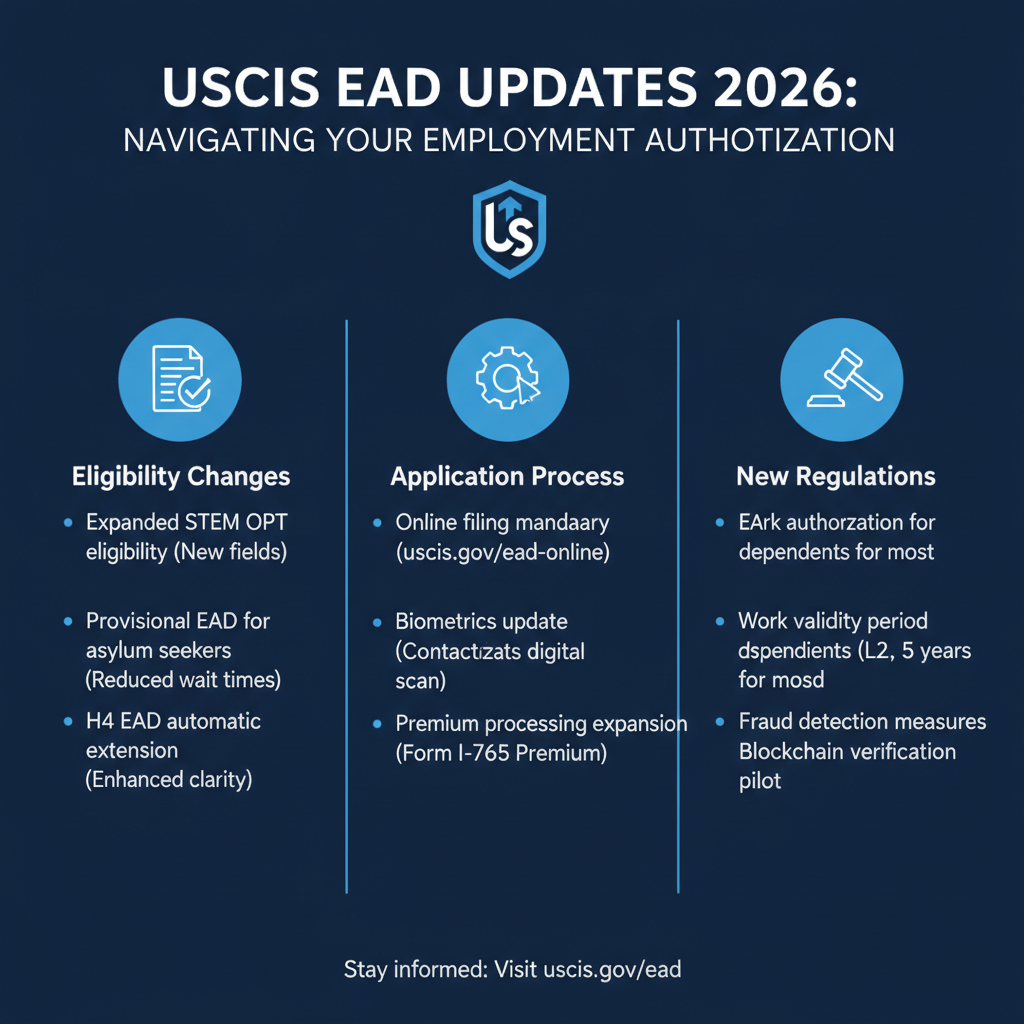
For thousands of immigrants living in Orlando, throughout Central Florida, and across the United States, the ability to work legally is not just a convenience—it's a fundamental necessity. An Employment Authorization Document (EAD), often referred to as a "work permit," is the key to achieving this. Recently, the U.S. Citizenship and Immigration Services (USCIS) has continued to implement updates and changes to its processing procedures for EAD applications and renewals, impacting everyone from asylum seekers and adjustment of status applicants to students on Optional Practical Training (OPT) and certain H-4 visa holders.
Why this news is showing up now
The immigration landscape is constantly evolving, and 2026 is no exception. USCIS, the federal agency responsible for processing EAD applications, has been under immense pressure in recent years to address backlogs and streamline operations. These "updates" often manifest as policy adjustments, procedural changes, or even technology enhancements aimed at improving efficiency or, conversely, responding to new challenges. The ongoing dialogue around EAD processing reflects a continuous effort by USCIS to manage caseloads, adhere to legal mandates, and adapt to the needs of a diverse immigrant population.
In particular, recent discussions and internal USCIS memos have focused on strategies to prevent lapses in employment authorization, especially for those eligible for automatic extensions. There's also been an emphasis on digital transformation and optimizing the intake and adjudication process for Form I-765, the Application for Employment Authorization. For applicants, this means potential shifts in processing times, requirements for submitting evidence, and the overall experience of interacting with the agency. Staying informed, therefore, isn't just helpful; it's crucial for maintaining continuous work authorization.
How it can affect Florida residents
Florida, particularly the Orlando metropolitan area and the I-4 corridor, is a vibrant hub for immigrants from all corners of the globe. From agricultural workers in South Florida to hospitality professionals in Orlando, and students attending universities across the state, many rely on EADs to contribute to our economy and support their families. Any changes to EAD processing directly impact these individuals and their employers.
For Central Florida residents, these updates can mean several things:
- Economic Stability: Timely EAD processing ensures individuals can continue working, providing for their families, and contributing to the local economy without interruption. Delays can lead to job loss, financial hardship, and stress.
- Employer Compliance: Businesses in Orlando and Orange County depend on employees with valid work authorization. Updates to EAD rules or processing times can affect their hiring practices and compliance with federal employment laws, including E-Verify requirements.
- Local USCIS Impact: While EAD applications are generally processed at national service centers, local USCIS field offices, like the one in Orlando, may be involved in biometrics appointments or interviews related to underlying immigration applications (e.g., Adjustment of Status) that also trigger EAD eligibility. Changes to national processing can ripple down to local operations.
- Increased Demand for Legal Services: Confusion or complexity arising from new updates often leads to increased demand for expert legal guidance. Imigrar, based in Orlando, is uniquely positioned to assist our local community navigate these changes.
Understanding these updates is not merely about bureaucratic procedure; it's about safeguarding livelihoods and ensuring stability for countless families in our Florida communities.
Need Help Navigating EAD Updates? Our Orlando immigration team at Imigrar is ready to assist you. Don't let processing changes jeopardize your work authorization. Call +1 786-791-3106 for a free consultation, or message us online. Se Habla Español.
What Employment Authorization Document (EAD) Processing Is (and Why It Matters)
At its core, an Employment Authorization Document (EAD) is a permit issued by USCIS that grants certain non-citizens in the United States legal permission to work for a specific period. It's a critical document for many immigrants, as it allows them to pursue employment, earn a living, and fully participate in the U.S. economy while their underlying immigration case is pending or while they hold a specific non-immigrant status that permits work.
A plain-English definition
Think of an EAD as your official "work permit." It's a card, similar to a driver's license, that shows employers you are legally authorized to work in the United States. It's not a visa, nor is it a green card, but it's often a stepping stone towards more permanent immigration statuses or a necessary document for those with temporary statuses that allow employment. Without a valid EAD (or other specific work authorization like a green card or certain employment-based visas), it is illegal for most non-citizens to work in the U.S.
The "processing" of an EAD refers to the entire lifecycle of your application, from the moment you mail it to USCIS until you receive a decision. This includes filing Form I-765, attending biometrics, responding to any requests for additional information, and finally, receiving your EAD card. The efficiency and timeliness of this process directly impact an individual's ability to work and support themselves and their family.
Key terms you need to know
Understanding the terminology is vital when dealing with EAD applications:
- Form I-765: This is the official "Application for Employment Authorization" form that you must file with USCIS to request an EAD. It's the central document for this entire process. You can find the latest version and instructions on the USCIS Forms page.
- EAD Category: This refers to the specific reason you are eligible for an EAD. USCIS assigns a category code (e.g., (c)(9) for Adjustment of Status applicants, (c)(3)(C) for F-1 OPT, (c)(26) for H-4 spouses). Knowing your correct category is essential for filing correctly.
- Adjustment of Status (AOS): The process of applying for a green card while physically present in the United States. Many AOS applicants are eligible for an EAD while their Form I-485, Application to Register Permanent Residence or Adjust Status, is pending.
- Asylum Applicant: Individuals who have applied for asylum in the U.S. are generally eligible for an EAD 180 days after filing their asylum application, provided it is still pending.
- F-1 Optional Practical Training (OPT): A period during which F-1 nonimmigrant students can work in a field directly related to their major area of study. This requires an EAD. STEM OPT extensions also require an EAD.
- H-4 EAD: Certain H-4 dependent spouses of H-1B nonimmigrants who are seeking employment-based lawful permanent resident status are eligible for an EAD.
- Receipt Notice: A notice issued by USCIS after they accept your application, confirming they have received it and providing a Receipt Number (e.g., SRC, LIN, EAC, WAC, IOE). This number is crucial for tracking your case status online.
- Biometrics: The process of collecting your fingerprints, photograph, and signature. This is usually required for identity verification and background checks. You will receive an appointment notice for this at a local Application Support Center (ASC).
- Automatic Extension: For certain EAD categories, if you file for renewal before your current EAD expires, your work authorization may be automatically extended for a specific period (e.g., 540 days as of late 2023 for some categories, though this period can change). This helps prevent gaps in employment authorization.
- Request for Evidence (RFE): A notice from USCIS asking for more information or documents to support your application. Failing to respond adequately or on time can lead to a denial.
- Expedite Request: A request to USCIS to process your application faster due to urgent circumstances, such as severe financial loss, humanitarian reasons, or national interest. These are granted on a case-by-case basis and require strong evidence.
Understanding these terms empowers you to navigate the EAD process more effectively and communicate clearly with your legal counsel or USCIS. For more detailed definitions, you can always refer to the USCIS official website's glossary.
Current Immigration Law: The Foundation for Your Work Permit
The authority for USCIS to grant employment authorization stems from the Immigration and Nationality Act (INA) and its corresponding regulations in the Code of Federal Regulations (CFR). Specifically, Section 274A of the INA (8 U.S.C. § 1324a) makes it unlawful for employers to hire individuals not authorized to work in the U.S., while 8 CFR § 274a.12 outlines the categories of aliens authorized for employment, either incident to their status or by applying for an EAD.
Federal requirements
Federal law dictates who is eligible for an EAD and under what conditions. The regulations define numerous categories of individuals who may apply for an EAD. These categories are crucial, as they determine not only eligibility but also the required documentation and sometimes even the processing priority. Some common categories include:
- Asylum Applicants: Individuals who have filed Form I-589, Application for Asylum and for Withholding of Removal, and whose application has been pending for at least 180 days. (8 CFR § 274a.12(c)(8))
- Applicants for Adjustment of Status: Individuals who have filed Form I-485, Application to Register Permanent Residence or Adjust Status, and whose application is pending. (8 CFR § 274a.12(c)(9)) Often, Form I-765 can be filed concurrently with Form I-485 and Form I-131 (Application for Travel Document).
- Refugees and Asylees: Individuals granted refugee or asylum status. (8 CFR § 274a.12(a)(3) and (a)(10))
- Nonimmigrants with specific work authorization: For example, F-1 students seeking Optional Practical Training (OPT) (8 CFR § 274a.12(c)(3)(i)), J-2 spouses of J-1 exchange visitors (8 CFR § 274a.12(c)(5)), or certain H-4 spouses (8 CFR § 274a.12(c)(26)).
- Individuals granted Temporary Protected Status (TPS): Nationals of designated countries who cannot return safely to their home country. (8 CFR § 274a.12(a)(12))
- Deferred Action for Childhood Arrivals (DACA) recipients: Those granted deferred action under DACA. (8 CFR § 274a.12(c)(33))
Each category has specific requirements for initial application and renewal. It's imperative that applicants correctly identify their category on Form I-765, as an incorrect category can lead to delays or denial. USCIS also regularly updates its policy manual (USCIS Policy Manual) which provides detailed guidance on these regulations.
Reminder: The legal framework for EADs is complex. Consulting with an immigration attorney is highly recommended to ensure you meet all federal requirements for your specific situation.
Florida-specific considerations
While EADs are federal documents, state laws and local practices in Florida can influence the employment landscape for EAD holders.
- E-Verify Requirements: Florida has state laws requiring certain employers, particularly public employers and contractors, to use E-Verify to confirm the employment eligibility of new hires. E-Verify is an internet-based system operated by USCIS in partnership with the Social Security Administration (SSA). It compares information from an employee's Form I-9, Employment Eligibility Verification, to data from U.S. Department of Homeland Security and SSA records to confirm employment eligibility. While EADs are valid documents for Form I-9, understanding E-Verify's role is crucial for employers and employees in Florida. For more information, visit the E-Verify Website.
- Professional Licensing: For certain professions (e.g., healthcare, law, teaching) in Florida, applicants for professional licenses may need to demonstrate legal presence and work authorization. A valid EAD can satisfy this requirement, but specific state board rules should be reviewed.
- Local Economy & Industries: Florida’s economy, especially in areas like Orlando, relies heavily on tourism, hospitality, agriculture, and construction. Many EAD holders find employment in these sectors. Understanding the local job market can help EAD applicants align their career goals with available opportunities.
- Driver's Licenses: EAD holders in Florida are generally eligible to apply for a Florida driver's license or state identification card, which is often a critical document for daily life and employment.
Imigrar understands these local nuances. If your case is in Orlando or anywhere in Central Florida, we can provide guidance tailored to both federal immigration law and the practical realities of living and working in Florida.
Confused by Immigration Law? Imigrar clarifies the complexities. Our Orlando-based legal team is here to ensure your EAD application meets all federal and local requirements. Get your free consultation today: +1 786-791-3106. ¡Se Habla Español!
How to Apply for or Renew Your EAD: A Complete Step-by-Step Guide
Applying for or renewing your Employment Authorization Document (EAD) involves a methodical process. Following these steps carefully can help ensure a smooth application and avoid unnecessary delays. This guide is based on current USCIS practices as of August 2026.
1) Determine Your Eligibility and EAD Category
Before anything else, you must confirm you are eligible for an EAD and identify the correct eligibility category. This is arguably the most critical first step. Eligibility is tied to your underlying immigration status or application. Common categories include:
- (c)(9): Adjustment of Status applicants (Form I-485 pending).
- (c)(8): Asylum applicants (application pending for 180 days).
- (c)(3)(C): F-1 student seeking Optional Practical Training (OPT).
- (c)(26): H-4 spouses of certain H-1B nonimmigrants.
- (a)(12): TPS beneficiaries.
- (c)(33): DACA recipients.
Actionable Advice: Refer to the official USCIS instructions for Form I-765 or the USCIS Policy Manual to accurately determine your category. An incorrect category can lead to significant delays or denial. If unsure, consult with an immigration attorney.
2) Gather Required Documents and Information
Once your eligibility is confirmed, compile all necessary supporting documents. The exact list will depend on your EAD category, but generally includes:
- Photocopy of your last EAD card (if renewing).
- Two identical passport-style photos (taken within 30 days of filing). Write your name and A-number (if applicable) lightly on the back.
- Photocopy of your government-issued identity document with photo (e.g., passport ID page, birth certificate with photo ID, national identity card).
- Photocopy of your I-94 Arrival/Departure Record. You can retrieve this electronically from the CBP website.
- Evidence of your immigration status and eligibility for the requested category:
- For (c)(9) Adjustment of Status: Photocopy of Form I-485 Receipt Notice.
- For (c)(8) Asylum: Photocopy of Form I-589 Receipt Notice.
- For (c)(3)(C) F-1 OPT: Form I-20 endorsed for OPT, academic transcripts.
- For (c)(26) H-4 EAD: Photocopy of H-1B spouse's Form I-797 Approval Notice, marriage certificate, H-4 Form I-797 Approval Notice.
- For TPS: Evidence of TPS designation.
- Previous EAD cards (front and back copies), if applicable.
- Marriage certificate or birth certificate if your name has changed or for derivative beneficiaries.
- Any other documents specifically required by your EAD category.
Important: Always send photocopies, not original documents, unless USCIS specifically requests originals. Ensure all foreign language documents are accompanied by a certified English translation.
3) Complete and File Form I-765, Application for Employment Authorization
Fill out Form I-765 accurately and completely. Pay close attention to every question. Ensure consistency with previous immigration forms.
- Part 1: Reason for Applying: Check the appropriate box (initial permission, replacement, or renewal).
- Part 2: Information About You: Provide your full legal name, address, date of birth, country of birth, country of citizenship, and A-Number (if you have one).
- Part 2: Eligibility Category: This is where you enter the specific code determined in Step 1 (e.g., (c)(9)).
- Sign and Date: An unsigned form will be rejected.
Filing Fee: As of 2026, the filing fee for Form I-765 is typically $410, plus an $85 biometrics fee for some categories, though fees are subject to change by USCIS. Check the USCIS Fee Schedule for the most current information. Certain categories (like asylum applicants) may be fee-exempt. You can pay by money order, personal check, cashier's check, or by credit card using Form G-1450, Authorization for Credit Card Transactions. Make checks payable to "U.S. Department of Homeland Security."
Where to File: The filing address for Form I-765 depends on your eligibility category and the state you reside in. Check the "Where to File" section on the USCIS I-765 page for the most up-to-date instructions. For many Florida residents, the filing address will be a USCIS Lockbox facility.
Tip: Make a complete copy of your entire application package (Form I-765 and all supporting documents) for your records before mailing it. Send your application via certified mail with a return receipt requested, or a courier service that provides tracking, to confirm delivery.
4) Attend Biometrics Appointment (If Required)
After USCIS receives your application, they will mail you a Receipt Notice (Form I-797C). For most EAD applicants, USCIS will then schedule a biometrics appointment at a local Application Support Center (ASC). For Orlando residents, this would typically be the Orlando ASC.
- You will receive an appointment notice (Form I-797C) indicating the date, time, and location.
- You must attend this appointment. Bring the appointment notice and a valid photo ID (e.g., passport, driver's license).
- At the ASC, your fingerprints, photograph, and signature will be collected. This data is used for background checks.
Warning: Missing your biometrics appointment without rescheduling can lead to delays or even a denial of your application.
5) Respond to Requests for Evidence (RFE) or Notices of Intent to Deny (NOID)
During processing, USCIS may determine they need more information or clarification. They will send you an RFE or, in some cases, a Notice of Intent to Deny (NOID).
- RFE: Clearly outlines what additional documents or information USCIS requires. It will specify a deadline (usually 60-90 days).
- NOID: Indicates USCIS intends to deny your application and provides reasons. It gives you a chance to respond and overcome the grounds for denial.
Actionable Advice: Respond to RFEs and NOIDs promptly and thoroughly. Provide exactly what is requested, and if you are unsure, seek legal counsel. Failure to respond by the deadline will almost certainly result in a denial.
6) Monitor Your Case Status and Prepare for Approval
You can track the status of your EAD application online using the Receipt Number provided on your Form I-797C Receipt Notice. Visit the USCIS Case Status Online page.
- Regularly check your case status.
- Once approved, USCIS will mail you an approval notice and then your EAD card. This can take several weeks after approval.
- The EAD card will have an expiration date. Make a note of it and plan for renewal well in advance.
Timeline Expectation: Processing times vary significantly by EAD category and the specific service center. Check the USCIS Processing Times page for the most current estimates. For many categories, it can range from a few months to over a year. For renewal, plan to file at least 180 days before your current EAD expires.
7) Understand EAD Renewals and Automatic Extensions
If you need to continue working beyond your EAD's expiration date, you must file for a renewal. The process for renewal is largely the same as for an initial application.
- File Early: It is highly recommended to file your renewal application at least 180 days before your current EAD expires to avoid any lapse in employment authorization.
- Automatic Extensions: For certain EAD categories (e.g., (c)(8) asylum applicants, (c)(9) adjustment of status applicants, (c)(26) H-4 spouses), if you file a timely renewal application, your existing EAD may be automatically extended for up to 540 days from its expiration date. This automatic extension is valid while your renewal application is pending


