

The reporting that sparked this guide: Employment Authorization Document Processing (USCIS)
What This News Means for Immigrants in Orlando and Across Florida
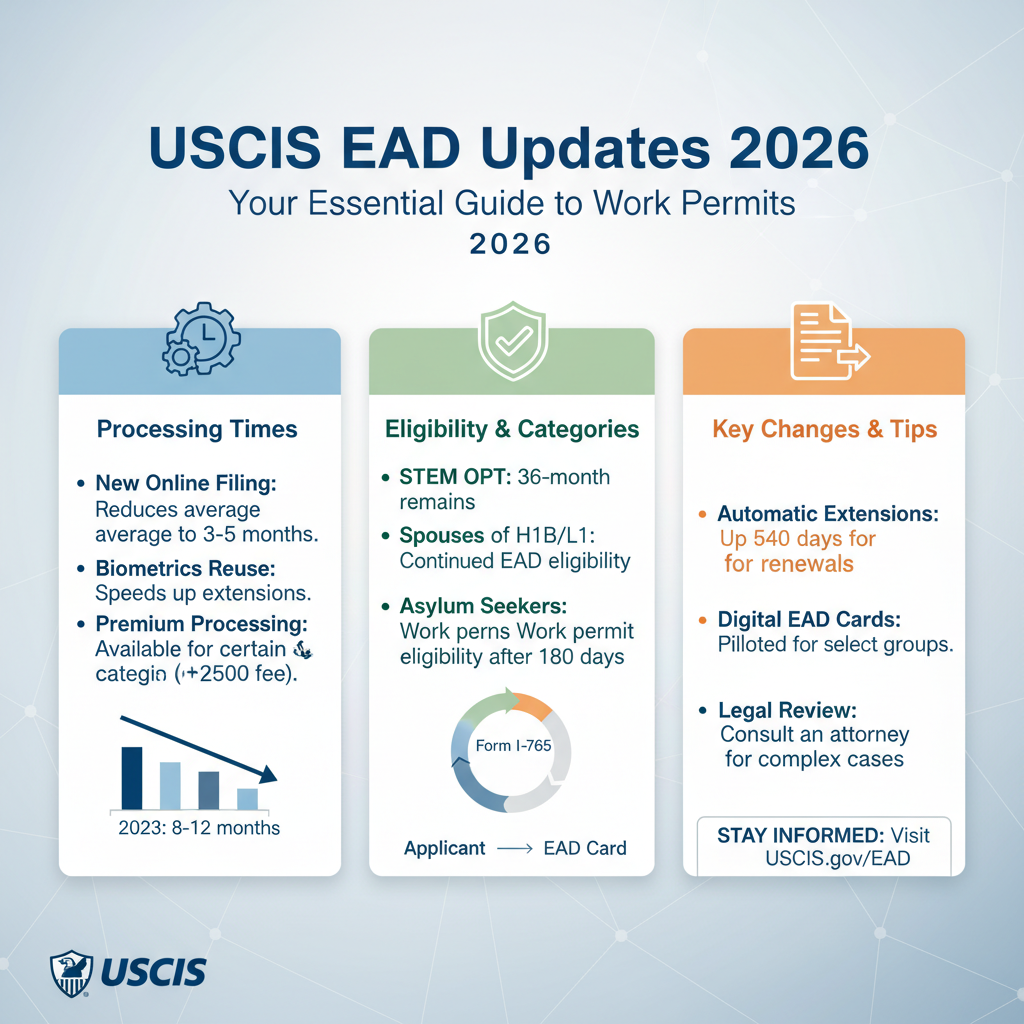
The ability to work legally in the United States is a cornerstone of building a new life for many immigrants. For those on specific nonimmigrant visas, awaiting Green Card approval, or seeking asylum, an Employment Authorization Document (EAD), often called a "work permit," is absolutely essential. Recent and ongoing updates from U.S. Citizenship and Immigration Services (USCIS) regarding EAD application and renewal processing have significant implications for individuals and families not just in Orlando and Florida, but nationwide. At Imigrar, we understand that these changes can bring both hope and anxiety, and our goal is to provide clarity and guidance.
Why this news is showing up now
USCIS has been under immense pressure to address growing backlogs across various immigration benefit requests, including EADs. In response, the agency has periodically implemented policy changes, processing efficiency initiatives, and temporary measures to alleviate burdens on applicants. This "news" isn't a single event but rather an ongoing commitment by USCIS to streamline operations, reduce processing times, and enhance the overall experience for applicants. As of early 2026, these efforts continue to evolve, with USCIS consistently evaluating its strategies to manage the high volume of applications. These updates often involve adjustments to automatic EAD extension periods, revised guidance for specific eligibility categories, and technological advancements to improve case processing.
The agency’s focus on processing times and efficiencies directly impacts the lives of hundreds of thousands of individuals. For many, the ability to work means the difference between stability and severe financial hardship. Therefore, any communication from USCIS about EAD processing is critically important and warrants close attention.
How it can affect Florida residents
Florida is home to a vibrant and diverse immigrant population, with Orlando serving as a significant hub for new arrivals and established communities. For residents across Florida, especially those in Central Florida and along the I-4 corridor, these EAD processing updates have direct and tangible effects:
- Economic Stability: Timely EAD approval or renewal means continued employment, allowing individuals and families to maintain financial stability, pay rent, purchase groceries, and contribute to the local economy in cities like Orlando, Kissimmee, and Tampa. Delays can lead to job loss, severe financial strain, and increased stress.
- Planning and Uncertainty: Fluctuations in processing times can create immense uncertainty for individuals trying to plan their futures. Will they be able to continue working? Will they need to pause their career? Understanding the latest USCIS guidance helps manage these expectations.
- Local USCIS Impact: While EAD applications are generally processed at USCIS service centers nationwide, the Orlando USCIS Field Office plays a role in some related processes, such as biometric appointments. Any general improvements in USCIS efficiency can indirectly benefit local applicants by reducing overall system strain.
- Legal Guidance: The complexity of these updates underscores the need for expert legal counsel. Florida residents need access to up-to-date information and personalized advice to navigate the application process successfully. Imigrar, located in Orlando, is uniquely positioned to assist our community with these critical matters.
Staying informed about these developments is not just about understanding policy; it’s about protecting your ability to live and thrive in the U.S.
Need Help? Our Orlando immigration team is ready to assist. Call +1 786-791-3106 for a free consultation, or message us online. Se Habla Español.
What Employment Authorization Documents (EADs) Are (and Why They Matter)
An Employment Authorization Document (EAD), commonly known as a work permit, is a crucial document issued by USCIS that grants certain non-citizens explicit permission to work legally in the United States. For many, it's the gateway to financial independence, career growth, and the ability to contribute fully to their communities.
A plain-English definition
Think of an EAD as your official permission slip from the U.S. government to get a job. If you are not a U.S. citizen or a Lawful Permanent Resident (Green Card holder), but you have applied for certain immigration benefits or hold specific nonimmigrant statuses, you generally need an EAD to work legally. This document proves to employers that you are authorized to be employed in the U.S. for a specific period. It’s a physical card, similar in appearance to a driver's license, that contains your photo, name, and expiration date.
Without an EAD (unless you have a visa category that inherently permits employment, like an H-1B or L-1), working in the U.S. is considered unauthorized employment, which can have severe negative consequences for your current and future immigration status.
Key terms you need to know
Navigating immigration processes requires understanding specific terminology. Here are some key terms related to EADs:
- Employment Authorization Document (EAD): The official term for the work permit.
- Form I-765, Application for Employment Authorization: The specific USCIS form you must file to request an EAD.
- USCIS (U.S. Citizenship and Immigration Services): The government agency responsible for processing immigration benefit requests, including EAD applications. You can find more information on the USCIS official website.
- Eligibility Category: A specific code (e.g., (c)(9), (a)(5)) on your EAD that indicates the legal basis for your work authorization. Your eligibility depends on your current immigration status or pending application (e.g., asylum applicant, student with Optional Practical Training (OPT), spouse of an H-1B visa holder, or applicant for Adjustment of Status).
- Adjustment of Status (AOS): The process of applying for a Green Card while physically present in the United States. Many AOS applicants are eligible for an EAD while their Green Card application (Form I-485) is pending.
- Nonimmigrant Visa: A visa issued for a temporary stay in the U.S. (e.g., F-1 student, H-4 spouse). Some nonimmigrant visa holders may be eligible for EADs.
- Petitioner/Beneficiary: In family-based immigration, the petitioner is the U.S. citizen or LPR who files a petition (e.g., Form I-130) for a relative (the beneficiary). The beneficiary may then apply for an EAD if they are also filing for Adjustment of Status.
- Automatic Extension: A period during which certain EAD renewal applicants can continue to work even after their current EAD expires, while their renewal application is pending. The length of this extension can vary based on USCIS policy updates.
- Receipt Notice: The official notice (Form I-797C) issued by USCIS acknowledging receipt of your application. For EAD renewals, this notice is critical for proving your automatic extension.
Understanding these terms is vital for accurately completing your application and comprehending the various stages of the EAD process.
Current Immigration Law: The Foundation for Employment Authorization
The authority for USCIS to grant employment authorization stems from federal immigration law, primarily the Immigration and Nationality Act (INA) and its implementing regulations found in the Code of Federal Regulations (CFR), specifically 8 CFR § 274a.12. These laws define who is eligible for an EAD and under what conditions.
Federal requirements
Federal law outlines several categories of non-citizens who may be eligible to apply for an EAD. It's crucial to identify the correct eligibility category for your situation, as this dictates the required evidence and affects processing. Some common categories include:
- Asylum Seekers and Asylees: Individuals who have filed Form I-589, Application for Asylum and for Withholding of Removal, and whose application has been pending for at least 150 days, are eligible to apply for an EAD under category (c)(8). Those granted asylum are eligible under category (a)(5).
- Applicants for Adjustment of Status: Individuals who have filed Form I-485, Application to Register Permanent Residence or Adjust Status, are eligible for an EAD under category (c)(9) while their Green Card application is pending. This EAD is often filed concurrently with the I-485.
- Nonimmigrant Students (F-1) with Optional Practical Training (OPT): F-1 students seeking work authorization for practical training directly related to their major field of study are eligible under category (c)(3)(A), (c)(3)(B), or (c)(3)(C) (for STEM OPT extension).
- Spouses of Certain Nonimmigrants: Spouses of E, L, and H-1B visa holders (H-4 spouses) may be eligible for an EAD under specific conditions, primarily category (c)(26) for H-4 spouses whose principal spouse has an approved Form I-140 or has reached certain stages of the Green Card process.
- U Nonimmigrants: Victims of certain crimes who have received a U nonimmigrant status are eligible under category (a)(14).
- Temporary Protected Status (TPS) Beneficiaries: Individuals granted TPS are eligible under category (a)(12) or (c)(19).
Each category has specific requirements for eligibility and documentation. For a comprehensive list of all eligibility categories, applicants should consult the USCIS official website and the instructions for Form I-765.
Important: Eligibility for an EAD does not automatically grant you a Green Card or U.S. citizenship. It is temporary work authorization tied to your underlying immigration status or application.
Florida-specific considerations
While immigration law is federal, and there are no Florida-specific EAD laws, the practical implications for Florida residents are significant. For instance, obtaining a Florida driver's license or state identification card often requires proof of lawful presence and, for many non-citizens, an EAD card serves as that primary evidence of work authorization and legal status to the Florida Department of Highway Safety and Motor Vehicles (FLHSMV). The expiration date on your EAD will directly impact the validity period of your Florida driver's license or ID. Therefore, timely renewal of your EAD is critical not just for employment but also for maintaining essential state-issued identification.
Furthermore, the high volume of immigrants in Central Florida means that local employers are generally familiar with EADs, but it remains the applicant's responsibility to present a valid, unexpired document. Understanding the rules for automatic extensions (if applicable) is vital for continued employment in Florida while a renewal is pending.
How to Apply for or Renew Your EAD: A Complete Step-by-Step Guide
Applying for or renewing your Employment Authorization Document (EAD) involves careful attention to detail and adherence to USCIS requirements. This step-by-step guide will walk you through the process, helping you avoid common pitfalls. For specific forms and instructions, always refer to the USCIS Forms page.
1) Determine Your Eligibility & Category
Before doing anything else, you must confirm that you are eligible for an EAD and identify the correct eligibility category. Your eligibility is tied to your underlying immigration status or application. For example, if you have a pending Form I-485, your category is typically (c)(9). If you are an asylum applicant, it’s (c)(8). USCIS provides a detailed list of EAD eligibility categories on their website. Misidentifying your category can lead to delays or denial.
- Action: Review the USCIS Form I-765 instructions thoroughly. Consult an immigration attorney if you are unsure about your eligibility or category.
2) Gather Required Documents
The documents you need will vary based on your eligibility category, but generally include proof of identity, immigration status, and the basis for your EAD application. Always make copies of everything you send to USCIS.
- Photocopies of previous EAD (front and back), if renewing.
- Photocopies of your last Form I-94, Arrival/Departure Record.
- Photocopies of your passport identity page and visa page (if applicable).
- Photocopies of any other immigration documents proving your status (e.g., I-797 approval notices for underlying petitions like Form I-130, Form I-140, or Form I-589 receipt notice).
- Two identical passport-style photos (taken within 30 days of filing).
- For specific categories:
- (c)(9) Adjustment of Status: Copy of your Form I-485 receipt notice.
- (c)(8) Asylum Applicants: Copy of your Form I-589 receipt notice and proof your application has been pending for 150 days.
- (c)(26) H-4 Spouses: Copy of your H-4 visa, I-94, your spouse's H-1B approval notices, and your spouse's approved Form I-140 (if applicable).
- (c)(3) F-1 OPT: Copy of your I-20 with Designated School Official (DSO) recommendation for OPT.
Reminder: Do NOT send original documents unless specifically requested by USCIS. Send high-quality photocopies.
3) Complete Form I-765, Application for Employment Authorization
Fill out Form I-765 completely and accurately. Pay close attention to every field. If a question does not apply to you, write "N/A" (not applicable) or "None." Do not leave blank spaces. Ensure your name matches your immigration documents exactly. You can download the form from the USCIS website.
- Action: Use the latest version of the form. Double-check all personal information, dates, and addresses. Sign the form in blue ink.
4) Pay the Filing Fee (or Request a Fee Waiver)
As of 2026, the filing fee for Form I-765 is typically $410, plus an additional $85 for biometrics services for some applicants (check current fees on the USCIS website as they can change). You can pay by money order, personal check, cashier’s check, or by credit card using Form G-1450, Authorization for Credit Card Transactions. Certain eligibility categories, such as asylum applicants, may be exempt from fees or eligible for a fee waiver by filing Form I-912, Request for Fee Waiver.
- Action: Verify the current filing fee on the USCIS website. Make checks or money orders payable to "U.S. Department of Homeland Security."
5) Assemble & Mail Your Application
Organize your application packet carefully. Place the check or money order on top, followed by Form I-765, then your supporting documents in a logical order (e.g., EAD copy, I-94, passport, other evidence). Make a complete copy of the entire assembled package for your records before mailing.
- Where to Mail: The filing address depends on your eligibility category and whether you are filing other forms concurrently (e.g., Form I-485). Always refer to the "Where to File" section on the USCIS website for Form I-765 or the specific form you are filing with.
- Action: Use a reputable mail service with tracking (e.g., USPS Certified Mail, FedEx, UPS) to ensure proof of delivery.
6) Attend Biometrics Appointment (if required)
After USCIS receives your application, they may send you a notice (Form I-797C) scheduling a biometrics appointment at a local Application Support Center (ASC). This appointment is to collect your fingerprints, photograph, and signature. Not all EAD applicants require biometrics, particularly if USCIS has recent biometrics on file. For Central Florida residents, this appointment will likely be at the Orlando USCIS Field Office or another nearby ASC.
- Action: Attend your appointment on time with the appointment notice and a valid photo ID. If you cannot attend, follow the instructions on the notice to reschedule immediately.
7) Track Your Case & Respond to RFEs
Once USCIS accepts your application, you will receive a receipt notice (Form I-797C) with a 13-digit receipt number. You can use this number to track your case status online. USCIS may also send a Request for Evidence (RFE) if they need more information or clarification. Respond to RFEs promptly and completely.
- Action: Monitor your mail and online case status regularly. If you receive an RFE, consult with an immigration attorney to ensure a comprehensive and timely response.
Warning: Unauthorized employment can have severe immigration consequences. Do not start working until you have received your EAD card or your automatic extension is clearly valid.
Overwhelmed by the EAD process? Imigrar is here to help. Our experienced Orlando immigration attorneys can guide you through every step. Call +1 786-791-3106 for a free consultation. Se Habla Español.
Practical Steps You Can Take Today for Your EAD Application
Proactive preparation is key to a smooth EAD application or renewal process. Here are actionable steps you can take right now to set yourself up for success.
Actionable checklist with 5+ items
- Verify Your Eligibility: Re-read the instructions for Form I-765 and the USCIS eligibility categories page. Confirm your specific category and its unique requirements. Don't guess.
- Check Processing Times: Visit the USCIS Processing Times page. Select Form I-765 and your specific service center/field office (based on your mailing address). This will give you an estimate of how long your application might take.
- Locate All Existing Immigration Documents: Gather your passport, visa, I-94, previous EADs, Green Card applications (Form I-485 receipt), asylum applications (Form I-589 receipt), and any I-797 approval notices. Organize them in a dedicated folder.
- Obtain New Passport-Style Photos: Get two identical, color, passport-style photos (2x2 inches) taken within the last 30 days. Ensure they meet U.S. Department of State photo requirements.
- Review Automatic Extension Rules (for Renewals): If you are renewing your EAD, understand if your category is eligible for an automatic extension and its current length (e.g., up to 540 days for certain categories as per previous USCIS announcements, though this can change). Your Form I-797C receipt notice for your renewal application, along with your expired EAD, serves as proof of this extension.
- Budget for Fees: Check the current Form I-765 filing fee and plan accordingly. Remember that fees can change, so always verify on the USCIS website just before filing.
- Consult an Attorney: Even if you think your case is straightforward, an experienced immigration attorney can identify potential issues, ensure accuracy, and provide peace of mind.
Document preparation guidance
Meticulous document preparation can prevent RFEs and delays:
- Photocopy Everything: Always keep a complete copy of your entire application packet for your records. This includes the filled-out form, all supporting documents, and the check/money order.
- High-Quality Copies: Ensure all photocopies are clear, legible, and true representations of the original documents. Avoid blurry or cut-off copies.
- Organize Logically: Arrange your documents in the order listed in the Form I-765 instructions or in a logical sequence (e.g., form, fee, photos, then supporting documents by type). Use fasteners (binder clips, paper clips) but avoid staples unless necessary.
- Label Clearly: If you have many supporting documents, consider using sticky notes or cover sheets to label sections (e.g., "Copy of I-94," "I-485 Receipt Notice").
- Do Not Send Originals: Unless USCIS specifically asks for an original document, send only photocopies. Sending originals risks losing them.
Timeline expectations
EAD processing times can fluctuate significantly due to USCIS workload, policy changes, and the specific eligibility category. While USCIS has made efforts to reduce backlogs, it’s still common for EAD applications to take several months, and sometimes over a year, to process. For example, processing times for the Orlando USCIS Field Office (which handles biometrics) and the various service centers (which handle adjudication) can be found on the USCIS Processing Times page.
- Initial Receipt: Expect a receipt notice (Form I-797C) within 2-4 weeks of mailing your application.
- Biometrics Appointment: If required, a biometrics appointment notice usually arrives within 4-8 weeks after the receipt notice. The appointment itself will be a few weeks later.
- Decision: The time to receive a decision varies wildly by category and service center. It can range from 3 months to over 18 months. Always check the USCIS website for the most current estimates.
- Renewals: It is highly recommended to file for EAD renewal 120 to 180 days before your current EAD expires. This allows time for processing and maximizes the chances of receiving your new EAD before the old one expires, or leveraging an automatic extension if applicable.
Important: These are general estimates. Your individual processing time may differ. Regular monitoring of your case status online is crucial.
How Imigrar Helps Immigrants in Orlando and Beyond
Navigating the complexities of U.S. immigration law, especially with ongoing USCIS updates, can be daunting. At Imigrar, our mission is to "Keep Families Together" by providing expert, compassionate legal guidance to immigrants in Orlando, across Florida, and nationwide.
Our experience and expertise
Our team of dedicated immigration attorneys possesses extensive experience in all facets of immigration law, including Employment Authorization Documents. We stay current on the latest USCIS policies, regulations, and processing changes to ensure our clients receive the most accurate and effective representation. We understand the specific challenges faced by individuals and families in Central Florida, whether it’s dealing with the Orlando USCIS Field Office or understanding the impact of federal policies on local communities. From initial eligibility assessment to preparing and filing complex applications, responding to RFEs, and addressing potential denials, we are committed to guiding you through every step of the process with integrity and professionalism.
We pride ourselves on our client-centered approach, offering personalized strategies tailored to each unique situation. Our deep knowledge of EAD categories, required documentation, and USCIS procedures means we can help you avoid common mistakes and pursue the strongest possible application.
Free consultation offer
We believe that everyone deserves access to quality legal advice. That’s why Imigrar offers a free consultation to discuss your EAD application or renewal. During this initial consultation, we will:
- Review your current immigration status and goals.
- Assess your eligibility for an EAD and identify the correct category.
- Explain the application process, timeline expectations, and potential challenges.
- Answer your questions and provide clear, actionable advice.
- Discuss how our services can specifically benefit your case.
This consultation is an


