


At Imigrar, we understand that securing the right to work in the United States is paramount for many immigrants and their families. An Employment Authorization Document (EAD), often referred to as a work permit, is your gateway to legal employment. Recent updates from USCIS regarding EAD application and renewal processing have brought both challenges and opportunities. As your trusted immigration law firm in Orlando, Florida, serving clients nationwide, Imigrar is dedicated to helping you navigate these changes with clarity and confidence.
This comprehensive guide will break down the latest news, explain what an EAD is, detail the application process, and offer actionable advice to ensure your journey to employment authorization is as smooth as possible. Our mission is to Keep Families Together, and ensuring you have the legal right to work is a crucial part of that commitment.
The reporting that sparked this guide
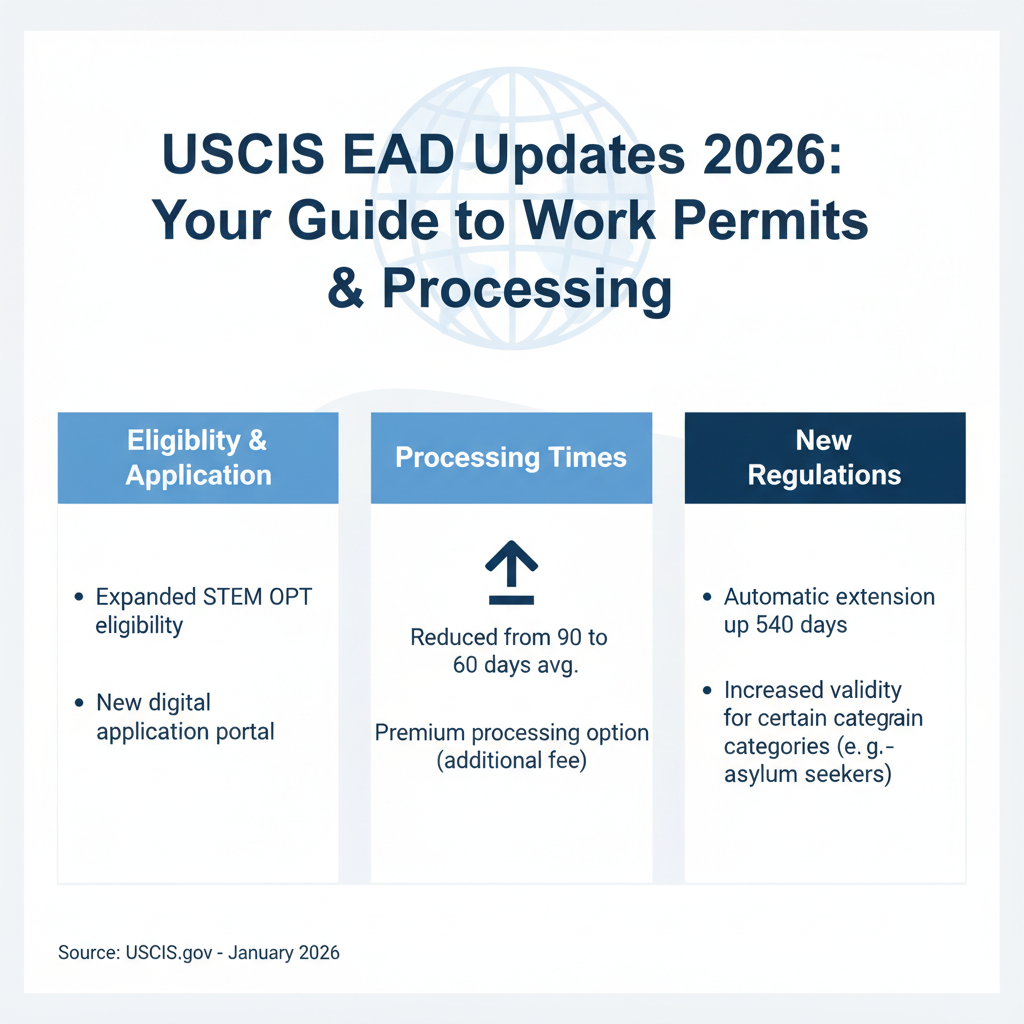
The information and guidance provided in this article are informed by ongoing developments and public announcements from U.S. Citizenship and Immigration Services (USCIS) regarding the processing of Employment Authorization Documents. Staying current with these updates is essential for anyone applying for or renewing their work permit. For the most recent official news directly from federal sources, please refer to:
Employment Authorization Document Processing (USCIS)
What This News Means for Immigrants in Orlando and Across Florida
The landscape of immigration processing is constantly evolving, and recent USCIS updates regarding Employment Authorization Documents (EADs) are particularly significant. For immigrants and their families residing in Orlando, Central Florida, and throughout the Sunshine State, these changes can directly impact your ability to work legally and maintain financial stability.
Why this news is showing up now
The current focus on EAD processing stems from a confluence of factors. Over the past few years, USCIS has faced unprecedented backlogs across various application types, including Form I-765, Application for Employment Authorization. These delays have caused significant stress and financial hardship for many individuals and families awaiting their work permits.
In response to public outcry, legal challenges, and a commitment to improve efficiency, USCIS has been implementing several initiatives. These include:
- Increased Staffing: Hiring more personnel to process applications.
- Technological Enhancements: Expanding online filing options and digital processing capabilities.
- Policy Adjustments: Issuing temporary final rules and policy alerts to streamline certain EAD categories, such as extending the validity period for some EADs and providing automatic extensions for renewals.
- Focus on Backlog Reduction: Prioritizing certain application types to chip away at the accumulated workload.
These efforts are ongoing, and the news you're seeing now reflects USCIS's continued attempts to address these challenges and provide clearer guidance to applicants. As of 2026-06-04, the agency continues to refine its processes, making it crucial for applicants to stay informed and adhere strictly to current requirements.
How it can affect Florida residents
Florida, with its vibrant and diverse immigrant communities, is particularly sensitive to changes in EAD processing. For Central Florida residents, including those in Orlando, Kissimmee, and surrounding Orange County, a delayed or mishandled EAD application can have immediate and severe consequences:
- Employment Opportunities: Without a valid EAD, individuals cannot legally work. Delays can mean lost job offers, inability to start new employment, or even loss of current employment if a renewal is pending. This directly impacts household income and stability along the I-4 corridor and beyond.
- Economic Impact: The ability for immigrants to work legally contributes significantly to Florida's economy. Delays in EAD issuance can stifle economic participation and growth.
- Family Stability: Many families rely on the income generated by EAD holders. Processing delays can create immense financial strain, impacting housing, food, and other essential needs, directly challenging Imigrar's mission to Keep Families Together.
- Uncertainty and Stress: The anxiety of not knowing when a work permit will arrive or be renewed is a heavy burden. This uncertainty can affect mental health and overall well-being.
- Orlando USCIS Field Office: While many EAD applications are processed at service centers, the Orlando USCIS Field Office handles interviews and certain local adjustments, meaning local processing times and procedures can still be relevant for some EAD-related cases, especially those tied to an underlying application like Adjustment of Status.
Understanding these updates and how to properly apply or renew your EAD is not just about paperwork; it's about securing your future and your family's stability in Florida.
Need Clarity on EAD Processing? Don't let uncertainty derail your future. Our Orlando immigration team at Imigrar is ready to assist with your EAD application or renewal. Call +1 786-791-3106 for a free consultation, or message us online. Se Habla Español.
What Employment Authorization Documents (EADs) Are (and Why They Matter)
For many non-citizens in the United States, the ability to work legally is essential for self-sufficiency, contributing to society, and providing for their families. An Employment Authorization Document (EAD) is the key that unlocks this right. Understanding what it is and why it matters is the first step in navigating the immigration process effectively.
A plain-English definition
An Employment Authorization Document (EAD), commonly known as a work permit, is a plastic card issued by USCIS that proves you are authorized to work in the United States for a specific period. It looks similar to a driver's license or state ID card and contains your photo, name, date of birth, and an expiration date. When you present an EAD to an employer, it serves as evidence of your legal right to be employed.
Important: An EAD is not a visa and does not grant you immigration status. Instead, it is a benefit granted to individuals who already have a specific immigration status or a pending application for one that allows for employment authorization.
Key terms you need to know
To fully grasp the EAD process, it's helpful to be familiar with several key terms:
- Employment Authorization Document (EAD): The official name for the work permit card itself.
- Form I-765, Application for Employment Authorization: The specific form you must file with USCIS to request an EAD.
- USCIS (U.S. Citizenship and Immigration Services): The government agency responsible for overseeing legal immigration to the United States and issuing EADs.
- Adjustment of Status (AOS): The process by which an eligible non-citizen already in the United States applies to become a lawful permanent resident (get a Green Card) without having to return to their home country. Many individuals with pending Adjustment of Status applications are eligible for an EAD. This is often filed on Form I-485.
- Nonimmigrant Visa: A visa granted to foreign nationals wishing to enter the U.S. temporarily for a specific purpose (e.g., F-1 student, H-1B worker, L-1 intracompany transferee). While some nonimmigrant visa holders have inherent work authorization tied to their visa, others (like F-1 students in certain situations) may need an EAD.
- Asylum Seeker / Refugee: Individuals who have sought or been granted protection in the U.S. due to persecution in their home country. Both asylum seekers with pending applications (**Form I-589**) and granted refugees are typically eligible for an EAD.
- Deferred Action for Childhood Arrivals (DACA): An immigration policy that allows certain undocumented immigrants who entered the U.S. as minors to receive a renewable two-year period of deferred action from deportation and eligibility for an EAD.
- Biometrics: The collection of unique physical characteristics (fingerprints, photograph, signature) used for identity verification and background checks. Many EAD applicants are required to attend a biometrics appointment.
- Request for Evidence (RFE): A notice from USCIS requesting additional documents or information to support your application. Failing to respond to an RFE can lead to delays or denial.
- Automatic Extension: For certain EAD categories, when you file a timely renewal application, your existing EAD may automatically extend for a specific period (e.g., 180 days, or more recently, up to 540 days for some categories), allowing you to continue working while your renewal is processed.
The EAD is more than just a piece of plastic; it represents the ability to build a life, support a family, and contribute to the community. For many immigrants in Orlando and beyond, it's a vital step towards achieving the American dream. Ensuring its proper application and timely renewal is paramount.
Current Immigration Law: The Foundation for EADs
The ability to obtain an Employment Authorization Document (EAD) is rooted deeply in U.S. immigration law, specifically within the Immigration and Nationality Act (INA) and its corresponding regulations found in the Code of Federal Regulations (CFR). Understanding these legal foundations is crucial for establishing eligibility and successfully navigating the application process.
Federal requirements
The primary legal framework for employment authorization can be found in Section 274A of the INA (8 U.S.C. § 1324a), which prohibits the knowing employment of unauthorized aliens. This section also outlines the requirements for employers to verify the employment eligibility of all new hires. The specific categories of individuals eligible for an EAD are detailed in 8 CFR § 274a.12.
This regulation lists numerous categories, generally falling into a few broad groups:
- Asylum and Refugee-Related: Individuals granted asylum, refugees, and asylum seekers with a pending **Form I-589, Application for Asylum and for Withholding of Removal**, who have waited a certain period without a decision.
- Family-Based Immigration: Applicants for Adjustment of Status (**Form I-485**) based on an approved family petition (**Form I-130, Petition for Alien Relative**). These applicants can often file Form I-765 concurrently with their Form I-485.
- Employment-Based Immigration: Applicants for Adjustment of Status based on an approved employment petition, and certain nonimmigrant workers (e.g., those with specific types of visas or statuses like L-2 spouses).
- Temporary Protected Status (TPS): Nationals of certain countries designated for TPS, who are granted temporary relief from deportation and employment authorization.
- Deferred Action: Individuals granted deferred action, such as DACA recipients.
- Other Specific Categories: Including fiancés of U.S. citizens, certain spouses of H-1B visa holders, and individuals granted deferred enforced departure, among others.
Each eligibility category has specific requirements and often requires particular supporting documentation to prove your underlying status or pending application. For instance, an individual filing for an EAD based on a pending Adjustment of Status (c)(9) category must have a pending Form I-485. Similarly, a DACA recipient would apply under the (c)(33) category, requiring proof of their DACA status.
USCIS forms central to the EAD process include:
- Form I-765, Application for Employment Authorization: The primary form for requesting an EAD.
- Form I-485, Application to Register Permanent Residence or Adjust Status: Often filed concurrently with Form I-765 for those seeking a Green Card.
- Form I-130, Petition for Alien Relative: The initial step for many family-based Green Card applications, which can eventually lead to EAD eligibility via Form I-485.
- Form I-589, Application for Asylum and for Withholding of Removal: For asylum seekers seeking an EAD after 150 days of their application pending.
- Form I-912, Request for Fee Waiver: For eligible applicants who cannot afford the filing fees.
All forms, detailed instructions, and eligibility criteria are available on the USCIS Forms page and the USCIS official website. It is crucial to always refer to the most current version of forms and instructions, as they are updated frequently.
Florida-specific considerations
While the requirements for obtaining an EAD are federal, Florida has specific state laws that interact with federal immigration policy, particularly concerning employment verification. Florida does not have its own state-level work permit or EAD program; all employment authorization comes from the federal government (USCIS).
However, Florida law mandates that certain employers use E-Verify, a federal internet-based system that allows businesses to determine the eligibility of their employees to work in the U.S. This means that even with a valid EAD, your employer in Orlando or anywhere in Florida will likely run your information through E-Verify to confirm your authorization. This system checks your information against data from the Department of Homeland Security (DHS) and the Social Security Administration (SSA).
Warning: Florida has strict penalties for employers who knowingly hire or continue to employ unauthorized workers. For individuals, working without a valid EAD is a violation of immigration law and can have severe consequences, including making you inadmissible or deportable. Therefore, ensuring you have a valid EAD and understand its expiration date is not just a matter of compliance but crucial for maintaining your immigration standing in Florida.
For Central Florida residents, staying informed about both federal EAD requirements and Florida's employment verification laws is essential. Imigrar is here to provide guidance on both fronts, ensuring you remain compliant and protected.
Confused by EAD Laws? Imigrar's expert attorneys can clarify eligibility, legal requirements, and guide you through the EAD application process. Call our Orlando office at +1 786-791-3106 for a free consultation. Se Habla Español.

How to Apply for or Renew Your EAD: A Complete Step-by-Step Guide
Applying for or renewing an Employment Authorization Document (EAD) can seem daunting, but by breaking it down into manageable steps, the process becomes clearer. This guide provides a detailed walkthrough to help you navigate Form I-765 and associated requirements.
1) Determine Your Eligibility Category
Before you even touch Form I-765, you must identify which eligibility category applies to you. This is arguably the most critical step, as it dictates the required supporting documents and can affect processing times. The categories are listed on the USCIS Form I-765 instructions (Part 2, Item 27). Common categories include:
- (c)(9) - Adjustment of Status Applicants: If you have a pending Form I-485, Application to Register Permanent Residence or Adjust Status.
- (c)(8) - Asylum Applicants: If you have a pending Form I-589, Application for Asylum and for Withholding of Removal, and your application has been pending for at least 150 days.
- (c)(14) - DACA Recipients: If you have been granted Deferred Action for Childhood Arrivals.
- (a)(12) - Temporary Protected Status (TPS): If you have been granted TPS.
- (a)(5) - Refugee: If you have been granted refugee status.
- (c)(26) - Spouses of H-1B Nonimmigrants: If you are the spouse of an H-1B visa holder and meet certain conditions.
Important: Choosing the incorrect category can lead to significant delays or a denial. If you are unsure, consult with an immigration attorney.
- Required Documents for this step (for your records):
- Proof of your underlying immigration status or pending application (e.g., I-485 receipt notice, I-589 receipt notice, DACA approval notice, I-797 approval for H-1B spouse).
2) Gather Required Documents
Once you know your eligibility category, compile all necessary supporting documents. This list can vary, but generally includes:
- Form I-765, Application for Employment Authorization: Ensure it's the latest version from USCIS Forms.
- Two Passport-Style Photos: Taken within 30 days of filing, unmounted, color, with a white background. Write your name and Alien Registration Number (A-Number) lightly on the back.
- Copy of Government-Issued Photo Identification: Such as your passport identity page, or a national identity card with photo.
- Copy of Your Last EAD (if renewing): Front and back.
- Copy of Your I-94 Arrival/Departure Record: Front and back, or printed from CBP website.
- Copy of Your Visa (if applicable): The page in your passport.
- Copy of Your Birth Certificate (with certified translation if not in English).
- Copy of Your Marriage Certificate (if applicable, with certified translation).
- Proof of Relationship (if applying as a dependent): Marriage certificate for spouse, birth certificate for child, etc.
- Evidence for Your Eligibility Category:
- For (c)(9) Adjustment of Status: Copy of I-485 receipt notice or proof of pending I-485.
- For (c)(8) Asylum: Copy of I-589 receipt notice.
- For (c)(14) DACA: Copy of your latest I-797 DACA approval notice.
- For (c)(26) H-1B Spouse: Copy of your spouse's H-1B approval notice (I-797), your marriage certificate, and your I-94.
- Payment for the Filing Fee: Check or money order payable to "U.S. Department of Homeland Security."
Reminder: Always make copies of ALL documents you send to USCIS for your personal records.
3) Complete Form I-765, Application for Employment Authorization
Fill out Form I-765 accurately and completely. Read the instructions carefully. Common pitfalls include:
- Part 1. Reason for Applying: Clearly indicate if this is an "Initial permission to accept employment," "Replacement of lost, stolen, or damaged EAD," or "Renewal of my permission to accept employment."
- Part 2. Information About You: Ensure your name, address, date of birth, country of birth, and A-Number (if you have one) match your other immigration documents exactly.
- Part 2, Item 27. Eligibility Category: Enter the correct three-character code (e.g., (c)(9), (c)(8), (c)(14)).
- Signatures: Don't forget to sign the form in blue or black ink. Unsigned forms will be rejected.
If a question does not apply to you, write "N/A" (not applicable). If a numerical answer is zero, write "None."
- Required Documents for this step:
- Completed and signed Form I-765.
4) Pay the Filing Fee (or Request a Fee Waiver)
As of 2026-06-04, the filing fee for Form I-765 is typically $410, plus an $85 biometrics fee for a total of $495 (though some


