What This News Means for Immigrants in Orlando and Across Florida
Why this news is showing up now
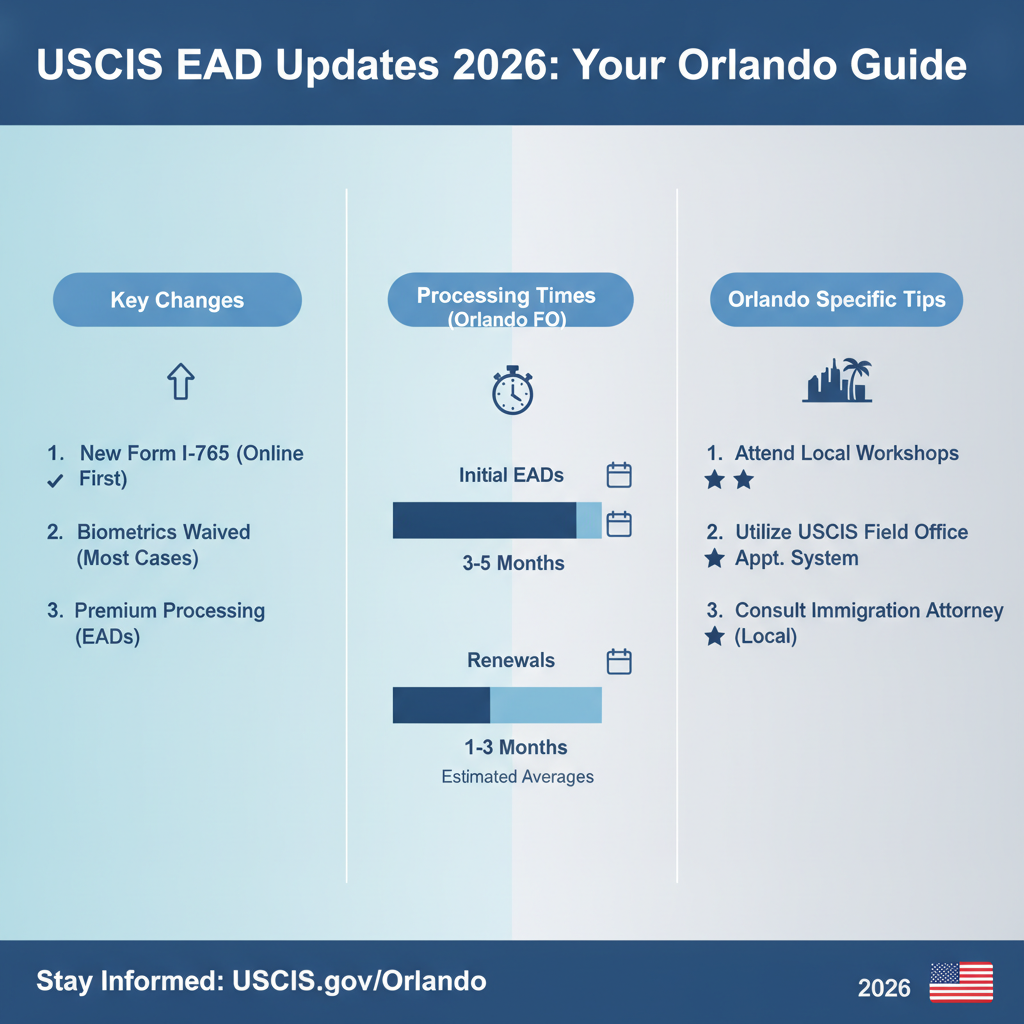
Over the past few years, USCIS has faced unprecedented challenges, leading to significant backlogs and extended processing times across many immigration benefit categories, including **Form I-765**, Application for Employment Authorization. In response to widespread concern and the critical need for immigrants to maintain their legal ability to work, USCIS has implemented various strategies to improve efficiency. By 2026, these efforts have brought about noticeable shifts. The "news" surrounding EAD processing reflects USCIS's ongoing commitment to streamline operations, reduce processing times, and enhance the applicant experience. This includes a continued emphasis on digital processing, potential expansion of premium processing services to certain EAD categories, and adjustments to policies regarding automatic extensions. The goal is to ensure that eligible individuals can obtain or renew their **work permits** more predictably, minimizing disruptions to their employment and livelihoods. These updates are a direct response to the economic necessity of a stable workforce and the humanitarian imperative to keep families united and self-sufficient.How it can affect Florida residents
For the vibrant immigrant communities in Florida, particularly in the bustling Orlando metropolitan area, these **USCIS updates** are profoundly significant. Florida’s economy, heavily reliant on tourism, agriculture, healthcare, and technology, benefits immensely from its diverse workforce. Delays in EAD processing can lead to job loss, financial hardship, and immense stress for individuals and their families. * **Employment Stability:** Faster processing and clearer guidelines mean less uncertainty for current employees and easier onboarding for new hires. This directly impacts individuals working in Orlando’s hospitality sector, healthcare facilities, or tech companies along the I-4 corridor. * **Economic Contribution:** When immigrants can work legally and without interruption, they contribute to the state’s tax base, consumer spending, and overall economic growth, which is vital for Central Florida. * **Family Well-being:** The ability to work is often directly linked to a family’s ability to pay bills, access healthcare, and plan for the future. Timely EADs help keep families together and stable, aligning perfectly with Imigrar's mission. * **Legal Compliance:** Understanding the latest **EAD application and renewal updates** helps both immigrants and their Orlando-based employers ensure compliance with federal immigration laws, avoiding potential penalties. For Central Florida residents, staying informed about these changes is not just about bureaucracy; it's about securing their future and contributing to the community they call home. The Orlando USCIS Field Office and local immigration services play a crucial role in these processes, making local expertise invaluable.Need Help? Our Orlando immigration team is ready to assist. Call +1 786-791-3106 for a free consultation, or message us online. Se Habla Español.
What Employment Authorization Documents (EADs) Are (and Why They Matter)
An **Employment Authorization Document (EAD)**, often referred to as a **work permit**, is a critical document issued by U.S. Citizenship and Immigration Services (USCIS) that provides non-citizens with legal permission to work in the United States. For many immigrants, especially those awaiting other immigration benefits like **Adjustment of Status** to permanent residency, or those under specific nonimmigrant categories, the EAD is their gateway to lawful employment.A plain-English definition
Think of an EAD as your official permission slip from the U.S. government to get a job. It’s a physical card, similar to a driver’s license, that proves you are authorized to work for any employer in the U.S. (unlike some visas that tie you to a specific employer). Without an EAD, most non-citizens are not allowed to be employed in the U.S., and doing so can have severe immigration consequences. This document is essential for securing employment, opening bank accounts, obtaining a Social Security Number, and generally integrating into American society.Key terms you need to know
Navigating the EAD process involves understanding several specific terms: * **Employment Authorization Document (EAD) / Work Permit:** The official card issued by USCIS allowing you to work in the U.S. * **USCIS:** U.S. Citizenship and Immigration Services, the government agency responsible for processing EAD applications. * **Form I-765, Application for Employment Authorization:** The specific form you must file with USCIS to apply for or renew your EAD. * **Adjustment of Status (AOS):** The process of applying for lawful permanent resident (green card) status while physically present in the United States. Many individuals with a pending **Form I-485** (Application to Register Permanent Residence or Adjust Status) are eligible for an EAD. * **Automatic Extension:** A provision that allows certain EAD categories to continue working for a specific period (often up to **540 days** as per recent policies, though this can change) beyond their EAD card’s expiration date, provided they filed a timely renewal application. * **Eligibility Category:** The specific legal basis under which an individual qualifies for an EAD. Examples include (c)(9) for pending AOS, (c)(3)(C) for F-1 Optional Practical Training (OPT) STEM Extension, (c)(26) for H-4 spouses, or (a)(5) for Asylees. * **Biometrics Appointment:** An appointment at a USCIS Application Support Center (ASC) to capture fingerprints, photos, and a signature, which are used for background checks. * **Request for Evidence (RFE):** A letter from USCIS requesting additional documents or information to support your application. * **Notice of Intent to Deny (NOID):** A letter from USCIS indicating their intention to deny your application and giving you an opportunity to respond. * **Premium Processing:** An expedited service offered by USCIS for certain forms, allowing for faster processing in exchange for an additional fee. While historically not available for most EADs, USCIS has been expanding its availability to certain categories by 2026. Understanding these terms is crucial for anyone engaging with the EAD application or renewal process, ensuring you can accurately complete forms and understand communications from USCIS.Current Immigration Law: The Foundation for Work Authorization
The authority for issuing **Employment Authorization Documents** stems from the Immigration and Nationality Act (INA) and its implementing regulations, primarily found in Title 8 of the Code of Federal Regulations (8 CFR). These laws define who is eligible for work authorization and under what conditions.Federal requirements
Federal law, specifically Section 274A of the INA (8 U.S.C. § 1324a) and 8 CFR Part 274a, outlines the general prohibition against unauthorized employment and establishes the categories of non-citizens who are authorized to work in the United States. Eligibility for an EAD is not universal; it is granted to specific groups of individuals based on their immigration status or the nature of their pending immigration applications. Common categories eligible for EADs include: * **Asylees and Refugees:** Individuals granted asylum or refugee status in the U.S. (8 CFR 274a.12(a)(5) and (a)(3)). * **Applicants for Asylum or Adjustment of Status:** Individuals with a pending **Form I-589** (Application for Asylum and for Withholding of Removal) or **Form I-485** (Application to Register Permanent Residence or Adjust Status) (8 CFR 274a.12(c)(8) and (c)(9)). * **Certain Nonimmigrants:** This includes: * **F-1 students** authorized for Optional Practical Training (OPT) or STEM OPT (8 CFR 274a.12(c)(3)). * **H-4 spouses** of H-1B nonimmigrants who meet certain criteria, typically those whose H-1B spouse has an approved Form I-140 (Immigrant Petition for Alien Worker) or has been granted an extension of H-1B status beyond the sixth year (8 CFR 274a.12(c)(26)). * Certain nonimmigrants with compelling circumstances who are granted employment authorization. * **Deferred Action for Childhood Arrivals (DACA) recipients:** Individuals granted deferred action under DACA (8 CFR 274a.12(c)(33)). * **Temporary Protected Status (TPS) beneficiaries:** Individuals granted TPS (8 CFR 274a.12(a)(12) and (c)(19)). The core document for applying for an EAD is **Form I-765**, Application for Employment Authorization. This form requires applicants to specify their eligibility category and provide supporting documentation to prove their qualification. It is crucial to select the correct category on the form, as an error can lead to delays or denial. For the most up-to-date information on eligibility and requirements, always refer to the USCIS official website.Florida-specific considerations
While immigration law is federal, applying for an EAD in Florida means interacting with federal agencies that serve the state. There are no Florida-specific state laws that grant or deny **employment authorization**; the requirements are uniform across the U.S. However, Florida residents should be aware of: * **USCIS Field Offices:** The Orlando USCIS Field Office, while primarily handling interviews for **Adjustment of Status** and naturalization, is a local point of contact. EAD applications are generally processed at USCIS Service Centers, but any required biometrics appointments will be scheduled at an Application Support Center (ASC) convenient to your residence, such as the one serving Orange County. * **Local Employers:** Employers in Orlando and across Florida must comply with federal regulations regarding the verification of employment eligibility using **Form I-9**, Employment Eligibility Verification. Having a valid EAD is key to passing this verification. * **Legal Resources:** Access to experienced immigration attorneys in Orlando, like Imigrar, is vital for navigating the federal complexities of EAD applications. We understand the specific needs and challenges faced by immigrants in Central Florida.Need Help? Our Orlando immigration team is ready to assist. Call +1 786-791-3106 for a free consultation, or message us online. Se Habla Español.
How to Apply for or Renew Your EAD: A Complete Step-by-Step Guide
Applying for or renewing your **Employment Authorization Document (EAD)** can seem daunting, but breaking it down into manageable steps makes the process clearer. This guide will walk you through the essential stages.1) Determine Your Eligibility Category and Gather Initial Information
Before you begin, it’s critical to understand *why* you are eligible for an EAD. Your eligibility category dictates which supporting documents you’ll need. Common categories include: * **Pending Adjustment of Status (AOS):** If you have a pending **Form I-485**, you’re typically eligible under category (c)(9). * **F-1 Optional Practical Training (OPT):** For students seeking post-completion or STEM OPT, categories (c)(3)(A), (c)(3)(B), or (c)(3)(C). * **H-4 Spouse:** For certain H-4 visa holders, category (c)(26). * **Asylum Applicant:** If you have a pending asylum application for **180 days** or more, category (c)(8). * **Asylee/Refugee:** If you have been granted asylum or refugee status, categories (a)(5) or (a)(3). * **DACA Recipient:** Category (c)(33). **Action:** Identify your specific eligibility category. This will guide you in filling out **Form I-765** correctly and gathering the right evidence. Consult the USCIS Forms page for detailed category descriptions.2) Complete Form I-765, Application for Employment Authorization
This is the core of your application. * **Download the Latest Form:** Always use the most current version of **Form I-765** from the USCIS official website. Outdated forms will be rejected. * **Read Instructions Carefully:** The instructions document provides detailed guidance for each question and lists specific requirements for different eligibility categories. * **Provide Accurate Information:** Ensure all information matches your other immigration documents (passport, I-94, previous EADs). Double-check names, dates of birth, and addresses. * **Select Correct Category:** In Part 2, Item 27, enter the correct eligibility category code. For renewals, check the "Renewal" box in Part 1, Item 1.b. * **Signature:** Do not forget to sign the form in blue or black ink. An unsigned form will be rejected. **Reminder:** If you are renewing, apply well in advance of your current EAD's expiration date. USCIS recommends filing at least 120-180 days before expiration.3) Assemble Your Supporting Documentation
This is where many applications go wrong due to missing or incorrect documents. The required documents vary significantly by eligibility category. **General Required Documents (for most EAD applications):** * **Two identical passport-style photos:** Taken within **30 days** of filing, unretouched, full front view, white background. Write your name and Alien Registration Number (A-Number) lightly on the back. * **Copy of government-issued photo identification:** (e.g., passport identity page, driver’s license). * **Copy of previous EAD card (front and back):** If you are renewing or have had an EAD before. * **Copy of your Form I-94, Arrival/Departure Record:** Obtainable from CBP's website. * **Proof of current immigration status:** (e.g., copy of your visa stamp, **Form I-797** Approval Notice for your underlying petition). **Category-Specific Documents (Examples):** * **For AOS (c)(9):** Copy of your **Form I-485** receipt notice. * **For F-1 OPT:** Copy of **Form I-20** endorsed for OPT, copy of academic transcripts, copy of any previous EADs for OPT. * **For H-4 Spouse (c)(26):** Copy of your spouse’s H-1B approval notice (**Form I-797**), copy of your marriage certificate, copy of your spouse’s **Form I-140** approval notice (if applicable). * **For Asylum Applicants (c)(8):** Copy of your **Form I-589** receipt notice. **Important:** Provide *copies* of all documents unless USCIS specifically requests originals. Keep the originals for your records. Organize your documents logically with cover sheets.4) Pay the Filing Fee (or Request a Fee Waiver)
* **Check the Current Fee:** The filing fee for **Form I-765** can change. Always verify the current fee on the USCIS official website. * **Payment Methods:** You can pay by money order, personal check, cashier’s check, or credit card using **Form G-1450**, Authorization for Credit Card Transactions. Make checks payable to "U.S. Department of Homeland Security." * **Fee Waivers:** Certain applicants may be eligible for a fee waiver if they can demonstrate inability to pay. This typically requires filing **Form I-912**, Request for Fee Waiver, along with supporting evidence (e.g., proof of means-tested benefits, household income below 150% of the poverty level). **Warning:** Submitting the incorrect fee or an invalid payment method will lead to rejection of your application.5) File Your Application with USCIS
* **Mailing Address:** The correct filing address depends on your eligibility category and the state you reside in. Check the "Where to File" section on the **Form I-765** instructions or the USCIS website for mailing addresses. For Florida residents, applications are typically sent to a USCIS Lockbox facility. * **Online Filing:** USCIS has expanded online filing options for certain EAD categories. If your category is eligible, filing online can sometimes be faster and provides immediate confirmation. Create a USCIS online account to check eligibility and file electronically. * **Keep Records:** Always make a complete copy of your entire application package before mailing it. Send your application via certified mail with return receipt requested, or a courier service that provides tracking, so you have proof of mailing and delivery.6) Attend Biometrics Appointment (If Required)
After USCIS accepts your application, you may receive an appointment notice for biometrics. * **Purpose:** At this appointment, your fingerprints, photograph, and signature will be collected for background and security checks. * **Location:** The notice will specify the date, time, and location of your local Application Support Center (ASC), such as the one serving Orange County. * **What to Bring:** Bring the appointment notice and a valid photo ID. **Important:** Missing your biometrics appointment without rescheduling can lead to delays or denial.7) Monitor Your Case Status and Respond to RFEs
* **Case Status Online:** After filing, you will receive a receipt notice (**Form I-797C**) with a 13-character receipt number. Use this number to track your case status online at USCIS Case Status Online. * **Request for Evidence (RFE) / Notice of Intent to Deny (NOID):** USCIS may send an RFE if they need more information or a NOID if they intend to deny your application. It is crucial to respond promptly and thoroughly by the deadline provided. Failure to respond will likely result in denial. * **Approval and EAD Card Delivery:** If approved, USCIS will mail your EAD card to the address on file. Ensure your address is always up-to-date with USCIS, especially if you move within Orlando or elsewhere in Florida.