


At Imigrar, we understand that securing the right to work in the United States is a cornerstone of building a new life for many immigrants and their families. An Employment Authorization Document (EAD), often referred to as a work permit, is essential for countless individuals in Orlando, throughout Florida, and across the nation. Staying informed about the latest processing updates from U.S. Citizenship and Immigration Services (USCIS) is crucial for a smooth application or renewal process.
This comprehensive guide is designed to cut through the complexity, providing you with clear, actionable information about EAD applications and renewals in light of recent USCIS announcements. Our goal is to empower you with the knowledge needed to navigate this vital aspect of your immigration journey, keeping families together and thriving.
The reporting that sparked this guide
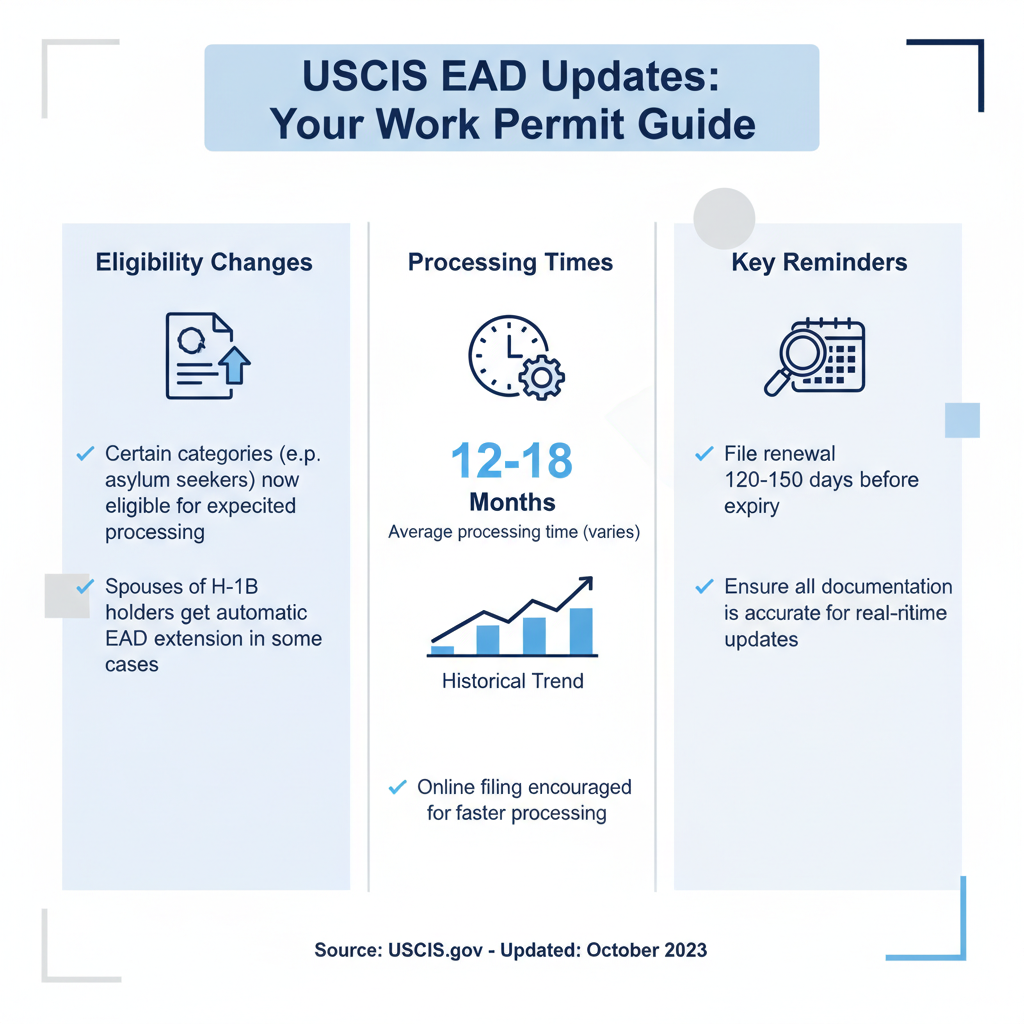
Recent reports from USCIS indicate ongoing efforts to streamline processing, address backlogs, and implement new policies affecting Employment Authorization Document applications and renewals. These updates are a continuous part of USCIS's operational adjustments to manage caseloads and improve efficiency. For more general information on immigration law news, you can refer to broad reports such as those found via Employment Authorization Document Processing (USCIS).
What This News Means for Immigrants in Orlando and Across Florida
Understanding the latest USCIS updates regarding Employment Authorization Documents (EADs) is not just about keeping up with bureaucratic changes; it's about safeguarding your ability to work, support your family, and contribute to your community. For immigrants in Orlando and across the Sunshine State, these changes can have direct and significant impacts on daily life and future planning.
Why this news is showing up now
As of April 26, 2026, USCIS continues to grapple with the aftermath of increased filing volumes and operational challenges experienced over recent years. In response, the agency has been actively implementing various initiatives aimed at improving efficiency, reducing processing times, and providing relief to applicants. These initiatives often involve policy adjustments, technological enhancements, and resource allocation shifts. The current news reflects USCIS's ongoing commitment to these efforts, particularly concerning the high volume of Form I-765 applications. The goal is to create a more predictable and timely process for obtaining and renewing work authorization, which is critical for the economic stability of immigrants and the broader economy.
For instance, USCIS has been exploring ways to expand premium processing options, clarify eligibility for automatic EAD extensions, and digitize more application processes. These moves are a direct response to public and stakeholder feedback regarding lengthy delays that have left many individuals in precarious situations, unable to work legally while awaiting a decision. The continuous flow of news surrounding EAD processing highlights a dynamic environment where policy and procedure are regularly refined to meet evolving demands.
How it can affect Florida residents
Florida, a state with a vibrant and diverse immigrant population, is particularly sensitive to changes in EAD processing. For residents in Orlando, Central Florida, and throughout the I-4 corridor, quicker or more predictable EAD processing means:
- Job Security and Opportunities: Timely EADs ensure that individuals can start new jobs, maintain current employment, and pursue career advancement without interruption. Delays can lead to job loss, financial hardship, and uncertainty.
- Economic Stability for Families: The ability to work legally directly impacts a family's financial stability, allowing them to pay bills, buy homes, and invest in their children's education. Any slowdown in EAD processing can reverberate through households, creating stress and instability.
- Community Contribution: Immigrants with valid work permits contribute significantly to Florida's economy and social fabric, filling essential labor gaps in various industries, from hospitality and agriculture to healthcare and technology. Efficient EAD processing supports this vital contribution.
- Orlando-Specific Impact: With a significant number of immigrants residing in Orange County and surrounding areas, the Orlando USCIS Field Office and local businesses feel the direct impact of EAD processing times. Longer waits can affect local employers struggling to staff positions and immigrants eager to contribute their skills.
- Planning and Uncertainty: For those awaiting an Adjustment of Status decision or other immigration benefits, a valid EAD provides crucial interim authorization. Unpredictable processing times can make long-term planning, such as renting an apartment or securing a loan, extremely difficult.
Given Florida's robust job market and its welcoming stance for many immigrant communities, efficient EAD processing is not merely a convenience but a necessity. Imigrar, located in Orlando, is acutely aware of these local impacts and stands ready to assist our neighbors and clients across the state in navigating these critical updates.
Need Help? Our Orlando immigration team is ready to assist. Call +1 786-791-3106 for a free consultation, or message us online. Se Habla Español.
What the Employment Authorization Document (EAD) Is (and Why It Matters)
The Employment Authorization Document (EAD) is a crucial piece of identification for many non-citizens in the United States. Without it, most non-citizens are not permitted to work legally in the U.S. Understanding what an EAD is and why it's so important is the first step in successfully navigating the application process.
A plain-English definition
Simply put, an Employment Authorization Document (EAD) is a card issued by U.S. Citizenship and Immigration Services (USCIS) that proves you are authorized to work in the United States. It's often referred to as a "work permit." This card looks similar to a driver's license and contains your photo, name, date of birth, and an expiration date. It's distinct from a green card (which grants permanent residency and inherent work authorization) or a visa (which allows entry for a specific purpose). An EAD provides the legal permission to accept employment in the U.S. for a specific period, typically one or two years, depending on your immigration category.
Having an EAD allows you to:
- Legally accept employment in the United States.
- Obtain a Social Security number (if you don't already have one).
- Apply for a driver's license or state ID in some states, including Florida.
- Prove your eligibility to work to employers for Form I-9, Employment Eligibility Verification.
Key terms you need to know
Navigating immigration processes involves understanding specific terminology. Here are some key terms related to EADs:
- USCIS (U.S. Citizenship and Immigration Services): The government agency responsible for overseeing lawful immigration to the United States. They process EAD applications.
- Form I-765, Application for Employment Authorization: This is the official form you must file with USCIS to apply for an EAD or to renew an existing one.
- Eligibility Category: USCIS assigns specific categories under which individuals can apply for an EAD. Your eligibility category depends on your current immigration status or the benefit you are seeking (e.g., asylum applicant, DACA recipient, spouse of a U.S. citizen applying for a green card).
- Adjustment of Status (AOS): The process by which an eligible non-citizen already in the United States can apply for lawful permanent resident status (a green card) without having to return to their home country to complete visa processing. Individuals with a pending Form I-485, Application to Register Permanent Residence or Adjust Status, are often eligible for an EAD.
- Nonimmigrant Visa: A visa issued to foreign nationals seeking to enter the U.S. temporarily for a specific purpose (e.g., H-1B for specialty occupations, F-1 for students, L-1 for intracompany transfers). Some nonimmigrant visa holders or their dependents (e.g., certain H-4 spouses) may be eligible for an EAD.
- Work Permit: A common, informal term for the Employment Authorization Document (EAD).
- Automatic Extension: Certain EAD categories are eligible for an automatic extension of their expiring EAD for up to 180 days (or even 540 days in some cases, depending on policy updates) when they file a timely renewal application. This allows them to continue working while USCIS processes their new EAD.
- Receipt Notice: A document sent by USCIS acknowledging receipt of your application. For EAD renewals eligible for an automatic extension, this notice, along with your expired EAD, serves as proof of continued work authorization.
- Biometrics Appointment: An appointment at a USCIS Application Support Center (ASC) where your fingerprints, photograph, and signature are taken. This is often required for identity verification and background checks.
- RFE (Request for Evidence): A letter from USCIS requesting additional information or documentation to support your application. Failing to respond to an RFE can lead to denial.
Understanding these terms will help you comprehend the requirements and procedures involved in obtaining and maintaining your work authorization. The EAD is a critical bridge for many immigrants, allowing them to build stable lives while pursuing long-term immigration goals.
Current Immigration Law: The Foundation for Your Work Authorization
The legal framework governing Employment Authorization Documents (EADs) is rooted in federal immigration law, primarily the Immigration and Nationality Act (INA) and its implementing regulations found in the Code of Federal Regulations (CFR). These laws define who is eligible for work authorization, under what conditions, and for how long. There are no state-specific EAD laws; eligibility is determined solely by federal statutes.
Federal requirements
The authority for USCIS to grant employment authorization stems from Section 274A of the Immigration and Nationality Act (INA) and 8 Code of Federal Regulations (CFR) § 274a.12. This section outlines the various categories of foreign nationals who are eligible to apply for an EAD. Eligibility is not universal; it depends on your specific immigration status or the type of immigration benefit you are seeking. Some of the most common eligibility categories include:
- Applicants for Adjustment of Status (AOS): Individuals who have filed Form I-485, Application to Register Permanent Residence or Adjust Status, are generally eligible for an EAD while their green card application is pending. This is often filed concurrently with Form I-130, Petition for Alien Relative, or other immigrant visa petitions.
- Asylum Seekers and Asylees: Individuals with a pending Form I-589, Application for Asylum and for Withholding of Removal, who have waited at least 150 days after filing, or those who have been granted asylum, are eligible.
- Refugees: Individuals admitted to the U.S. as refugees.
- DACA Recipients: Individuals granted Deferred Action for Childhood Arrivals (DACA).
- F-1 Students with Optional Practical Training (OPT): Foreign students pursuing certain academic programs can apply for an EAD for practical training related to their field of study.
- Certain Spouses of Nonimmigrants: For example, spouses of L-1 intracompany transferees (L-2 status) and, in certain circumstances, spouses of H-1B specialty occupation workers (H-4 status).
- Temporary Protected Status (TPS) Beneficiaries: Individuals granted TPS due to conditions in their home country.
- U-Visa and T-Visa Applicants: Victims of certain crimes or human trafficking who are cooperating with law enforcement.
- Parolees: Individuals granted parole into the U.S. for humanitarian reasons or significant public benefit.
Each category has specific requirements and documentation needed to prove eligibility. It's crucial to correctly identify your eligibility category on Form I-765, as an error can lead to delays or denial. You can find detailed information about eligibility categories and requirements on the USCIS official website and within the USCIS Policy Manual.
Florida-specific considerations
While the eligibility and application process for an EAD are entirely federal, there are some Florida-specific considerations that immigrants should be aware of:
- E-Verify Requirements: Florida state law mandates that certain public and private employers use E-Verify, an internet-based system operated by USCIS, to confirm the employment eligibility of newly hired employees. While your EAD proves your eligibility, knowing your employer uses E-Verify is important.
- Professional Licensing: Many professions in Florida (e.g., nursing, teaching, real estate) require state licenses. To obtain these licenses, you must typically prove your legal authorization to work in the U.S. with documents like an EAD.
- Driver's License and State ID: In Florida, an unexpired EAD card can be used as a primary document to obtain a Florida driver's license or state identification card, provided it is accompanied by other required identity and residency documents. This is crucial for mobility and daily life.
- Local USCIS Field Office: While the Orlando USCIS Field Office primarily handles interviews for green card applications and naturalization, it's a local resource for general inquiries, though EAD applications are generally processed at service centers. For Central Florida residents, understanding the local immigration landscape is key.
It's important to remember that state laws cannot override federal immigration laws. Therefore, your eligibility for an EAD will always be determined by USCIS based on federal guidelines. However, knowing how your EAD interacts with state regulations and services can help you navigate life in Florida more effectively.
Navigating EAD complexities? Our Orlando immigration attorneys are here to provide clarity and expert assistance. Don't risk delays or denials. Call Imigrar at +1 786-791-3106 for your free consultation. Se Habla Español.

How to Apply for or Renew Your EAD: A Complete Step-by-Step Guide
Applying for an initial Employment Authorization Document (EAD) or renewing an existing one requires careful attention to detail. This step-by-step guide will walk you through the process, helping you compile the necessary information and documents for a successful application. Remember, precision is key, and mistakes can lead to significant delays.
1) Determine Your Eligibility Category
Before you even touch Form I-765, you must accurately identify the eligibility category under which you are applying. This is paramount because the required supporting evidence varies significantly by category. Common categories include:
- (c)(9): Adjustment of Status applicants (those with a pending Form I-485).
- (c)(8): Asylum applicants who have had their asylum application pending for at least 150 days.
- (c)(33): DACA recipients.
- (a)(12): Temporary Protected Status (TPS) beneficiaries.
- (c)(26): Certain H-4 spouses of H-1B nonimmigrants.
- (c)(3)(i), (c)(3)(ii), (c)(3)(iii): F-1 students seeking Optional Practical Training (OPT).
Reminder: Your eligibility category is listed in the instructions for Form I-765. If you are unsure, consult an immigration attorney. Incorrectly identifying your category is a common reason for RFEs or denials.
2) Gather Required Documents
Once your eligibility category is clear, begin collecting all necessary supporting documentation. While specific documents vary, a general list includes:
- Two Passport-Style Photos: Taken within 30 days of filing, with a white to off-white background, unretouched, and printed on thin photo paper. Write your name and A-number (if applicable) lightly on the back.
- Copy of Government-Issued Photo ID: Such as a passport identity page, birth certificate with photo ID, or a driver's license.
- Copy of Your Last EAD Card (if renewing): Front and back.
- Copy of Your Visa (if applicable): From your passport.
- Copy of Your I-94 Arrival/Departure Record: You can print this from CBP's website.
- Proof of Immigration Status: Depending on your category:
- For Adjustment of Status (c)(9): Copy of your Form I-485 receipt notice, or a copy of the entire Form I-485 if filing concurrently. Copy of Form I-130/I-140 approval notice or receipt.
- For Asylum Applicants (c)(8): Copy of your Form I-589 receipt notice or a copy of the entire filed Form I-589.
- For H-4 EAD (c)(26): Copy of the H-1B spouse's Form I-797 approval notice, H-1B spouse's most recent pay stub, marriage certificate, and your own H-4 Form I-797 approval notice and I-94.
- For DACA (c)(33): Copy of your last Form I-797 DACA approval notice.
- Proof of Previous EADs: If you've had EADs before, copies of all previous cards.
- Birth Certificate: Copy.
- Marriage Certificate: If applicable, for derivative applicants.
Important: Always provide copies, not original documents, unless specifically requested by USCIS. Keep a complete set of all submitted documents for your records.
3) Complete Form I-765, Application for Employment Authorization
This is the core of your application. You can download the latest version of Form I-765 from the USCIS Forms page. Fill out the form accurately and completely. Here are key sections to focus on:
- Part 1: Reason for Applying: Clearly check the box that corresponds to your application (initial permission, renewal, or replacement).
- Part 2: Information About You:
- Name: Ensure it matches your legal documents exactly.
- Address: Provide your current mailing address. If you move, update USCIS immediately. For Central Florida residents, ensure your Orange County address is correct.
- A-Number (Alien Registration Number): If you have one, provide it. This is typically found on previous immigration documents.
- USCIS Online Account Number: If you have one, include it.
- Eligibility Category: This is critical. Enter the correct category code (e.g., c9, c8, c26). If you are filing under a category that requires an explanation (e.g., certain students), ensure you provide it.
- Previous EADs: Provide information on any prior EADs you've received.
- Social Security Number: You can request one directly on the form if you don't have one.
- Part 3: Applicant's Statement, Contact Information, Declaration, Certification, and Signature:
- Read everything carefully.
- Sign and date the form. An unsigned form will be rejected.
Warning: Do not leave any required fields blank. If a question does not apply to you, write "N/A" (not applicable). If a numeric response is required and it doesn't apply, write "None."
4) Prepare Supporting Evidence and Fees
Once Form I-765 is complete and signed, compile it with all your supporting documents. You will also need to include the correct filing fee, or a request for a fee waiver.
- Filing Fee: Check the USCIS website for the current Form I-765 filing fee. Fees change periodically, so verify before mailing.
- Payment Method: You can pay by money order, personal check, cashier's check, or by credit card using Form G-1450, Authorization for Credit Card Transactions. Make checks payable to "U.S. Department of Homeland Security."
- Fee Waiver: If you cannot afford the fee, you may be eligible for a fee waiver by filing Form I-912, Request for Fee Waiver. Eligibility is based on income, receipt of means-tested benefits, or financial hardship.
- Organize Your Packet: Use fasteners or paper clips. Do not staple entire packets. Consider using cover sheets to separate sections (e.g., "Form I-765," "Photos," "Supporting Documents").
5) File Your Application with USCIS
The filing address depends on your eligibility category and whether you are filing Form I-765 concurrently with another application (like Form I-485). Always check the "Where to File" section on the USCIS I-765 page or the form instructions for the correct mailing address.
- Mailing: Send your application via certified mail with a return receipt requested, or through a courier service that provides tracking. This provides proof of mailing and delivery.
- Online Filing: USCIS is expanding online filing options. Many EAD categories are now eligible for online submission. Creating a USCIS online account allows you to file, pay fees, and track your case electronically. This is often faster and provides instant confirmation.
- Concurrent Filing: If you are filing your EAD application along with another form (e.g., Form I-485), ensure both are sent to the correct address for the primary application.
6) Attend Biometrics Appointment (If Required)
After filing, most EAD applicants will receive a notice for a biometrics appointment at a local Application Support Center (ASC). This appointment is for collecting your fingerprints, photograph, and signature for background checks. The Orlando USCIS Application Support Center serves Central Florida residents.
Related Articles
You may also be interested in:
-
H-1B Visa Lottery Changes FY2027: A Guide for Florida Immigrants
Understand the new H-1B visa lottery rules for FY2027 and their impact. Imigrar offers expert guidance for immigrants in Orlando and nationwide....
-
DACA Updates 2026: Your Essential Renewal Guide for Dreamers in
Stay informed on DACA updates and the renewal process. Imigrar provides a comprehensive guide for DACA recipients in Orlando and Florida, helping you ...
-
DACA Renewal 2026: Updates & Guide for Florida Dreamers
Stay informed on DACA renewal in 2026. This comprehensive guide covers eligibility, the step-by-step renewal process, legal updates, and how Imigrar h...
-
Master Your Green Card Interview: Expert Tips for Success in 2026
Facing your Green Card interview in Orlando or anywhere in the U.S.? This comprehensive guide from Imigrar provides essential preparation tips, docume...


