

In the dynamic landscape of U.S. immigration, staying informed about policy changes and processing updates is crucial for immigrants and their families. At Imigrar, your trusted immigration law firm in Orlando, Florida, we understand the profound impact that an Employment Authorization Document (EAD), often referred to as a work permit, has on your ability to live, work, and thrive in the United States. Today, we delve into recent developments from U.S. Citizenship and Immigration Services (USCIS) regarding EAD applications and renewals, providing a comprehensive guide to help you navigate this vital process.
The reporting that sparked this guide
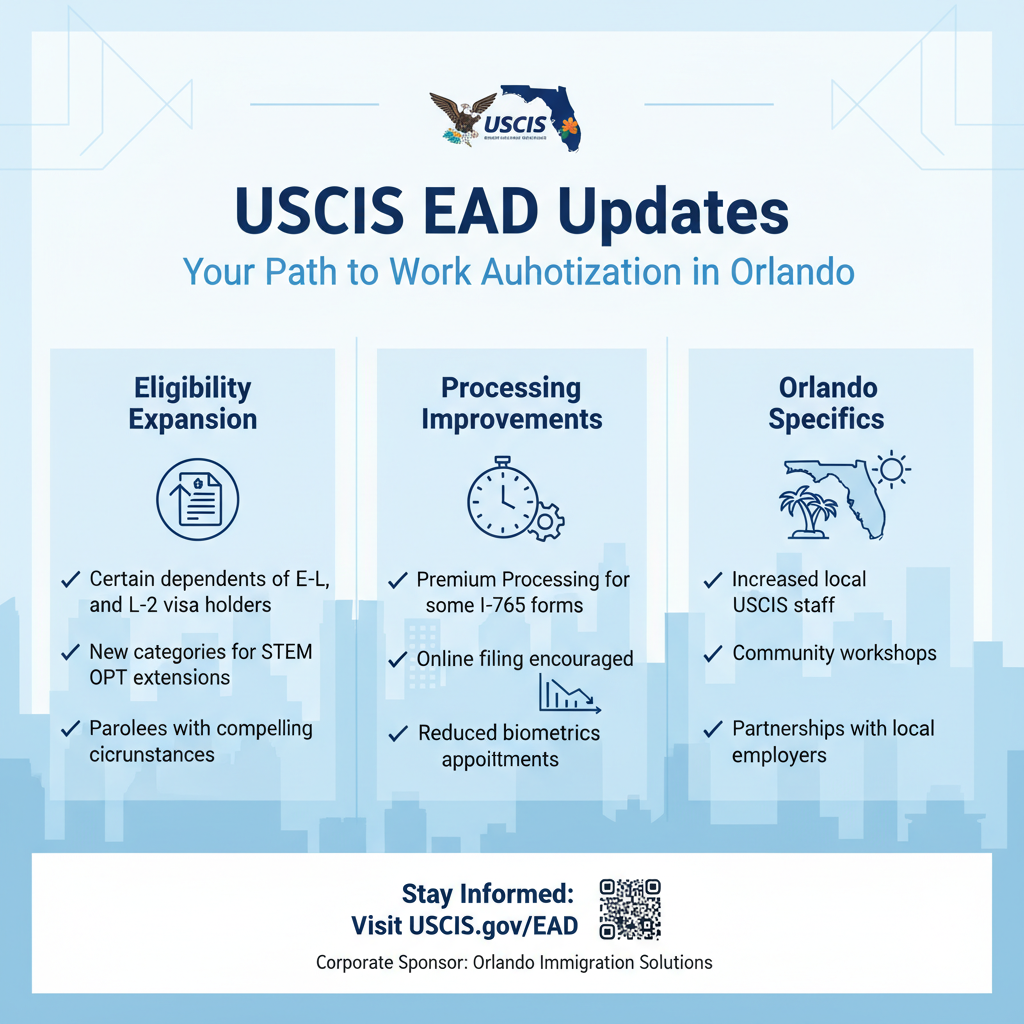
The information and guidance in this article are inspired by ongoing discussions and reports surrounding Employment Authorization Document Processing (USCIS), particularly concerning USCIS's efforts to streamline operations, reduce backlogs, and clarify policies for applicants seeking to work legally in the United States.
What This News Means for Immigrants in Orlando and Across Florida
Recent updates and ongoing initiatives by USCIS regarding Employment Authorization Documents are designed to enhance efficiency and address persistent processing delays. For immigrants residing in Orlando, across Central Florida, and throughout the Sunshine State, these changes carry significant weight, directly impacting their ability to secure and maintain legal employment.
Why this news is showing up now
The conversation around EAD processing has been particularly active in recent years, largely driven by several factors:
- Pandemic-Related Backlogs: The COVID-19 pandemic significantly disrupted USCIS operations, leading to unprecedented backlogs across various application types, including Form I-765, the Application for Employment Authorization.
- Increased Demand: A growing number of individuals eligible for EADs—including asylum seekers, applicants for Adjustment of Status, and certain nonimmigrant visa holders—has placed additional strain on the system.
- USCIS Initiatives: In response to these challenges, USCIS has implemented various strategies aimed at improving efficiency. These include temporary final rules extending the validity period for certain automatic EAD extensions, efforts to increase staffing, and a focus on digital processing to mitigate delays. The agency consistently reviews its policies to reduce processing times for employment authorization applications, understanding that timely work authorization is essential for immigrants and the U.S. economy.
- Public and Congressional Pressure: Advocacy from immigration attorneys, community organizations, and congressional representatives has also spurred USCIS to address EAD processing times more aggressively, acknowledging the severe economic and personal hardship caused by delays.
How it can affect Florida residents
For individuals and families in Florida, these USCIS updates are not abstract policies; they have tangible, day-to-day consequences:
- Employment Stability: Faster processing times mean less uncertainty for those awaiting initial EADs or renewals. This can prevent gaps in employment, allowing individuals to maintain their jobs, support their families, and contribute to Florida's economy without interruption. For many in Orlando, where tourism and service industries are prevalent, continuous work authorization is paramount.
- Economic Contribution: With timely EADs, immigrants can enter or re-enter the workforce more quickly, boosting local economies in areas like Orange County and beyond. This contributes to tax revenues and fills labor demands across various sectors.
- Planning and Peace of Mind: Reduced processing backlogs provide greater predictability, allowing immigrants and their employers to plan for the future with more confidence. This alleviates immense stress and anxiety often associated with the EAD application process.
- Impact on Businesses: Florida businesses, particularly those along the I-4 corridor that rely on a diverse workforce, benefit from a stable pool of authorized workers. Delays in EAD processing can create staffing shortages and operational challenges.
- Local USCIS Field Office: While most EAD processing occurs at service centers, residents in Central Florida may interact with the Orlando USCIS Field Office for biometrics appointments or other related matters. Efficient federal processing indirectly improves the overall immigration experience locally.
Important: Staying abreast of these developments is critical. Imigrar is committed to providing the most current and accurate information to help our clients navigate these changes effectively.
Need Help? Our Orlando immigration team is ready to assist. Call +1 786-791-3106 for a free consultation, or message us online. Se Habla Español.
What Employment Authorization Documents (EADs) Are (and Why They Matter)
An Employment Authorization Document, commonly known as an EAD or a "work permit," is a critical document issued by USCIS that grants certain non-U.S. citizens legal permission to work in the United States for a specific period. It's a tangible card, similar to a driver's license, that employers use to verify an individual's authorization to work.
A plain-English definition
Simply put, an Employment Authorization Document (EAD) is your official pass to work legally in the U.S. If you're not a U.S. citizen or a lawful permanent resident (Green Card holder), you generally need an EAD to accept employment. This document is crucial because it allows individuals to earn a living, support their families, and contribute to the economy while they pursue a more permanent immigration status or remain in the U.S. under specific temporary categories. Without an EAD, working in the U.S. is illegal and can have severe immigration consequences.
Key terms you need to know
Understanding the following terms is essential when discussing EADs:
- Form I-765: This is the official application form, "Application for Employment Authorization," that you must file with USCIS to request an EAD.
- USCIS (U.S. Citizenship and Immigration Services): The government agency responsible for processing immigration benefits, including EAD applications. You can find more information and forms on the USCIS official website.
- Adjustment of Status (AOS): The process by which an eligible non-citizen already in the United States applies for lawful permanent resident status (a Green Card) without having to return to their home country to complete visa processing. Individuals with a pending Form I-485 (Application to Register Permanent Residence or Adjust Status) are typically eligible for an EAD.
- Asylum Seeker/Asylee: Individuals who have applied for asylum or been granted asylum in the U.S. are generally eligible for an EAD.
- F-1 Optional Practical Training (OPT): A program that allows international students (F-1 visa holders) to gain work experience in their field of study in the U.S. They require an EAD for this training.
- H-4 EAD: Certain H-4 dependent spouses of H-1B nonimmigrants who are seeking employment-based lawful permanent residence are eligible for an EAD.
- L-2 EAD: L-2 spouses of L-1 intracompany transferees have automatic work authorization incident to their status, but an EAD card serves as proof of this authorization.
- Automatic Extension: For certain EAD categories, if you file your renewal application before your current EAD expires, your work authorization and/or EAD card may be automatically extended for a specific period (currently up to 540 days) while USCIS processes your renewal.
- Receipt Notice (Form I-797C): A document issued by USCIS acknowledging that they have received your application. This notice is critical, especially for proving an automatic extension of your EAD.
- Concurrent Filing: The practice of filing multiple immigration forms at the same time, often done when filing Form I-485 with Form I-765 (and sometimes Form I-131 for Advance Parole).
- Expedited Processing: A request to USCIS to speed up the processing of an application due to urgent circumstances, though it is rarely granted for EADs.
The EAD is more than just a piece of plastic; it's a gateway to self-sufficiency, financial stability, and integration into American society. Without it, many essential aspects of life, from obtaining a Social Security number to getting a driver's license, become significantly more challenging or impossible.
Current Immigration Law: The Foundation for Work Authorization
The authority for USCIS to grant employment authorization stems from the Immigration and Nationality Act (INA) and subsequent regulations found in the Code of Federal Regulations (CFR), primarily 8 CFR Part 274a. These laws outline who is eligible for an EAD, under what conditions, and for how long. Understanding this legal framework is key to successfully navigating the application process.
Federal requirements
Federal law dictates the broad categories of non-U.S. citizens who may be eligible for an EAD. These categories are diverse and depend heavily on an individual's underlying immigration status or circumstances. Key provisions include:
- INA § 274A: This section of the INA makes it unlawful for an employer to hire or continue to employ an alien who is not authorized to work in the United States. It also establishes the requirement for employers to verify the employment eligibility of all new hires.
- 8 CFR Part 274a.12: This regulation lists the specific classes of aliens authorized to be employed in the U.S. and those who require an EAD. This is where the various EAD categories (e.g., (c)(9) for Adjustment of Status applicants, (c)(8) for asylum applicants, (c)(3)(C) for F-1 OPT) are defined.
- Primary Eligibility Categories:
- Applicants for Adjustment of Status: Individuals with a pending Form I-485 (Application to Register Permanent Residence or Adjust Status) are eligible for an EAD under category (c)(9). Often, this EAD is filed concurrently with Form I-485 and Form I-131 (Application for Travel Document, for Advance Parole).
- Asylum Applicants and Asylees: Individuals who have filed Form I-589 (Application for Asylum and for Withholding of Removal) and whose application has been pending for at least 180 days (without delay caused by the applicant) are eligible. Those granted asylum also qualify.
- Refugees: Individuals granted refugee status.
- Nonimmigrants with Specific Authorizations: This includes certain spouses of nonimmigrants, such as H-4 EAD holders (spouses of H-1B visa holders awaiting Green Cards) and some L-2 spouses. F-1 students seeking Optional Practical Training (OPT) also fall into this category.
- DACA Recipients: Individuals granted Deferred Action for Childhood Arrivals (DACA) are eligible to apply for an EAD.
- Temporary Protected Status (TPS) Holders: Individuals granted TPS are authorized to work.
- Required Form: The central piece of this legal framework is Form I-765, the "Application for Employment Authorization." This form, along with supporting documentation and the correct filing fee, must be submitted to USCIS. You can always access the latest versions of immigration forms on the USCIS Forms page.
Florida-specific considerations
While employment authorization is primarily a federal matter, granted by USCIS, there are state-level considerations for those residing in Florida:
- E-Verify Requirements: Florida law mandates that certain public and private employers use E-Verify, an internet-based system operated by USCIS, to confirm the employment eligibility of their employees. While an EAD proves your federal authorization to work, employers in Florida subject to this mandate will use E-Verify to confirm it.
- Driver's Licenses and State IDs: Having an EAD is often a crucial document for obtaining a Florida driver's license or state identification card, which is essential for daily life in Orlando and across the state, facilitating everything from commuting along the I-4 corridor to accessing services.
- Professional Licensing: For certain professions in Florida (e.g., healthcare, law), state licensing boards may require proof of legal work authorization in addition to educational and professional qualifications. Your EAD serves as this proof.
- Local Economic Impact: Florida's economy, particularly in metropolitan areas like Orlando and surrounding Orange County, relies heavily on a diverse workforce. Delays in EAD processing can impact local labor markets and the ability of businesses to fill positions.
Reminder: It's important to understand that no Florida state law can grant or deny federal employment authorization. State laws interact with, but do not override, the federal immigration framework for EADs.
Need Help? Our Orlando immigration team is ready to assist. Call +1 786-791-3106 for a free consultation, or message us online. Se Habla Español.

How to Apply for or Renew Your EAD: A Complete Step-by-Step Guide
Applying for or renewing an EAD can seem daunting, but by following a structured approach, you can navigate the process effectively. This guide provides a detailed breakdown of each step, whether you're applying for the first time or seeking to renew your existing work authorization.
1) Determine Your Eligibility and Category
Before anything else, you must confirm that you are eligible for an EAD and identify the correct eligibility category. This is the foundation of your application.
- Review USCIS Guidelines: Visit the USCIS website for EAD eligibility to understand the various categories. Common categories include:
- (c)(9): Pending Adjustment of Status (Form I-485)
- (c)(8): Asylum applicant (after 180 days pending) or Asylee
- (a)(5): Refugee
- (c)(3)(C): F-1 student seeking Optional Practical Training (OPT)
- (c)(26): H-4 spouse of certain H-1B nonimmigrants
- (a)(17): TPS recipient
- (c)(33): DACA recipient
- Gather Eligibility Proof: Collect documents that prove your current immigration status and eligibility for the chosen category.
- Required Documents for Eligibility Proof (examples vary by category):
- Copy of your Form I-94, Arrival/Departure Record (front and back)
- Copy of your last visa stamp (if applicable)
- Copy of your birth certificate (with certified translation if not in English)
- Copy of your marriage certificate (if applying as a spouse)
- Copy of your most recent Form I-797C, Receipt Notice, for your underlying application (e.g., Form I-485, Form I-589)
- Copy of your previous EAD (for renewals)
- Proof of relationship (e.g., marriage certificate, birth certificate for dependents)
- Evidence of your nonimmigrant status (e.g., H-1B, L-1, F-1 visa documents)
2) Gather Required Documents and Information
Once your eligibility is confirmed, compile all necessary supporting documents. Accuracy and completeness are paramount to avoid delays or denials.
- Identification Documents:
- Two identical passport-style photos (taken within the last 30 days, white background, no glasses)
- Copy of government-issued photo identification (e.g., passport bio page, driver's license)
- Copy of your Social Security card (if you have one)
- Previous EAD and Immigration Documents (for renewals):
- Copy of the front and back of your most recent EAD card
- Copy of your EAD approval notice (Form I-797)
- Proof of Status/Application:
- Copy of your Form I-94 (front and back)
- Copy of your last visa stamp
- Copy of your Form I-797C for your underlying petition/application (e.g., Form I-485, Form I-130, Form I-589 approval or receipt notice)
- For F-1 OPT: Copy of Form I-20 endorsed for OPT
- For H-4 EAD: Copies of H-1B spouse's Form I-797 approval notices (I-129) and your H-4 Form I-797 (I-539)
- Biographic Information: Ensure you have accurate dates of birth, addresses, employment history, and other personal data required for the form.
3) Complete Form I-765 Accurately
Filling out Form I-765 correctly is critical. Read the instructions carefully, and ensure all information is current and consistent with your supporting documents.
- Download the Latest Form: Always use the most current version of Form I-765 from the USCIS Forms page.
- Read Instructions Thoroughly: The instructions document provides detailed guidance for


