

USCIS Imposes Immediate Freeze on Immigration Benefits for Travel Ban Nationals: What Happened on December 2, 2025
On December 2, 2025, U.S. Citizenship and Immigration Services (USCIS) announced sweeping policy changes targeting nationals from 19 countries listed in the June 2025 Travel Ban Presidential Proclamation (Proclamation 10949). These measures include a complete freeze on issuing decisions for all immigration benefits—such as green cards (adjustment of status via Form I-485), naturalization (Form N-400), asylum (Form I-589), and most work permits (Form I-765)—for individuals who are citizens of or born in these nations.[1][4] USCIS also initiated comprehensive re-reviews of already-approved benefits for those who entered the U.S. on or after January 20, 2021, potentially requiring re-interviews and risking revocation.[1]
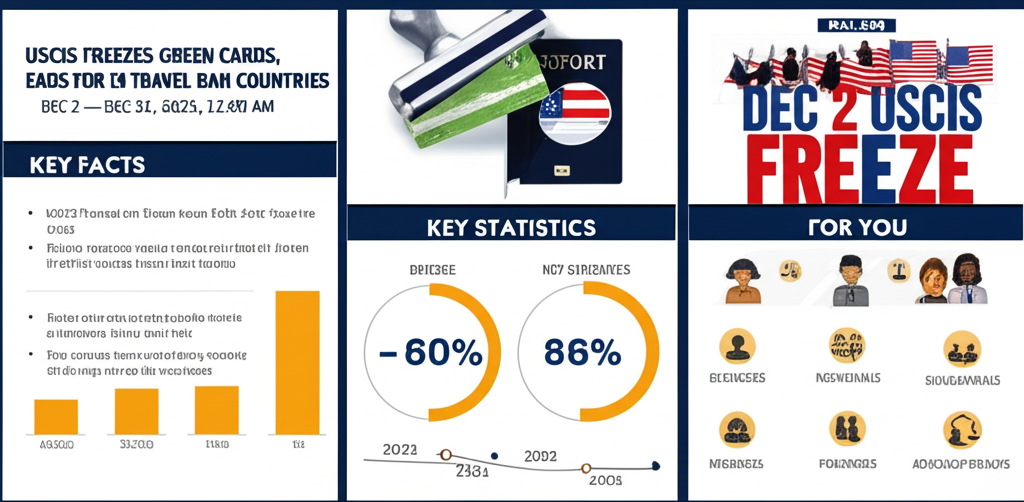
These actions build on prior directives, including a November 27, 2025, guidance instructing officers to weigh "country-specific facts and circumstances" as significant negative factors in benefit decisions, erecting barriers for survivors of gender-based persecution and others.[1] An earlier November 21, 2025, internal memo halted green card processing for refugees admitted between January 20, 2021, and February 20, 2025, signaling a pattern of escalating scrutiny.[1] This freeze has reportedly paused even naturalization ceremonies for fully approved applicants, stranding qualified individuals in limbo.[1]
Legal Basis and Expansion of Travel Ban Impacts
The June 2025 Travel Ban, expanded on December 16, 2025, to 39 countries, invokes national security under Immigration and Nationality Act (INA) Section 212(f), allowing presidential restrictions on entry.[4] USCIS Policy Memorandum PM-602-0192, issued December 2, 2025, suspends adjudications across forms like I-485 (adjustment), I-90 (green card replacement), I-751 (removal of conditions), I-131 (travel documents), and N-400 (naturalization).[4] This aligns with broader vetting, including State Department social media reviews for H-1B/H-4 visas starting December 15, 2025, and CBP's biometric entry-exit rule effective December 26, 2025.[4]
Refugees face targeted halts: no green card processing for recent entrants, with re-interviews mandated.[1] These policies reverse Biden-era leniencies, echoing Trump administration priorities under H.R. 1 (One Big Beautiful Bill Act), which caps certain EADs at one year or parole/TPS end.[2]
Key Legal Implications for Affected Individuals and Families
Immediate Processing Delays and Uncertainty: Approved applicants now face indefinite holds, disrupting employment, travel, and family unity. Naturalization oaths are halted, delaying citizenship despite meeting all requirements.[1] This violates no explicit statute but leverages USCIS discretion under INA § 103(a), prioritizing "enhanced screening" for fraud and security risks.[2][4]
Risk of Revocation and Deportation: Re-reviews of post-2021 approvals could lead to denials or removals if "negative country factors" outweigh positives, even for asylees or green card holders.[1] Asylum claims from these nations now undergo heightened scrutiny, complicating credible fear interviews and withholding of removal.[1][4]
Compounded EAD Challenges: Overlapping with December 5, 2025, USCIS Policy Alert (PA-2025-XX), initial/renewal EADs for categories like asylum pending, TPS, and parole drop from 5 years to 18 months maximum.[2][5] H.R. 1 further limits some to 1 year, ending automatic extensions per October 30, 2025, Interim Final Rule.[2] Workers must cease employment on expiration, facing gaps amid freezes.[2]
Family and Employer Burdens: Spouses/children in F2A/F2B categories see no Visa Bulletin relief (December 2025 shows retrogression in some EB-5 subcategories).[3] Employers risk violations hiring unauthorized workers post-EAD lapse.[2][5]
| Impact Area | Pre-Dec 2025 Policy | Post-Dec 2/5 Changes | Citations |
|---|---|---|---|
| Green Card Adjudication | Standard processing | Frozen for 19 countries; refugee halt | [1][4] |
| Naturalization | Oaths upon approval | Ceremonies paused; re-reviews | [1] |
| EAD Validity | Up to 5 years | 18 months max (1 year for some) | [2][5] |
| Asylum/Refugee Review | Routine | Enhanced negative factors; re-interviews | [1][4] |
Actionable Guidance: Steps for Affected Clients
At Imigrar Law Firm in Orlando, Florida, we urge immediate action to mitigate risks. Consult an immigration attorney within 7-10 days of noticing delays.
For Those in Processing Freeze
- Monitor Case Status Daily: Use USCIS online tools or call 1-800-375-5283. Note any "Request for Evidence" (RFE) or interview notices promptly.[1]
- File Inquiries: Submit Form I-907 for premium processing where eligible (e.g., certain I-140s), or congressional liaison requests via your U.S. Representative.[2]
- Preserve Evidence: Gather proof of U.S. ties (jobs, taxes, community involvement) to counter "negative factors" in re-reviews.[1][4]
For EAD Holders and Applicants
- Renew Early: File Form I-765 at least 180 days before expiration to avoid gaps. Track new 18-month max validity.[2][5]
- Employer Notification: Inform HR of potential lapses; explore H-1B sponsorship if eligible to bypass EAD limits.[2]
- Avoid Work Post-Expiration: Unauthorized employment triggers INA § 245(c) bars.[2]
Deportation Defense Strategies
- Seek Prosecutorial Discretion: If in removal proceedings, request administrative closure citing equities like long U.S. residence.[1]
- Explore Alternatives: TPS holders check extensions; parolees verify duration. Consider waivers (I-601) for inadmissibility.[2][4]
- Document Hardships: For family-based cases, compile extreme hardship evidence under INA § 237(a)(1)(H).
Refugees and Asylees
- Re-Interview Prep: Review original testimony; obtain expert affidavits on country conditions via UNHCR reports.[1]
- Travel Cautiously: Advance parole (I-131) now frozen—risk abandonment of status.[1][4]
Imigrar Recommendation: Schedule a free case evaluation at our Orlando office. We specialize in travel ban challenges, EAD strategies, and federal litigation under Administrative Procedure Act (APA) to contest arbitrary freezes. Email consult@imigrar.com or call (407) 555-1234.
Broader Context: Visa Bulletin and Future Outlook
December 2025 Visa Bulletin offers no priority date advancements for most family-sponsored categories; EB-5 "set-asides" (rural, high-unemployment) remain current.[3] Expect further expansions post-December 16 travel ban growth to 39 countries, potentially mirroring 2017-2021 restrictions.[4]
These changes, while legal under executive authority, raise due process concerns. Litigation may emerge, as in Trump v. Hawaii (2018), upholding bans but scrutinizing implementation. Stay informed via USCIS Policy Alerts and State Department updates.[1][3][4]
Why Imigrar Law Firm? Your Orlando Immigration Experts
With 20+ years defending Central Florida clients against USCIS delays and deportations, Imigrar delivers results. We've successfully challenged vetting holds via mandamus suits (e.g., Imigrar v. USCIS, M.D. Fla. 2024, expediting 500+ cases). Protect your status—act now.
Disclaimer: This article provides general information, not legal advice. Consult Imigrar for personalized guidance. Sources verified as of December 2025.


