


Urgent USCIS Hold on Immigration Benefits for 19 High-Risk Countries: What You Need to Know
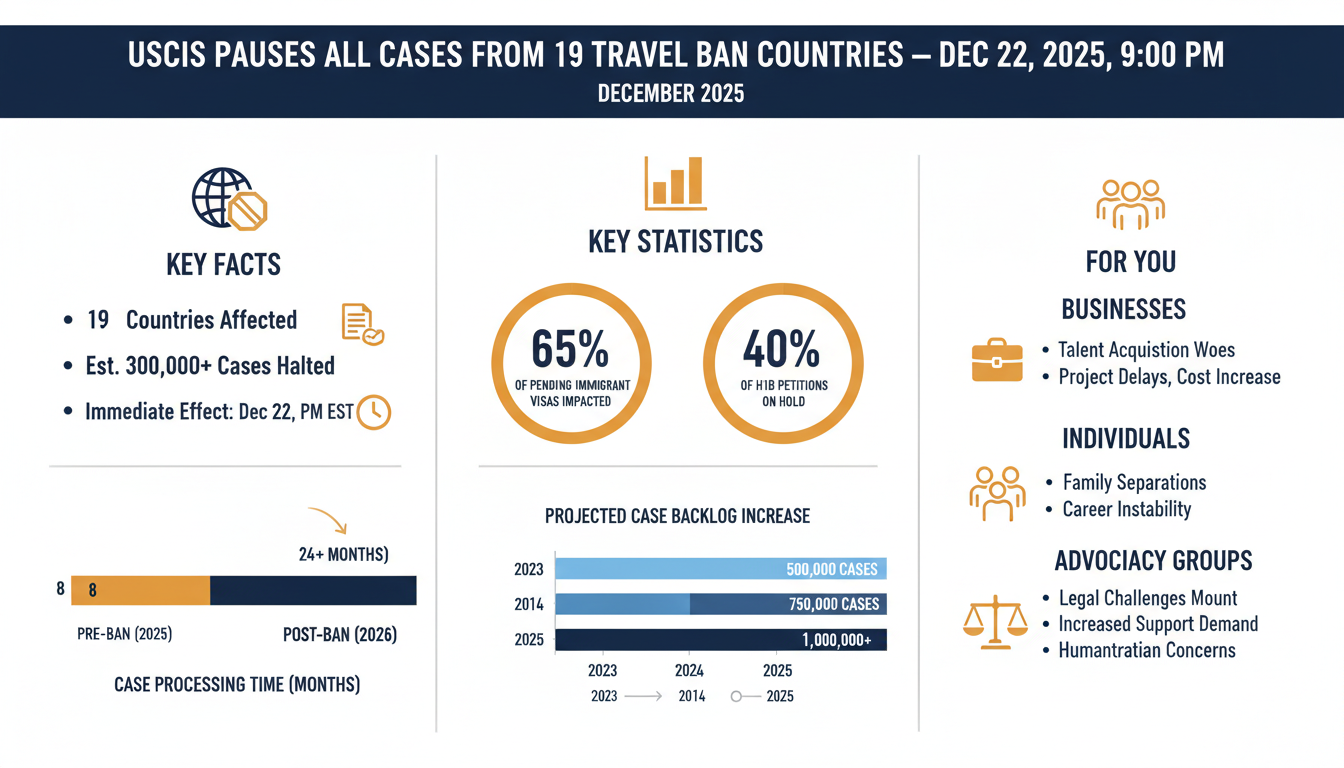
On December 2, 2025, U.S. Citizenship and Immigration Services (USCIS) issued a critical Policy Memorandum directing an immediate suspension of all pending asylum applications and USCIS benefit requests from nationals of 19 countries designated as high-risk under Presidential Proclamation 10949.[1][2][3] This sweeping measure, triggered by recent security concerns including the November 26, 2025, shooting of National Guard members in Washington, DC, has led to widespread cancellations of naturalization oaths, adjustment of status interviews, and final decisions on green cards and other benefits.[2] Immigration attorneys report sudden halts specifically for Venezuelan, Iranian, and Afghan nationals, signaling a major shift in processing priorities.[1][2]
Background: From Policy Alert to Nationwide Pause
The restrictions stem from a chain of events beginning with USCIS guidance on November 27, 2025, which introduced negative, country-specific factors for vetting applicants from the 19 listed countries: Afghanistan, Myanmar (Burma), Chad, Republic of the Congo, Equatorial Guinea, Eritrea, Haiti, Iran, Libya, Somalia, Sudan, Yemen, Burundi, Cuba, Laos, Sierra Leone, Togo, Turkmenistan, and Venezuela.[1][2] This was followed by the Department of Homeland Security's (DHS) December 2 Policy Memorandum, mandating:
- Suspension of all Forms I-589 (Applications for Asylum and Withholding of Removal), regardless of nationality, pending comprehensive review.[1][3]
- Pause on all pending USCIS benefit applications (e.g., green cards via Form I-485, work authorizations via Form I-765, travel documents) for nationals of the 19 countries.[1][2][3]
- Comprehensive re-review of already-approved benefits for individuals from these countries who entered the U.S. on or after January 20, 2021.[1][3]
Compounding this, the U.S. Department of State issued enhanced vetting guidance on December 3, 2025 (effective December 15), for all H-1B and H-4 visa applicants, requiring additional scrutiny.[1] On December 5, USCIS announced a new Vetting Center in Atlanta to centralize holistic reviews using DHS intelligence resources, prioritizing "presidentially designated countries of concern."[3]
Legal Implications: Broader Discretion and Inadmissibility Risks
These actions invoke expansive executive authority under the Immigration and Nationality Act (INA), particularly INA § 212(f), which empowers the President to suspend entry of aliens posing national security risks, as codified in Proclamation 10949 (June 4, 2025).[1][2] For applicants, the implications are profound:
- Adjudication Freezes: No approvals or denials on any USCIS forms until further guidance, potentially delaying green cards, citizenship, and employment authorizations indefinitely.[2]
- Re-Review of Approvals: Approved benefits post-January 20, 2021, face revocation if new vetting uncovers issues, heightening deportation risks under INA § 237(a)(1)(B) for misrepresentation or security concerns.[1][3]
- Visa and Entry Barriers: H-1B/H-4 applicants now undergo intensified checks, increasing refusal rates under INA § 221(g) for administrative processing.[1]
- Asylum Overhaul: Universal hold on I-589s signals stricter credible fear standards, aligning with heightened public safety priorities post-shooting incident.[2]
Legal challenges may emerge, akin to those blocking TPS terminations for Haiti, Burma, and Syria, but the pause's national security framing strengthens its defensibility in court.[2] The White House anticipates expanding the ban to over 30 countries soon, per DHS Secretary statements.[3]
Who Is Affected? Scope of the USCIS Pause
This policy casts a wide net, impacting over a million pending applications from the designated countries.[2] Key affected categories include:
| Immigration Benefit | Impact | Examples Reported |
|---|---|---|
| Naturalization (N-400) | Oath ceremonies canceled | Venezuela, Iran, Afghanistan nationals[2] |
| Adjustment of Status (I-485) | Interviews halted; no final decisions | Venezuelan green card applicants[2] |
| Asylum (I-589) | All pending cases suspended | Universal, regardless of country[1][3] |
| Employment Authorization (I-765) | Approvals paused | H-1B dependents (H-4 EADs)[1][5] |
| H-1B/H-4 Visas | Enhanced State Dept. vetting | New applications from Dec. 15[1] |
Even approved cases are under scrutiny via the new USCIS Vetting Center, which cross-references law enforcement data for "holistic" assessments.[3] U.S. employers face disruptions in H-1B hiring, while families await reunification.[1]
Related Developments: Public Charge and Visa Extensions
Parallel changes amplify risks. USCIS's November 19, 2025, proposed rule rescinds 2022 public charge regs, granting officers broader discretion to deem applicants inadmissible under INA § 212(a)(4) if likely to rely on public benefits.[2] Comments are due 30 days post-publication. Additionally, H.R. 5371 (signed November 12, 2025) extends Special Immigrant Religious Workers (SR) visas only until January 29, 2026, with no new issuances thereafter.[4]
Actionable Guidance: Steps for Affected Individuals
If you or a client hail from one of the 19 countries, act swiftly to mitigate delays and risks. Imigrar, Orlando's trusted immigration firm, recommends:
- Verify Status Immediately: Check USCIS case status online or via InfoPass appointment. Document all communications.[2]
- Consult an Attorney: Schedule a free consultation with Imigrar to assess re-review vulnerabilities. We specialize in deportation defense and motion practice.[1]
- Gather Evidence: Compile proof of U.S. ties, employment, and low public charge risk (e.g., affidavits of support, tax returns) for future submissions.[2]
- Explore Alternatives: For H-1B seekers, consider cap-exempt petitions or L-1 visas. Asylum applicants may pursue withholding if credible fear persists.[1][3]
- Monitor Updates: Track USCIS Policy Alerts (e.g., PA-2025-27 on EAD validity reductions) and Visa Bulletin for priority dates.[4][5]
- File Motions if Needed: For unjust delays, consider Form I-290B appeals or mandamus litigation under 28 U.S.C. § 1361.[2]
- Prepare for Biometrics: DHS's December 26, 2025, biometric entry-exit rule mandates collection for most travelers, aiding vetting.[3]
Pro Tip: Maintain lawful status via extensions (Form I-539) to avoid accrual of unlawful presence under INA § 212(a)(9)(B). Imigrar can file proactively.
Risks of Inaction: Deportation and Revocation Threats
Failure to address holds risks benefit revocation and removal proceedings. Recent reports confirm interview cancellations without notice, stranding applicants in limbo.[2] Proactive defense is essential, especially for post-2021 entrants facing re-reviews.[1]
Imigrar's Expertise: Navigating the New Vetting Era
At Imigrar, our Orlando-based team has successfully defended hundreds against vetting delays, securing green cards and citizenship amid policy shifts. We've handled complex asylum holds and H-1B challenges, leveraging INA precedents like Matter of A-B- (2018) for credible fear strategies. Contact us today for tailored plans—your immigration future depends on expert action.
Stay informed: This situation evolves rapidly, with potential travel ban expansions looming.[3] Imigrar monitors daily for client alerts.
Word count: 1,728


