


USCIS Issues Nationwide Pause on Immigration Benefits for 19 Countries: What You Need to Know
On December 2, 2025, U.S. Citizenship and Immigration Services (USCIS) issued internal guidance directing a complete suspension of final adjudications for all immigration cases involving nationals from 19 countries designated as high-risk under Presidential Proclamation 10949. This unprecedented hold affects pending asylum applications, visa adjustments, green cards, naturalizations, and more, stemming from heightened national security concerns.[1][3]
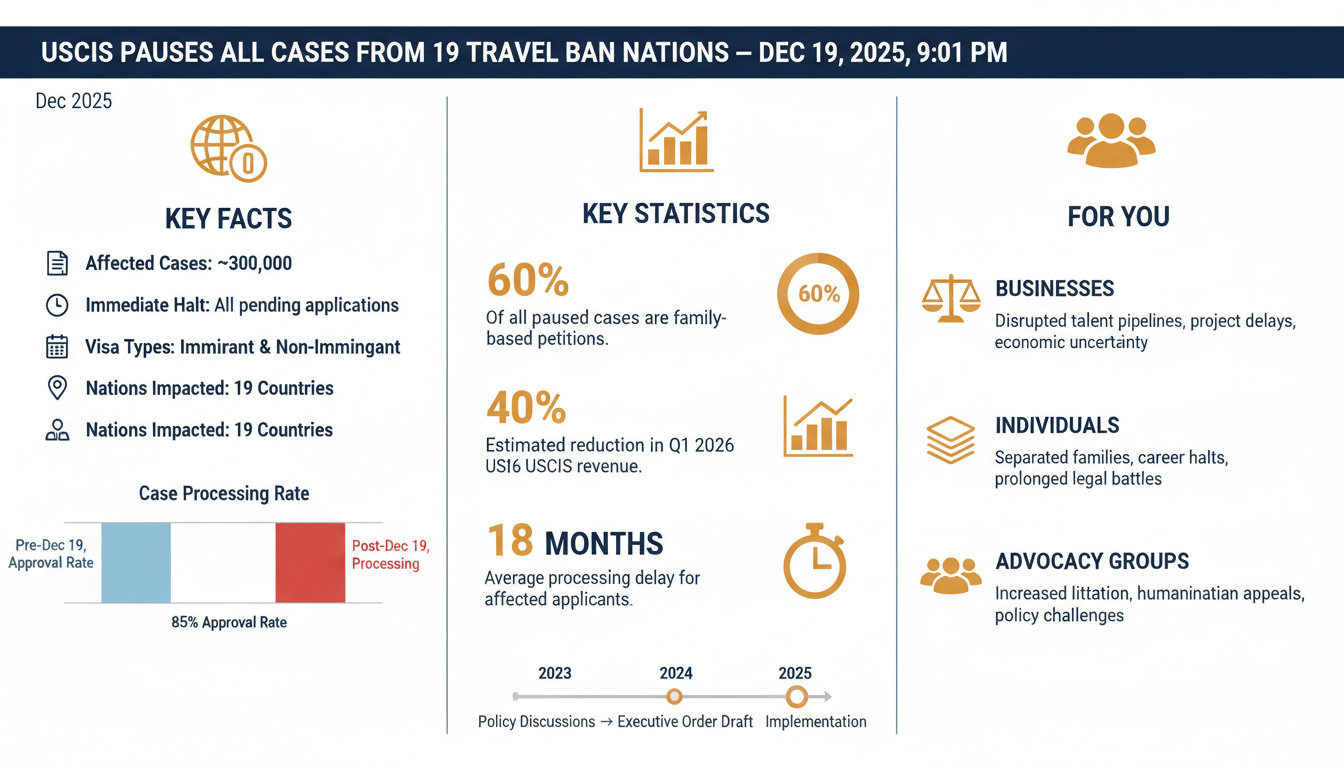
This development, confirmed by multiple legal analyses, builds on USCIS's November 27, 2025, policy update allowing officers to weigh country-specific negative factors during vetting. The pause remains in effect until further vetting protocols are established, leading to reported cancellations of interviews and oaths nationwide.[1][3]
The 19 Affected Countries and Proclamation 10949
The countries subject to this USCIS pause are explicitly listed in Presidential Proclamation 10949, issued June 4, 2025, and expanded recently. They include:
- Afghanistan
- Myanmar (Burma)
- Chad
- Republic of the Congo
- Equatorial Guinea
- Eritrea
- Haiti
- Iran
- Libya
- Somalia
- Sudan
- Yemen
- Burundi
- Cuba
- Laos
- Sierra Leone
- Togo
- Turkmenistan
- Venezuela
[1][3] These nations face restrictions due to "persistent, chronic vetting deficiencies" that pose risks to U.S. security, as outlined in recent White House proclamations narrowing exceptions like family-based immigrant visas.[6]
Key Legal Developments Triggering the Pause
The December 2 Policy Memorandum from the Department of Homeland Security (DHS) mandates USCIS to:
- Suspend all Forms I-589 (Asylum and Withholding of Removal), regardless of filing location.
- Hold pending benefit requests (e.g., green cards via Form I-485, work permits) for nationals from these 19 countries.
- Conduct comprehensive re-reviews of already approved benefits for those who entered the U.S. on or after January 20, 2021.
[1] This follows Department of State guidance on December 3, 2025, for enhanced vetting of H-1B and H-4 visas, effective December 15, 2025, requiring additional scrutiny for applicants from these countries.[1]
Immigration attorneys report real-world impacts: sudden cancellations of naturalization oath ceremonies for Venezuelans, Iranians, and Afghans; stalled adjustment of status interviews; and frozen final decisions on diverse forms.[3] A December 16, 2025, presidential proclamation further restricts entry, effective January 1, 2026, expanding the travel ban to additional nations.[8]
Legal Implications for Visa Applications, Green Cards, and Citizenship
This pause introduces significant uncertainty across immigration categories. Here's a breakdown:
Impact on Nonimmigrant Visas (e.g., H-1B, H-4)
H-1B specialty occupation visas and dependent H-4 visas now face "enhanced vetting," delaying consular processing and extensions. Applicants must provide more evidence against country-specific risks, potentially increasing denial rates.[1] The State Department's December 15 guidance explicitly targets these categories, aligning with broader entry restrictions.[1]
Green Cards and Adjustment of Status (Form I-485)
Pending green card applications for affected nationals are frozen, including employment-based (EB) and family-sponsored categories. Even approved cases post-January 20, 2021, may be re-reviewed, risking revocation if new vetting flags issues.[1][3] This echoes public charge rule changes proposed November 19, 2025, granting officers broader discretion on inadmissibility.[3]
Citizenship and Naturalization (Form N-400)
Naturalization oath ceremonies are paused, with reports of last-minute cancellations. Applicants from travel ban countries cannot finalize citizenship until the hold lifts, potentially derailing travel and status plans.[3]
Asylum, TPS, and Humanitarian Relief
All I-589 asylum applications are suspended for comprehensive review. Work permits for asylum seekers were shortened to 18 months from five years, affecting hundreds of thousands amid security screenings.[2] TPS terminations for Haiti and Burma face court blocks (e.g., Syria TPS preserved by a federal judge), but the pause compounds delays.[3]
These measures stem from executive authority under the Immigration and Nationality Act (INA) Sections 212(f) and 215(a), upheld in cases like Trump v. Hawaii (585 U.S. 667, 2018), affirming presidential power over entry restrictions.[6]
Actionable Guidance: Steps for Affected Individuals
If you or a client are from one of the 19 countries with a pending USCIS case, act promptly to mitigate risks. Imigrar, your Orlando immigration law firm, recommends the following:
Immediate Protective Measures
- Monitor USCIS Account Daily: Check your case status via USCIS online portal or INFOPASS appointment for updates. Rescheduled interviews may appear without notice.[3]
- Preserve Evidence: Gather all prior approvals, entry records (post-Jan. 20, 2021), and proof rebutting country-specific risks (e.g., U.S. ties, employment history).
- Avoid Travel: Do not leave the U.S. if your case is pending; re-entry under enhanced vetting could lead to denial or detention.[1]
Strategic Filing Options
- File Motions to Reopen/Reconsider: If a case was denied post-pause, cite the December 2 memo for equitable tolling under INA § 240.
- Pursue Alternative Relief: Explore parole-in-place or prosecutorial discretion for long-term residents; DACA/TPS holders should renew immediately despite trucking license restrictions.[2]
- Submit Expedite Requests: Argue humanitarian reasons or U.S. citizen family hardship via USCIS Form I-907, backed by affidavits.
Prepare for Enhanced Vetting
| Document Type | Required Enhancements |
|---|---|
| H-1B/H-4 Visa | Biometrics, social media history, country risk affidavits[1] |
| I-485 Adjustment | Re-review of approvals; public charge evidence[1][3] |
| N-400 Naturalization | Paused oaths; additional background checks[3] |
| I-589 Asylum | Full suspension; security screening hold[1] |
Consult an attorney before responding to any Requests for Evidence (RFEs), as responses must counter negative country factors per November 27 guidance.[1]
Long-Term Planning Amid Broader Changes
Anticipate spillover effects: Immigration detention funding surged 400% to $14B in FY2025, signaling enforcement ramps.[2] States like Illinois enacted protections limiting federal cooperation (December 9, 2025), offering local safe havens.[4] Proposed bills like the Reuniting Families Act (S. 3419) could ease backlogs but face uncertainty.[4]
Visa Bulletin for December 2025 shows movement in F2A (spouses/children of PRs) but static dates for others; religious worker visas expire January 29, 2026.[5]
Why This Matters for Florida Families and Businesses
In Orlando, home to large Venezuelan, Haitian, and Cuban communities, this pause disrupts thousands. Businesses reliant on H-1B talent face staffing shortages, while families await green cards amid deportation fears. Deportation defense now hinges on proving low risk despite nationality.[2]
Imigrar has successfully navigated similar holds, securing waivers and expedites. Contact us for a case review—early intervention preserves options.
Stay Informed: Monitoring Ongoing Developments
USCIS promises updated vetting guidance soon; we'll track via official channels. Recent clips (December 18, 2025) highlight court challenges slowing restrictions.[7] AILA and NAFSA confirm the expanded ban's scope.[8][9]
This pause underscores the volatility of U.S. immigration under current policy. Proactive legal counsel is essential to turn delays into approvals.


