

At Imigrar, we understand that waiting for a decision on your immigration application can be one of the most stressful periods in an immigrant's journey. The uncertainty of USCIS processing times directly impacts families, careers, and futures. As we navigate 2026, staying informed about the latest updates from U.S. Citizenship and Immigration Services (USCIS) is more critical than ever.
This comprehensive guide from Imigrar, your trusted immigration law firm in Orlando, Florida, is designed to demystify USCIS processing times for 2026. We'll break down what the latest news means for you, how to track your case, and practical steps you can take to keep your application moving forward. Our mission is to help Keep Families Together, and clarity on these timelines is a vital part of that commitment.
Need Help? Our Orlando immigration team is ready to assist. Navigating complex USCIS processing times requires expertise. Call +1 786-791-3106 for a free consultation, or message us online. Se Habla Español.
The reporting that sparked this guide:
USCIS Processing Times and Updates for 2026 (USCIS)
What This News Means for Immigrants in Orlando and Across Florida
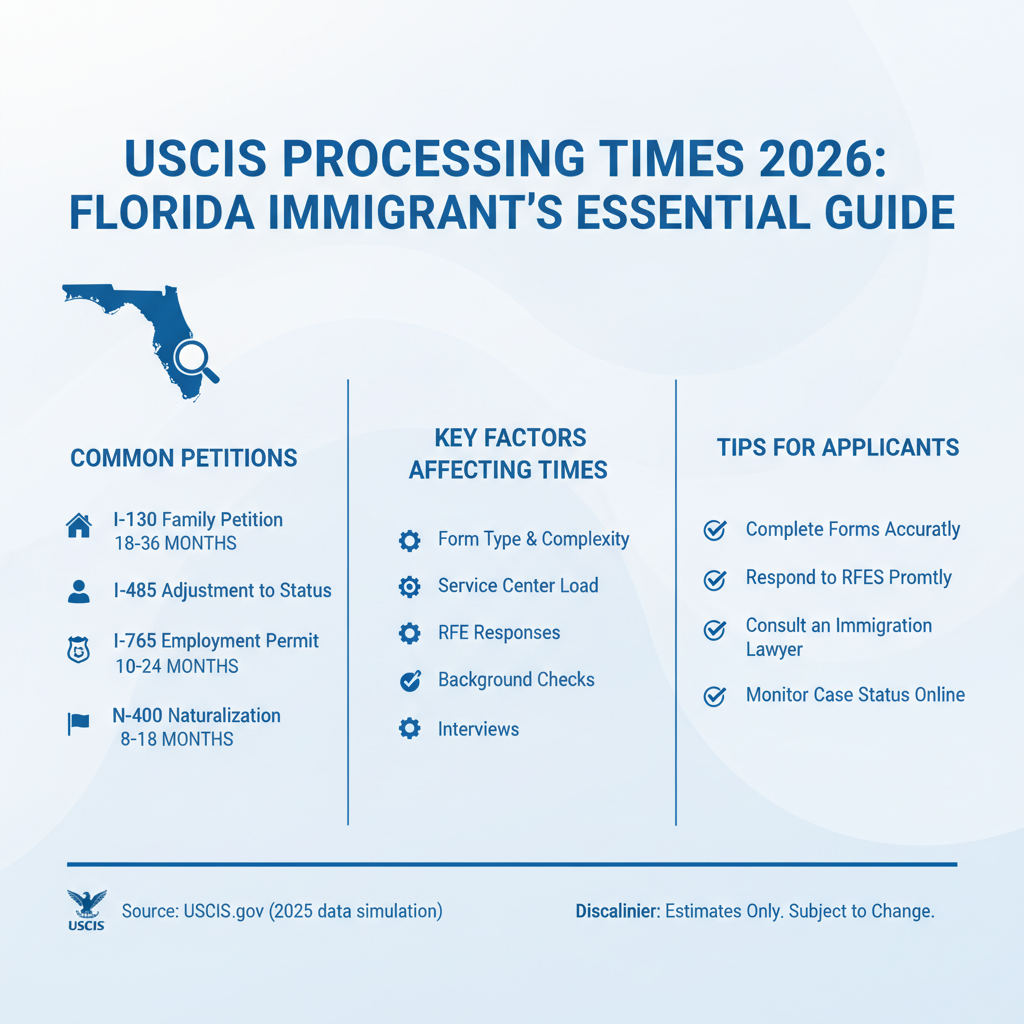
The continuous updates from USCIS regarding processing times are more than just statistics; they are direct indicators of how long individuals and families may have to wait for life-changing decisions. For immigrants in Orlando, across Central Florida, and throughout the nation, these updates dictate planning for everything from employment to family reunification.
Why this news is showing up now
USCIS is constantly working to manage a massive volume of immigration applications across various categories, including family-based petitions, employment-based visas, naturalization applications, and humanitarian relief. The processing times are dynamic and subject to change based on several factors:
- Application Volume: Fluctuations in the number of new filings can significantly impact how quickly existing cases are processed. A surge in a particular form type can create backlogs.
- Staffing Levels and Resources: USCIS's ability to adjudicate cases is directly tied to its budget and workforce. Hiring freezes, budget cuts, or increased staffing can all affect efficiency.
- Policy Changes: New immigration policies, executive orders, or regulatory changes can alter processing priorities, introduce new review steps, or require additional documentation, thereby affecting timelines.
- Technological Advancements: USCIS is continually working to modernize its systems, but the implementation of new technologies can sometimes lead to temporary delays or, conversely, long-term efficiencies.
- National Security and Public Safety Priorities: Cases may undergo additional scrutiny based on evolving national security concerns, leading to longer processing times for certain categories.
As we entered 2026, USCIS likely released new projections and data reflecting these ongoing operational challenges and strategic initiatives. These updates are a proactive measure to manage public expectations and provide transparency regarding their current operational capacity. They serve as a crucial benchmark for applicants and legal professionals alike.
How it can affect Florida residents
Florida is one of the most diverse states in the U.S., with a significant immigrant population. The impact of USCIS processing times on Florida residents is profound:
- Family Reunification: For families hoping to sponsor relatives, longer processing times for forms like Form I-130 (Petition for Alien Relative) mean extended periods of separation. This is particularly poignant for the many international families residing along the I-4 corridor and throughout Orange County.
- Employment and Economic Stability: Delays in employment authorization (Form I-765) or employment-based green card applications (Form I-485, Form I-140) can directly affect an individual's ability to work, sustain their family, and contribute to Florida's economy. This is a major concern for professionals, agricultural workers, and those in the tourism industry that heavily relies on immigrant labor.
- Travel Plans and Uncertainty: For those awaiting travel documents (Form I-131, Advance Parole) or green card approvals, unpredictable processing times can make planning international travel impossible, potentially preventing visits to ailing family members abroad.
- Naturalization Delays: Aspiring U.S. citizens in Orlando and across Florida waiting for their Form N-400 (Application for Naturalization) can experience delays in exercising their full civic rights, including voting.
- Local Field Office Impact: The Orlando USCIS Field Office handles many interviews and local adjudications, particularly for Adjustment of Status applications. Fluctuations in national processing times can create localized backlogs or surges in interview scheduling, directly affecting Central Florida residents.
- Community Stress: Extended waits can lead to increased anxiety, financial strain, and psychological stress for immigrant communities throughout Florida. Understanding these timelines is the first step in managing expectations and making informed decisions.
At Imigrar, we are deeply committed to helping our Florida community navigate these challenges. We monitor these updates closely to provide the most current and relevant advice to our clients.
Feeling overwhelmed by USCIS delays? Don't face it alone. Imigrar's experienced attorneys can help you understand your options and advocate for your case. Call us at +1 786-791-3106 for a free consultation. Se Habla Español.
What USCIS Processing Times Are (and Why They Matter)
Understanding USCIS processing times is fundamental to managing your immigration journey. These aren't just arbitrary numbers; they are crucial estimates that help you gauge how long it might take for USCIS to make a decision on your application or petition.
A plain-English definition
Simply put, USCIS processing times represent the estimated period USCIS takes to adjudicate a particular immigration application or petition from the date they receive it. These times are typically displayed as a range (e.g., "5 to 9 months") or a median, indicating how long it has taken to process 80% or 50% of similar cases recently. They are calculated based on historical data from the past few months and are subject to change. It's Important: These are estimates, not guarantees. Your individual case might take more or less time depending on its complexity, completeness, and the specific service center or field office handling it.
Key terms you need to know
Navigating USCIS processing requires familiarity with specific terminology:
- Receipt Date: This is the date USCIS officially received your application or petition. You'll find this on your Form I-797C, Notice of Action. This date is crucial for tracking your case against posted processing times.
- Priority Date: This is especially important for family-sponsored and employment-based immigrant visas that are subject to annual quotas. For family-sponsored preferences, it's the date USCIS receives the Form I-130. For employment-based petitions, it's the date the Form I-140 (or labor certification application, if applicable) is properly filed. Your Priority Date determines your place in line for a visa number.
- Current Date / Final Action Date: Published monthly in the Visa Bulletin by the U.S. Department of State, the Final Action Date indicates when a visa number is available for a particular preference category and country of chargeability. Your Priority Date must be earlier than the Final Action Date for your category to be eligible for a green card.
- Dates for Filing: Also in the Visa Bulletin, the Dates for Filing chart allows certain applicants to file their Form I-485 (Application to Register Permanent Residence or Adjust Status) earlier than their Final Action Date, provided USCIS accepts these dates.
- Notice of Action (Form I-797): This is the official communication from USCIS. There are several versions (I-797C for receipt notices, I-797 for approvals). Keep all of them!
- Case Status Online: An online tool provided by USCIS (USCIS Case Status Online) where you can check the status of your application using your receipt number.
- Service Center: One of five regional centers (California, Nebraska, Texas, Vermont, Potomac) that process various immigration forms. Your receipt number (e.g., EAC, WAC, LIN, SRC, MSC, IOE) indicates which service center is handling your case.
- Field Office: Local USCIS offices (like the Orlando USCIS Field Office) that handle interviews, naturalization ceremonies, and some local adjudications, particularly for Adjustment of Status cases.
- Adjustment of Status (AOS): The process of applying for a green card while physically present in the United States, typically using Form I-485.
- Consular Processing: The process of applying for an immigrant visa through a U.S. embassy or consulate abroad, for those not eligible for or choosing not to pursue Adjustment of Status.
Understanding these terms empowers you to interpret USCIS updates accurately and effectively track your application's progress. They are the language of your immigration journey, and speaking it fluently can significantly reduce stress and uncertainty.
Current Immigration Law: The Foundation of Processing
USCIS processing times are not arbitrary; they are the operational reflection of complex federal immigration laws and regulations. The framework for almost all immigration benefits is established primarily by the Immigration and Nationality Act (INA), a federal statute that governs who can enter, reside in, and become a citizen of the United States.
Federal requirements
The core of U.S. immigration law is the Immigration and Nationality Act (INA). This act, along with subsequent amendments, dictates the categories of individuals eligible for various immigration benefits and the procedures for obtaining them. Key sections of the INA that heavily influence processing times include:
- INA §201-204: These sections define immigrant visa categories, including family-sponsored preferences (e.g., U.S. citizens sponsoring spouses, children, parents, siblings) and employment-based preferences (e.g., individuals with extraordinary ability, advanced degrees, skilled workers). The annual numerical limits imposed by these sections directly lead to backlogs and the need for Priority Dates and the Visa Bulletin.
- INA §245: This section outlines the eligibility requirements and process for Adjustment of Status within the U.S. Applicants must meet specific criteria, including lawful entry, maintaining status (in most cases), and having an immigrant visa immediately available. The adjudication of Form I-485, the application for adjustment, is a significant part of USCIS's workload.
- INA §212 and §237: These sections detail grounds of inadmissibility (reasons a person may be denied entry or a green card) and deportability (reasons a permanent resident may be removed). Cases involving waivers for these grounds often require additional scrutiny, extending processing times.
- 8 Code of Federal Regulations (CFR): Beyond the INA, detailed regulations found in the CFR provide the specific rules and procedures that USCIS and other agencies must follow when adjudicating applications. These regulations outline documentation requirements, interview protocols, and eligibility criteria for various forms.
Each application, such as Form I-130 (Petition for Alien Relative), Form I-140 (Immigrant Petition for Alien Worker), Form I-485 (Application to Register Permanent Residence or Adjust Status), Form I-765 (Application for Employment Authorization), or Form I-131 (Application for Travel Document), must strictly adhere to these federal laws and regulations. Any deviation or missing information can lead to Requests for Evidence (RFEs), Notices of Intent to Deny (NOIDs), or outright denials, all of which contribute to processing delays.
For official information on these laws and forms, always refer to the USCIS official website and the USCIS Forms page.
Florida-specific considerations
While immigration law is federal, its implementation and impact have local nuances. Florida does not have its own immigration laws separate from federal statutes. However, certain state-level policies and demographic realities can indirectly affect the experience of immigrants navigating federal processing:
- Local Law Enforcement Cooperation: Florida's stance on cooperation between local law enforcement and federal immigration authorities can influence the environment for immigrants, particularly those with enforcement concerns. This doesn't directly affect USCIS processing times but can add a layer of apprehension for applicants.
- High Volume of Applicants: As a major destination for immigrants, Florida, and particularly metropolitan areas like Orlando, Kissimmee, and Miami, sees a disproportionately high number of immigration applications. This can put additional strain on the local Orlando USCIS Field Office and associated federal resources, potentially contributing to localized processing variations.
- Diverse Caseload: The Orlando USCIS Field Office handles a wide array of cases reflecting Florida's diverse population, from family-based petitions for Latin American and Caribbean immigrants to employment-based applications for professionals in the tech and tourism sectors. This diverse caseload requires USCIS adjudicators to be proficient across many complex immigration categories.
- Accessibility to Legal Services: While not a legal requirement, access to experienced immigration attorneys like Imigrar in Orlando is a critical practical consideration. Legal representation can help ensure applications are complete, accurate, and adhere to all federal requirements, thereby minimizing delays.
Understanding the interplay between federal law and local impact is crucial. While the laws are national, your experience navigating them in Florida is unique, and having local legal expertise can make a significant difference.
How to Track Your USCIS Case and Understand Processing Times: A Complete Step-by-Step Guide
One of the most empowering actions you can take as an immigration applicant is to actively monitor your case and understand the publicly available processing time information. This guide will walk you through the essential steps.
1) Locate Your Receipt Number (EAC, WAC, LIN, SRC, MSC, IOE)
Your journey begins with your receipt number. This unique 13-character identifier (e.g., MSC26XXXXXXX, IOE09XXXXXXX) is assigned to your application or petition by USCIS upon receipt. You will find it on your Form I-797C, Notice of Action, which is typically mailed to you a few weeks after USCIS receives your application. The first three letters indicate the service center:
- EAC: Eastern Adjudication Center (now part of Vermont Service Center)
- WAC: Western Adjudication Center (now part of California Service Center)
- LIN: Lincoln Service Center (now part of Nebraska Service Center)
- SRC: Southern Regional Center (now part of Texas Service Center)
- MSC: Missouri Service Center (National Benefits Center)
- IOE: ELIS (Electronic Immigration System), often for online filings
Required Documents:
- Form I-797C Notice of Action (for each application you filed)
Important: Keep all your Form I-797C notices in a safe, organized place. They contain vital information for tracking your case.
2) Check Your Case Status Online
Once you have your receipt number, the easiest way to get an immediate update is through the USCIS Case Status Online tool.
- Visit the USCIS Case Status Online website.
- Enter your 13-character receipt number in the designated field.
- Click "Check Status."
The system will display the most recent action taken on your case (e.g., "Case Was Received," "Request for Evidence Was Sent," "Card Was Produced"). While this provides real-time updates on status changes, it doesn't give you an estimated completion time.
Required Documents:
- Your 13-character receipt number
3) Understand USCIS Processing Times Tool
To get an estimate of how long your specific application might take, you need to use the official USCIS Processing Times page.
- Go to the USCIS Processing Times website.
- Select the "Form" you filed (e.g., Form I-485, Form I-130).
- Select the "Form Category" (e.g., "Family-based adjustment applicants" or "U.S. Citizen filing for spouse, parent, or child under 21").
- Select the "Field Office or Service Center" that is processing your case. This is indicated by the first three letters of your receipt number or, for interviews, the local office like the Orlando USCIS Field Office.
- Click "Get processing time."
The page will then display a range of times (e.g., "10.5 Months to 13 Months") or a median time. It also shows the "Case Inquiry Date," which is the date by which you can submit an inquiry if your case is outside the normal processing time.
Required Documents:
- The specific form number you filed
- The service center or field office handling your case (from your Form I-797C)
4) Interpret the Data: What the Times Mean for You
Once you retrieve the processing times, compare your receipt date to the displayed range. If your receipt date is earlier than the start of the range, your case is likely still within normal processing times. If your receipt date is earlier than the "Case Inquiry Date," then your case is outside the normal processing times, and you may be able to take further action.
Reminder: USCIS processing times are historical averages. Your individual case might be faster or slower due to factors like RFEs, background checks, or interview scheduling. For those in Orlando, the local field office's current workload can significantly influence interview scheduling for Form I-485.
5) When to Submit an "Outside Normal Processing Times" Inquiry
If your case has exceeded the posted "Case Inquiry Date" for your specific form and office, you are eligible to submit an "e-Request" online.
- Visit the USCIS e-Request page.
- Select "Case outside normal processing time."
- Follow the prompts, providing your receipt number and other requested information.
USCIS typically responds to these inquiries within 15-30 days. This is an important step, but it doesn't always guarantee immediate action or a faster decision, though it can sometimes prompt a review of your case. An attorney can help you determine the best timing for such an inquiry.
Required Documents:
- Your 13-character receipt number
- Details of your application (form type, filing date)
6) Monitor Visa Bulletin for Family & Employment-Based Cases
For individuals applying for a green card through certain family-sponsored or employment-based categories, simply checking processing times isn't enough. You must also monitor the Visa Bulletin, published monthly by the U.S. Department of State.


