What This News Means for Immigrants in Orlando and Across Florida
The United States Citizenship and Immigration Services (USCIS) is the federal agency responsible for administering the nation’s lawful immigration system. For millions of hopeful immigrants and their families, the pace at which USCIS processes applications and petitions is a critical factor, often determining life-changing decisions about work, family reunification, and residency. As we navigate the midpoint of 2026, USCIS has continued its ongoing efforts to refine its operational efficiency, leading to new processing time data and procedural updates. These updates are not just numbers; they represent the real-life timelines impacting individuals and families striving for a future in the U.S. For those residing in Orlando, Central Florida, and indeed throughout the Sunshine State, staying informed about these changes is paramount. Imigrar, your dedicated immigration law firm in Orlando, understands the anxiety and uncertainty that come with waiting. Our goal with this comprehensive guide is to break down the latest USCIS processing time updates for 2026, explain their implications, and provide actionable steps to help you navigate your immigration journey with confidence.Why this news is showing up now
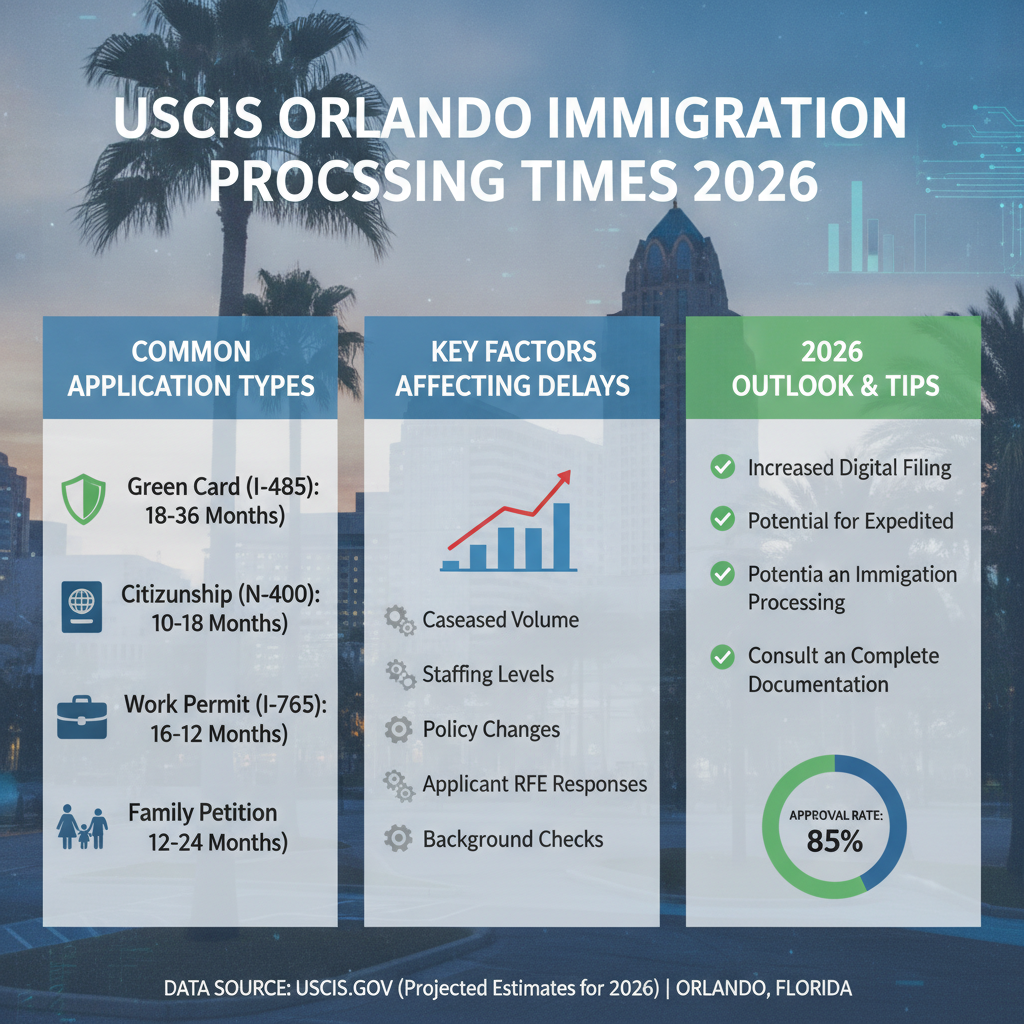
USCIS processing times are dynamic, constantly fluctuating based on a multitude of factors, including caseload volume, staffing levels, budget allocations, and policy shifts. Throughout 2025 and into 2026, USCIS has been actively working to address backlogs exacerbated by the global pandemic and subsequent operational adjustments. The agency frequently releases updated processing time data, often on a monthly or quarterly basis, to reflect the current reality of case adjudication. The "news" of processing time updates is therefore a continuous stream of information, reflecting USCIS’s commitment to transparency (though often imperfect) and its ongoing efforts to manage its workload. Specifically, in 2026, we are seeing the cumulative effect of several initiatives aimed at improving efficiency, along with the continued challenges posed by high application volumes in certain categories. USCIS has been investing in digital transformation, hiring additional personnel, and streamlining various internal processes. However, certain complex case types or those requiring extensive background checks inevitably take longer. This means that while some application types may see improvements, others might still experience significant wait times, making it crucial to consult the most current data.How it can affect Florida residents
Florida is a melting pot of cultures and a primary destination for immigrants from across the globe, particularly from Latin America and the Caribbean. This high volume of immigration, coupled with specific local demographics, means that USCIS processing times have a direct and significant impact on Florida residents. **Specific impacts for Florida residents include:** * **Orlando USCIS Field Office and Service Centers:** While many applications are processed at one of the national service centers (e.g., California, Nebraska, Texas, Vermont), interviews for green cards (Form I-485, Adjustment of Status) and naturalization (Form N-400) are typically conducted at local field offices. The Orlando USCIS Field Office, serving Orange County and much of Central Florida, processes a high volume of these interviews. Local processing times for interviews can fluctuate based on the specific office's workload and staffing. * **Family-Based Petitions:** Florida has a large population of families seeking reunification. Delays in processing Form I-130 (Petition for Alien Relative) and subsequent applications for green cards can mean years of separation for loved ones. The ripple effect of these delays impacts the economic stability and emotional well-being of countless families along the I-4 corridor and beyond. * **Employment Authorization Documents (EADs):** Many immigrants, particularly asylum seekers, refugees, and those with pending adjustment of status applications, rely on Form I-765 for work authorization. Delays in EAD processing can lead to job loss, financial hardship, and an inability to contribute fully to Florida's economy. * **Naturalization Applications:** For many long-term residents in Florida, becoming a U.S. citizen is the ultimate goal. Processing times for Form N-400 (Application for Naturalization) directly affect when individuals can exercise their right to vote and fully participate in civic life. * **Refugee and Asylum Seekers:** Florida, with its significant refugee resettlement programs and a high number of asylum seekers, is particularly sensitive to processing times for asylum applications (Form I-589) and related benefits. * **Economic Impact:** Delays can impact Florida's labor force, particularly in sectors that rely on immigrant workers, from agriculture to hospitality, both vital to the state's economy. Understanding these localized impacts is crucial. Imigrar recognizes that your case is not just a number; it’s your future. We are dedicated to helping our Orlando clients navigate these complexities and keep their families together.Need Help? Our Orlando immigration team is ready to assist. Call +1 786-791-3106 for a free consultation, or message us online. Se Habla Español.
What USCIS Processing Times Is (and Why It Matters)
USCIS processing times refer to the estimated duration it takes the agency to process a specific form or application from the date it receives it until a decision is made. These times are published online by USCIS and are meant to give applicants an idea of how long they can expect to wait. However, it’s crucial to understand that these are *estimates* and not guarantees.A plain-English definition
Think of USCIS processing times as the queue at a very busy government office. When you submit your application, you get in line. The processing time tells you how long people who submitted their applications around the same time as you are currently waiting to get to the front of that line and have their case decided. It's an average, not an exact countdown for your specific case. Several factors can make your case move faster or slower than the average, such as the completeness of your application, whether you receive a Request for Evidence (RFE), or the specific officer assigned to your case.Key terms you need to know
Navigating the world of immigration requires understanding specific terminology. Here are some key terms related to USCIS processing times and application statuses: * **Processing Time:** The estimated period USCIS takes to process a particular form. It's usually displayed as a range (e.g., 8 to 14 months) or as "time to complete 80% of cases." * **Receipt Date:** The date USCIS officially received your application or petition. This is typically the date printed on your **Form I-797C, Notice of Action** (Receipt Notice). This date is crucial for tracking your case against published processing times. * **Priority Date:** For certain visa categories, especially family-sponsored and employment-based immigration, this is the date your petition (e.g., Form I-130 or Form I-140) was properly filed with USCIS. It establishes your place in the waiting line for an immigrant visa. You can only apply for a green card (Adjustment of Status) or immigrant visa (Consular Processing) once your **Priority Date** becomes **Current** according to the monthly **Visa Bulletin**. * **Current Date:** Refers to the **Priority Date** that allows an applicant to move forward with their green card application. This is published monthly in the **Visa Bulletin** by the U.S. Department of State. * **Visa Bulletin:** A monthly publication by the U.S. Department of State that summarizes the availability of immigrant visas for the upcoming month. It indicates which **Priority Dates** are **Current** for various visa categories and countries of chargeability. * **Service Request:** If your case is taking longer than the posted processing times, you may be eligible to submit an "outside normal processing time" service request with USCIS. * **Request for Evidence (RFE):** A letter from USCIS asking for additional documents or information to support your application. Responding promptly and thoroughly is critical. * **Notice of Intent to Deny (NOID):** A notice from USCIS indicating that they intend to deny your application unless you provide additional information or clarification within a specified timeframe. * **Employment Authorization Document (EAD):** Also known as a work permit, this is issued after approval of Form I-765, allowing non-citizens to work legally in the U.S. * **Advance Parole (AP):** Issued after approval of Form I-131, this document allows certain non-citizens with pending immigration applications (like Adjustment of Status) to travel outside the U.S. and return without abandoning their application. * **Adjustment of Status (AOS):** The process of applying for lawful permanent residence (a green card) while remaining in the U.S. This typically involves filing Form I-485. * **Consular Processing:** The process of applying for an immigrant visa at a U.S. embassy or consulate abroad. This is for individuals who are outside the U.S. and cannot adjust status. Understanding these terms is your first step towards demystifying the immigration process.Current Immigration Law: The Foundation
The entire U.S. immigration system is built upon a complex framework of federal laws, regulations, and judicial precedents. Understanding this foundation is key to comprehending why applications are processed the way they are and what legal requirements must be met.Federal requirements
The primary legal authority governing immigration in the United States is the **Immigration and Nationality Act (INA)**, codified in Title 8 of the U.S. Code. The INA covers virtually all aspects of immigration law, including: * **Admission and exclusion of aliens:** Who can enter the U.S. and under what conditions. * **Categories of visas:** Defines immigrant and non-immigrant visa types (e.g., family-based, employment-based, refugee/asylum). * **Naturalization:** The process of becoming a U.S. citizen. * **Enforcement:** Rules for deportation (removal) and other immigration violations. USCIS operates under the Department of Homeland Security (DHS) and is responsible for administering the benefits provisions of the INA. Other key federal agencies involved include the Department of State (which issues visas abroad and the **Visa Bulletin**) and the Department of Justice (which oversees immigration courts through the Executive Office for Immigration Review, or EOIR). Specific sections of the INA are relevant to common applications: * **INA §201 & §203:** Define immigrant visa categories and numerical limitations for family-sponsored and employment-based immigration, directly impacting **Priority Dates** and the **Visa Bulletin**. * **INA §245:** Governs **Adjustment of Status** (filing Form I-485) for those already in the U.S. * **INA §316:** Outlines general requirements for **Naturalization** (filing Form N-400). All immigration applications must strictly adhere to the requirements set forth in the INA and its corresponding regulations (found in Title 8 of the Code of Federal Regulations, or 8 CFR). Failure to meet these federal requirements is a common reason for RFEs, NOIDs, or outright denials, all of which significantly prolong processing times.Florida-specific considerations
While immigration law is predominantly federal, Florida's unique context can present specific considerations for applicants: * **Local Enforcement:** While local law enforcement agencies in Florida generally do not enforce federal immigration laws, some jurisdictions may cooperate with federal immigration authorities. This interplay can sometimes create additional complexities for immigrants, particularly those without lawful status, affecting their ability to apply for certain benefits or attend interviews without fear. * **Access to Services:** Florida has a robust network of community organizations and legal aid services, but also a high demand. Access to quality legal representation is crucial, especially given the state's diverse immigrant population and the complexities of navigating USCIS processes. * **State IDs and Licenses:** While not directly affecting USCIS processing, Florida's requirements for state identification cards and driver's licenses for non-citizens often depend on their immigration status and the validity of their immigration documents, such as EADs or green cards. Delays in obtaining these underlying immigration documents can therefore impact daily life in Florida. **Important:** Regardless of where you live in Florida, the underlying eligibility criteria and documentary requirements for USCIS forms are federal. There are no "Florida-specific" immigration forms or processing rules from USCIS itself. However, the Orlando USCIS Field Office, like other local offices, has its own unique interview scheduling patterns and local procedures that can subtly influence the applicant experience. **Key USCIS Forms and Their Importance for Processing Times:** * Form I-130, Petition for Alien Relative: The initial step for family-based green cards. Its processing time determines when your **Priority Date** is established. * Form I-485, Application to Register Permanent Residence or Adjust Status: The application for a green card while in the U.S. Its processing time is often the longest and most scrutinized. * Form I-765, Application for Employment Authorization: Essential for obtaining a work permit. Delays here can cause significant financial hardship. * Form I-131, Application for Travel Document: Used for **Advance Parole** to travel abroad while Form I-485 is pending. * Form N-400, Application for Naturalization: For those seeking U.S. citizenship. * Form I-140, Immigrant Petition for Alien Worker: The initial step for most employment-based green cards. * Form I-589, Application for Asylum and for Withholding of Removal: Critical for those seeking protection in the U.S. For the most up-to-date information on forms and their requirements, always refer to the USCIS official website and specifically the USCIS Forms page.Need Help? Our Orlando immigration team is ready to assist. Call +1 786-791-3106 for a free consultation, or message us online. Se Habla Español.
How to Navigate Your Immigration Application: A Complete Step-by-Step Guide
Understanding USCIS processing times is only one part of the equation. The other, equally important part, is knowing how to effectively prepare and submit your application to minimize delays and maximize your chances of approval. This guide focuses on a general path, but remember that each case is unique.1) Understand Your Eligibility and Select the Correct Visa Category
Before you even fill out a form, you must confirm your eligibility for the immigration benefit you seek. This involves a thorough review of your personal circumstances, family relationships, employment history, and immigration history. Incorrectly identifying your eligibility or choosing the wrong visa category is a common cause of significant delays and even denials. * **Action:** Research the specific requirements for the visa or green card you are applying for (e.g., family-based, employment-based, asylum, etc.). Consult the USCIS website and, ideally, an experienced immigration attorney. * **Required Documents (Examples):** * Birth Certificates (for yourself and family members) * Marriage Certificates (if applicable) * Divorce Decrees (if applicable) * Passports and travel documents * Previous visa stamps and entry/exit records (I-94) * Educational diplomas and transcripts (for employment-based visas) * Proof of relationship (e.g., photos, joint bank accounts, for family petitions)2) Gather All Required Documents and Complete Your Petition/Application
This is the most labor-intensive step. USCIS requires specific evidence to support every claim made in your application. An incomplete application or missing documents will almost certainly lead to a **Request for Evidence (RFE)**, significantly extending your processing time. Organize your documents meticulously. Ensure all foreign language documents are accompanied by certified English translations. * **Action:** Fill out all required forms completely and accurately. Do not leave any fields blank; if a question doesn't apply, write "N/A." Attach all supporting evidence clearly labeled. Make multiple copies of everything before mailing. * **Required Documents (Examples for a Family-Based Green Card Application - Form I-130 & Form I-485 package):** * **Form I-130, Petition for Alien Relative** (filed by the U.S. citizen/LPR petitioner) * **Form I-485, Application to Register Permanent Residence or Adjust Status** (filed by the beneficiary) * **Form I-765, Application for Employment Authorization** (optional, filed concurrently with I-485) * **Form I-131, Application for Travel Document** (optional, filed concurrently with I-485 for **Advance Parole**) * **Form I-864, Affidavit of Support** (from the petitioner/sponsor) * **Form I-693, Report of Medical Examination and Vaccination Record** (completed by a USCIS-approved civil surgeon) * Passport-style photographs (specific quantity and size) * Copy of birth certificates (petitioner and beneficiary) * Copy of marriage certificate (if applicable) * Copy of petitioner's proof of U.S. citizenship or LPR status (e.g., U.S. passport, birth certificate, green card) * Copy of beneficiary's passport, visa, and **Form I-94** * Financial documents for **Form I-864** (tax transcripts, employment letters, pay stubs) * Proof of bona fide marriage (for spousal petitions: joint bank accounts, leases, utility bills, photos, affidavits from friends/family) * Certified English translations for any non-English documents.3) File Your Application and Track Your Receipt and Priority Dates
Once your application package is complete, mail it to the correct USCIS lockbox facility. You will receive a **Receipt Notice (Form I-797C)**, usually within a few weeks, confirming that USCIS has received your application and providing a **Receipt Number**. This number is vital for tracking your case online. For categories with numerical limitations, your **Priority Date** will be established as the date USCIS received your petition. * **Action:** Mail your application using a trackable method (e.g., USPS Certified Mail with Return Receipt, FedEx, UPS). Keep a complete copy of everything you sent. Use the **Receipt Number** to create an online account and track your case status on the USCIS Case Status Online tool. * **Required Documents:** * **Form I-797C, Notice of Action** (Receipt Notice)4) Attend Your Biometrics Appointment (If Applicable)
Most applicants for green cards, work permits, and naturalization will receive an appointment notice for a biometrics collection. This involves taking your fingerprints, photograph, and signature at an Application Support Center (ASC). This data is used for background checks. * **Action:** Attend your biometrics appointment as scheduled. Bring your appointment notice, a valid government-issued photo ID, and any other requested documents. Do not miss this appointment; rescheduling can cause significant delays. * **Required Documents:** * Biometrics Appointment Notice * Valid Photo Identification (e.g., passport, driver's license)5) Respond to RFEs and Prepare for Interview (If Applicable)
If USCIS determines your application is missing information or requires clarification, they will send an RFE. It is critical to respond within the given timeframe (usually **60 to 90 days**) and provide all requested evidence. For many green card and naturalization applications, an interview at a local USCIS field office (like the Orlando USCIS Field Office) will be scheduled. * **Action:** If you receive an RFE, gather the requested documents immediately and submit them well before the deadline. If an interview is scheduled, prepare thoroughly with your attorney. Review your application, supporting documents, and be ready to answer questions truthfully and consistently. * **Required Documents:** * **Request for Evidence (RFE)** notice * Requested evidence (originals and copies, as specified) * Interview Appointment Notice * All original documents submitted with your application (birth certificates, marriage certificates, passports, etc.) * Any additional evidence of continuing eligibility (e.g., recent utility bills, bank statements, photos for spousal cases)6) Track Processing Times and Follow Up on Your Case
Regularly check the USCIS Processing Times page using your form type and the service center/field office processing your case. If your case goes beyond the "normal processing time" range, you may be eligible to submit an "outside normal processing time" service request online or by calling the USCIS Contact Center. * **Action:** Monitor your case status online and check processing times. If eligible, submit a service request. Keep a record of all communication with USCIS. * **Required Documents:** * Your **Receipt Number** * Dates of all previous communications with USCIS7) Receive Decision and Plan Next Steps
Once USCIS has completed its review, you will receive a decision. If approved, you will typically receive an approval notice, followed by your green card or naturalization certificate. If denied, the notice will explain the reasons for denial and your options, which may include filing a motion to reconsider/reopen or an appeal. * **Action:** If approved, ensure your documents are correct. If denied, consult with an immigration attorney immediately to understand your options and next steps. * **Required Documents:** * Approval Notice (e.g., Form I-797, Approval Notice) * Green Card or Naturalization Certificate * Denial NoticeNeed Help? Our Orlando immigration team is ready to assist. Call +1 786-791-3106 for a free consultation, or message us online. Se Habla Español.