


For immigrants and their families across the United States, few aspects of the immigration journey evoke more anxiety and anticipation than USCIS processing times. The wait for a decision on a visa petition, an adjustment of status application, or a naturalization request can feel endless, impacting lives, careers, and the ability to keep families together. As we move through 2026, the U.S. Citizenship and Immigration Services (USCIS) continues to update its processing metrics, reflecting changes in application volume, staffing, and policy. Understanding these updates is crucial for anyone with an active or pending immigration case.
At Imigrar, an immigration law firm rooted in Orlando, Florida, our mission is to provide clarity, support, and expert legal representation to help you navigate these complex processes. We understand the unique challenges faced by immigrants in Central Florida and nationwide, and we are dedicated to empowering you with the knowledge needed to make informed decisions.
Need Help? Our Orlando immigration team is ready to assist. Call +1 786-791-3106 for a free consultation, or message us online. Se Habla Español.
The reporting that sparked this guide:
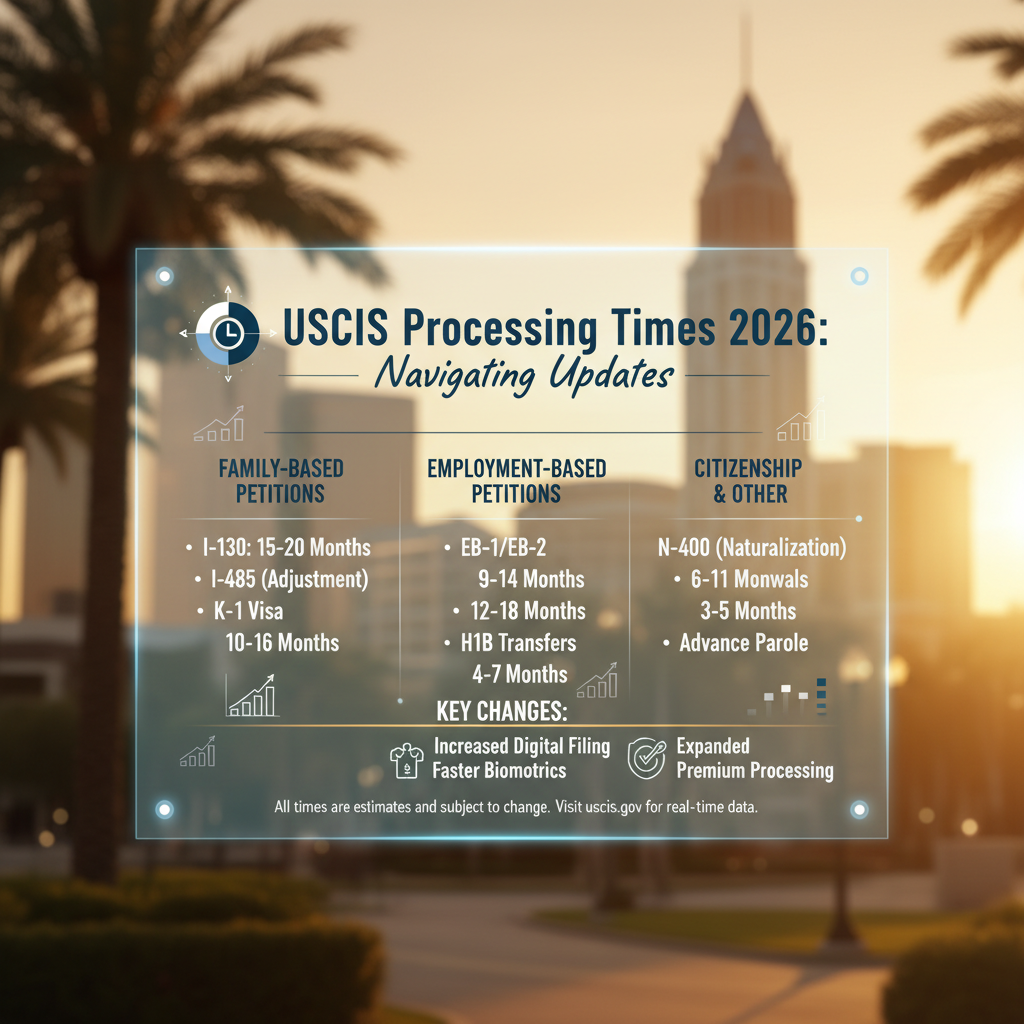
USCIS Processing Times and Updates for 2026 (USCIS)
What This News Means for Immigrants in Orlando and Across Florida
The continuous updates from USCIS regarding processing times are not just numbers; they are a direct reflection of the waiting period that millions of individuals and families face. For those living in Orlando, across Florida, and indeed nationwide, these updates dictate the pace of their lives and future plans.
Why this news is showing up now
USCIS processing times are dynamic, constantly fluctuating based on several factors. Updates, especially significant ones, typically emerge due to:
- Budgetary Allocations: USCIS is primarily funded by application fees. Changes in fee structures or congressional appropriations can impact staffing levels and resource availability, directly affecting how quickly cases are processed.
- Application Volume: Surges or dips in specific application types (e.g., family-based petitions, employment-based visas, naturalization applications) can overwhelm or underutilize resources, leading to longer or shorter wait times.
- Policy Changes: New immigration policies, executive orders, or changes in how applications are adjudicated can introduce new steps, require additional review, or shift priorities, all of which influence processing speed.
- Technological Advancements: USCIS continuously works to modernize its systems. While intended to improve efficiency, initial implementation can sometimes cause temporary delays or require adjustments.
- Staffing Levels: The number of immigration officers and support staff available to review and adjudicate cases is a primary determinant of processing speed. Hiring initiatives or attrition can significantly impact these numbers.
As we navigate 2026, a combination of these factors is contributing to the current landscape of processing times, making it essential for applicants to stay informed.
How it can affect Florida residents
While USCIS processing times are federal, their impact is deeply felt at the local level. For residents in Orlando and other parts of Florida, these updates can have specific implications:
- Orlando USCIS Field Office: The Orlando USCIS Field Office handles interviews for Adjustment of Status (Form I-485), naturalization (Form N-400), and other local services. Fluctuations in national processing times can lead to longer waits for interviews at this specific office, impacting Central Florida residents directly.
- Economic Impact: Delays in work authorization (Form I-765) can severely impact individuals and families along the I-4 corridor, affecting their ability to work, support themselves, and contribute to the local economy.
- Family Separation: Longer processing times for family-based petitions (Form I-130) mean longer periods of separation for families, a profound concern for Imigrar, whose tagline is "Keep Families Together."
- Community Planning: For those awaiting green cards or citizenship, delays affect long-term planning for housing, education, and career development within communities like Orange County.
- Legal Strategy: Understanding current processing trends allows immigration attorneys in Orlando to better advise clients on timelines, potential challenges, and appropriate legal strategies.
Staying abreast of these updates is not just about managing expectations; it's about proactively planning and, when necessary, advocating for your case.
What USCIS Processing Times Are (and Why They Matter)
Understanding USCIS processing times is fundamental to managing your immigration journey. These times represent the period USCIS estimates it will take to process a particular form or application from the date it is received until a decision is made.
A plain-English definition
Think of USCIS processing times as the estimated wait time for your immigration application. When you submit a form to USCIS, it goes into a queue. USCIS publishes estimates of how long it takes to get through that queue for different types of applications at different service centers or field offices. It's not a guarantee, but it's the best available indicator of how long you might wait for a decision on your case.
These times are usually presented as a range (e.g., "6 to 12 months") or as a date that USCIS is currently processing applications received before. They are designed to give applicants a general idea of when they might expect to hear back.
Key terms you need to know
Navigating USCIS processing times requires familiarity with specific terminology:
- Receipt Date: This is the date USCIS officially received your application. It’s crucial because processing times are measured from this date. You'll find it on your Form I-797C, Notice of Action.
- Notice of Action (Form I-797): This is an official communication from USCIS. The initial one (Form I-797C) confirms receipt of your application. Others might notify you of biometrics appointments, requests for evidence, or interview schedules.
- Service Center: One of several regional USCIS offices (e.g., Vermont Service Center, Nebraska Service Center, Texas Service Center, California Service Center, Potomac Service Center) that process certain types of applications. The processing time for the same form can vary significantly between service centers.
- Field Office: Local USCIS offices (like the Orlando USCIS Field Office) handle interviews, infopass appointments, and some specific local applications, primarily Adjustment of Status and naturalization cases.
- Priority Date: For certain preference-based immigrant visas (e.g., family-based and employment-based categories), the Priority Date is the date your petition (Form I-130 or Form I-140) was properly filed. This date determines your place in the visa queue. You cannot apply for a green card until your Priority Date becomes "current" according to the Visa Bulletin.
- Request for Evidence (RFE): A letter from USCIS asking for additional documents or information to support your application. Responding promptly and thoroughly is critical.
- Notice of Intent to Deny (NOID): A notice from USCIS indicating their intention to deny your application unless you provide specific information or explanation within a given timeframe. This is a serious notice.
- Adjudication: The process by which an immigration officer reviews your application and makes a decision (approval, denial, RFE, NOID).
- Case Status Online: The USCIS online tool that allows you to check the status of your application using your receipt number.
Understanding these terms will help you interpret USCIS communications and monitor your case more effectively.
Need Help? Our Orlando immigration team is ready to assist. Call +1 786-791-3106 for a free consultation, or message us online. Se Habla Español.
Current Immigration Law: The Foundation of Processing
USCIS processing times, while administrative, are fundamentally governed by complex layers of immigration law. The framework for who can apply, what forms are needed, and how applications are processed stems from federal statutes and regulations.
Federal requirements
The primary legal authority for U.S. immigration law is the Immigration and Nationality Act (INA). The INA, along with its accompanying regulations in the Code of Federal Regulations (CFR), dictates:
- Eligibility Criteria: Who qualifies for specific visas, green cards, or naturalization. Each form, such as Form I-130, Petition for Alien Relative, or Form I-485, Application to Register Permanent Residence or Adjust Status, has strict eligibility requirements outlined in the INA.
- Application Procedures: The specific steps and documentation required for filing. For instance, Form I-765, Application for Employment Authorization, and Form I-131, Application for Travel Document, have distinct filing instructions.
- Adjudication Standards: The legal standards immigration officers must apply when reviewing cases. This includes grounds of inadmissibility, waivers, and the burden of proof on the applicant.
- Numerical Limitations: For certain visa categories (especially family preference and employment-based), the INA imposes annual numerical limits, creating backlogs and the Visa Bulletin system. This directly impacts how long it takes for a Priority Date to become current, even if the petition itself is approved quickly.
- Administrative Processing: The rules governing how USCIS manages its workload, including the authority to request additional evidence, conduct interviews, and issue decisions.
Staying compliant with these federal requirements is paramount. Any deviation can lead to delays, RFEs, or even denials. Applicants must always refer to the USCIS official website for the most current forms and instructions.
Florida-specific considerations
While USCIS processing is a federal function, certain state-level factors can indirectly influence an immigrant's journey, particularly in a diverse state like Florida:
- State ID and Driver's License: Florida's Department of Highway Safety and Motor Vehicles (DHSMV) has specific requirements for immigrants to obtain state identification or a driver's license. Delays in obtaining Employment Authorization Documents (EADs) or green cards can impact an individual's ability to drive or prove identity within the state.
- Public Benefits: Eligibility for certain state or local public benefits in Florida is often tied to immigration status. Prolonged processing times can delay access to these benefits for eligible individuals.
- Notary Public Services: While not a legal requirement for most USCIS forms, notarization for supporting documents is sometimes requested or beneficial. Florida notaries must follow state regulations.
- Local Law Enforcement: While not directly related to USCIS processing, interactions with local law enforcement (e.g., in Orange County) can have implications for an immigrant's case if it leads to criminal charges, potentially affecting eligibility for benefits or creating grounds of inadmissibility.
Important: It's crucial to understand that the processing of your USCIS application itself is governed by federal law, not state law. However, your life as an immigrant in Florida is influenced by both federal immigration status and state-level rules and regulations.
How to Navigate USCIS Processing Times: A Complete Step-by-Step Guide
Managing the wait for your immigration application requires a strategic approach. This guide outlines the essential steps to help you navigate USCIS processing times effectively.
1) Understanding Your Application Type and Relevant Forms
Before you even begin, identify the specific immigration benefit you seek (e.g., green card through family, work permit, naturalization) and the corresponding USCIS forms. Each form has unique requirements and processing pathways.
- Key Forms to Identify:
- Form I-130: Petition for Alien Relative (for family-based immigration)
- Form I-485: Application to Register Permanent Residence or Adjust Status (to get a green card from within the U.S.)
- Form I-765: Application for Employment Authorization (for work permits)
- Form I-131: Application for Travel Document (for Advance Parole or Reentry Permit)
- Form N-400: Application for Naturalization (to become a U.S. citizen)
- Form I-129F: Petition for Alien Fiancé(e)
- Required Documents (General Examples, specific to form):
- Proof of identity (passport, birth certificate)
- Proof of relationship (marriage certificate, birth certificates)
- Financial documents (tax returns, Form I-864 Affidavit of Support)
- Photos (passport-style)
- Biographic information (e.g., addresses, employment history)
- Translations of foreign documents (certified)
- Action: Visit USCIS Forms to download the latest version of your required forms and instructions. Read the instructions meticulously.
2) Preparing a Comprehensive and Accurate Application Package
The single most effective way to prevent delays is to submit a complete, accurate, and well-organized application. Incomplete applications are a primary cause of RFEs and processing delays.
- Key Components:
- All required forms filled out completely and legibly.
- All supporting documents listed in the form instructions.
- Correct filing fees (check current fees on USCIS website).
- Cover letter (optional, but recommended for complex cases) listing contents.
- Required Documents (General, common across many forms):
- Copy of passport biographical page
- Copy of birth certificate
- Copy of previous visa stamps or I-94 record
- Marriage certificate (if applicable)
- Divorce decrees (if applicable)
- Police clearances (if applicable)
- Medical exam results (Form I-693, sealed envelope)
- Action: Double-check every field, sign all necessary sections, and make copies of everything you submit for your records. Organize documents with tabs and labels.
3) Submitting Your Application and Receiving Receipt Notices
Once your package is ready, mail it to the correct USCIS lockbox facility or service center as specified in the form instructions. Electronic filing is available for some forms.
- Submission Process:
- Use certified mail with return receipt requested for physical submissions.
- For online submissions, ensure you receive and save all confirmation emails.
- Receipt Notices:
- Within a few weeks, you should receive a Form I-797C, Notice of Action, confirming receipt of your application. This notice will contain your Receipt Number (a 13-character code starting with three letters, e.g., EAC, WAC, LIN, SRC, NBC, MSC, IOE).
- This Receipt Number is essential for tracking your case.
- Action: Safely store your receipt notice. This is your primary proof of filing.
4) Monitoring Your Case Status and Processing Times
Regularly check your case status online and compare it against published processing times.
- Tools for Monitoring:
- USCIS Case Status Online: Enter your receipt number to see real-time updates.
- USCIS Processing Times: Select your form type and the service center or field office (e.g., Orlando USCIS Field Office) that is handling your case. This tool provides an estimated range or a "case inquiry date."
- Visa Bulletin: If you are applying for a green card through a preference category, monitor the U.S. Department of State Visa Bulletin monthly to see if your Priority Date is becoming current.
- Understanding the Data:
- The processing times typically show the range within which 80% of cases are completed.
- The "case inquiry date" indicates when you can ask USCIS about your case if it's outside normal processing times.
- Action: Check your case status weekly or bi-weekly. Bookmark the relevant processing times page.
5) Responding to RFEs and Interview Notices Promptly
If USCIS sends an RFE or an interview notice, respond immediately and thoroughly.
- RFEs:
- Carefully read the RFE to understand exactly what is being requested.
- Gather all requested documents.
- Submit your response by the deadline provided (typically 87 days, but always check the notice).
- Include the original RFE notice with your response.
- Interview Notices:
- Note the date, time, and location (e.g., Orlando USCIS Field Office).
- Prepare all original documents you submitted, plus any updates or additional evidence.
- Practice answering potential questions.
- Action: Do not ignore any correspondence from USCIS. Delays in responding can lead to denial. If you receive an RFE or interview notice, consider consulting with an immigration attorney immediately.
6) Following Up on Out-of-Normal Processing Times
If your case is outside the normal processing times listed on the USCIS website, you can initiate an inquiry.
- When to Inquire: Only after your Receipt Date passes the "case inquiry date" listed for your form and service center/field office on the USCIS Processing Times page.
- How to Inquire:
- Online: Use the USCIS e-Request tool for "Case outside normal processing time."
- By Phone: Call the USCIS Contact Center (1-800-375-5283).
- Through a Lawyer: An attorney can submit an inquiry on your behalf and follow up more effectively.
- Action: Document all inquiries, including dates, reference numbers, and the content of communications.
7) Receiving a Decision and Next Steps
Once USCIS adjudicates your case, you will receive a decision notice.
- Approval: Congratulations! The notice will explain the next steps, such as receiving your green card or naturalization certificate.
- Denial: A denial notice will explain the reasons. You may have options like filing a motion to reopen/reconsider or appealing the decision.
- Action: Carefully review the decision. If approved, follow the instructions. If denied, seek immediate legal counsel to explore your options.
Need Help? Our Orlando immigration team is ready to assist. Call +1 786-791-3106 for a free consultation, or message us online. Se Habla Español.
Practical Steps You Can Take Today
While you cannot control USCIS processing times, you can proactively manage your application to minimize delays and stress. Here are actionable steps:
- 1. Gather and Organize All Documents Now: Don't wait until the last minute. Create a comprehensive checklist of all required documents for your specific application. Collect original birth certificates, marriage licenses, passports, and financial records. Scan and make copies of everything.
- 2. Create a Dedicated Immigration Folder (Physical and Digital): Keep all correspondence from USCIS, copies of submitted forms, and supporting documents organized. A digital backup is also advisable. This ensures you can quickly access any information needed for RFEs or inquiries.
- 3. Know Your Receipt Number and Priority Date: Memorize or keep these numbers readily accessible. They are your key to checking case status and making inquiries.
- 4. Regularly Check USCIS Processing Times and Case Status: Make it a habit to visit the USCIS Processing Times page and Case Status Online. Understand the "case inquiry date" for your specific application.
- 5. Update Your Address Promptly: If you move, especially for Central Florida residents relocating within Orlando or Orange County, inform USCIS immediately using Form AR-11, Alien's Change of Address Card, and update your case online. Failure to do so can result in missed notices.
- 6. Prepare for Biometrics and Interviews: Be ready for your biometrics appointment (fingerprints, photos, signature) and any potential interviews. For interviews at the Orlando USCIS Field Office, ensure you have all original documents.
- 7. Seek Legal Counsel Early: An experienced immigration attorney can help you prepare a strong application, interpret USCIS notices, advise on potential issues, and follow up on delays. Don't wait for a problem to arise.
- 8. Avoid Travel Without Advance Parole: If you have a pending Adjustment of Status (Form I-485), do not travel outside the U.S. without an approved Advance Parole (Form I-131) document, or your application may be considered abandoned. Warning: This is a critical mistake.
Document preparation guidance
Accuracy and completeness are paramount:
- Read Instructions Carefully: Each form has specific instructions. Follow them precisely.
- Use Latest Forms: Always download forms directly from the USCIS website to ensure you're using the most current version.
- Organize: Submit documents in the order requested, with a cover letter and tabs if helpful.
- Copies: Send copies of supporting documents unless originals are specifically requested. Keep your own set of copies.
- Translations: Any document not in English must be accompanied by a complete, certified English translation and a certification from the translator.
Timeline expectations
While specific timelines vary wildly, here are general expectations for common forms in 2026:
- Form I-130 (Petition for Alien Relative): Can range from 6 months to 2 years, depending on the service center and relationship category.
- Form I-485 (Adjustment of Status): Highly variable, often tied to Priority Date availability (if applicable), and local field office workload (e.g., Orlando Field Office). Can take 1 to 3 years or more.
- Form I-765 (Employment Authorization Document - EAD): Often processed concurrently with Form I-485, but can take 3 to 12 months


