

The journey through the U.S. immigration system can often feel like navigating a complex maze, with one of the most significant challenges being the unpredictable nature of application processing times. For immigrants and their families in Orlando, across Florida, and nationwide, understanding these timelines is not just important—it's critical for planning futures, making life decisions, and managing expectations.
At Imigrar, an immigration law firm rooted in Orlando, Florida, we are committed to keeping families together by providing professional, accurate, and timely information. Today, we delve into the latest USCIS processing time updates for 2026, offering a comprehensive guide to help you understand what these changes mean for your case.
The reporting that sparked this guide:
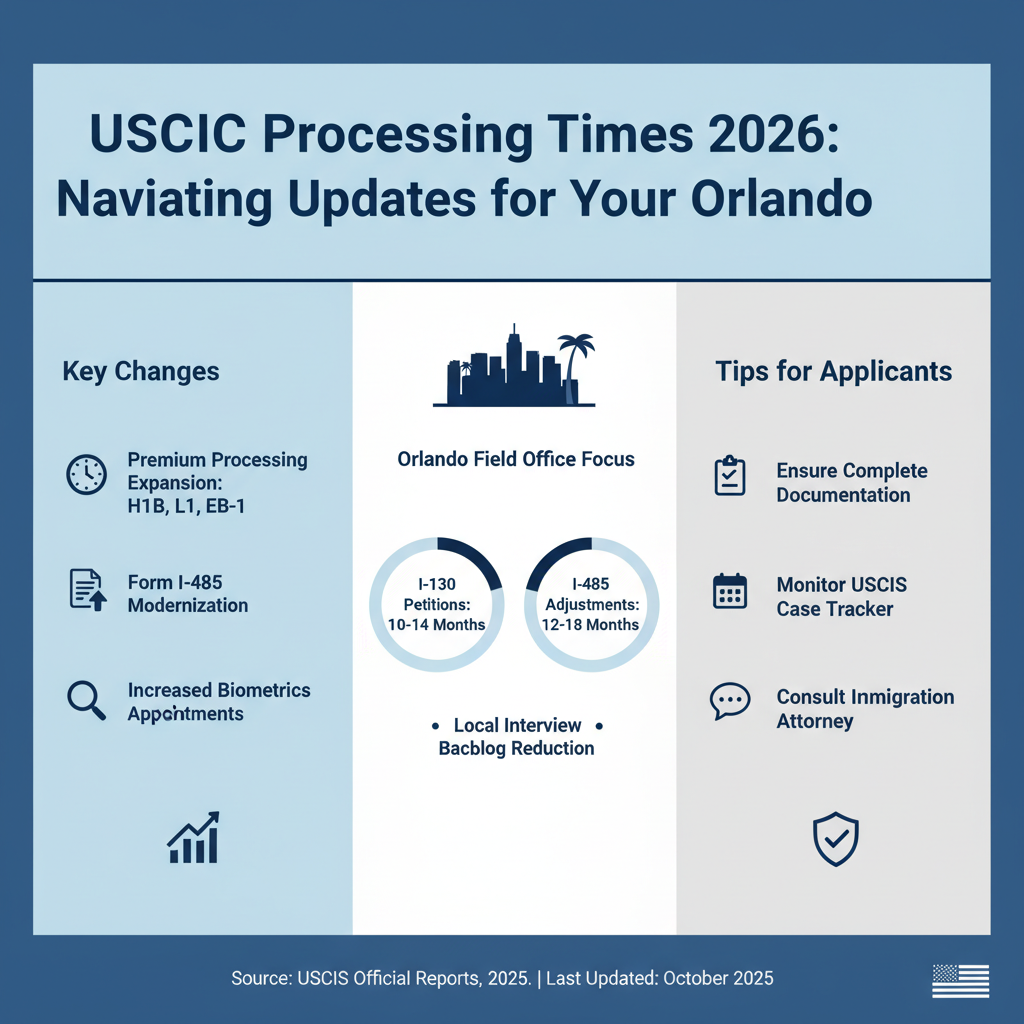
USCIS Processing Times and Updates for 2026 (USCIS)
What This News Means for Immigrants in Orlando and Across Florida
The news regarding USCIS processing times is a constant, evolving topic because it directly impacts the lives of millions. As of mid-2026, USCIS continues to grapple with a significant backlog of applications, even as it implements new strategies to improve efficiency. This ongoing effort to streamline processes and reduce wait times is what continually brings processing time updates to the forefront.
Why this news is showing up now
Immigration processing times are never static. They are dynamic figures influenced by a multitude of factors, including:
- Application Volume: Fluctuations in the number of applications received.
- Staffing Levels: The availability of USCIS officers to review and adjudicate cases.
- Budgetary Constraints: Funding impacts resources, technology, and personnel.
- Policy Changes: New directives or interpretations of immigration law can alter processing procedures.
- Technological Upgrades: Implementation of new systems designed to improve efficiency, which can have initial adjustment periods.
- National and Global Events: Crises, pandemics, or changes in international relations can divert resources or alter priorities.
For 2026, USCIS has indicated a continued focus on backlog reduction initiatives, particularly for family-based petitions, employment authorization documents, and naturalization applications. These efforts, combined with ongoing legislative discussions and administrative priorities, mean that processing times are always subject to review and adjustment. The current news cycle reflects USCIS's regular updates to its publicly available processing time data, reflecting the outcomes of these ongoing efforts and the current operational reality.
How it can affect Florida residents
Florida is one of the most diverse states in the nation, with a vibrant immigrant community. This means that a high volume of immigration applications originates from cities like Orlando, Miami, Tampa, and Jacksonville. Consequently, processing times can be uniquely affected for Florida residents:
- Orlando USCIS Field Office: If your case requires an interview or local adjudication, the specific workload and staffing at the Orlando Field Office (or other nearby offices like Tampa or Miami) will directly influence your wait time. High demand in Central Florida can sometimes lead to longer scheduling waits for interviews compared to less populated areas.
- High Volume of Specific Case Types: Florida’s demographics mean a significant number of family-based petitions (e.g., **Form I-130** and **Form I-485**), asylum applications, and naturalization cases (**Form N-400**) are filed here. Updates to processing times for these specific forms will have a pronounced impact on a large segment of Florida’s immigrant population.
- Economic Impact: Delays in employment authorization documents (**Form I-765**) can significantly impact individuals and families along the I-4 corridor and across Orange County, affecting their ability to work and contribute to the local economy.
- Increased Complexity: Certain cases, such as those involving humanitarian parole or specific visa categories popular in Florida, might experience unique processing considerations.
Understanding these local nuances is crucial. While federal law governs immigration, the practical application and processing at local field offices directly shape the experience for those living in Florida. Keeping abreast of these updates allows you to anticipate potential delays or, hopefully, faster resolutions.
Need Help Navigating Processing Times? Our Orlando immigration team at Imigrar is ready to assist. We understand the unique challenges faced by Florida residents. Call +1 786-791-3106 for a free consultation, or message us online. Se Habla Español.
What USCIS Processing Times Are (and Why They Matter)
A plain-English definition
Simply put, **USCIS processing times** refer to the estimated amount of time it takes for U.S. Citizenship and Immigration Services (USCIS) to process an immigration application or petition from the moment it is received until a decision is made. These times are not guarantees but rather estimates based on historical data of how long similar cases have taken to complete. They vary significantly depending on the type of application, the specific USCIS service center or field office handling the case, and other individual factors.
When you check processing times on the USCIS website, you'll typically see a range (e.g., 10 to 14 months). This range indicates that most similar cases filed around a certain date are completed within that timeframe. USCIS updates these times regularly, usually on a monthly basis, to reflect the most current operational realities.
Key terms you need to know
To effectively understand and monitor your case, familiarize yourself with these crucial terms:
- Receipt Date: This is the date USCIS officially receives your application or petition. It is typically printed on your **Form I-797C, Notice of Action**, which is your official receipt notice. This date is critical for tracking your case.
- Priority Date: For certain family-sponsored and employment-based immigration categories, the **Priority Date** is the date your petition (**Form I-130** or **Form I-140**) was properly filed with USCIS (or, in some employment cases, the date the labor certification application was accepted for processing by the Department of Labor). This date determines your place in line for an available visa number, which is essential for green card eligibility in numerically limited categories.
- Current Processing Times: These are the most up-to-date estimates USCIS provides for how long it takes to process specific forms at particular service centers or field offices.
- Historical Processing Times: Data reflecting how long cases took in the past. While not directly predictive, it can offer context and reveal trends.
- Service Request: If your case falls outside the **normal processing times** published by USCIS, you may be eligible to submit an online **Service Request** (e-request) to inquire about your case.
- Outside Normal Processing Times: This refers to a case that has exceeded the upper range of the published processing times for its specific form and location. This is the threshold for making an inquiry.
- Case Status Online Tool: An online portal where you can enter your **receipt number** to check the most recent status updates on your individual case.
- Premium Processing: An optional service available for certain employment-based petitions and some other forms, which guarantees USCIS action (approval, denial, RFE, or NOID) within a specific timeframe, usually 15 or 30 calendar days, for an additional fee. It does not guarantee approval.
- Adjustment of Status: The process by which an eligible immigrant already in the United States can apply for lawful permanent resident status (a Green Card) without having to return to their home country. This typically involves filing **Form I-485**.
- Consular Processing: The process by which an eligible immigrant applies for an immigrant visa at a U.S. embassy or consulate abroad to become a lawful permanent resident upon entry into the U.S.
- Request for Evidence (RFE): A letter from USCIS asking for additional documentation or information needed to make a decision on your application. RFEs extend processing times.
- Notice of Intent to Deny (NOID): A letter from USCIS indicating that they intend to deny your application unless you provide specific information or evidence to overcome their concerns. NOIDs are serious and require prompt, thorough responses.
Understanding these terms is your first step toward effectively monitoring your immigration application and knowing when and how to take action.
Current Immigration Law: The Foundation of Processing Times
While processing times are administrative metrics, they are deeply rooted in the underlying immigration laws that govern eligibility, procedures, and the very categories of immigration benefits available. The primary legal framework for U.S. immigration is the **Immigration and Nationality Act (INA)**.
Federal requirements
The **Immigration and Nationality Act (INA)**, along with its associated regulations and judicial precedents, establishes the rules for who can immigrate to the U.S., under what conditions, and through what processes. Every immigration application, from a family petition to a naturalization request, is adjudicated based on specific sections of the INA.
- Eligibility Criteria: The INA defines who is eligible for various visas and green cards (e.g., family relationships under INA §201, employment categories under INA §203). Processing times are directly affected by the need for USCIS officers to thoroughly review evidence to ensure an applicant meets these stringent legal criteria.
- Application Forms: Each immigration benefit has a corresponding USCIS form mandated by regulation. For example, **Form I-130, Petition for Alien Relative**, is required for family sponsorship, while **Form I-485, Application to Register Permanent Residence or Adjust Status**, is used for green card applications within the U.S. **Form I-765, Application for Employment Authorization**, allows eligible non-citizens to work, and **Form N-400, Application for Naturalization**, is for U.S. citizenship. The complexity of these forms and the required supporting documentation (dictated by law) directly influence review times.
- Numerical Limitations: Many immigrant visa categories (e.g., certain family-based preferences, most employment-based categories) are subject to annual numerical caps under the INA. This creates a waiting line, managed by the **Priority Date** system and the monthly **Visa Bulletin** from the U.S. Department of State (U.S. Department of State). Even if USCIS processes a petition quickly, a green card cannot be issued until a visa number becomes "current" for that applicant's category and country of chargeability.
- Security Checks and Vetting: Federal law mandates extensive background and security checks for all immigration applicants. These checks, involving multiple government agencies, are a non-negotiable part of the process and can be a significant factor in overall processing times.
- Administrative Appeals: If a case is denied, the INA and its regulations provide for avenues of appeal or motions to reopen/reconsider, often through the **Administrative Appeals Office (AAO)** or the **Executive Office for Immigration Review (EOIR)** (Executive Office for Immigration Review). These processes add further layers of time to a case.
The strict adherence to these federal requirements by USCIS is a primary reason why immigration processing can be lengthy and why it's crucial for applicants to submit complete and accurate information from the outset.
Florida-specific considerations
While immigration law is federal, its implementation has local impacts. Florida's unique position as a major entry point and home to a large and diverse immigrant population creates specific dynamics:
- High Volume of Cases: Florida consistently ranks among the top states for immigration applications. The sheer volume of cases filed with the USCIS service centers and processed by the Orlando, Tampa, and Miami Field Offices means that these offices often operate at or near capacity. This high demand can sometimes lead to longer scheduling waits for interviews or naturalization ceremonies compared to field offices in states with lower immigration populations.
- Specific Demographics: Florida has significant populations from Latin America and the Caribbean, leading to a high proportion of family-based petitions, asylum claims, and Temporary Protected Status (TPS) applications. Processing time updates for these categories are particularly relevant for Florida residents.
- Local Resources: The resources available at the Orlando USCIS Field Office, including staffing and infrastructure, play a direct role in how efficiently local interviews and final adjudications occur. While USCIS aims for national consistency, local operational realities can cause variations.
- Coordination with Local Agencies: Occasionally, USCIS may coordinate with local law enforcement or social services, particularly in complex cases or those involving criminal history. This inter-agency communication, while necessary, can add to processing timelines.
For any immigration application, understanding the federal legal foundation is paramount. For those in Orlando and the surrounding Central Florida area, recognizing how these federal laws are applied and processed locally is key to anticipating your journey.
For official forms and detailed instructions, always refer to the USCIS official website and USCIS Forms page.
Feeling overwhelmed by immigration laws and forms? Imigrar is here to simplify the process for you. Our experienced attorneys in Orlando are experts in current immigration law. Contact us at +1 786-791-3106 for a free, no-obligation consultation. Se Habla Español.

How to Navigate USCIS Processing Times: A Complete Step-by-Step Guide
Monitoring your immigration application’s progress is an essential part of the journey. While you cannot directly control USCIS processing speeds, you can be proactive in staying informed and responding appropriately. Here’s a detailed guide:
1) Understand Your Application Type and Form
Before you can track your case, you must know exactly what you filed. Different immigration benefits have different forms, and each form has its own processing timeline. For instance, a **Form I-130** (Petition for Alien Relative) will have a different timeline than a **Form N-400** (Application for Naturalization).
- Identify Your Form(s): Review the copies of the application(s) you submitted. Common forms include:
- **Form I-130:** Family-sponsored petition.
- **Form I-485:** Adjustment of Status (Green Card application in the U.S.).
- **Form I-765:** Application for Employment Authorization (EAD).
- **Form I-131:** Application for Travel Document (Advance Parole, Reentry Permit).
- **Form N-400:** Application for Naturalization (Citizenship).
- **Form I-140:** Immigrant Petition for Alien Worker.
- Know Your Category: Understand if your application falls under family-based, employment-based, humanitarian, or naturalization categories, as this affects priority and processing.
- Required Documents for this step:
- A complete copy of your filed application(s).
- Any **Form I-797C, Notice of Action**, you received, particularly the one acknowledging receipt of your initial application.
2) Locate Your USCIS Receipt Number
Once USCIS receives your application, they will send you a **Form I-797C, Notice of Action**, typically within 2-4 weeks. This notice is crucial because it contains your unique 13-character **receipt number**. This number usually starts with three letters (e.g., "EAC," "WAC," "LIN," "SRC," "MSC," or "IOE"), followed by 10 numbers.
- Find the Number: Look for the "Receipt Number" on your **Form I-797C**. Keep this document in a safe place.
- Importance: This number is your key to checking your case status online and making inquiries with USCIS. Without it, tracking is extremely difficult.
- Required Documents for this step:
- Your **Form I-797C, Notice of Action** (Receipt Notice).
3) Check Current Processing Times Online
USCIS provides an online tool to check current processing times. This is your primary resource for understanding how long similar cases are taking.
- Access the Tool: Go to the official USCIS Processing Times page.
- Select Your Form: From the dropdown menu, choose the specific form you filed (e.g., "I-485, Application to Register Permanent Residence or Adjust Status").
- Select Your Field Office/Service Center: This is critical. For forms processed at a Service Center (e.g., **Form I-130**, **Form I-140**, **Form I-765**), select the center indicated on your **Form I-797C** (e.g., California Service Center, Nebraska Service Center, Texas Service Center, Vermont Service Center). For forms requiring a local interview (e.g., **Form I-485**, **Form N-400**), select the USCIS Field Office closest to your residence (e.g., "Orlando Field Office").
- Interpret the Results: The tool will display a range of months. It also shows a "receipt date for a case inquiry." If your **Receipt Date** is earlier than this date, your case is likely **outside normal processing times**, and you may be able to make an inquiry.
- Required Documents for this step:
- Your **Form I-797C** to identify the correct Service Center/Field Office and your **Receipt Date**.
4) Understand Your Priority Date and Visa Bulletin (If Applicable)
If you are applying for a Green Card in a numerically limited category (most family-based preference categories, all employment-based categories), your **Priority Date** is paramount. Even if your petition (**Form I-130** or **Form I-140**) is approved, you cannot file your **Form I-485** or receive an immigrant visa until your **Priority Date** becomes "current" according to the monthly **Visa Bulletin**


