

The journey through the U.S. immigration system can often feel like navigating a complex labyrinth, with one of the most significant challenges being the unpredictable nature of application processing times. For immigrants and their families in Orlando, across Florida, and throughout the nation, understanding these timelines is crucial for planning futures, managing expectations, and reducing anxiety.
The reporting that sparked this guide
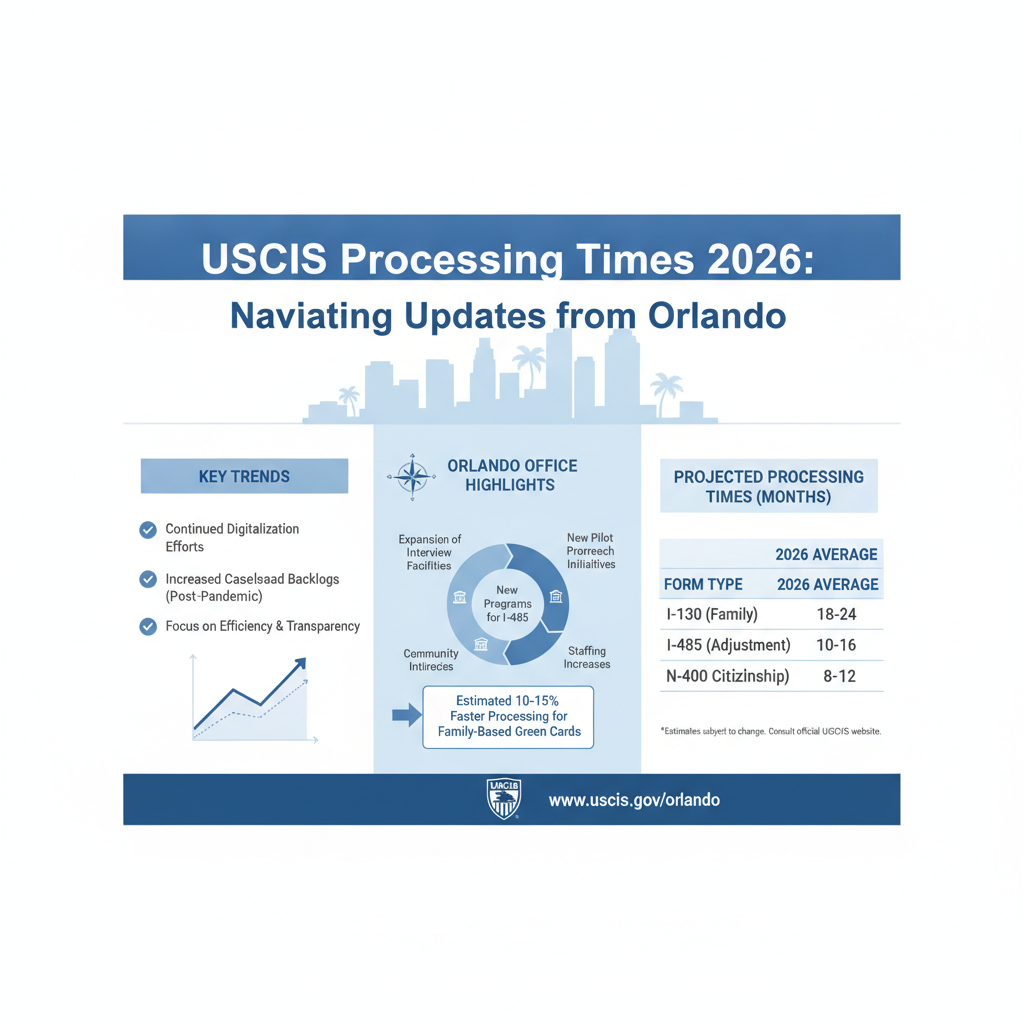
Recent discussions and updates from official channels regarding immigration application backlogs and processing efficiencies have highlighted the ongoing need for applicants to stay informed. These conversations, often spurred by official USCIS announcements and public reporting, underscore the dynamic environment of immigration processing. For the most current official information, always refer to the source: USCIS Processing Times and Updates for 2026 (USCIS)
What This News Means for Immigrants in Orlando and Across Florida
As we move through 2026, USCIS continues to grapple with a high volume of applications, aiming to balance efficiency with thoroughness. This ongoing effort directly impacts individuals and families seeking to build their lives in the U.S., including the vibrant immigrant communities throughout Florida.
Why this news is showing up now
The topic of USCIS processing times is perennially relevant, but specific updates and discussions gain traction at various points due to several converging factors:
- Ongoing Backlog Management: USCIS has been actively working to reduce existing backlogs exacerbated by past operational challenges, including the COVID-19 pandemic. Announcements about new hiring initiatives, technological upgrades, or policy adjustments aimed at improving efficiency directly lead to discussions about processing times.
- Annual Fiscal Year Reviews: Towards the end or beginning of a new fiscal year (which for the federal government starts October 1), USCIS often releases performance data, strategic plans, and budget requests that shed light on their capacity and projected processing capabilities.
- Legislative and Policy Changes: New immigration policies, executive actions, or even proposed legislation can significantly alter application volumes or processing procedures, prompting updates and discussions about their impact on timelines. For instance, any changes to visa availability or eligibility criteria can create immediate shifts.
- Public Demand and Advocacy: The immigrant community, advocacy groups, and legal professionals constantly press for transparency and improvements in processing times. USCIS often responds to this pressure with new data releases or explanations of their efforts.
- Technological Implementations: USCIS periodically rolls out new online tools, digital filing options, or internal processing systems. While intended to streamline operations, their initial implementation can sometimes cause temporary shifts in processing times or data reporting.
In 2026, these factors continue to play a role, making "USCIS Processing Times" a consistently trending topic as applicants seek clarity and predictability.
How it can affect Florida residents
Florida is home to one of the largest and most diverse immigrant populations in the United States, making any USCIS processing update particularly impactful here. For residents of Orlando and the wider Central Florida region, these updates have specific implications:
- Orlando USCIS Field Office: The local Field Office in Orlando handles many critical steps, including interviews for naturalization and adjustment of status applications (Form I-485). Longer processing times at the national service centers can create a bottleneck for cases eventually transferred to local offices for final adjudication. Conversely, improvements can mean quicker interview scheduling.
- Diverse Immigrant Communities: Florida’s population includes significant communities from Latin America, the Caribbean, and other global regions. Many families rely on family-based petitions (Form I-130) which are often subject to lengthy wait times, especially for certain preference categories. Updates to these categories directly affect thousands of Floridians.
- Economic Impact: Delays in employment-based visas (e.g., Form I-140, Form I-765 for Employment Authorization) can impact Florida's labor market, especially in sectors reliant on immigrant workers, such as agriculture, hospitality, and healthcare. Orlando, with its robust tourism and tech industries, feels this keenly.
- Family Reunification: Imigrar's tagline, "Keep Families Together," resonates deeply in Florida. Extended processing times for petitions like Form I-130 mean longer separations for families, causing immense emotional and financial strain. Any news indicating potential acceleration or further delays directly impacts these families.
- Naturalization Backlogs: Many long-term residents in Florida aspire to become U.S. citizens via Form N-400. Delays in processing these applications can mean longer waits for civic participation, voting rights, and enhanced benefits.
- Orlando-Specific Challenges: The Orlando USCIS Field Office, like others in major metropolitan areas, handles a high volume of cases. Understanding current local processing trends is vital. For residents in Orange County and along the I-4 corridor, checking the specific processing times for the Orlando office is as important as checking national service center times.
Staying informed about these updates is not just about curiosity; it's about making informed decisions, planning your life, and understanding when to seek legal intervention. Imigrar is here to help you navigate these complexities.
Need Help Navigating USCIS Updates? Our Orlando immigration team is ready to assist. Call +1 786-791-3106 for a free consultation, or message us online. Se Habla Español.
What USCIS Processing Times Are (and Why They Matter)
For anyone engaged with the U.S. immigration system, the term "processing times" is a constant source of anxiety and anticipation. Understanding what it truly means is the first step in managing your expectations and planning your future.
A plain-English definition
USCIS processing times represent the estimated duration it takes for the U.S. Citizenship and Immigration Services (USCIS) to process an immigration application or petition from the date they receive it until they make a final decision. These are not guarantees, but rather averages based on historical data. USCIS publishes these times to give applicants an idea of how long they might expect to wait.
Important: Processing times can fluctuate significantly based on various factors, including the type of application, the specific USCIS service center or field office handling the case, the complexity of the individual case, and the current workload and staffing levels at USCIS.
Key terms you need to know
To fully grasp USCIS processing, it's essential to understand these key terms:
- Processing Times: The estimated time range for USCIS to complete a specific form, from receipt to decision. These are updated monthly on the USCIS website.
- Receipt Date: The date USCIS officially received your application or petition. This is crucial for tracking your case and determining when it falls within or outside normal processing times.
- Priority Date: For certain numerically limited visa categories (e.g., many family-sponsored and employment-based categories), the Priority Date is the date your petition was properly filed with USCIS (or received by the National Visa Center for consular processing). This date determines your place in the visa queue and is critical for understanding when a visa number might become available according to the U.S. Department of State's Visa Bulletin.
- Filing Date: The date you mailed or submitted your application. This may differ slightly from the Receipt Date.
- Case Status: An online tool provided by USCIS (USCIS Case Status Online) where you can check the current status of your application using your Receipt Number. It tells you if your application has been received, if biometrics were scheduled, if an RFE was issued, or if a decision has been made.
- Visa Bulletin: A monthly publication by the U.S. Department of State that provides information on the availability of immigrant visas for family-sponsored and employment-based preference categories. Your Priority Date must be "current" according to the Visa Bulletin before a visa can be issued or before you can file for Adjustment of Status.
- Adjustment of Status (AOS): The process of applying for lawful permanent resident status (a Green Card) while physically present in the United States. This typically involves filing Form I-485.
- Consular Processing: The process of applying for an immigrant visa at a U.S. embassy or consulate abroad. This is for individuals outside the U.S. seeking to enter as lawful permanent residents.
- Service Center: One of several regional USCIS offices (e.g., California, Nebraska, Texas, Vermont) that primarily process mail-in applications and petitions that do not require an interview.
- Field Office: Local USCIS offices (like the one in Orlando) that handle interviews, biometrics appointments, and other in-person services for applicants residing in their jurisdiction.
- Request for Evidence (RFE): A letter from USCIS asking for additional documentation or information to support your application. Responding to an RFE promptly and completely is crucial to avoid delays or denial.
- Notice of Intent to Deny (NOID): A notice from USCIS indicating that they intend to deny your application and giving you an opportunity to respond with additional evidence or explanation.
Current Immigration Law: The Foundation of Processing
While processing times are administrative, they are fundamentally shaped by the underlying immigration laws of the United States. The Immigration and Nationality Act (INA) is the principal body of law governing immigration, dictating who is eligible for what benefits and establishing the framework that USCIS operates within.
Federal requirements
The INA, along with subsequent amendments and regulations, establishes the various pathways to legal immigration, each with its own set of requirements and often, numerical limitations. These federal requirements are uniform across the nation, ensuring a consistent legal standard, even if processing times vary by location.
- Family-Based Immigration: Governed by INA sections like 201, 203, and 204. This category allows U.S. citizens and lawful permanent residents to sponsor certain family members. The process typically starts with Form I-130, Petition for Alien Relative. Immediate relatives (spouses, minor children, and parents of U.S. citizens) have visas immediately available, but other preference categories (e.g., married children of U.S. citizens, siblings) are subject to annual quotas and thus longer waits determined by the Visa Bulletin.
- Employment-Based Immigration: Governed by INA sections 203(b) and 204. This category is for foreign nationals seeking to immigrate based on their employment skills or investment. It often involves an employer filing Form I-140, Immigrant Petition for Alien Worker, or in some cases, the individual filing directly (e.g., EB-1 extraordinary ability). These categories are also subject to annual numerical limits.
- Naturalization: Governed by INA sections 310-337. This is the process by which lawful permanent residents apply to become U.S. citizens after meeting specific residency and other eligibility criteria, typically by filing Form N-400, Application for Naturalization.
- Adjustment of Status: Covered under INA Section 245. This allows eligible individuals already in the U.S. to apply for a Green Card without having to leave the country, typically by filing Form I-485, Application to Register Permanent Residence or Adjust Status. Eligibility criteria are strict, including lawful entry and maintenance of status.
- Waivers: Many applicants may need to file waivers (e.g., Form I-601, Application for Waiver of Grounds of Inadmissibility) if they have certain inadmissibility issues. These can add significant time to the processing period.
All these forms and processes are overseen by USCIS official website, which is part of the Department of Homeland Security (DHS).
Florida-specific considerations
While the laws are federal, their implementation has local nuances. For Florida residents, especially those in Orlando, these considerations are important:
- Orlando Field Office Jurisdiction: The Orlando USCIS Field Office serves a wide area of Central Florida, including Orange, Seminole, Osceola, Volusia, Brevard, and other surrounding counties. If your case requires an interview (e.g., for Adjustment of Status or Naturalization), it will likely be scheduled at this office. The local office's workload can influence the speed of interview scheduling, even if the initial petition was processed at a national service center.
- Local Biometrics Appointments: Applicants in Florida will attend biometrics appointments at Application Support Centers (ASCs) conveniently located throughout the state, including in Orlando. The availability of these appointments can sometimes impact overall timelines.
- High Volume of Cases: Florida's large immigrant population means its USCIS offices handle a substantial number of applications. This high volume can sometimes contribute to longer wait times compared to less populous areas, but USCIS strives for national consistency.
- Diverse Needs: The specific needs of Florida's diverse communities, from seasonal workers to highly skilled professionals, mean a broad range of application types are processed, each with its own set of requirements and processing patterns.
Understanding these foundational laws and local factors is essential for any immigrant in Florida seeking to navigate the USCIS system effectively.
Overwhelmed by Immigration Law? Our expert attorneys at Imigrar simplify complex requirements. Get a free consultation by calling +1 786-791-3106 or contact us online. Se Habla Español.
How to Navigate USCIS Processing Times: A Complete Step-by-Step Guide
Understanding and tracking your immigration application's progress is empowering. This guide will walk you through the essential steps to monitor and manage your case in light of USCIS processing times.
1) Understand Your Application Type and Relevant Forms
Before you can track, you must know what you're tracking. Each immigration pathway involves specific forms and processes, and processing times vary significantly between them. Action: Identify your specific application type (e.g., family-sponsored Green Card, employment-based visa, naturalization, DACA renewal). Required Documents (General examples):
- For family petitions: Form I-130 (Petition for Alien Relative)
- For Green Card applications (in U.S.): Form I-485 (Application to Register Permanent Residence or Adjust Status)
- For employment authorization: Form I-765 (Application for Employment Authorization)
- For travel documents: Form I-131 (Application for Travel Document - for Advance Parole or Reentry Permit)
- For naturalization: Form N-400 (Application for Naturalization)
- Supporting documents like birth certificates, marriage certificates, passports, photos, medical exam results (Form I-693), and affidavits of support (Form I-864).
2) Monitor the USCIS Processing Times Tool
This is your primary resource for estimated wait times. USCIS updates this tool monthly. Action: Regularly check the official USCIS Processing Times page. Steps:
- Go to the USCIS Processing Times page.
- Select your "Form" (e.g., I-130, I-485, N-400).
- Select the "Form Category" (e.g., "Family-Sponsored I-130," "Employment-Based I-485").
- Select the "Field Office or Service Center" that has jurisdiction over your case. For many initial petitions, this will be a Service Center (e.g., Nebraska, Texas). For interviews (like I-485 or N-400), select your local Field Office (e.g., Orlando Field Office).
- Click "Get processing time."
3) Track Your Case Status Online
Once USCIS receives your application, they will send you a Receipt Notice (Form I-797C) with a 13-character Receipt Number (e.g., EAC-23-123-45678). Action: Use your Receipt Number to check your case status online. Steps:
- Go to the USCIS Case Status Online tool.
- Enter your 13-character Receipt Number without dashes.
- Click "Check Status."
4) Understand the Visa Bulletin (if applicable)
If your application is for a numerically limited immigrant visa (most family-based preference categories and employment-based categories), your Priority Date must become "current" before USCIS can finalize your Green Card application or the Department of State can issue your immigrant visa. Action: Review the monthly Visa Bulletin published by the U.S. Department of State. Steps:
- Locate your visa category (e.g., F2A for spouses and children of LPRs, EB-3 for skilled workers).
- Find the "Final Action Dates" chart or "Dates for Filing" chart.
- Compare your Priority Date to the date listed for your country of chargeability and visa category. If your Priority Date is earlier than the listed date, your visa number is current.
5) Respond to Requests for Evidence (RFEs) Promptly
An RFE means USCIS needs more information or clarification to process your application. Failing to respond or responding inadequately is a common cause of delays and denials. Action: Gather all requested documents and submit a complete response well before the deadline. Required Documents:
- The original RFE notice.
- All documents specifically requested by USCIS.
- A cover letter summarizing the contents of your response.
- Copies of previously submitted documents if they help clarify the new evidence.
6) Inquire About Your Case (Outside Normal Processing Times)
If your case has been pending longer than the "receipt date for a case inquiry" shown on the USCIS processing times tool, you can make an inquiry. Action: Submit an "e-Request" online or call USCIS. Steps:
- Confirm your case is truly outside the normal processing range using the USCIS Processing Times tool.
- Go to the USCIS e-Request page for "Case Outside Normal Processing Time."
- Provide your Receipt Number, application type, and other requested information.
- Alternatively, you can call the USCIS Contact Center (+1-800-375-5283) for assistance.
7) Prepare for Interviews and Biometrics
Many applications, especially Form I-485 and Form N-400, require an interview and/or biometrics (fingerprints, photos, signature). Action: Attend all scheduled appointments, fully prepared. Required Documents for Biometrics (Form I-797C, Appointment Notice):
- The original Biometrics Appointment Notice.
- A valid government-issued photo identification (e.g., passport, state ID).
- The original Interview Appointment Notice.
- Valid photo identification (e.g., passport).
- All original documents submitted with your application (birth certificates, marriage certificates, divorce decrees, police clearances, employment letters, tax returns, etc.).
- Any updated documents since your initial filing.
- For marriage-based Green Cards, extensive evidence of a bona fide marriage (joint bank accounts, leases, photos, utility bills).
Practical Steps You Can Take Today to Expedite Your Case
While you can't directly control USCIS's workload, you can take proactive steps to ensure your application moves as smoothly as possible and to manage your expectations.
Actionable Checklist for Applicants
- Gather All Documents Early and Accurately: Start collecting all necessary personal documents (birth certificates, marriage licenses, passports, photos) long before you plan to file. Ensure all names, dates, and places match across all documents.
- Complete Applications Thoroughly: Fill out every section of the form completely and accurately. Even seemingly minor omissions or errors can lead to RFEs and significant delays.
- Provide Comprehensive Supporting Evidence: Don't just meet the minimum requirements. Provide strong, clear, and organized evidence to support your claims (e.g., for marriage-based petitions, provide ample proof of a bona fide relationship).
- Keep Copies of Everything: Make a complete copy of your entire application package, including all forms, supporting documents, and the check/money order, before mailing it. This is your safeguard.
- Stay Informed on USCIS Updates: Regularly check the USCIS official website for policy changes, processing time updates, and news alerts that might affect your case.
- Respond to RFEs Immediately: If you receive an RFE, address it fully and submit your response well before the deadline. If you're unsure how to respond, consult an attorney immediately.
- Update Your Address Promptly: If you move, file Form AR-11, Alien's Change of Address Card, with USCIS online or by mail within 10 days of moving. Failure to do so can result in missed notices and critical delays.
- Consult with an Experienced Immigration Attorney: An attorney can review your application for completeness, advise on strategy, identify potential issues, and represent you if problems arise. This is especially crucial for complex cases or if you have any adverse immigration or criminal history.
Document Preparation Guidance
- Organization is Key: Arrange your documents logically, following the USCIS instructions. Use tabs or dividers for different sections (e.g., forms, identity documents, financial documents, relationship evidence).
- Clear Copies: Provide clear, legible copies of all required documents.


