


The reporting that sparked this guide
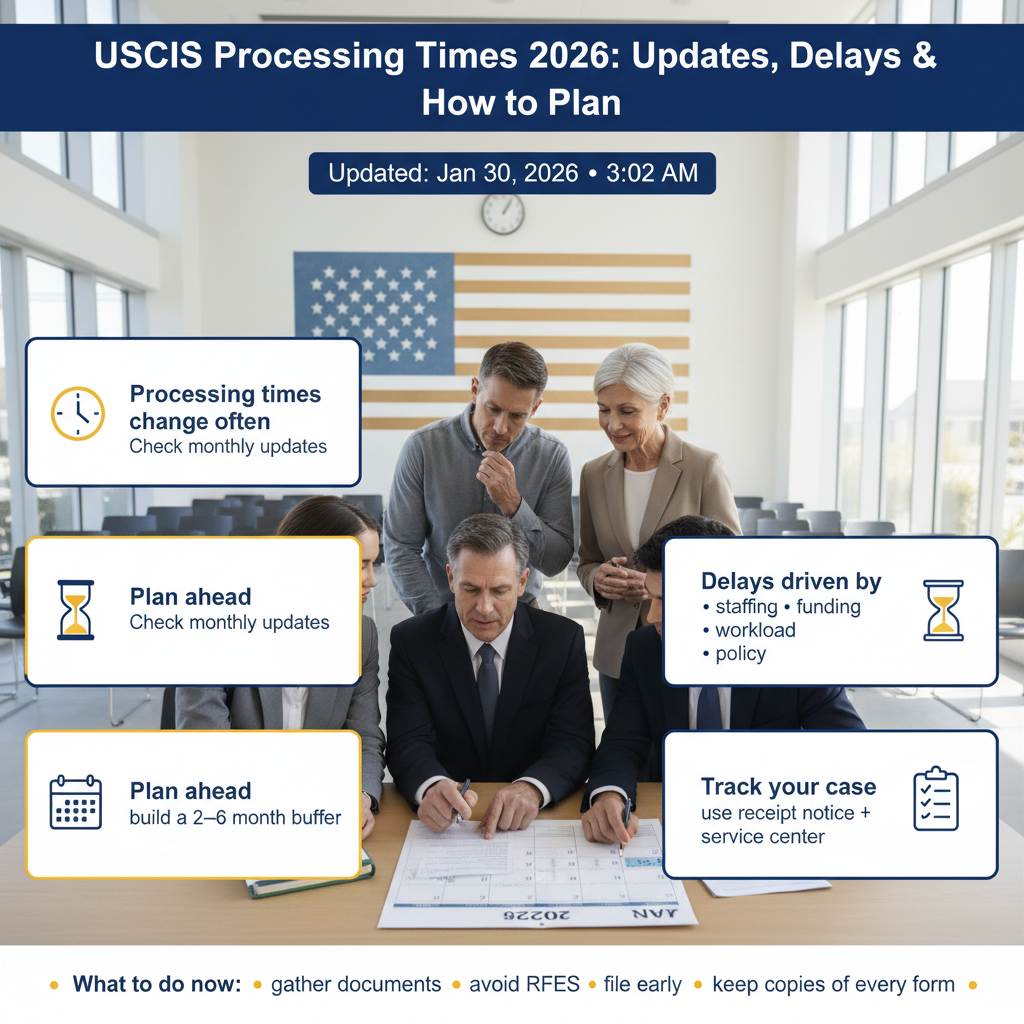
The reporting that sparked this guide: USCIS Processing Times and Updates for 2026 (USCIS)
Reminder: USCIS processing times change frequently based on staffing, funding, workload, and policy updates. This article explains how to read the latest updates, what they mean for common applications, and how to protect your case from avoidable delays—especially if your case is in Orlando or elsewhere in Florida.
Need Help? Our Orlando immigration team is ready to assist. Call +1 786-791-3106 for a free consultation, or message us online. Se Habla Español.
What This News Means for Immigrants in Orlando and Across Florida
Why this news is showing up now
USCIS processing times are a “moving target,” and 2026 continues a trend we’ve seen over the last several years: more people applying, more categories with backlogs, and frequent operational changes. When USCIS posts updated timelines—especially for high-volume forms like Form I-485 (green card), Form I-130 (family petition), Form I-765 (work permit/EAD), and Form N-400 (citizenship)—it impacts real-life decisions: work authorization, travel plans, school enrollment, and family reunification.
In 2026, applicants are paying closer attention for three reasons:
- Higher case volume in family-based, employment-based, and humanitarian filings.
- Biometrics, RFEs, and interview scheduling remain uneven by office and category.
- Processing-time transparency tools (like USCIS’s official calculator) are now widely used by employers and families to plan.
Important: “Processing time” is not a guarantee. It’s a backward-looking estimate based on recently completed cases. Your case can be faster—or much slower—depending on the facts, your background checks, your evidence, and where your file is handled.
How it can affect Florida residents
Florida is one of the busiest states for immigration filings. For Central Florida residents along the I-4 corridor—Orlando, Kissimmee, Sanford, Winter Park, and surrounding Orange County communities—USCIS timelines can affect:
- Adjustment of Status applicants waiting for interview notices and green cards.
- Work permit renewals that must be filed early to prevent job interruptions.
- Naturalization applicants trying to align travel, taxes, and selective service issues before filing.
- Family members abroad waiting for National Visa Center (NVC) steps after USCIS approval.
If your case is in Orlando, your timeline may depend on where the case is physically processed: a USCIS service center, the Orlando-area field office for interviews, or a combination of both. The Orlando USCIS Field Office’s interview scheduling capacity can be a major factor for Form I-485 and Form N-400 cases.
Warning: If you assume your case will be approved “soon” and delay renewing an EAD, updating an address, or responding to a request for evidence (RFE), you can unintentionally add months (or more) to your timeline.
What USCIS Processing Times and Updates for 2026 Is (and Why It Matters)
A plain-English definition
“USCIS processing time” is the estimated amount of time USCIS takes to decide a specific type of application (for example, a green card or work permit). USCIS posts these estimates by:
- Form type (e.g., Form I-130, Form I-485, Form I-765, Form N-400)
- Category (e.g., spouse of a U.S. citizen vs. sibling petition)
- Processing location (service center or field office)
In 2026, the “updates” matter because they influence when you can realistically expect:
- A receipt notice and case number
- Biometrics appointment
- An interview (if required)
- Approval, denial, or additional evidence request
- Card production (EAD/green card) and delivery
Key terms you need to know
- Receipt Notice: Proof USCIS accepted your filing and assigned a case number.
- RFE (Request for Evidence): USCIS asks for more documents; this pauses progress until you respond.
- NOID (Notice of Intent to Deny): USCIS believes the case should be denied unless you overcome concerns.
- Biometrics: Fingerprints/photo for background checks.
- Adjustment of Status: Applying for a green card from inside the U.S. (often with Form I-485).
- Priority Date: Your place in line for visa availability (critical in many family/employment categories).
- 90-day window: Commonly used for timing rules (for example, many applicants plan filings around a 90-day period—your specific situation may differ).
- 180 days: A planning benchmark many families use for renewals and travel buffers; some immigration rules also use 180-day concepts (for example, continuous residence issues in naturalization). Always confirm which “180 days” rule applies to your category.
Important: USCIS processing times are only one part of the journey. If consular processing is involved, Department of State timelines also apply. See: U.S. Department of State.
Current Immigration Law: The Foundation
USCIS processing is shaped by federal immigration law and regulations, plus USCIS policy guidance. While processing “speed” is operational, your eligibility and evidence requirements come from statutes and regulations that do not change simply because timelines change.
Federal requirements
Key legal sources that underpin most USCIS filings include:
- Immigration and Nationality Act (INA) (8 U.S.C. §§ 1101 et seq.)
- 8 C.F.R. (Department of Homeland Security immigration regulations)
- USCIS Policy Manual (agency guidance interpreting the INA and regulations)
Common forms affected by 2026 processing time updates include:
- Form I-130 (Petition for Alien Relative)
- Form I-485 (Application to Register Permanent Residence or Adjust Status)
- Form I-765 (Application for Employment Authorization)
- Form I-131 (Application for Travel Document / Advance Parole)
- Form N-400 (Application for Naturalization)
- Form I-751 (Petition to Remove Conditions on Residence)
- Form I-129 (Petition for a Nonimmigrant Worker)
You can confirm current filing instructions and editions at: USCIS Forms and the USCIS official website.
Florida-specific considerations
Immigration law is federal, but Florida residents often face practical, location-based issues that directly affect timelines:
- Interview scheduling at the local field office can be a bottleneck for Adjustment of Status and naturalization.
- Mail reliability and address changes matter—especially for families that move within Orange County or along the I-4 corridor.
- Employment verification timing can be critical in Florida’s tourism, healthcare, construction, and service industries when EAD renewals are delayed.
Reminder: If you move, you must update your address with USCIS promptly (often within 10 days under federal rules). Missing an interview notice because you moved can set your case back for months.
How to Track and Respond to USCIS Processing Times: A Complete Step-by-Step Guide
1) Identify your exact form, category, and where it’s being processed
Processing times vary dramatically by form and category. Start by confirming the exact form(s) you filed and whether your case is handled by a service center, a field office, or both.
Documents to gather:
- USCIS receipt notices for each form (Form I-797C)
- A copy of your filing package (what you sent)
- Any RFE/NOID notices you’ve received
- Your USCIS online account screenshots (if applicable)
2) Check the official USCIS processing time tool the right way
Use the official tool here: USCIS Processing Times. Select the correct form and the correct field office or service center.
Many applicants accidentally select the wrong category (for example, choosing “all other” instead of “immediate relative”), which can make the estimate look far worse—or deceptively better—than reality.
Documents to gather:
- Receipt number prefix (e.g., MSC, IOE, LIN, SRC, WAC—varies by filing method and location)
- Your category (immediate relative, family preference, employment-based, etc.)
- Field office name if your case involves an interview (e.g., Orlando area)
3) Compare your “receipt date” to the posted “case inquiry date”
USCIS generally lets you submit an “outside normal processing time” request only after your case is older than the posted inquiry date for that form/location. In other words, the question is not “how long have I waited?” but “am I past the inquiry threshold?”
Important: A case can be delayed for legitimate reasons (security checks, missing evidence, background review). But if you are past the inquiry date, you may be eligible to request an update.
Documents to gather:
- Receipt date from your I-797C
- Screenshot/PDF of the USCIS inquiry date shown on the tool
- Timeline notes: biometrics date, RFE response date, interview date (if any)
4) Prevent delays by auditing your case for “self-inflicted” issues
Before you contact USCIS, check for common delay triggers:
- Did you respond to an RFE by the deadline?
- Did you sign every form in ink (where required)?
- Did you submit correct fees and correct form editions?
- Did you upload/send translations and required civil documents?
- Did you attend biometrics and interviews as scheduled?
Warning: A missed biometrics appointment or interview can lead to denial for abandonment in some cases. If you missed something, speak with an attorney immediately to evaluate reopening options.
Documents to gather:
- RFE response proof (delivery confirmation, copy of response)
- Biometrics appointment notice and attendance proof (if any)
- Interview notice and reschedule confirmations (if applicable)
5) Submit the right type of request: e-Request, expedite, or congressional help
If your case is outside normal processing time, you can usually submit an online case inquiry (often called an “e-Request”) through USCIS. In limited situations, you can request an expedite based on USCIS expedite criteria (for example, severe financial loss, humanitarian reasons, urgent medical needs).
For some families, requesting help through a congressional office is also an option after reasonable attempts to resolve through USCIS channels.
Documents to gather:
- Proof your case is outside normal processing time (screenshots)
- Evidence supporting expedite (job loss notice, eviction notice, medical letters, etc.)
- Government-issued ID and signed privacy release (for congressional assistance)
6) If your case involves a visa abroad, plan for Department of State steps too
USCIS approval is not the end for consular processing cases. After Form I-130 approval, many cases go to the National Visa Center (NVC) and then to a U.S. consulate. That means separate queues, document review, and interview scheduling governed by the Department of State.
Track consular procedures and civil document requirements at: U.S. Department of State.
Documents to gather:
- USCIS approval notice (I-797)
- Passports, birth certificates, marriage/divorce records
- Police certificates (as required by the consulate)
- Affidavit of Support evidence (often Form I-864)
Need Help? Our Orlando immigration team is ready to assist. Call +1 786-791-3106 for a free consultation, or message us online. Se Habla Español.
Practical Steps You Can Take Today
Processing times may be outside your control, but preparation is not. The goal is to keep your case “decision-ready” so that if USCIS touches your file, it can be approved without an RFE or reschedule.
Actionable checklist (do these now)
- Set calendar reminders for renewals at least 180 days before expiration (EAD, conditional green card, etc.).
- Create a single case folder (digital + paper) with every receipt, notice, and submission copy.
- Update your address immediately after any move and keep proof.
- Check your USCIS online account weekly for notices, RFEs, and updates.
- Prepare interview-ready evidence (relationship documents, joint financials, tax transcripts).
- Order key records early (birth certificates, certified dispositions, translations).
- Plan travel carefully—do not depart without confirming whether you need Advance Parole (Form I-131).
Document preparation guidance
USCIS delays often come from incomplete submissions or unclear evidence. Strong preparation usually includes:
- Certified translations for any non-English document (with translator certification).
- Clear, consistent names and dates across passports, birth certificates, and forms.
- Proof of lawful entry where required (I-94 record, passport admission stamp).
- Evidence of a bona fide marriage when filing through a spouse (joint lease, joint bank accounts, insurance, photos, affidavits).
- Tax records (IRS transcripts often preferred) for sponsorship and naturalization.
Reminder: If your case is in Orlando and you are likely to be interviewed at the local field office, bring originals and an organized binder. Interview reschedules can add months.
Timeline expectations (planning, not promises)
Because USCIS updates shift in 2026, it’s better to plan in “bands” rather than exact dates:
- Receipts: often weeks, sometimes longer depending on filing method and volume.
- Biometrics: can be scheduled within weeks to months; some applicants may have biometrics reused.
- EAD/Advance Parole: varies widely; renew early and track auto-extension rules if eligible.
- Interviews: field office dependent; the Orlando USCIS Field Office timeline can differ from other Florida offices.
- Final decisions: can be quick after interview or can take additional months if review is required.
Warning: If you must travel, change jobs, or move, talk to an attorney first. A “normal life event” can trigger immigration consequences if timed poorly.
How Imigrar Helps Immigrants in Orlando
At Imigrar, we help families and individuals navigate USCIS delays with a strategy focused on accuracy, evidence, and proactive case management. Our tagline is “Keep Families Together”, and we take that seriously—especially when processing times create uncertainty.
- We evaluate whether you should file now or wait based on visa availability and your Priority Date.
- We prepare “decision-ready” filings designed to reduce RFEs and interview problems.
- We track deadlines and help you plan renewals within the safest timeframes (including the 90-day window planning many clients use for life events and travel buffers).
- We advise Central Florida residents on what to expect with the Orlando USCIS Field Office and how to prepare for interviews.
- We assist with case inquiries, expedite requests when appropriate, and responses to RFEs/NOIDs.
Se Habla Español. We serve clients in Orlando, throughout Florida, and nationwide.
Call +1 786-791-3106 for a free consultation or message us online at https://www.imigrar.com/contact.
Need Help? Our Orlando immigration team is ready to assist. Call +1 786-791-3106 for a free consultation, or message us online. Se Habla Español.
Frequently Asked Questions
Q: Do longer USCIS processing times affect my eligibility for a green card or citizenship?
A: Usually, longer processing times do not change eligibility by themselves—but delays can create indirect risks. For example, if your work permit expires and you don’t renew in time, you may lose employment. Or if you travel without Advance Parole while your Adjustment of Status (Form I-485) is pending, you could abandon the application. Keep your status compliant, renew on time (many people plan at least 180 days ahead), and speak with an attorney if your facts change.
Q: If my case is in Orlando, will it be faster or slower than the national average?
A: It depends on the form and whether an interview is required. Some steps are handled by service centers nationwide, while interviews are handled locally. The Orlando USCIS Field Office’s interview capacity can affect Form I-485 and Form N-400 timelines. For Central Florida residents, we recommend checking the exact field office in the USCIS tool and planning for potential reschedules.
Q: How do I know when I can submit an “outside normal processing time” request?
A: Use the official calculator at USCIS Processing Times. Look for the “case inquiry date.” If your receipt date is earlier than that inquiry date, you may be eligible to submit a request. Important: If you had an RFE, your timeline may effectively reset or extend depending on when USCIS received your response.
Q: What documents should I keep ready in case USCIS issues an RFE?
A: Keep (1) identity and civil documents (passports, birth/marriage/divorce certificates with certified translations), (2) proof of lawful entry (I-94), (3) financial documents (tax transcripts, pay stubs), and (4) category-specific evidence (for marriage cases, joint documents and photos). If you’re filing Form I-130 and Form I-485 together, organize evidence so you can respond quickly within the deadline on the notice.
Q: How much does it cost to file, and can delays increase the cost?
A: Filing costs depend on the form(s) and your category, and USCIS fees can change. Always confirm current fees and fee waivers (if available) on USCIS Forms. Delays can increase costs indirectly—such as needing additional renewals for Form I-765 (EAD) or paying for updated medical exams if a prior exam expires. An attorney can help you time submissions to reduce repeat costs.
Q: What happens if USCIS denies my case after a long wait?
A: A denial can have serious consequences depending on your current status. Some denials can be challenged through a motion to reopen/reconsider, an appeal (if available), or refiling with corrected evidence. If you are in removal proceedings, immigration court timelines and rules apply through the Executive Office for Immigration Review. Warning: Do not ignore a denial notice—deadlines can be short, and missing them can eliminate options.
Q: Can I travel while my case is pending if USCIS is taking too long?
A: Sometimes, but it depends on your case. Many Adjustment of Status applicants must have Advance Parole (often via Form I-131) before traveling. Traveling without it can be treated as abandoning the application. If you are in a nonimmigrant status (like H-1B or L-1), different travel rules may apply. Get legal advice before booking travel, especially if your case is in Orlando and an interview notice could arrive while you’re away.
Common Mistakes (and How to Avoid Them)
Mistake #1: Waiting too long to renew work authorization
Many applicants assume their EAD will renew quickly, then face job interruptions. Avoid this by planning early—often at least 180 days ahead—and keeping proof of timely filing. If eligible, ask about automatic extension categories and what employers can accept for I-9 purposes.
Mistake #2: Checking the wrong processing time category or location
The USCIS tool is only helpful if you select the correct form, category, and office. Selecting the wrong option can lead to poor decisions (like filing unnecessary inquiries or panicking about normal timelines). Use your receipt notice details and confirm whether your case is tied to the Orlando field office or a service center.
Mistake #3: Responding to RFEs with incomplete or disorganized evidence
RFEs are common, and a weak response can lead to denial. Treat an RFE like a second filing: tabbed exhibits, a cover letter, and direct answers to each request. Important: Respond by the deadline on the notice—late submissions are often rejected.
Additional Official Resources to Monitor in 2026
For the most accurate, up-to-date information, use official government sources:
- USCIS official website (news, policy updates, forms, alerts)
- USCIS Processing Times (office-by-office estimates and inquiry dates)
- USCIS Forms (current editions, instructions, and fees)
- U.S. Department of State (consular processing, visa instructions, interview prep)
- Executive Office for Immigration Review (immigration court procedures if applicable)
Reminder: Social media can be useful for community updates, but it is not a substitute for official guidance or individualized legal advice. USCIS timelines in 2026 can shift quickly; confirm before acting.
Need Help? Our Orlando immigration team is ready to assist. Call +1 786-791-3106 for a free consultation, or message us online. Se Habla Español.
Closing: Plan Around Processing Times—Don’t Let Them Control You
USCIS processing time updates for 2026 are a reminder that immigration planning is not just about eligibility—it’s also about timing, documentation, and risk management. Whether you are filing Form I-130 for a loved one, pursuing Adjustment of Status with Form I-485, renewing an EAD, or applying for citizenship, the best approach is proactive: file accurately, respond quickly, and keep your case interview-ready.
If your case is in Orlando—or anywhere in Florida along the I-4 corridor—local interview scheduling and mail logistics can make a meaningful difference. For Orange County families, small mistakes (an address change not reported, an RFE answered late, an expired medical exam) can add months to a process that already feels too long.
Imigrar is here to help you move forward with clarity and confidence.
Need help now? Call +1 786-791-3106 for a free consultation or message us at https://www.imigrar.com/contact. Se Habla Español.


