


The reporting that sparked this guide
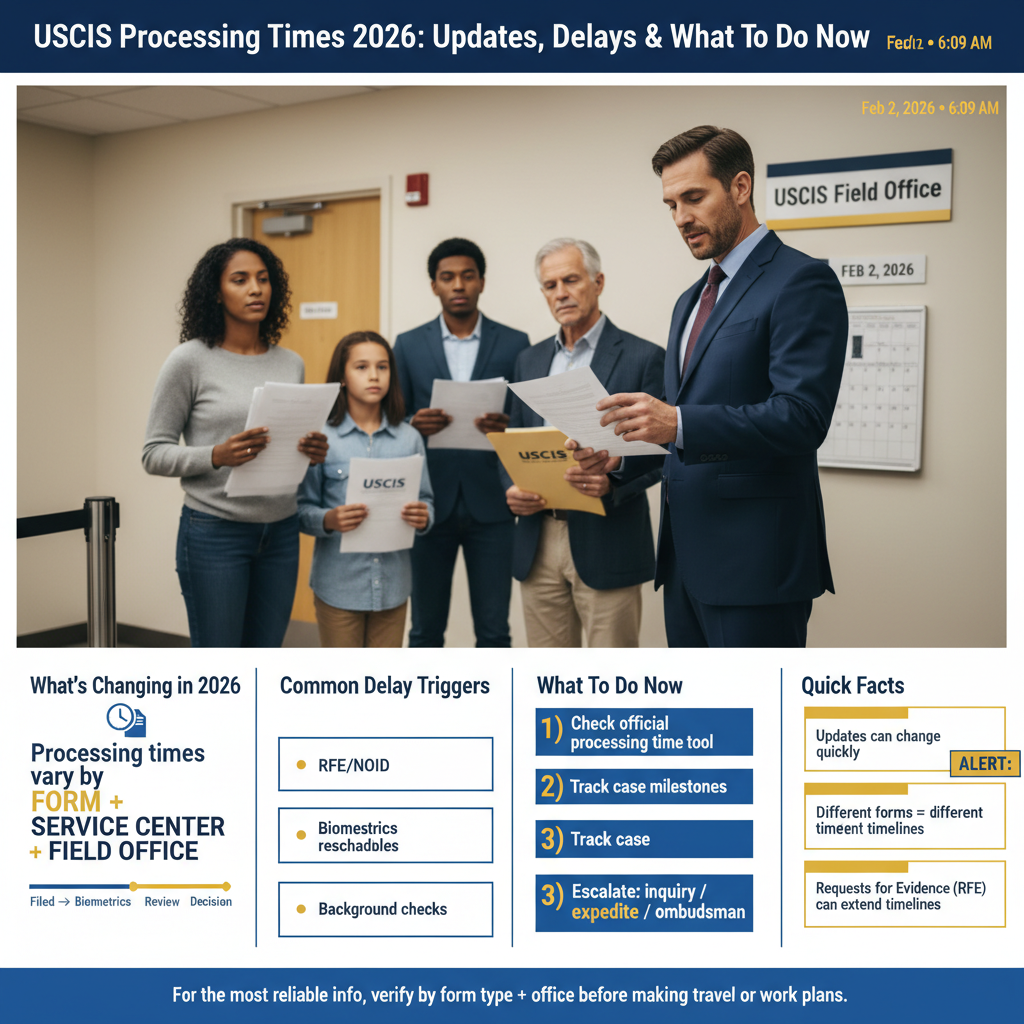
This article is based on recent USCIS-related reporting and public updates highlighted in immigration news coverage, including: USCIS Processing Times and Updates for 2026 (USCIS).
Reminder: USCIS processing times can change quickly by form type, service center, and field office. The most reliable place to confirm current estimates is the official USCIS tools linked throughout this guide.
Need Help? Our Orlando immigration team is ready to assist. Call +1 786-791-3106 for a free consultation, or message us online. Se Habla Español.
What This News Means for Immigrants in Orlando and Across Florida
Why this news is showing up now
USCIS processing times are a trending topic in 2026 because many families and employers are feeling the real-life effects of backlogs and uneven timelines across different USCIS offices. Even when USCIS reports overall progress, applicants still see major differences depending on:
- The form you filed (for example, Form I-130 vs. Form I-485)
- Whether you filed online or by mail
- The USCIS service center handling your petition
- The local field office that schedules interviews (if required)
- Security checks, biometrics capacity, and staffing levels
USCIS also continues to adjust internal workflows, expand online tools, and shift workloads between offices. These operational changes can improve timelines for some categories while slowing others—sometimes with little warning.
Important: “Processing time” is not a guarantee. It’s an estimate based on recent case completions and can move up or down month to month.
How it can affect Florida residents
For Central Florida residents—especially along the I-4 corridor (Orlando, Kissimmee, Sanford, Daytona, and surrounding areas)—USCIS timing affects daily life in practical ways:
- Work authorization delays can impact jobs, licensing, and household income.
- Travel limitations may last longer if advance parole is pending.
- Family separation can be extended when consular processing or waivers are delayed.
- Driver’s license and Real ID eligibility can be affected depending on your current status and pending applications.
- Immigration court strategy (for people in removal proceedings) may depend on how quickly USCIS can adjudicate a petition or application.
If your case is in Orlando, the timing of interview scheduling and local workload can directly affect how quickly your Adjustment of Status case moves forward.
What USCIS Processing Times and Updates for 2026 Is (and Why It Matters)
A plain-English definition
“USCIS processing times” are USCIS’s published estimates for how long it may take to make a decision on an immigration request—such as a petition, application, or benefit request. In 2026, these timelines remain a major planning tool for immigrants because they influence:
- When you can start working (EAD timing)
- When you can travel (advance parole timing)
- When you can become a permanent resident (green card timing)
- When you can naturalize (citizenship timing)
- Whether you need to renew documents to avoid gaps
USCIS updates may include changes to posted processing times, new filing procedures, revised form editions, fee changes, or operational shifts that impact how quickly cases move.
Key terms you need to know
- Receipt Notice: The confirmation USCIS received your filing (often Form I-797). Your “receipt date” is critical for tracking.
- Biometrics: Fingerprints/photo appointment used for background checks; may be waived or reused in some cases.
- RFE (Request for Evidence): USCIS asks for more documents. This can pause or extend processing.
- NOID (Notice of Intent to Deny): A serious warning that USCIS plans to deny unless you respond effectively.
- Priority Date: Your place in line for certain immigrant visas (especially family preference and employment categories).
- Adjustment of Status: Applying for a green card from inside the U.S. (often using Form I-485).
- Consular Processing: Getting an immigrant visa through a U.S. embassy/consulate abroad after USCIS approves the petition.
- Case Outside Normal Processing Time: A USCIS category allowing you to submit an inquiry when your case exceeds posted ranges.
Warning: Many people confuse “processing time” with “case inquiry date.” USCIS typically only allows inquiries after a certain date shown in the processing time tool.
Current Immigration Law: The Foundation
USCIS processing times are not just an administrative issue—they interact with federal statutes and regulations that govern eligibility, filing windows, and consequences of unlawful presence. Understanding the legal foundation helps you avoid mistakes when delays happen.
Federal requirements
Most USCIS benefits are governed by the Immigration and Nationality Act (INA) and federal regulations in Title 8 of the Code of Federal Regulations (8 C.F.R.). Common legal anchors include:
- INA § 201–203 (immigrant visa categories and numerical limits impacting Priority Date backlogs)
- INA § 245 (rules for Adjustment of Status using Form I-485)
- INA § 212 (inadmissibility grounds that can lead to denial and require waivers)
- INA § 237 (deportability grounds that can intersect with pending USCIS filings)
- INA § 316 and related provisions (naturalization requirements, continuous residence, physical presence, good moral character)
USCIS also publishes policy guidance through the USCIS Policy Manual and updates procedures through form instructions and alerts on the USCIS official website.
Important: Processing delays do not automatically “protect” you from status problems. If your underlying status expires, you may need a timely extension/change filing (or other strategy) to avoid falling out of status.
Florida-specific considerations
Immigration law is federal, but Florida residents face state-level practical impacts tied to timelines—especially around identification, employment, and local agency requirements. For Central Florida residents in Orange County and the broader I-4 corridor:
- DMV/FLHSMV documentation rules may require proof of lawful status or pending benefit eligibility; delays can complicate license renewals.
- Employers may have strict I-9 reverification timelines; delayed EAD renewals can risk job continuity.
- Local USCIS field office scheduling realities matter. The Orlando USCIS Field Office may have different interview availability than other Florida offices.
Common USCIS forms affected by delays include Form I-130, Form I-485, Form I-765 (EAD), Form I-131 (travel document), and Form N-400 (citizenship). You can confirm current editions and instructions at USCIS Forms.
Need Help? Our Orlando immigration team is ready to assist. Call +1 786-791-3106 for a free consultation, or message us online. Se Habla Español.
How to Track and Respond to USCIS Processing Times in 2026: A Complete Step-by-Step Guide
1) Identify your exact case type and where it is being processed
Before you can use USCIS processing time estimates, you must match your filing to the correct form type and office. Many applicants accidentally check the wrong category and assume their case is “late” when it is not.
Documents to gather:
- Your USCIS receipt notice(s) (Form I-797) for each filing
- A copy of the full application/petition package you submitted
- Any USCIS online account screenshots (if you filed online)
- Biometrics notice (if issued)
- RFE/NOID notices (if any)
Tip for Orlando cases: Some filings are handled by a service center first, but interviews (for example, many Form I-485 cases) may be scheduled through The Orlando USCIS Field Office. That local step can be the longest phase for some families.
2) Use the official USCIS processing time tool (and interpret it correctly)
USCIS provides a public tool that shows estimated time ranges and an “inquiry date.” Use it here: USCIS Processing Times.
When you check, pay attention to:
- The correct form (for example, Form I-130 vs. Form I-485)
- The correct category (immediate relative vs. preference category; family vs. employment)
- The correct office (service center or field office)
Reminder: USCIS often publishes a range (e.g., “X months to Y months”). Your case can fall anywhere within that range.
Documents to gather:
- Receipt number(s)
- Receipt date
- Office listed on your receipt notice (when applicable)
- Category selection details (e.g., spouse of U.S. citizen vs. unmarried adult child)
3) Track your case status and set a “delay response plan”
In 2026, many applicants benefit from building a simple plan: what you will do at 30, 60, and 90 days with no movement. You can check case status here: USCIS official website.
Consider these common “pause points”:
- Waiting for biometrics scheduling
- Waiting after biometrics for background checks
- Waiting for an interview (common for Adjustment of Status)
- Waiting after interview for final decision
- Waiting after RFE response for review
Warning: If you move, you must update your address promptly. Address problems can cause missed biometrics/interview notices and denials.
Documents to gather:
- USCIS online account access (username/password recovery info)
- Mail tracking proof for filings and RFE responses
- Any address change confirmations
4) Respond quickly and strategically to RFEs, NOIDs, and interview notices
A major reason cases exceed “normal” processing times is an incomplete or weak response to a USCIS request. In 2026, USCIS continues to enforce strict deadlines and expects well-organized evidence.
Typical deadlines vary, but you must follow your notice exactly. If you receive an RFE or NOID:
- Read the notice line-by-line
- Respond with the requested evidence only (plus clarifying items)
- Include a cover letter and a tabbed/indexed exhibit list
- Mail with tracking and keep a complete copy
Important: Some immigration benefits have strict filing windows—like a naturalization-related response timeline or renewal timing. For certain renewals, planning ahead by 180 days is a best practice to reduce gaps (where allowed by the form instructions).
Documents to gather (examples):
- Updated civil documents (birth/marriage/divorce certificates)
- Proof of bona fide marriage (leases, bank statements, insurance, photos)
- Tax returns (IRS transcripts if available)
- Employment letters and pay stubs (for affidavit of support or work-based filings)
- Certified court dispositions for any arrests/citations
5) If your case is outside normal processing time, submit the right inquiry (and escalate when appropriate)
Once your receipt date is earlier than the USCIS “inquiry date,” you may be able to request help through USCIS tools. Options may include:
- “Outside normal processing time” service request (through USCIS online tools)
- USCIS Contact Center inquiry
- Congressional assistance (your U.S. Representative or Senator)
- Ombudsman assistance in limited situations (case-by-case)
Reminder: An inquiry is not a lawsuit and not a guarantee. It is a request for USCIS to review delays or missing actions.
Documents to gather:
- Receipt notice(s)
- Processing time screenshot showing inquiry eligibility
- Timeline summary (dates of filing, biometrics, RFE, interview)
- Proof of urgent harm (job loss letter, medical documentation) if requesting expedited review
6) Coordinate USCIS timelines with visa bulletin and consular steps (when applicable)
Some applicants are subject to visa availability rules and must watch the Department of State Visa Bulletin and related consular processing timelines. This is especially important for preference categories where the Priority Date controls when a green card can be issued.
Helpful resources include:
- U.S. Department of State (visa processing and consular information)
Important: If your case involves immigration court, timing also intersects with EOIR scheduling and continuances. Learn more at: Executive Office for Immigration Review.
Documents to gather:
- Your petition approval notice (if already approved)
- Your Priority Date and category
- Any NVC or consulate correspondence (for consular processing)
- Any EOIR hearing notices (if in proceedings)
Need Help? Our Orlando immigration team is ready to assist. Call +1 786-791-3106 for a free consultation, or message us online. Se Habla Español.
Practical Steps You Can Take Today
Whether you filed a family petition, a green card application, or citizenship, you can take steps now to reduce the chance that processing delays turn into legal problems.
Actionable checklist (do these this week)
- Confirm your receipt notices are correct (name, DOB, category, address). Fix errors immediately.
- Create a case timeline with dates: filed, receipt, biometrics, RFE, response mailed, interview, decision.
- Track document expirations (passport, I-94, EAD, advance parole). Plan renewals early—often up to 180 days before expiration when permitted by instructions.
- Scan everything into a secure folder: filings, notices, evidence, delivery confirmations, translations.
- Prepare for an interview now (if applicable): review forms for consistency and gather updated relationship/eligibility evidence.
- Update your address promptly after moving to avoid missed notices.
- Check the correct processing-time category at least monthly using USCIS Processing Times.
Document preparation guidance
Processing delays often expose weak documentation because USCIS has more time to scrutinize cases and issue RFEs. Strengthen your file by keeping:
- Certified civil documents and certified translations (if not in English)
- Updated proof of shared life for marriage cases (housing, finances, insurance, children’s records)
- Tax evidence and income proof for sponsorship (affidavit of support cases)
- Complete certified court dispositions for any criminal or traffic issues
- Employment verification letters and pay records (especially if work authorization is critical)
Warning: Never submit altered documents. Misrepresentation can trigger a denial and long-term immigration consequences.
Timeline expectations (planning without guessing)
In 2026, timeline planning should be “range-based.” Instead of assuming a single finish date, plan for:
- A best-case scenario (no RFE, no interview delay)
- A likely scenario (biometrics + possible interview queue)
- A worst-case scenario (RFE/NOID, rescheduled interview, background check delays)
For Central Florida residents, interview timing at The Orlando USCIS Field Office can be a key variable in Adjustment of Status cases.
How Imigrar Helps Immigrants in Orlando
At Imigrar, we help clients in Orlando and across Florida—and we serve clients nationwide—navigate USCIS processing delays with a strategy that protects status, work authorization, and family unity. Our mission is simple: Keep Families Together.
We assist with:
- Family-based immigration, including Form I-130 petitions and Form I-485 green card filings
- EAD and travel document planning (Form I-765 / Form I-131) to reduce gaps
- RFE/NOID responses with organized evidence and legal arguments
- Interview preparation for Adjustment of Status at the Orlando field office
- Case delay troubleshooting and appropriate escalation
- Coordination with consular processing and the U.S. Department of State when needed
Se Habla Español. We understand how stressful delays can be, especially when your ability to work, travel, or stay with family is on the line.
Call us for a free consultation at +1 786-791-3106 or message us online.
Frequently Asked Questions
Q: How do I know if I’m eligible to file even if USCIS processing times are long?
A: Eligibility depends on the specific benefit and your current immigration situation—not on how long USCIS is taking. For example, for Adjustment of Status using Form I-485, eligibility often depends on lawful entry, visa availability (if applicable), and admissibility under INA § 212. If you’re unsure, confirm the form instructions at USCIS Forms and speak with an attorney before filing—especially if you have prior overstays, entries without inspection, or criminal history.
Q: Can long processing times affect my current immigration status?
A: Yes. A pending application does not always “freeze” your status. Some filings provide a period of authorized stay, while others do not. If your nonimmigrant status is expiring, you may need an extension or change of status filing (when eligible) to avoid unlawful presence. Warning: Unlawful presence can trigger serious bars to reentry if you depart the U.S. Get legal advice before traveling or letting a status expire.
Q: How long will my case take in 2026?
A: It depends on the form, category, and office. Use USCIS Processing Times and select your exact case type and office. If your case is in Orlando, interview scheduling through The Orlando USCIS Field Office may be a key factor for Form I-485 cases. Plan using ranges rather than a single date, and build in time for possible RFEs.
Q: What documents should I prepare to avoid delays?
A: Strong initial filing packages reduce RFEs. Common essentials include identity documents, certified civil documents, translations, proof of eligibility (relationship evidence for Form I-130, admissibility evidence for Form I-485), and financial sponsorship documents when required. Keep copies of everything and proof of delivery. Reminder: Always use the correct edition of each form from USCIS Forms.
Q: How much does it cost to file, and do delays increase costs?
A: Filing fees vary by form and can change. Check current fees and instructions directly on the USCIS official website. Delays can increase indirect costs—like needing additional document renewals, obtaining updated medical exams (when required), or paying for replacements of expiring work permits. Planning renewals early (often up to 180 days ahead where allowed) can reduce emergency expenses.
Q: What happens if USCIS denies my application after a long wait?
A: A denial can have different consequences depending on what you filed and your current status. Some denials can be appealed or reopened (motions), while others require refiling or pursuing a different option. If you are out of status or in removal proceedings, a denial can be more serious. If you receive a denial, act quickly, read the decision carefully, and consult an attorney immediately to evaluate deadlines and options. If your case involves court, resources about proceedings are available at Executive Office for Immigration Review.
Q: Is there a “90-day window” that applies to USCIS processing times?
A: The phrase 90-day window can apply in different contexts (for example, some renewal planning strategies or certain notice response timing misconceptions). USCIS processing times are not governed by a universal 90-day rule. Always follow the specific deadline on your USCIS notice and the filing instructions for your form. If you’re trying to time renewals or travel, speak with counsel to avoid accidental gaps.
Common Mistakes (and How to Avoid Them)
Mistake #1: Checking the wrong processing-time category or office
Many people select the wrong form category (for example, choosing a different family relationship type) or the wrong office. That leads to unnecessary panic—or missed opportunities to inquire when the case truly is late. Always match your receipt notice details to the tool at USCIS Processing Times.
Mistake #2: Letting work authorization or travel documents expire while waiting
Delays can be manageable if you plan renewals properly. Track expiration dates and file renewal requests as early as the form instructions allow—often up to 180 days in advance. If you must travel, do not assume a pending application allows reentry without the correct document.
Mistake #3: Responding to an RFE with disorganized or incomplete evidence
An RFE is not just a request—it’s a roadmap to approval. Weak responses can lead to denials after months of waiting. Use a structured cover letter, provide exactly what is requested, and include clear, credible supporting evidence. If you’re unsure, get legal help before you respond.
Need Help? Our Orlando immigration team is ready to assist. Call +1 786-791-3106 for a free consultation, or message us online. Se Habla Español.
USCIS Updates to Watch Closely in 2026 (What We’re Seeing in Practice)
While exact processing times vary, several patterns commonly drive 2026 delays and updates:
- Workload shifts between service centers and field offices that change local interview queues.
- Greater scrutiny of identity, relationship, and admissibility evidence leading to more RFEs in some categories.
- Digital communication changes (USCIS online accounts, document uploads in some processes) that reduce mailing delays for some but create confusion for others.
- Biometrics reuse in some cases, but not consistently across all filings.
- Interview requirements that can be applied differently depending on case type and local office capacity.
Important: Always verify current procedures on the USCIS official website and follow the latest form instructions from USCIS Forms.
Orlando & Central Florida Timing: Local Realities That Matter
For Central Florida residents, the “local” portion of the process can be the most unpredictable. If your case is in Orlando, consider these planning points:
- The Orlando USCIS Field Office may schedule interviews based on local capacity, staffing, and case mix.
- Moving within Orange County or across the I-4 corridor can sometimes shift which field office handles your interview—address updates must be accurate.
- Marriage-based Adjustment of Status cases often require updated relationship evidence at interview, even if you submitted strong evidence initially.
If you are coordinating with consular steps, remember that USCIS approval is only one stage. The Department of State and consulates have separate timelines and document rules. Start at: U.S. Department of State.
Government Resources (Official Links)

Closing: Don’t Let USCIS Delays Create Preventable Problems
USCIS processing times in 2026 can feel unpredictable, but most families can reduce risk by tracking timelines, preparing strong documentation, and responding quickly to any USCIS request. If you’re waiting on Form I-130, Form I-485, work authorization, or citizenship—and you’re unsure what to do next—getting a legal plan can prevent small delays from turning into denials, status gaps, or missed opportunities.
Need personalized guidance? Imigrar is here to help immigrants in Orlando, throughout Florida, and nationwide.
Need Help? Our Orlando immigration team is ready to assist. Call +1 786-791-3106 for a free consultation, or message us online. Se Habla Español.


