

The reporting that sparked this guide
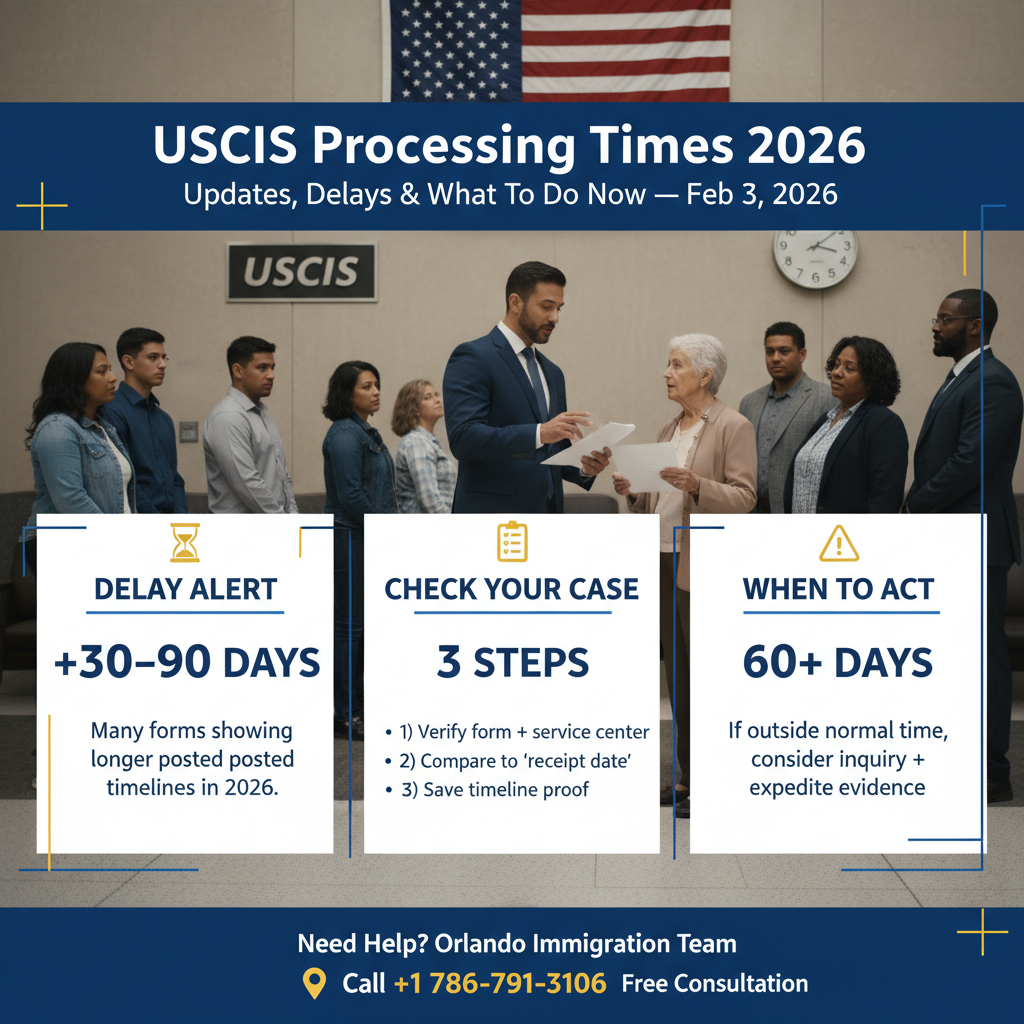
The reporting that sparked this guide: USCIS Processing Times and Updates for 2026 (USCIS)
Need Help? Our Orlando immigration team is ready to assist. Call +1 786-791-3106 for a free consultation, or message us online. Se Habla Español.
What This News Means for Immigrants in Orlando and Across Florida
Why this news is showing up now
USCIS processing times have been a top concern for families, employers, and humanitarian applicants for several years—and in 2026, the issue is still trending because the consequences of delays are immediate and personal: work authorization renewals, travel permission, interview scheduling, family reunification, and even maintaining lawful status.
USCIS publicly reports estimated processing times and “case inquiry” dates, and those numbers can change as workloads shift between service centers and field offices. In 2026, applicants are watching more closely because:
- USCIS continues to rebalance workloads across service centers and local field offices.
- Many families are filing concurrent packages (for example, Form I-130 with Form I-485) and need predictable timelines for Adjustment of Status, work permits, and interviews.
- Renewals (especially for EADs) are time-sensitive and can affect employment, driver’s licenses, and daily life.
- More applicants are using online accounts and tracking tools, which makes processing-time shifts more visible.
Important: USCIS processing times are not guarantees. They are estimates based on completed cases, and your timeline depends on eligibility, background checks, evidence quality, interview needs, and which office is handling the case.
How it can affect Florida residents
For Florida residents—especially in Central Florida—processing times can affect planning for school, travel, employment, and family emergencies. If your case is in Orlando, your final interview and decision for many benefits (like family-based Adjustment of Status or naturalization) may involve The Orlando USCIS Field Office. Local office workloads can change, and those changes may impact interview scheduling.
For Central Florida residents along the I-4 corridor (including Orange County and neighboring counties), longer processing times can create practical issues such as:
- Gaps in employment authorization if an EAD renewal is filed late or a request for evidence (RFE) is mishandled.
- Delayed international travel plans if Form I-131 Advance Parole is pending.
- Family separation if consular processing is delayed after an Form I-130 approval.
- Difficulty proving lawful presence for state agencies when documents are pending.
Warning: Delays can also increase the risk of falling out of status for certain nonimmigrants if they rely on timely adjudication to change or extend status.
What USCIS Processing Times and Updates for 2026 Is (and Why It Matters)
A plain-English definition
“USCIS processing times” are USCIS’s published estimates of how long it takes to decide certain immigration applications and petitions—such as family petitions, green card applications, work permits, travel documents, naturalization, and more. In 2026, “updates” refers to the ongoing changes USCIS makes to:
- How it calculates processing times
- Which cases are prioritized
- Where cases are routed (service center vs. field office)
- How applicants can submit inquiries when a case is outside normal time
These updates matter because they influence real-world decisions: when to file, how to avoid gaps, whether to request expedited processing, and how to plan around the 90-day window for certain renewals or the 180 days automatic extension rules that may apply to some EAD categories.
Key terms you need to know
- Processing Time: An estimate of how long USCIS takes to complete a case type at a specific office.
- Receipt Notice (Form I-797C): Proof USCIS accepted your filing and assigned a receipt number.
- RFE (Request for Evidence): USCIS asks for missing documents or clarification; responding correctly can prevent denial.
- NOID (Notice of Intent to Deny): USCIS warns it plans to deny unless you overcome concerns with evidence and legal argument.
- Biometrics: Fingerprints/photo/signature used for identity and background checks.
- Expedite Request: A request for faster processing based on USCIS criteria (e.g., severe financial loss, urgent humanitarian reasons).
- Priority Date: Your place in line for a visa category (especially important in family- and employment-based cases). Your Priority Date can control when you can file or finalize a green card.
- Adjustment of Status: Applying for a green card from inside the U.S., commonly through Form I-485.
Reminder: Processing times differ by form, category, and office. A “fast” timeline for one form may be “slow” for another.
Current Immigration Law: The Foundation
USCIS processing times don’t exist in a vacuum. They operate within federal immigration law, agency regulations, security checks, and annual visa limits. Understanding the legal foundation helps you set realistic expectations and avoid mistakes that cause avoidable delays.
Federal requirements
USCIS adjudicates benefits under the Immigration and Nationality Act (INA) and related federal regulations, including:
- INA § 201–203 (8 U.S.C. §§ 1151–1153): Family- and employment-based immigrant visa categories and numerical limits.
- INA § 245 (8 U.S.C. § 1255): Eligibility rules for Adjustment of Status via Form I-485.
- INA § 204 (8 U.S.C. § 1154): Family petition process via Form I-130 and employment petition rules.
- INA § 316 (8 U.S.C. § 1427): Naturalization eligibility requirements (residence, physical presence, good moral character).
- 8 C.F.R. Parts 103, 204, 245, 274a, 316: Key regulations for filings, evidence, EADs, and naturalization procedures.
USCIS publishes official guidance, filing instructions, and processing-time tools on the USCIS official website, including the official processing time portal: USCIS Processing Times. For form editions, fees, and filing addresses, use: USCIS Forms.
Important: Even when USCIS is “backlogged,” the legal requirements do not change. A case can be delayed and still be denied if eligibility is not met or evidence is insufficient.
Florida-specific considerations
Immigration law is federal, but living in Florida can shape how delays affect you. For Central Florida residents, practical considerations include:
- Local interview scheduling: Many cases require an interview at The Orlando USCIS Field Office, and local workload impacts timing.
- Mail reliability and address changes: If you move within Orange County or along the I-4 corridor, timely address updates can prevent missed biometrics or interview notices.
- State-level documentation: Delays can complicate driver’s license renewals, employment onboarding, and benefits verification depending on your category and documentation.
Reminder: Always update your address with USCIS promptly (generally within 10 days of moving) to avoid missed notices that can lead to denial for abandonment.
Need Help? Our Orlando immigration team is ready to assist. Call +1 786-791-3106 for a free consultation, or message us online. Se Habla Español.
How to Track and Respond to USCIS Processing Times in 2026: A Complete Step-by-Step Guide
1) Confirm your exact case type, category, and office
Processing times only make sense when you match the correct form, category, and office. For example, Form I-485 timelines vary depending on whether the basis is family, employment, asylum-related, or other categories—and whether your case is handled by a field office or a service center.
- Required documents / info:
- Receipt notice(s) (Form I-797C) for every filing
- Receipt number (e.g., IOE, MSC, LIN, SRC, WAC, etc.)
- Filing category (immediate relative vs. preference category; employment category; etc.)
- Your current address and any prior addresses used on the filing
If your case is in Orlando, identify whether your case is assigned to a service center for initial steps and later to The Orlando USCIS Field Office for interview/decision.
2) Check the official USCIS processing-time tool the right way
Use the official portal at USCIS Processing Times. Select:
- Form type (e.g., Form I-130, Form I-485, Form I-765, Form N-400)
- Category (this is crucial)
- Office (service center or field office)
- Required documents / info:
- Receipt notice with “Received Date”
- Office listed in your USCIS online account (if applicable)
- Any transfer notices (USCIS sometimes transfers cases between offices)
Important: USCIS often provides two key pieces of data: (1) an estimated time range and (2) a “case inquiry date.” If your receipt date is earlier than the case inquiry date, you may be eligible to submit an “outside normal processing time” request.
3) Track your case status and watch for RFEs, biometrics, and interview notices
Processing times can change overnight, but your case status updates and notices are what really matter. Track your receipt number and check your USCIS online account (if you have one). Keep an eye out for:
- Biometrics appointment notice
- RFE or NOID
- Medical exam issues (for Form I-485)
- Interview scheduling
- Requests to reschedule (which can add months)
- Required documents / info:
- All USCIS notices received (scan and save PDFs)
- Evidence you already submitted (complete copy of your filing)
- Any prior immigration history documents (I-94s, visas, approvals)
Warning: Missing a biometrics or interview appointment can lead to denial for abandonment. If you must reschedule, do it properly and keep proof.
4) Use the “outside normal processing time” inquiry and escalation options
If your case is beyond the “case inquiry date,” you may submit a service request through USCIS. If that doesn’t resolve the issue, escalation options may include:
- USCIS service request (online or by phone)
- Requesting a Tier 2 callback (when appropriate)
- Ombudsman assistance (case-by-case)
- Congressional inquiry through your U.S. Representative or Senator
- Required documents / info:
- Receipt number and receipt date
- Evidence of urgent need (job loss risk, medical issues, family emergency)
- Copies of prior service request confirmations
Reminder: An inquiry does not force approval—it prompts review and can correct administrative delays (lost files, unlinked biometrics, etc.).
5) Consider an expedite request (only when you meet USCIS criteria)
Expedite requests are not “premium processing” for most family cases; they are discretionary and require strong evidence. USCIS expedite criteria commonly include severe financial loss, urgent humanitarian reasons, nonprofit cultural/social interests, U.S. government interests, or clear USCIS error.
- Required documents / info:
- Employer letters showing imminent job loss or start date tied to EAD
- Medical letters and proof of urgent treatment needs
- Proof of financial harm (eviction notice, utility shutoff, bank statements)
- Evidence of family emergency (hospitalization, death certificate, etc.)
Important: Expedite success often depends on documentation quality and whether your case type is eligible for expedite handling.
6) Plan around travel, work, and status maintenance while you wait
Delays are not just frustrating—they can create legal risk if you travel without proper permission or let a status lapse. Your strategy should include:
- Whether you can travel while Form I-485 is pending (often requires approved Advance Parole via Form I-131, unless you hold certain valid statuses)
- Whether your EAD category qualifies for an automatic extension (commonly up to 180 days for eligible categories when timely filed)
- Whether you need to file an extension/change of nonimmigrant status while an immigrant process is pending
- Required documents / info:
- Passport biographic page and expiration date
- Current I-94 record (downloadable from CBP if applicable)
- Current EAD card and category code (if applicable)
- Copies of pending receipt notices
Warning: Traveling without proper authorization can result in USCIS treating your pending application as abandoned in many scenarios.
Need Help? Our Orlando immigration team is ready to assist. Call +1 786-791-3106 for a free consultation, or message us online. Se Habla Español.
Practical Steps You Can Take Today
Processing times may be outside your control, but preparation is not. Here are practical, high-impact steps you can take now to reduce delays and protect your case in 2026.
Actionable checklist (do these this week)
- 1) Build a complete “USCIS case file” binder (paper + digital): Include every form, every notice, every piece of evidence, and a mailing log.
- 2) Confirm your address is correct everywhere: USPS, USCIS account, and on any pending filings. Keep proof of updates.
- 3) Track processing times monthly (not daily): Use USCIS Processing Times and note the case inquiry date.
- 4) Prepare for an RFE before it happens: Identify weak points (missing translations, insufficient joint evidence, unclear employment history).
- 5) Calendar renewal windows: For many renewals, filing early can prevent gaps. Track the 90-day window when it applies to your benefit and the 180 days automatic extension rules if your EAD category qualifies.
- 6) Avoid unnecessary international travel: Especially if you have a pending Adjustment of Status case and no approved travel document.
Document preparation guidance
- Use clear scans, readable copies, and consistent naming (e.g., “I-130_MarriageCert_2026-01-15.pdf”).
- Include certified translations for any non-English documents (with translator certification).
- For family cases, organize bona fide relationship evidence by timeline (leases, insurance, bank statements, photos, affidavits).
- For employment cases, keep pay stubs, W-2s, offer letters, and job descriptions consistent across filings.
Timeline expectations (realistic planning)
In 2026, many applicants should plan for variability rather than a single “normal” timeline. A single case may move quickly at one stage (receipt/biometrics) and slow down later (interview scheduling or final review). For families in Orange County and across the I-4 corridor, it’s wise to plan for:
- Multiple months between key milestones, especially if an interview is required.
- Additional time if you receive an RFE (USCIS review resumes after your response is received and logged).
- Potential delays when cases are transferred between offices.
Reminder: Always rely on the official tools and notices, not social media timelines.
How Imigrar Helps Immigrants in Orlando
At Imigrar, we focus on strategies that reduce delays and protect families—because our mission is to Keep Families Together. We serve clients in Orlando and nationwide, with special attention to the realities of local processing at The Orlando USCIS Field Office and the practical needs of Central Florida residents.
Our team helps by:
- Reviewing eligibility and identifying red flags before filing (prior immigration history, unlawful presence, misrepresentation concerns).
- Preparing strong filings for Form I-130, Form I-485, Form I-765, Form I-131, and Form N-400 with organized evidence.
- Responding to RFEs/NOIDs with clear legal arguments and complete documentation.
- Planning around travel/work issues and protecting status while cases are pending.
- Guiding clients through interview preparation—especially for family-based green cards and naturalization.
We offer a free consultation to help you understand your timeline, options, and next steps. Se Habla Español.
Need Help? Our Orlando immigration team is ready to assist. Call +1 786-791-3106 for a free consultation, or message us online. Se Habla Español.
Frequently Asked Questions
Q: Am I eligible to file Form I-485 if my Form I-130 is still pending?
A: Sometimes. Immediate relatives of U.S. citizens (spouses, unmarried children under 21, and parents of U.S. citizens over 21) can often file concurrently—meaning Form I-130 and Form I-485 together—if they are otherwise eligible under INA § 245. Preference categories may need to wait until the Priority Date is current under the Visa Bulletin (see U.S. Department of State). Eligibility also depends on lawful entry and other factors. A legal review is strongly recommended.
Q: Will long USCIS processing times affect my current immigration status?
A: It depends on what you filed and what status you currently hold. Some applicants remain in a “period of authorized stay” while a properly filed application is pending (common with Adjustment of Status), but others must maintain an underlying nonimmigrant status (like F-1 or H-1B) to avoid problems. Warning: Do not assume a pending petition automatically protects you. Get case-specific advice.
Q: How can I estimate my timeline in 2026?
A: Use the official tool at USCIS Processing Times and select the correct form, category, and office. Then compare your receipt date to the “case inquiry date.” If your case is handled locally, remember that The Orlando USCIS Field Office interview availability can affect the final timeline for Central Florida residents.
Q: What documents most commonly cause delays or RFEs?
A: Common RFE triggers include missing civil documents (birth/marriage/divorce certificates), missing translations, unclear proof of lawful entry (I-94), insufficient relationship evidence for marriage cases, incomplete financial sponsorship evidence for Form I-864, and outdated medical exams for Form I-485. A complete, well-organized filing reduces delays.
Q: How much does it cost to file, and do processing delays change fees?
A: Filing costs depend on the form(s) and your category. USCIS fees can change, and processing delays do not usually reduce fees. Always confirm current fees and edition dates on USCIS Forms. If cost is a concern, ask about fee waiver eligibility for certain forms (where permitted) and budget for medical exams, translations, and mailing.
Q: What happens if USCIS denies my case after a long wait?
A: The next steps depend on the form and the reason for denial. Some denials allow a motion to reopen/reconsider, some allow an appeal, and some require refiling. In certain situations, a denial may place someone at risk of being referred to immigration court, where proceedings are handled by EOIR (see Executive Office for Immigration Review). If you receive a denial, act quickly and get legal advice immediately.
Q: Can I speed up my case if there’s an emergency?
A: Possibly. USCIS may grant an expedite request for urgent humanitarian reasons, severe financial loss, or other qualifying grounds. You must provide strong documentation. If your case is in Orlando, you may still request expedite, but USCIS discretion applies and outcomes vary.
Common Mistakes (and How to Avoid Them)
Mistake #1: Using the wrong processing-time category or office
Many applicants select the wrong category (for example, wrong family preference type) or check the wrong office. That can lead to false expectations and missed opportunities to submit a timely inquiry.
- How to avoid it: Match your receipt notice, category, and office exactly. If your case was transferred, use the most current office handling the case.
Mistake #2: Filing incomplete packets and “hoping USCIS will figure it out”
In 2026, incomplete packets often lead to RFEs, delays, or denials. Missing translations, unclear copies, inconsistent addresses, and incorrect fees are common issues.
- How to avoid it: File a clean, indexed packet with a cover letter, tabbed exhibits, and a complete copy saved for your records.
Mistake #3: Traveling or changing jobs without understanding the impact
Travel and employment changes can have serious consequences depending on your case type. For example, leaving the U.S. without proper permission while Form I-485 is pending can create abandonment issues, and changing jobs in certain employment-based cases can require careful compliance.
- How to avoid it: Get legal guidance before traveling or making major employment changes while your case is pending.
Additional Official Resources (Use These in 2026)
- USCIS official website (policy updates, announcements, instructions)
- USCIS Processing Times (official time estimates and inquiry dates)
- USCIS Forms (current editions, fees, where to file)
- U.S. Department of State (Visa Bulletin, consular processing information)
- Executive Office for Immigration Review (immigration court information)
Putting It All Together for Orlando and Central Florida Families
USCIS processing times in 2026 are best approached like a project: define the case type, track the correct office, plan for delays, and respond quickly to any USCIS notice. If your case is in Orlando, remember that local interview availability at The Orlando USCIS Field Office can be a major factor—especially for marriage-based green cards and naturalization.
For Central Florida residents in Orange County and across the I-4 corridor, the most effective approach is proactive:
- File correctly the first time.
- Keep your address current.
- Build strong evidence and prepare for RFEs.
- Plan around work and travel rules.
- Escalate appropriately when your case is truly outside normal processing times.
Reminder: The “fastest” case is usually the case filed with complete evidence, consistent information, and a strategy that anticipates USCIS questions.
Need Help? Our Orlando immigration team is ready to assist. Call +1 786-791-3106 for a free consultation, or message us online. Se Habla Español.
Closing: Get a Clear Plan for Your USCIS Timeline in 2026
Processing-time updates can feel overwhelming, but you do not have to navigate them alone. Whether you’re waiting on Form I-130, preparing Form I-485 for Adjustment of Status, renewing an EAD, or planning for naturalization, the key is a clear filing strategy and a realistic timeline plan based on official tools and your specific facts.
If you’re in Orlando, Orange County, or anywhere in Central Florida along the I-4 corridor—or if you’re filing from anywhere in the U.S.—Imigrar can help you understand your options and move forward with confidence.
Call +1 786-791-3106 for a free consultation, or message us online. Se Habla Español.


