


The reporting that sparked this guide
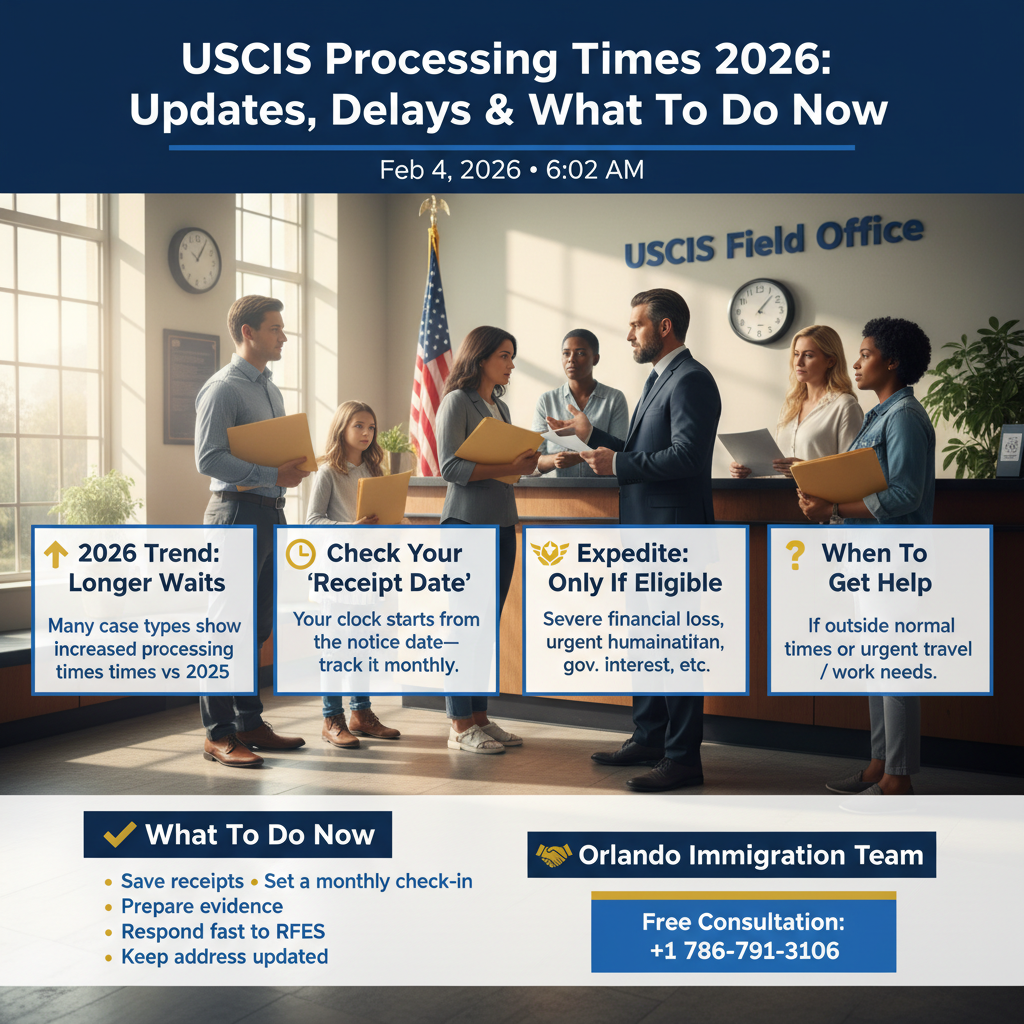
The reporting that sparked this guide: USCIS Processing Times and Updates for 2026 (USCIS)
Need Help? Our Orlando immigration team is ready to assist. Call +1 786-791-3106 for a free consultation, or message us online. Se Habla Español.
What This News Means for Immigrants in Orlando and Across Florida
Why this news is showing up now
USCIS processing times are a constant moving target, and 2026 is no exception. What’s driving the renewed attention is a combination of:
- Ongoing backlogs in certain case types (especially family-based and employment-based filings that require interviews or security checks).
- Policy and operational adjustments (staffing, workload shifts, and internal prioritization) that can speed up one form type while slowing another.
- Higher filing volumes tied to changing eligibility, humanitarian needs, and employer demand.
- Greater public reliance on tracking tools, especially the official USCIS Processing Times page, which many applicants now check weekly.
Important: “Processing time” is not a promise or a deadline. It is an estimate based on recent completions, and it can change quickly—sometimes within weeks—depending on the service center or field office handling your case.
How it can affect Florida residents
For Florida residents—and especially for families and workers along the I-4 corridor—processing time shifts can have real-life consequences:
- Work authorization timing (for example, an Employment Authorization Document linked to Adjustment of Status via Form I-485, or certain humanitarian categories).
- Travel planning (Advance Parole delays can affect weddings, funerals, business trips, and family emergencies abroad).
- Interview scheduling at field offices, including The Orlando USCIS Field Office, which may have different timelines than Miami, Tampa, or Jacksonville.
- Family unity—especially when a spouse or child is abroad and you’re waiting on Form I-130 approval and National Visa Center (NVC) processing.
- Status maintenance concerns for students, workers, or visitors approaching expiration dates while a change or extension is pending.
If your case is in Orlando, small differences in local interview availability, staffing, and caseload can change how long you wait. For Central Florida residents in Orange County and the broader I-4 corridor, that means planning ahead is not optional—it’s essential.
What USCIS Processing Times and Updates for 2026 Is (and Why It Matters)
A plain-English definition
USCIS “processing times” are the agency’s public estimates of how long it typically takes to complete certain immigration applications and petitions—like Form I-130 (family petition), Form I-485 (Adjustment of Status), Form N-400 (naturalization), and others.
In 2026, “processing time updates” refers to the fact that USCIS regularly refreshes:
- Estimated completion ranges (often displayed as a time range or “80% of cases completed by” metric).
- Which office is handling a form type (service center vs. field office).
- Public guidance about when you may submit an “outside normal processing time” request.
Reminder: The official source for these estimates is the USCIS website, not social media. Always verify using the USCIS Processing Times tool and your receipt notice.
Key terms you need to know
- Receipt Notice: The USCIS notice confirming your case was received, with a receipt number and the office handling it.
- Service Center: A USCIS processing facility that reviews many petitions (often mail-in adjudications). Your receipt prefix (e.g., “IOE,” “LIN,” “SRC,” “WAC”) can hint at routing, but routing can change.
- Field Office: A local USCIS office that usually conducts interviews for Form I-485 and Form N-400. Example: The Orlando USCIS Field Office.
- Priority Date: The date that sets your place in line for certain immigrant visas—especially employment-based and some family categories subject to annual limits. Your Priority Date is critical when using the Visa Bulletin.
- RFE (Request for Evidence): USCIS asks for additional documents. RFEs almost always extend timelines.
- NOID (Notice of Intent to Deny): USCIS believes you have not met requirements and gives you a chance to respond—high stakes, time-sensitive.
- Expedite Request: A request to speed up processing based on specific criteria (severe financial loss, humanitarian reasons, etc.). Approval is discretionary.
Warning: A “faster” published processing time does not guarantee your case will move faster—especially if your file needs background checks, an interview, an RFE response, or supervisory review.
Current Immigration Law: The Foundation
Processing times are not just an administrative issue—they interact with the legal rules that control eligibility, admissibility, filing windows, and whether you can remain in the U.S. while a case is pending.
Federal requirements
Key federal statutes and regulations that commonly shape case strategy and timing include:
- Immigration and Nationality Act (INA) provisions governing family-based and employment-based immigration, including INA §§ 201–203 (numerical limits) and INA § 245 (adjustment of status rules).
- 8 C.F.R. § 103 (USCIS procedures), including rules on filing, evidence, and responses to agency requests.
- 8 C.F.R. § 245 (adjustment regulations), including documentation and interview authority.
- INA § 212 (inadmissibility grounds) and related waivers—timing can matter if you need a waiver before approval.
Common USCIS forms that are affected by processing times include:
- Form I-130 (Petition for Alien Relative)
- Form I-485 (Application to Register Permanent Residence or Adjust Status)
- Form I-765 (Application for Employment Authorization)
- Form I-131 (Application for Travel Document / Advance Parole)
- Form N-400 (Application for Naturalization)
- Form I-751 (Petition to Remove Conditions on Residence)
- Form I-129 (Petition for a Nonimmigrant Worker)
For official guidance and the most current form editions, use the USCIS official website and the USCIS Forms library.
Florida-specific considerations
Immigration law is federal, but Florida residents often face state-level and practical issues that make timing more sensitive:
- Driver’s license and ID timing: Florida documentation rules can require careful coordination with your current immigration proof (I-94, EAD, approval notices).
- Employment verification: E-Verify usage and employer compliance culture can make EAD timing critical.
- Local office scheduling: The Orlando metro area continues to grow, and local demand can affect interview availability at The Orlando USCIS Field Office.
- Court and enforcement overlap: If someone is in removal proceedings, the timeline may also depend on the immigration court docket at EOIR. See Executive Office for Immigration Review.
Important: If you move within Florida (for example, from Orange County to Osceola or Seminole County), address updates can affect where your interview is scheduled. Always update USCIS promptly.
Need Help? Our Orlando immigration team is ready to assist. Call +1 786-791-3106 for a free consultation, or message us online. Se Habla Español.
How to Check and Respond to USCIS Processing Times in 2026: A Complete Step-by-Step Guide
1) Confirm your case type, form number, and the office handling it
Start with your receipt notice. Processing times vary dramatically depending on:
- The specific form (for example, Form I-130 vs. Form I-485).
- The category (immediate relative vs. preference category, employment-based classification, etc.).
- The office (service center or field office) assigned to your case.
Documents to gather:
- USCIS receipt notice (I-797C) for each pending form
- Copies of the full filing package submitted
- Your passport biographic page and U.S. entry record (I-94, if applicable)
- Prior approval notices, EAD cards, or travel documents
If your case is in Orlando and involves an interview (common with Adjustment of Status on Form I-485 and naturalization), your timing may depend on The Orlando USCIS Field Office calendar.
2) Use the official USCIS Processing Times tool the right way
Go to the official tool: USCIS Processing Times. Select:
- Form type (example: Form I-485)
- Category (example: family-based adjustment, employment-based adjustment, etc.)
- Office (service center or field office listed on your receipt or USCIS account)
Many applicants accidentally choose the wrong category, which can create unnecessary panic or false confidence.
Documents to gather:
- Receipt number(s)
- USCIS online account login (if you have one)
- Screenshot or PDF of the processing time result (for your records)
Reminder: USCIS may present an “estimated time range” and an “inquiry date.” The inquiry date is the earliest date you can usually submit an “outside normal processing time” request for that case type.
3) Compare your receipt date to the “inquiry date” and decide your next move
Once you have the USCIS inquiry date, compare it to:
- Your receipt date (from the I-797C).
- Any RFE/NOID deadlines you’re facing.
- Critical life events: job offers, expiring status, planned travel, family emergencies.
Documents to gather:
- RFE/NOID notices (if any)
- Proof of urgency (job offer letter, medical documentation, financial statements)
- Evidence of maintaining status (I-20 for students, I-797 approvals for workers, etc.)
Warning: Do not assume you can remain in the U.S. just because something is “pending.” Whether you are in authorized stay depends on your category and filing posture. This is especially sensitive for visitors and certain nonimmigrant statuses.
4) Respond perfectly to RFEs and avoid rejections that restart the clock
One of the biggest reasons cases slow down in 2026 is avoidable: incomplete filings or weak responses to RFEs.
Documents to gather (typical examples—varies by case):
- Updated civil documents (birth certificates, marriage certificates, divorce decrees)
- Proof of bona fide marriage (joint lease, insurance, bank statements, photos)
- Financial sponsorship evidence for Form I-864 (tax transcripts, W-2s, pay stubs)
- Medical exam (often Form I-693 for Form I-485 cases, as required)
- Translation certificates for non-English documents
Important: An RFE has a hard deadline. Missing it can cause a denial. A denial can trigger additional consequences (loss of work authorization eligibility, referral to removal proceedings in some situations, or the need to refile).
5) Use case tools: online account, e-Requests, Expedite, and congressional help (when appropriate)
In 2026, the most effective “next steps” depend on whether your case is truly outside normal time and whether you have a qualifying urgency.
Options may include:
- USCIS online account updates (upload requested evidence if allowed, monitor notices).
- e-Request for “outside normal processing time” (only after the inquiry date).
- Expedite request (discretionary; requires strong evidence).
- Congressional inquiry (your U.S. Representative or Senator’s office may request a status update).
- Ombudsman assistance in limited scenarios when normal channels fail (case-specific and not guaranteed).
Documents to gather:
- Proof your case is outside the posted timeframe (screenshots + receipt date)
- Evidence supporting expedite criteria (financial loss, medical need, humanitarian urgency)
- Signed privacy release form (for congressional inquiries)
Reminder: Expedite requests are not “pay to win.” They are granted only if you meet criteria and USCIS agrees.
6) Plan for the “second half” of the process: State Department, NVC, and interviews
Many families focus only on USCIS. But for consular processing, USCIS is only step one. After Form I-130 approval, many cases move to the Department of State.
- Track consular steps through the U.S. Department of State resources.
- Expect document collection, fees, and interview scheduling abroad.
- Be ready for additional security checks and medical exams.
Documents to gather:
- Approved I-130 notice (I-797)
- Police certificates (country-specific requirements)
- Passport validity confirmation
- Affidavit of Support documents (Form I-864)
- Relationship evidence (for spousal cases)
Important: Processing time stress often comes from not knowing which agency has the file. USCIS, NVC, and the consulate each have different timelines.
Practical Steps You Can Take Today
Processing times can feel out of your control—but your case quality and readiness are absolutely within your control. Here is a practical checklist that helps many Florida families and workers reduce delays and protect status.
- 1) Build a “USCIS master file”: keep every receipt, notice, and filing copy in one folder (digital + paper).
- 2) Track your case weekly using your receipt number and the official tools: USCIS official website and USCIS Processing Times.
- 3) Pre-prepare RFE-ready evidence:
- Updated joint documents (leases, utilities, insurance)
- Tax transcripts and pay stubs
- Certified translations
- 4) Align travel plans with your case posture: do not depart the U.S. without understanding the impact on Adjustment of Status and pending benefits.
- 5) Calendar critical dates:
- RFE deadlines
- Biometrics appointments
- Passport expiration
- Work permit renewal timing (often wise to file early when eligible)
- 6) Keep your address updated immediately after moving to avoid missed notices and interview confusion—especially along the I-4 corridor where moves between counties are common.
Timeline expectations (general): In 2026, many applicants should expect variability. Some cases may move surprisingly fast; others may stall after biometrics or before interview scheduling. A realistic plan includes budgeting time for at least one “pause” (RFE, background check, or interview queue).
Reminder: If you have a deadline-driven situation (job offer, expiring status, urgent travel), you may need a strategy beyond simply waiting.
Need Help? Our Orlando immigration team is ready to assist. Call +1 786-791-3106 for a free consultation, or message us online. Se Habla Español.
How Imigrar Helps Immigrants in Orlando
At Imigrar, we focus on practical, family-centered immigration solutions aligned with our tagline: Keep Families Together. We serve clients in Orlando, across Central Florida, and nationwide.
When processing times shift in 2026, our role is to help you:
- Choose the correct process (consular processing vs. Adjustment of Status under Form I-485).
- File strong, organized packages that reduce RFEs and delays.
- Prepare for biometrics and interviews at The Orlando USCIS Field Office.
- Respond strategically to RFEs/NOIDs with persuasive legal and factual support.
- Evaluate expedite options and timing-sensitive filings.
We offer a free consultation to help you understand your timeline, risks, and next steps. Se Habla Español.
Frequently Asked Questions
Q: Am I eligible to file Form I-485 if my Form I-130 is still pending?
A: Sometimes. If you are an “immediate relative” of a U.S. citizen (spouse, unmarried child under 21, or parent of a U.S. citizen over 21) and you are otherwise eligible, you may be able to file Form I-130 and Form I-485 together (“concurrent filing”). For preference categories, you usually need a current Priority Date based on the Visa Bulletin. A lawyer can confirm whether concurrent filing is allowed in your category and whether any inadmissibility issues apply.
Q: How do USCIS processing times affect my current immigration status?
A: It depends on what you filed and your current status. Some filings place you in a period of authorized stay; others do not. For example, many people filing Adjustment of Status with Form I-485 may remain while it is pending, but travel and work require separate authorization unless you already have it. Warning: Overstays or status violations can create serious problems in certain categories. If you are unsure, get a case-specific review before relying on “pending = safe.”
Q: How can I estimate my timeline if my case is handled by The Orlando USCIS Field Office?
A: Use the USCIS Processing Times tool and select the Orlando field office where applicable (for forms like Form N-400 and some Form I-485 categories). Then compare your receipt date to the posted “inquiry date.” If your case is past that date, you may be eligible to submit an “outside normal processing time” request. For Central Florida residents, interview scheduling is often the biggest variable.
Q: What documents most often cause delays or RFEs?
A: Common RFE triggers include missing civil documents, weak relationship evidence, incomplete financial sponsorship, and translation issues. For family cases, USCIS often wants clear proof of a real marriage (joint lease, joint bank, insurance, children’s birth certificates if applicable). For Form I-485, medical exam issues (such as missing signatures or outdated forms) can also delay approval. Keeping a complete “evidence binder” reduces stress and delays.
Q: How much does it cost to deal with long processing times (expedites, refiling, attorney help)?
A: USCIS filing fees vary by form and can change, so always verify on the USCIS Forms page and the specific form instructions. Expedite requests generally do not have an extra USCIS fee, but they require strong documentation. Refiling after a rejection or denial can be expensive because you may pay filing fees again and lose time. Attorney fees vary by complexity; a consultation can help you budget and avoid costly mistakes.
Q: What happens if my application is denied after a long wait?
A: A denial can have different consequences depending on the benefit sought and your current status. Options may include a motion to reopen/reconsider, an appeal (where permitted), refiling, or pursuing a different pathway. If you are placed in removal proceedings or already in court, the timing and strategy may involve EOIR; see Executive Office for Immigration Review. Important: Do not ignore a denial notice—deadlines can be short, sometimes within a 90-day window or less depending on the remedy.
Q: Can I travel while my Form I-485 is pending in 2026?
A: Many applicants should not travel internationally without Advance Parole or another valid status that permits reentry. Leaving the U.S. without proper authorization can be treated as abandoning Adjustment of Status. Warning: Travel rules are highly case-specific (prior overstays, unlawful presence, pending waivers, or certain statuses). Talk to an attorney before booking international travel.
Q: What if USCIS hasn’t updated my case for more than 180 days?
A: A long silence does not always mean something is wrong—background checks and interview queues can take time. First, confirm you are still within posted processing times. If you are outside normal times, submit an e-Request and keep proof. If that doesn’t work, a congressional inquiry or Ombudsman request may help in appropriate cases. If your livelihood or family safety is affected, you may also consider an expedite request with strong evidence.
Common Mistakes (and How to Avoid Them)
Mistake #1: Using the wrong processing-time category or office
Many people select the wrong category in the processing time tool (for example, choosing a different eligibility basis for Form I-485). That can lead to bad decisions—like filing inquiries too early or waiting too long.
How to avoid it: Match your receipt notice category and office. If unsure, confirm with a legal professional.
Mistake #2: Treating an RFE like a simple “document upload”
RFEs are legal requests, not casual reminders. A weak response can lead to denial even if you were eligible.
How to avoid it: Respond with a well-organized packet, tabbed exhibits, and a cover letter that explains how each document satisfies the request. Meet the deadline—no exceptions.
Mistake #3: Making life decisions (travel, quitting a job, moving) without checking immigration consequences
Delays can pressure people into risky choices—international travel without permission, moving and missing mail, or letting a work permit expire.
How to avoid it: Build a timeline plan. If you are in Orlando or Central Florida and you move within the I-4 corridor, update your address immediately and keep proof.
Need Help? Our Orlando immigration team is ready to assist. Call +1 786-791-3106 for a free consultation, or message us online. Se Habla Español.
USCIS Processing Times in 2026: Putting It All Together (Orlando Focus)
Processing time updates matter most when you connect them to your real case strategy. Here’s a practical way to think about it if you live in Orange County or nearby:
- Identify your “decision-maker”: service center vs. The Orlando USCIS Field Office.
- Understand your bottleneck: biometrics, RFE, interview queue, background checks, visa availability (Priority Date), or consular scheduling.
- Protect your work and travel: EAD and Advance Parole planning is often the difference between stability and crisis.
- Keep your case “interview-ready”: updated relationship evidence, updated job letters where relevant, and clean documentation.
Important: If your case involves multiple steps (USCIS + NVC + consulate), build a two-agency timeline so you don’t mistake “USCIS approved” for “visa issued.” Use the U.S. Department of State resources for the consular phase.
Official Resources to Bookmark (2026)
Closing: Don’t Let Processing Times Control Your Future
USCIS processing times in 2026 are changing—and while you can’t control USCIS capacity, you can control preparation, evidence quality, and smart timing. If you’re filing Form I-130, pursuing Adjustment of Status with Form I-485, waiting on an interview in Orlando, or trying to keep your family together, a clear plan makes the wait safer and often shorter.
Reminder: The best time to fix a case is before it’s filed—or immediately after a problem appears (RFE, delay outside normal times, or a potential denial).

Get Help from Imigrar (Orlando, Florida)
Want a case strategy built around real 2026 processing times and your specific facts? Imigrar serves Orlando, Central Florida, and clients nationwide.
Call +1 786-791-3106 for a free consultation or message us online. Se Habla Español.


