


The reporting that sparked this guide
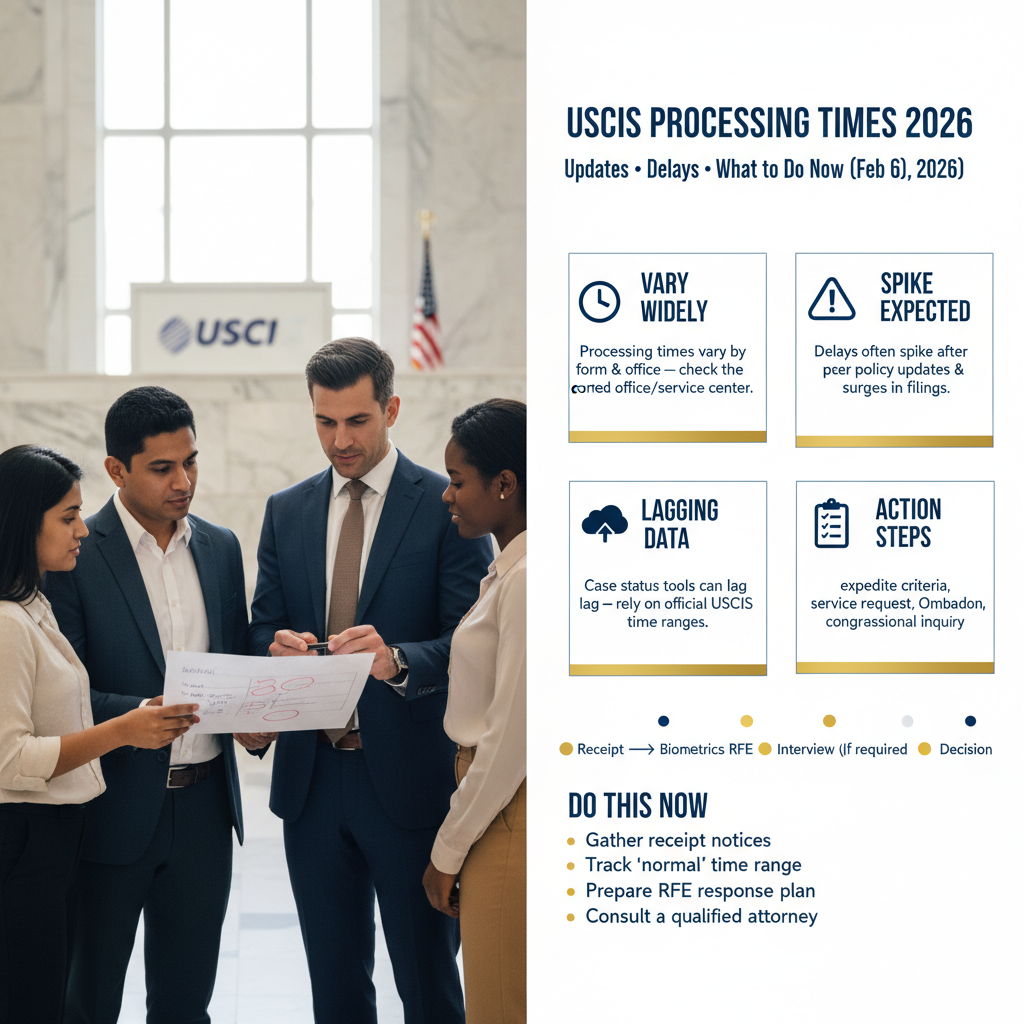
This article is based on recent USCIS-related reporting and public updates being widely circulated in immigration news feeds, including: USCIS Processing Times and Updates for 2026 (USCIS).
Important: USCIS processing times change frequently by form type, service center/field office, and case category. For the most current official data, use USCIS Processing Times and your online account at USCIS official website.
Need Help? Our Orlando immigration team is ready to assist. Call +1 786-791-3106 for a free consultation, or message us online. Se Habla Español.
What This News Means for Immigrants in Orlando and Across Florida
Why this news is showing up now
Processing time updates trend every year, but in 2026 they are especially visible because many families and workers are seeing different timelines depending on:
- Where the case is processed (service center vs. field office)
- Whether USCIS issues a biometrics appointment, RFE (Request for Evidence), or interview
- Changes in staffing, workload, and internal case routing
- Demand spikes for work permits and family-based filings
- Backlog effects in related systems (for example, consular processing through the U.S. Department of State)
Reminder: “USCIS processing time” is not one number. It varies by form, category, and location. Two people filing the same form can get very different results.
How it can affect Florida residents
For Florida residents—especially those along the I-4 corridor—processing time changes can affect day-to-day life in practical ways:
- Work authorization gaps if an EAD renewal is delayed
- Travel plans if Advance Parole is pending while Adjustment of Status is filed
- Family separation when consular processing or waivers take longer than expected
- Driver’s license and employment verification issues when documents expire before renewals arrive
- Case strategy decisions (for example, whether to file concurrently, or whether to upgrade an Form I-130 petition after naturalization)
If your case is in Orlando, timelines may be influenced by how your case is routed and whether an interview is scheduled at the Orlando USCIS Field Office. Even when a case is receipted quickly, the later steps—biometrics, interview, final review—can create the longest waits.
What USCIS Processing Times and Updates for 2026 Is (and Why It Matters)
A plain-English definition
USCIS processing times are USCIS’s published estimates for how long it takes to complete certain immigration applications and petitions. In 2026, “processing time updates” generally refers to:
- USCIS updating its online processing time ranges
- USCIS shifting workloads between service centers and field offices
- Changes in the “case inquiry date” (when you are allowed to ask USCIS about a case that is outside normal times)
- Policy or operational updates that change how quickly cases move
These times matter because they affect your ability to plan work, travel, school, family reunification, and legal compliance. A delay can create real risks if you miss a deadline like a 90-day window for certain filings, or if you rely on a document that expires in 180 days.
Key terms you need to know
- Receipt Notice (Form I-797C): Proof USCIS received your filing; it includes your receipt number.
- Biometrics: Fingerprints/photo appointment used for background checks.
- RFE: Request for Evidence—USCIS asks for more documents; this can pause or extend processing.
- NOID: Notice of Intent to Deny—USCIS plans to deny unless you respond successfully.
- Field Office: Local USCIS office that often handles interviews and final decisions for Adjustment of Status.
- Service Center: USCIS processing facility that handles many paper-based adjudications.
- Priority Date: Your place in line for a visa category (especially family preference and employment-based cases).
- Adjustment of Status: Applying for a green card from inside the United States (commonly via Form I-485).
- Consular Processing: Completing the immigrant visa process through a U.S. consulate abroad (see U.S. Department of State).
Need Help? Our Orlando immigration team is ready to assist. Call +1 786-791-3106 for a free consultation, or message us online. Se Habla Español.
Current Immigration Law: The Foundation
USCIS processing times do not exist in a vacuum. They are shaped by federal immigration law, regulations, agency procedures, and security/background check requirements.
Federal requirements
The main legal foundation is the Immigration and Nationality Act (INA), codified in Title 8 of the U.S. Code, along with federal regulations in Title 8 of the Code of Federal Regulations (8 C.F.R.). While processing time targets are operational, USCIS still must follow statutory eligibility requirements and admissibility rules.
Examples of common filings affected by 2026 processing times include:
- Family petition: Form I-130 (Petition for Alien Relative)
- Green card application: Form I-485 (Application to Register Permanent Residence or Adjust Status)
- Work permit: Form I-765 (Application for Employment Authorization)
- Travel document: Form I-131 (Application for Travel Document)
- Naturalization: Form N-400 (Application for Naturalization)
- Removal of conditions: Form I-751 (Petition to Remove Conditions on Residence)
Important: Your eligibility is governed by the law, not by how fast or slow USCIS is. Processing time changes can affect strategy (when to file, what to file together, how to avoid gaps), but they do not replace eligibility analysis.
Official resources to confirm requirements and instructions include: USCIS official website and USCIS Forms.
Florida-specific considerations
Immigration law is federal, but Florida residents face practical, location-based issues that can make delays harder:
- DMV/driver’s license timing: Many Florida credential renewals depend on unexpired immigration documents.
- Employment concentration: Central Florida’s tourism, healthcare, construction, and logistics sectors often require timely work authorization.
- Travel through major hubs: Orlando International Airport (MCO) travel plans can be disrupted if Advance Parole is pending.
- Local interview logistics: If an interview is scheduled at the Orlando USCIS Field Office, missing it can cause major delays or denial.
For Central Florida residents in Orange County and along the I-4 corridor, planning around biometrics and interview scheduling is crucial—especially when you have school, work shifts, or childcare needs.
How to Check and Respond to USCIS Processing Times in 2026: A Complete Step-by-Step Guide
1) Identify your exact form type, category, and processing location
Processing times differ based on the form, the classification, and where USCIS is handling the case. Start by confirming:
- The form number (example: Form I-130 vs. Form I-485)
- The category (example: immediate relative vs. family preference; employment category; asylum-based EAD category)
- The processing office (service center or field office)
Documents to gather for this step:
- Receipt notice(s) (Form I-797C) for each pending filing
- A copy of the full filed packet (what was submitted)
- Any USCIS online account screenshots showing the case status
- Any transfer notices (USCIS sometimes transfers cases)
2) Use the official USCIS Processing Times tool the right way
Go to USCIS Processing Times and select:
- Form type
- Form category (this is where many people choose the wrong option)
- Office (service center or field office)
USCIS will show a range and a “case inquiry date.” The inquiry date is often the most practical number: it tells you when USCIS considers a case “outside normal processing.”
Documents to gather for this step:
- Your receipt date (from Form I-797C)
- Your selected category and office (screenshots for your records)
- Any prior inquiry confirmations (if you already contacted USCIS)
3) Track your case status and notices weekly (not daily)
Case statuses can change without warning, and missing a notice can create delays. Track your case via:
- Your USCIS online account at USCIS official website
- Your mail (USCIS still sends many official notices by paper)
Warning: If you move, file a change of address promptly. Missing an RFE, biometrics appointment, or interview notice can lead to denial.
Documents to gather for this step:
- USCIS online account login details
- Proof of current address (lease, utility bill)
- Copies of every USCIS notice received to date
4) Respond to RFEs and interview notices strategically and on time
In 2026, many “delays” are actually caused by incomplete filings or weak evidence that triggers an RFE. If you receive an RFE:
- Read the request carefully and respond only with what’s asked (plus clearly labeled supporting evidence)
- Organize documents with a cover letter and exhibit list
- Mail using trackable delivery and keep proof of delivery
If you receive an interview notice (common for Adjustment of Status via Form I-485), prepare for identity, admissibility, and relationship questions.
Documents to gather for this step (common examples):
- RFE notice (original)
- Civil documents (birth certificates, marriage/divorce records)
- Proof of relationship (photos, joint lease, joint bank statements, insurance)
- Updated medical exam if required (often via Form I-693 process)
- Tax returns, W-2s/1099s, pay stubs (as applicable)
5) Use the correct escalation option when your case is truly outside normal times
If your case is beyond the published “case inquiry date,” you may be able to submit a service request. If the issue persists, there may be other options depending on the facts.
- USCIS e-Request or online inquiry (when eligible)
- Contacting USCIS by phone (document the date, time, and reference number)
- Seeking assistance through your congressional representative (casework)
- In limited situations, exploring federal court options (mandamus) with an attorney
Important: Escalation is most effective when your file is strong and complete. If the case is delayed because USCIS needs missing evidence, escalation alone rarely helps.
Documents to gather for this step:
- Processing time screenshot showing your case is outside normal times
- Receipt notice(s) and all prior notices
- Any proof of urgency (job offer, medical documentation, family emergency)
- Copies of prior service request responses
Need Help? Our Orlando immigration team is ready to assist. Call +1 786-791-3106 for a free consultation, or message us online. Se Habla Español.
Practical Steps You Can Take Today
If USCIS processing times in 2026 are affecting your plans, you can still take meaningful steps now to reduce risk and avoid preventable delays.
Actionable checklist (do these this week)
- Create a single “master file” (digital + paper) for every receipt notice, RFE, and submission.
- Check your category and office in the official tool: USCIS Processing Times.
- Confirm your mailing address is current with USCIS and that your name is on the mailbox.
- Set calendar reminders for expirations (passport, EAD, Advance Parole, I-94, medical exam timing).
- Prepare “RFE-ready” evidence now (updated pay stubs, taxes, relationship proof, translations).
- Review whether you have a Priority Date and track the Visa Bulletin when relevant (family preference/employment cases via U.S. Department of State).
Document preparation guidance
Many delays happen because documents are missing, inconsistent, or not properly translated. As a baseline:
- Use clear scans (no cut-off edges; readable stamps).
- Keep translations with a proper translator certification.
- Maintain consistency across names, dates, and addresses.
- For marriage-based cases, gather evidence across time (not only from one month).
Reminder: A well-prepared filing can reduce the chance of an RFE, which often adds months to a case.
Timeline expectations (realistic planning for 2026)
Because USCIS times vary, the best approach is to plan in ranges and build buffers:
- Expect that biometrics may be scheduled weeks after filing (sometimes reused, sometimes not).
- Expect that Adjustment of Status cases may require an interview at the Orlando USCIS Field Office depending on your case type.
- Expect that an RFE response can restart internal review timelines.
- Plan work/travel so you are not relying on “best case” timing.
Warning: Do not travel internationally while Form I-485 is pending unless you understand the rules and have a valid travel document (or qualify for a narrow exception). Speak with an attorney before traveling.
How Imigrar Helps Immigrants in Orlando
At Imigrar, we help families and individuals navigate USCIS delays with a strategy that focuses on building strong filings, preventing RFEs, and taking the right escalation steps at the right time. Our mission is to Keep Families Together.
- Case strategy aligned with your goals (family unity, work authorization, permanent residence, citizenship)
- Complete filing preparation and evidence organization
- RFE/NOID responses with clear legal and factual support
- Interview preparation for Adjustment of Status and naturalization
- Case troubleshooting when timelines exceed normal processing
We are based in Orlando and serve clients nationwide. Se Habla Español.
Call +1 786-791-3106 for a free consultation or contact us online.
Frequently Asked Questions
Q: If USCIS processing times increase in 2026, does that change my eligibility?
A: No. Processing time changes do not change the legal eligibility requirements under the INA and regulations. However, longer waits can affect practical eligibility issues—like whether you can maintain work authorization, avoid gaps in documentation, or meet a 90-day window for certain time-sensitive filings. If you’re unsure, get case-specific legal advice.
Q: Will a pending case protect my immigration status while I wait?
A: It depends on what you filed and your underlying status. A pending Form I-485 can place you in a period of authorized stay, but it is not the same as having a nonimmigrant status. Some filings do not protect status at all. Important: If you are in Orlando or elsewhere in Florida and your status is expiring, speak with an attorney before relying on “pending” as a safety net.
Q: How do I know whether my case is outside normal processing time?
A: Use the official tool at USCIS Processing Times. Select the correct form, category, and office, then compare your receipt date to the “case inquiry date.” If your receipt date is earlier than the inquiry date, you may be eligible to submit a service request.
Q: What documents should I keep ready in case USCIS issues an RFE?
A: Keep (1) civil documents (birth/marriage/divorce), (2) identity documents (passport, IDs), (3) proof of lawful entry or I-94 where applicable, (4) financial documents (tax returns, pay stubs, affidavit of support support), and (5) relationship evidence for family cases. Also keep certified translations. Having these ready can reduce response time and prevent mistakes.
Q: How much does it cost to file, and do delays increase costs?
A: USCIS filing fees vary by form and can change. Always verify current fees and filing addresses on USCIS Forms before submitting. Delays can increase costs indirectly (lost wages if an EAD is late, extra medical exams if timing expires, additional document requests). Budget for copies, translations, mailing, and potential legal help.
Q: What happens if my case is denied after a long wait?
A: The next steps depend on the form type and the reason for denial. Some denials can be reopened with a motion, appealed, or refiled; others may trigger removal proceedings. If a case is referred to immigration court, information and procedures are handled through the Executive Office for Immigration Review. Warning: Do not ignore a denial notice—deadlines can be short.
Q: If my spouse petition is approved, why is the green card still taking so long?
A: Many family cases involve multiple steps. For example, Form I-130 approval does not automatically grant a green card. If you’re in the U.S., you may still need Adjustment of Status via Form I-485. If you’re abroad, you may need consular processing through the U.S. Department of State. Each step has separate queues and requirements.
Common Mistakes (and How to Avoid Them)
Mistake #1: Using the wrong category in the USCIS processing time tool
Many forms have multiple categories (and selecting the wrong one can make you think your case is late when it isn’t—or vice versa). How to avoid it: Match your receipt notice category and read the dropdown options carefully. When in doubt, consult an attorney.
Mistake #2: Submitting incomplete evidence and triggering an RFE
RFEs commonly add months. How to avoid it: Build a well-organized packet, include required civil documents, and provide strong relationship/eligibility evidence from the start—especially for Form I-130 and Form I-485 cases.
Mistake #3: Missing appointments or notices due to address issues
Missed biometrics or interviews can lead to denial. How to avoid it: Keep your address updated, monitor your USCIS account, and save every notice. If your case is in Orlando, plan ahead for appointments at the Orlando USCIS Field Office and arrive early due to traffic along the I-4 corridor.
Additional Official Resources (Bookmark These)
Need Help? Our Orlando immigration team is ready to assist. Call +1 786-791-3106 for a free consultation, or message us online. Se Habla Español.

Closing: Get a 2026 Processing-Time Strategy Built for Your Case
USCIS processing times in 2026 can feel unpredictable—but your plan doesn’t have to be. The best way to protect your work, travel, and family goals is to file correctly, respond quickly, and escalate only when it truly helps.
If your case is in Orlando, if you live in Orange County, or if you’re anywhere in Central Florida along the I-4 corridor, our team can help you understand what the published timelines mean for your specific case and what to do next.
Need help now? Call Imigrar at +1 786-791-3106 for a free consultation, or message us online. Se Habla Español.


