


The reporting that sparked this guide
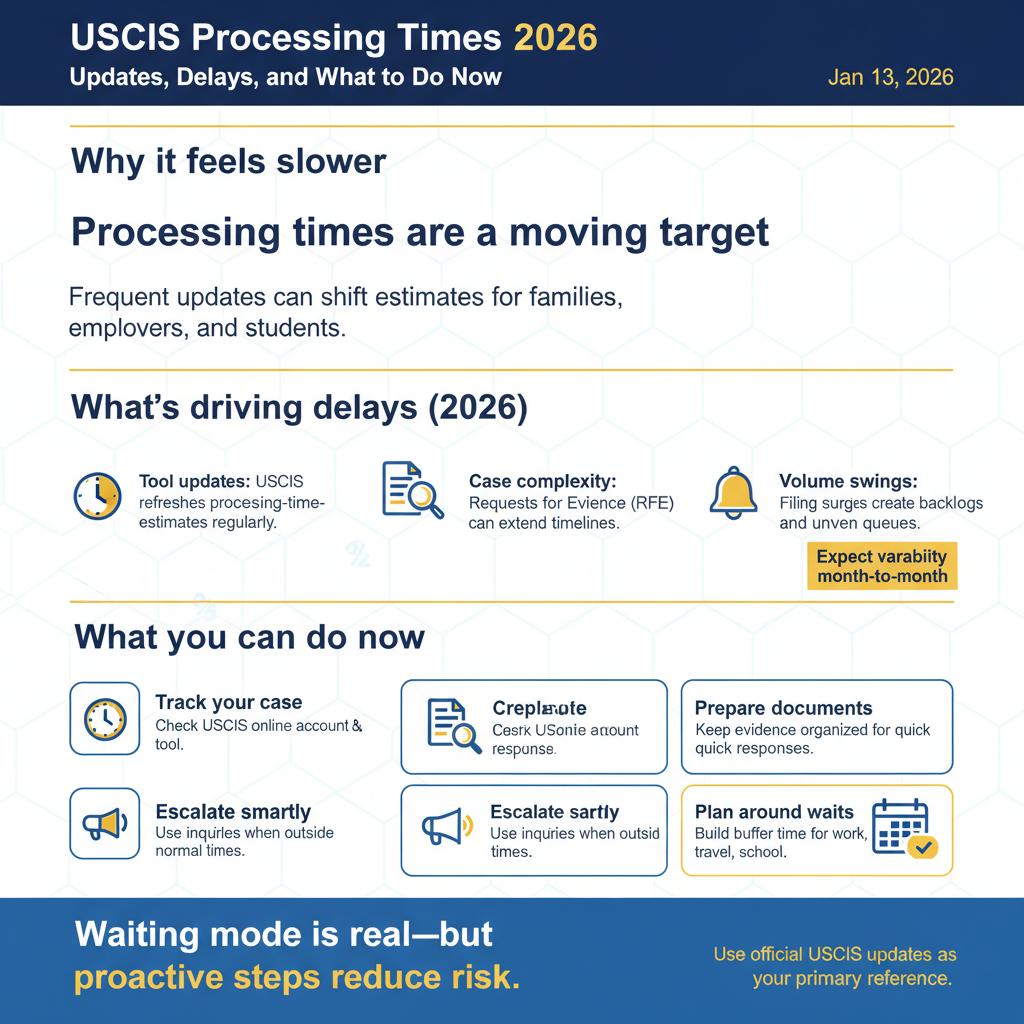
USCIS processing times are a moving target—and they’re a major reason families, employers, and students feel stuck in “waiting mode.” The news and updates that prompted this 2026 guide are reflected in:
USCIS Processing Times and Updates for 2026 (USCIS)
Reminder: USCIS updates processing tools and internal workloads throughout the year. Always verify your specific form and office using the official tracker: USCIS Processing Times.
Need Help? Our Orlando immigration team is ready to assist. Call +1 786-791-3106 for a free consultation, or message us online. Se Habla Español.
What This News Means for Immigrants in Orlando and Across Florida
Why this news is showing up now
Processing time conversations trend whenever USCIS updates its public estimates, changes internal workflows, or experiences new filing surges. In 2026, applicants are watching processing times closely because:
- USCIS continues to rebalance workloads across service centers and field offices to reduce backlogs.
- More cases are being routed for additional review (including identity, security, and fraud-prevention checks), which can extend timelines even when a case is otherwise approvable.
- Demand remains high for family-based immigration, work permits, naturalization, and humanitarian programs—causing uneven wait times by form type and location.
- Policy and operational updates (including interview practices, evidence standards, and digital processing expansions) can speed up some cases while slowing others.
Important: “Processing time” is not a promise. It’s a statistical estimate based on how long USCIS took to complete certain cases recently. Your timeline depends on the form, category, evidence quality, background checks, and which office handles your file.
How it can affect Florida residents
For Florida residents—especially in Central Florida along the I-4 corridor—processing times can affect everyday life: travel plans, employment authorization renewals, driver’s license renewals, and family stability.
- Work authorization timing: If you’re filing Form I-485 (green card through Adjustment of Status), your Form I-765 work permit timeline can determine whether you can start or keep a job.
- Family separation risk: Delays on Form I-130 petitions can prolong time apart for spouses, parents, and children.
- Travel uncertainty: Pending applicants may need Form I-131 (Advance Parole) to travel. Delays can force families to postpone emergencies or important events abroad.
- Local office differences: If your case is in Orlando, your interview scheduling and final decision may depend on the Orlando-area caseload and how USCIS distributes appointments.
In practical terms: staying organized, filing correctly, and tracking your case using the right tools can reduce avoidable delays—especially when USCIS is moving fast on some case types and slow on others.
Need Help? Our Orlando immigration team is ready to assist. Call +1 786-791-3106 for a free consultation, or message us online. Se Habla Español.
What USCIS Processing Times and Updates for 2026 Is (and Why It Matters)
A plain-English definition
USCIS processing times are USCIS’s published estimates of how long it takes to decide certain immigration applications and petitions. In 2026, “updates” generally refer to changes in:
- USCIS’s posted time ranges for a specific form and office
- How USCIS calculates time (including “typical” completion time and “case inquiry date”)
- Operational priorities (for example, backlog reduction or faster EAD adjudications)
- Digital processing, staffing, and workload reassignments
Why it matters: these timelines influence when you can work, travel, obtain permanent residence, or become a U.S. citizen—and they determine when you can escalate a case that appears stuck.
Key terms you need to know
- Receipt Notice (Form I-797C): Proof USCIS received your filing and assigned a receipt number.
- Biometrics Appointment: Fingerprints/photo appointment used for background checks. Missing it can delay or derail a case.
- RFE (Request for Evidence): USCIS asks for more documents. Responding late or incompletely can cause denial.
- NOID (Notice of Intent to Deny): USCIS believes the case should be denied unless you overcome concerns with evidence and legal argument.
- Case Inquiry Date: The date when USCIS says you may submit an “outside normal processing time” request.
- Priority Date: In many family- and employment-based categories, your place in line for a visa number. Your Priority Date is critical for consular processing and some green card pathways.
- Adjustment of Status: Applying for a green card inside the U.S., typically using Form I-485.
- Consular Processing: Applying for an immigrant visa at a U.S. consulate abroad after petition approval (often involving the U.S. Department of State).
- 180 days and the 90-day window: These timeframes often matter for renewals, responses, and strategic filing (for example, certain EAD renewals and naturalization timing). Warning: The correct window depends on the benefit type—always confirm the rule for your specific form.
Important: USCIS processing times are not uniform across the country. Two applicants filing the same form may have very different timelines depending on the service center, field office, background check results, and evidence quality.
Current Immigration Law: The Foundation
Processing times don’t exist in a vacuum—they are tied to legal requirements, annual visa limits, eligibility rules, and mandatory security screening. Understanding the legal framework helps you predict what can (and cannot) be sped up.
Federal requirements
Most USCIS benefits are governed by the Immigration and Nationality Act (INA) and related federal regulations in 8 C.F.R. Key legal concepts that affect processing include:
- Eligibility criteria set by the INA: For example, immediate relative categories, family preference categories, employment-based categories, and humanitarian benefits each have distinct requirements.
- Visa availability limits: Many green card categories are subject to annual numerical caps. Even if USCIS is fast, a visa number may not be available—your Priority Date controls when you can finalize.
- Mandatory background and security checks: USCIS must complete identity and security screening before approval.
- Evidence standards: USCIS can issue RFEs/NOIDs if the initial filing doesn’t meet the burden of proof.
Common USCIS forms tied to these federal rules include:
- Form I-130 (Petition for Alien Relative)
- Form I-485 (Application to Register Permanent Residence or Adjust Status)
- Form I-765 (Application for Employment Authorization)
- Form I-131 (Application for Travel Document)
- Form N-400 (Application for Naturalization)
- Form I-751 (Petition to Remove Conditions on Residence)
For official instructions and filing updates, use the USCIS official website and the forms library at USCIS Forms.
Florida-specific considerations
Immigration law is federal, but Florida residents face practical, location-based issues that can influence timelines and outcomes:
- Field office scheduling: The Orlando region’s appointment capacity can affect interview dates for Adjustment of Status and naturalization.
- Mailing and address stability: Central Florida residents who move frequently along the I-4 corridor (Orlando, Kissimmee, Sanford, Daytona, Tampa) must update addresses promptly to avoid missed biometrics or interview notices.
- State-level document access: Delays getting certified records (birth, marriage, divorce) can slow filings. Plan ahead if you need documents from Orange County or other Florida counties.
- Immigration court overlap: If you have removal proceedings, your case may involve the Executive Office for Immigration Review (EOIR). That can change strategy and timing (for example, whether USCIS or the Immigration Judge has jurisdiction over parts of the case).
Reminder: If your case is in Orlando, keep an eye on where USCIS is actually processing it—many forms are handled at service centers outside Florida, even if you live in Orange County.
How to Track and Respond to USCIS Processing Times in 2026: A Complete Step-by-Step Guide
This step-by-step system is designed for the most common situation: you filed (or will file) a USCIS application/petition and want to avoid delays, respond correctly to USCIS, and escalate only when appropriate.
1) Identify your form type, category, and where it’s being processed
Start by confirming exactly what you filed and which office is handling it. Processing times vary by form and by office/service center.
- Required documents/info:
- USCIS receipt notice(s) (I-797C) showing receipt number
- Copy of the full filed packet (or PDF submission confirmation)
- Filing date and delivery confirmation (if mailed)
- Your current address and any prior addresses since filing
Then check the official tool: USCIS Processing Times. Select your form (for example, Form I-130 or Form I-485) and the relevant office or service center shown on your receipt.
Warning: Many applicants accidentally check the wrong office (e.g., the Orlando Field Office when the receipt indicates a service center). That can lead to confusion and premature escalations.
2) Compare your timeline to USCIS’s “case inquiry date” (not just the average)
USCIS typically provides a “case inquiry date”—the point at which you can request help because the case is outside normal processing time.
- Required documents/info:
- Receipt number
- Form type and filing category (e.g., immediate relative vs. preference category)
- USCIS posted processing time page screenshot or notes
Important: Two people can file on the same day and finish months apart. Use the inquiry date as your “permission slip” to escalate—not the shortest timeline you saw online.
3) Make sure USCIS can reach you: address updates, online account, and mail monitoring
Many delays happen because USCIS sends a notice that never reaches the applicant. Missed biometrics and missed interviews can add months—or trigger denial.
- Required documents/info:
- USCIS online account login (if applicable)
- Proof of address (lease, utility bill)
- Any USPS mail forwarding confirmation (if you moved)
- Copies of all USCIS notices received so far
Reminder: If you move, update USCIS promptly (and keep confirmation). This is especially important for Central Florida residents who relocate within Orange County or along the I-4 corridor.
4) Prepare for the “usual suspects”: biometrics, RFEs, and interview readiness
In 2026, many cases still pause at predictable points. You can reduce delays by preparing in advance.
- Required documents (common examples):
- Government-issued ID (passport, driver’s license)
- Birth certificates (certified copies) + certified translations if needed
- Marriage certificate/divorce decrees (if applicable)
- Tax returns (often last 1–3 years depending on benefit)
- Pay stubs/employment letters
- Proof of relationship for family cases (photos, leases, insurance, bank accounts)
- Medical exam documentation if filing Form I-485 (as required by USCIS rules)
If the Orlando USCIS Field Office schedules your interview, treat it like the final exam: bring originals, organize evidence, and be consistent with your filing.
Warning: An incomplete RFE response or missing certified records is one of the fastest ways to add months to your case—or get denied.
5) Escalate the right way when you are outside normal processing time
If your case has passed the “case inquiry date,” you can escalate in a structured way. The goal is to prompt action without creating new confusion.
- Required documents/info:
- Receipt number(s) for all related filings (e.g., Form I-485, Form I-765, Form I-131)
- Timeline summary (filing date, biometrics date, RFE date/response date)
- Copies of RFEs and your response delivery proof
- Any urgent circumstances documentation (job loss notice, medical emergency, etc.)
Appropriate escalation options may include:
- Submitting an “outside normal processing time” request through USCIS tools
- Calling USCIS Contact Center (be prepared for tiered callbacks)
- Requesting help through your congressional representative (when appropriate)
- Seeking legal help to evaluate stronger options (including litigation risk/benefit in rare cases)
Important: Escalation works best when your file is clean. If your case has unresolved issues (missing evidence, complex admissibility concerns), escalation may simply trigger an RFE or NOID.
6) If you receive an RFE/NOID: respond fast, complete, and legally targeted
USCIS deadlines matter. Some notices provide a firm response period. Treat every notice as urgent.
- Required documents/info:
- The full RFE/NOID notice (all pages)
- All requested evidence, labeled and indexed
- Certified translations (if not in English)
- A cover letter mapping each request to your evidence
- Delivery tracking proof (USPS/UPS/FedEx)
Warning: Do not assume USCIS will “figure it out.” If they ask for something, answer exactly what they asked for, or explain why it doesn’t exist and provide alternatives.
7) Plan for downstream steps: visa bulletin, consular processing, and final approvals
Some cases are delayed not because USCIS is slow, but because the system requires additional steps.
- Required documents/info (depending on path):
- Your Priority Date and category
- Approval notice of Form I-130 or employment petition (if applicable)
- Consular processing instructions and civil documents for the embassy stage
- Updated financial sponsorship evidence (often Form I-864 for family cases)
For consular processing timelines and document requirements, consult the U.S. Department of State resources and your specific U.S. embassy/consulate instructions.
Need Help? Our Orlando immigration team is ready to assist. Call +1 786-791-3106 for a free consultation, or message us online. Se Habla Español.
Practical Steps You Can Take Today
When processing times shift, the best strategy is to control what you can control: accuracy, documentation, and proactive monitoring.
Actionable checklist (do this now)
- Check the correct processing-time page for your exact form and office: USCIS Processing Times.
- Create (or log into) your USCIS online account and enable updates if your receipt supports it.
- Scan and store every notice (receipt, biometrics, RFE, interview, approval) in a single folder.
- Prepare an “RFE-ready” evidence packet now (civil documents, translations, updated pay stubs, tax returns).
- Track your deadlines on a calendar with reminders. If you receive a notice with a response deadline, treat it as non-negotiable.
- Renew work authorization early when allowed (rules vary by category). Don’t wait until the last minute.
- Update your address immediately after moving and keep proof of the update.
Document preparation guidance
USCIS delays often come from missing, inconsistent, or hard-to-verify documents. Build a clean file:
- Civil documents: certified birth/marriage/divorce records; ensure names and dates match your filings.
- Translations: any non-English document should include a proper English translation and translator certification.
- Relationship evidence (family cases): joint leases, joint bills, insurance, photos over time, travel records, affidavits (as supplements, not substitutes).
- Financial evidence: tax transcripts/returns, W-2s/1099s, pay stubs, employer letters—especially if filing sponsorship documents.
Important: If you are filing Form I-130 and Form I-485 together (a “concurrent filing” scenario when permitted), inconsistencies across forms are a common reason for RFEs or interview concerns.
Timeline expectations (real-world framing for 2026)
Processing times can change quickly, but these practical realities remain true in 2026:
- Early stage: Receipt notices often arrive within weeks (varies by form and filing method).
- Mid stage: Biometrics may be scheduled within weeks to months, or reused in some cases.
- Decision stage: Interviews (when required) can create a “last mile” delay, especially at busy field offices.
- After an RFE: Add time for you to respond and for USCIS to review; this can be weeks to many months.
Reminder: If your case is in Orlando, interview availability at the Orlando USCIS Field Office can influence your end-to-end timeline even if the service center portion moved quickly.
How Imigrar Helps Immigrants in Orlando
At Imigrar, we help clients in Orlando, Central Florida, and nationwide navigate USCIS processing times with a strategy designed to reduce avoidable delays and protect eligibility.
- Case strategy and filing accuracy: We prepare complete filings with organized evidence to reduce RFEs and preventable denials.
- Processing-time monitoring: We track your case against USCIS benchmarks and identify when escalation is appropriate.
- RFE/NOID responses: We build targeted responses that address the legal and factual issues USCIS raised.
- Interview preparation: If the Orlando USCIS Field Office schedules your interview, we help you prepare documents and practice answering questions consistently and calmly.
- Family-focused approach: Our mission is to Keep Families Together.
Se Habla Español. We offer a free consultation to help you understand what USCIS processing updates mean for your specific case and what steps you can take now.
Need Help? Our Orlando immigration team is ready to assist. Call +1 786-791-3106 for a free consultation, or message us online. Se Habla Español.
Frequently Asked Questions
Q: Does a longer USCIS processing time mean I’m not eligible?
A: Not necessarily. Longer processing can be caused by workload, security checks, an interview backlog, or an RFE queue—not just eligibility problems. The key is to (1) confirm you’re checking the correct office on USCIS Processing Times, (2) confirm USCIS has your current address, and (3) review your case for common triggers like missing civil documents or inconsistent answers across Form I-130 and Form I-485.
Q: How do USCIS processing delays affect my immigration status?
A: It depends on what you filed and your current status. If you filed a timely extension/change of status, you may be authorized to remain while it’s pending (depending on the category). If you filed Adjustment of Status using Form I-485, you may remain in the U.S. while the case is pending, but travel and work require separate permissions (often Form I-131 and Form I-765). Warning: Traveling without proper authorization can be risky for many applicants—get legal advice before leaving the U.S.
Q: What is the fastest way to check my case and the correct processing time?
A: Use two tools: (1) your case status page using your receipt number and (2) the official processing-time tool at USCIS Processing Times. Make sure the “office” you select matches the one on your receipt notice. For form instructions and updates, verify on the USCIS official website.
Q: What documents are most likely to be requested and slow my case down?
A: The most common missing or weak items include: certified birth/marriage/divorce records; translation certifications; proof of a bona fide marriage; financial sponsorship evidence (income, taxes); and proof of lawful entry or eligibility for Adjustment of Status. If you’re in Orlando or Central Florida, also plan for local document retrieval time (e.g., certified records from Orange County).
Q: How much does it cost to fix delays or respond to an RFE?
A: USCIS does not charge a fee to answer an RFE itself, but you may incur costs for obtaining certified records, translations, medical exams, mailing, and legal representation. If you’re considering legal help, ask for a clear scope and fee quote. Important: Avoid “cheap fixes” that involve submitting incomplete evidence—an RFE response is often your best chance to prevent denial.
Q: What happens if my case is denied after a long wait?
A: A denial can have serious consequences depending on your current status and whether you have other options (refiling, motion to reopen/reconsider, appeal, or alternative relief). Some denials may also create referral risks in certain contexts. If you receive a denial notice, act quickly, read the reason carefully, and consult an attorney immediately to evaluate deadlines and next steps. If your case is connected to removal proceedings, EOIR procedures may matter: Executive Office for Immigration Review.
Q: Can I speed up my case with an expedite request in 2026?
A: Sometimes. Expedite requests may be considered for severe financial loss, urgent humanitarian reasons, nonprofit cultural/social interests, government interests, or clear USCIS error (criteria can be interpreted narrowly). You typically need strong documentation (job loss notice, medical records, emergency letters). Reminder: Expedite is discretionary—approval is never guaranteed, and weak expedite requests can waste time.
Common Mistakes (and How to Avoid Them)
Mistake #1: Checking the wrong office and assuming USCIS is “late”
Applicants often look up processing times for the Orlando Field Office when their case is actually at a service center listed on the receipt notice. How to avoid it: Match the office/service center on your I-797C receipt to the selection on USCIS Processing Times.
Mistake #2: Waiting too long to prepare documents or respond to an RFE
USCIS deadlines can be strict, and assembling certified records/translations can take time. How to avoid it: Build a document folder early and treat every notice as urgent. Track deadlines and aim to respond well before the due date.
Mistake #3: Filing inconsistent information across forms
Differences in addresses, employment history, dates of marriage/separation, or prior immigration history across Form I-130, Form I-485, and other filings can trigger RFEs, interviews, or fraud concerns. How to avoid it: Use a master timeline and review every form for consistency before filing.
Additional Official Resources (Use These in 2026)
For accurate, up-to-date guidance, rely on official sources—not social media rumors:
- USCIS official website
- USCIS Processing Times
- USCIS Forms
- U.S. Department of State
- Executive Office for Immigration Review
Important: If you’re comparing timelines, make sure you’re comparing the same form edition, filing category, and office. Small differences can change the estimate dramatically.
Closing: Turn 2026 USCIS Processing Updates Into a Plan
USCIS processing times in 2026 may feel unpredictable, but you can reduce risk by staying organized, filing accurately, tracking the correct office timelines, and responding strategically to any USCIS request.
For Central Florida residents, the practical reality is that the Orlando USCIS Field Office may control the final stretch of your case (especially interviews), while a service center may control earlier steps. Knowing where your case is—and what USCIS expects next—can save you months.
Reminder: If you are approaching a deadline, facing an RFE/NOID, worried about travel, or unsure how delays affect your status, get legal guidance before making a move that could harm your case.
Need Help? Our Orlando immigration team is ready to assist. Call +1 786-791-3106 for a free consultation, or message us online. Se Habla Español.


