


The reporting that sparked this guide
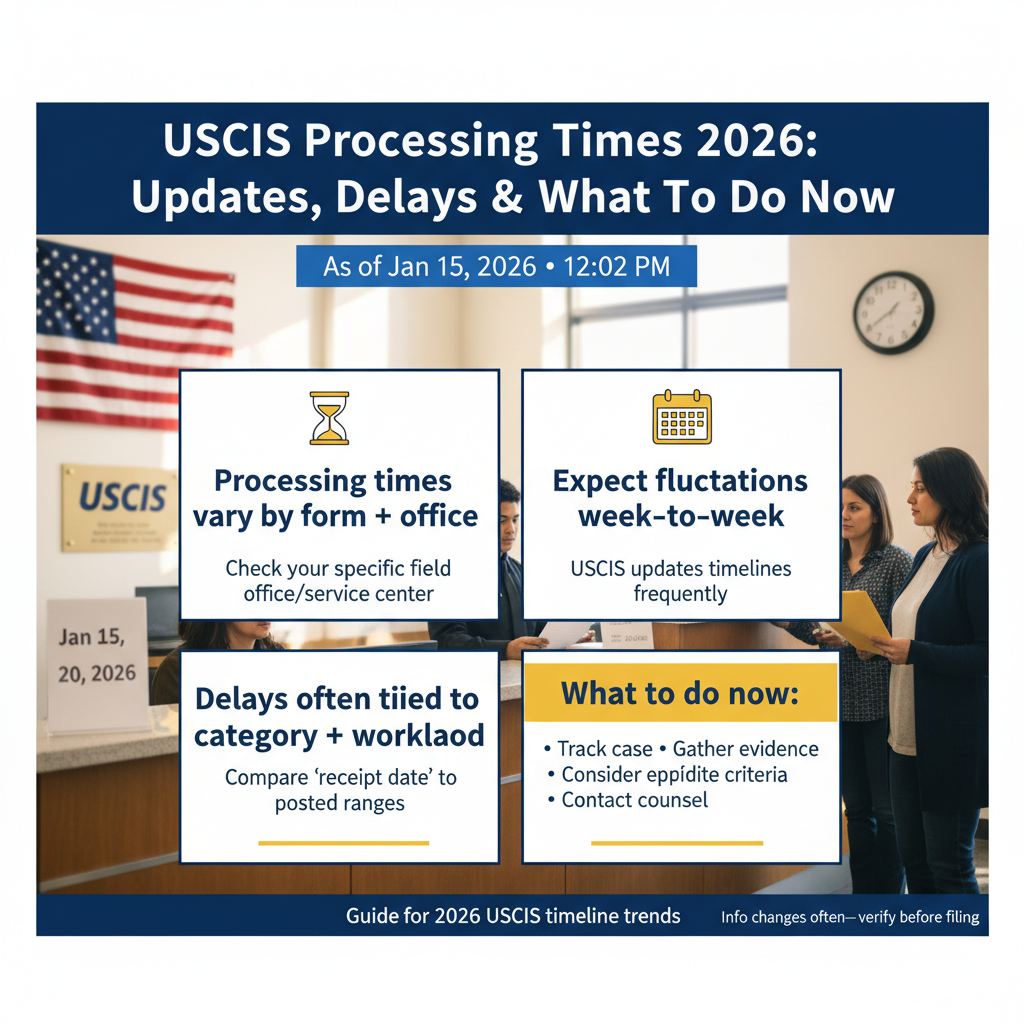
This article is based on ongoing USCIS-related reporting and public updates about processing trends and timelines. See the source feed here: USCIS Processing Times and Updates for 2026 (USCIS).
Reminder: USCIS processing times change frequently by form type, category, and the office handling the case. Always verify your specific timeline using the official tools linked throughout this guide.
Need Help? Our Orlando immigration team is ready to assist. Call +1 786-791-3106 for a free consultation, or message us online. Se Habla Español.
What This News Means for Immigrants in Orlando and Across Florida
Why this news is showing up now
USCIS processing times are trending in 2026 because many families and employers are seeing “mixed-speed” outcomes: some cases move faster due to policy changes, staffing shifts, and expanded online processing, while others slow down due to backlogs, extra security checks, evidence requests, or high filing volumes.
In practical terms, people are watching processing times closely because they affect:
- When you can start a job (work permit/EAD timing)
- When you can travel (advance parole timing)
- When you can become a permanent resident (green card timing)
- When a spouse/child can reunite with family (family petition timing)
- When a naturalization interview and oath may happen (citizenship timing)
Important: “Processing time” is not the same as a guaranteed deadline. It’s a statistical estimate based on recent case completions—your individual timeline can be shorter or longer.
How it can affect Florida residents
For Central Florida residents—especially along the I-4 corridor (Orlando, Kissimmee, Sanford, Daytona, and Tampa-area commuters)—processing time shifts can have immediate consequences. Many clients plan life events around immigration milestones: a new job offer, a move, a wedding, a child’s school enrollment, or international travel for family emergencies.
If your case is in Orlando or handled through the The Orlando USCIS Field Office, local appointment availability (biometrics, interviews, and InfoPass-style service requests) can influence how quickly a case moves after it reaches the “field office” stage.
For Orange County residents, delays can also create secondary issues like:
- Driver’s license renewal timing (depends on lawful status documentation)
- Employment verification concerns (I-9 re-verification when an EAD expires)
- Travel disruptions if Advance Parole is still pending
- Family separation if consular processing is delayed abroad
What USCIS Processing Times and Updates for 2026 Is (and Why It Matters)
A plain-English definition
USCIS “processing times” are USCIS’s published estimates of how long it typically takes to process a specific application or petition—such as a family petition, a green card application, a work permit, or citizenship—based on:
- The form type (example: Form I-130 vs. Form I-485)
- The category (immediate relative vs. preference category; employment-based vs. family-based)
- The office processing the case (service center, field office, or lockbox intake)
- Recent completion data
USCIS also issues operational updates—like expanding online filing, changing evidence standards, adjusting interview practices, or prioritizing certain case types—that can speed up or slow down timelines in 2026.
Key terms you need to know
- Receipt Notice: The confirmation USCIS received your filing and assigned a receipt number (often begins with IOE, MSC, LIN, SRC, WAC, etc.).
- Biometrics: Fingerprints/photo appointment used for background checks.
- RFE (Request for Evidence): USCIS asks for more documents; this almost always adds time.
- NOID (Notice of Intent to Deny): USCIS plans to deny unless you respond convincingly.
- Service Center vs. Field Office: Service centers often handle paper/initial adjudication; field offices frequently handle interviews for Adjustment of Status and naturalization.
- Adjustment of Status: Applying for a green card from inside the U.S., often using Form I-485.
- Priority Date: Your “place in line” for categories subject to annual limits (tracked via the Visa Bulletin).
- 90-day window: Commonly referenced for certain timing strategies (for example, many applicants plan renewals or filings around specific windows). Always confirm the rule that applies to your form.
- 180 days: A critical timing concept in multiple contexts (for example, some portability and renewal strategies reference 180-day thresholds). The exact rule depends on your case type.
Warning: Relying on social media timelines can be misleading. Two people filing the same form on the same day can still experience different processing due to background checks, office workload, and case complexity.
Current Immigration Law: The Foundation
Processing times are not just “how fast USCIS works.” They’re shaped by the legal framework that requires background checks, eligibility screening, quotas for certain categories, and procedural steps like interviews and biometrics.
Federal requirements
Key federal authorities and legal foundations include:
- The Immigration and Nationality Act (INA), which governs immigrant and nonimmigrant benefits.
- Federal regulations in Title 8 of the Code of Federal Regulations (8 C.F.R.), which set procedural rules for filings, evidence, interviews, and adjudications.
- Security and background check requirements (biometrics and vetting) that can add time depending on results and system queues.
Common USCIS forms tied to processing-time conversations in 2026 include:
- Form I-130 (Petition for Alien Relative)
- Form I-485 (Application to Register Permanent Residence or Adjust Status)
- Form I-765 (Application for Employment Authorization)
- Form I-131 (Application for Travel Document / Advance Parole)
- Form N-400 (Application for Naturalization)
- Form I-90 (Replace/Renew Green Card)
- Form I-751 (Remove Conditions on Residence)
For official guidance, always start with the USCIS official website and the USCIS tools linked below.
Florida-specific considerations
Immigration law is federal, but Florida residents can face state-level practical consequences when processing times stretch out. For Central Florida residents, delays may affect:
- Employment start dates and HR onboarding timelines
- Driver’s license/ID renewal planning
- Access to certain benefits that require updated proof of lawful status
- Travel planning from Orlando International Airport (MCO) if Advance Parole is pending
If your case is in Orlando, expect that local scheduling (biometrics and interviews) can be a major variable. The Orlando USCIS Field Office workload may differ from other Florida offices, and cases can also be routed through different service centers.
How to Check and Respond to USCIS Processing Times: A Complete Step-by-Step Guide
The most effective way to deal with processing-time uncertainty in 2026 is to track your case correctly, prepare for common delay triggers, and escalate appropriately when your case is truly outside normal timeframes.
1) Identify your exact form, category, and processing office
Before you compare timelines, confirm what you filed and where it’s being processed. A mismatch (wrong office or wrong category) is one of the most common reasons people think their case is “late” when it’s not.
- Required documents/info:
- USCIS receipt notice (Form I-797C) showing receipt number
- Copy of the filed form (example: Form I-130, Form I-485)
- Filing category details (immediate relative, family preference, employment-based, etc.)
- Mailing address used and whether you filed online
Important: Some cases start at a lockbox, then move to a service center, then to a field office. Your “processing office” may change mid-case.
2) Use the official USCIS Processing Times tool correctly
USCIS publishes a dedicated tool to estimate timelines by form and office. Use it as your baseline—not screenshots from forums.
- Required documents/info:
- Your form type
- Your office (service center or field office)
- Your receipt date
Use: USCIS Processing Times.
Reminder: Many forms show two key numbers: (1) an estimated time range and (2) a “case inquiry date” (the earliest date you can request an inquiry for being outside normal processing time).
3) Track your individual case status and notices
Processing-time averages do not reflect what’s happening in your specific file. You must track your case status and read every notice carefully.
- Required documents/info:
- Receipt number
- USCIS online account access (if applicable)
- All USCIS notices received (RFEs, biometrics, interview notices)
If you filed online or your case is in the electronic system, use your USCIS account to check uploads and notices. Also confirm your mailing address is current (see Step 5).
4) Prepare for the most common delay triggers (and prevent them)
In 2026, many delays are avoidable. The most frequent causes we see include incomplete filings, missing translations, insufficient financial evidence, and late RFE responses.
- Required documents (examples by case type):
- Identity documents: passport biographic page, birth certificate (with certified translation if not in English)
- For family cases: marriage certificate, divorce decrees, proof of bona fide relationship
- For Form I-485: medical exam (when required), lawful entry evidence, prior immigration history
- For sponsorship: Form I-864 with tax transcripts and proof of current income
- For EAD/AP: prior approvals, current status documents, photos (if required)
Warning: An RFE response that is incomplete or disorganized can cause a denial—not just a delay. Treat RFEs like a legal brief: organized, labeled, and supported.
5) Keep your address updated and your delivery trail clean
Missed notices are a hidden processing-time killer. If USCIS sends an RFE or interview notice to an old address, you can lose weeks—or your case—without realizing it.
- Required documents/info:
- Current physical and mailing address
- Receipt numbers for all pending cases
- USPS delivery tracking where available
If you move along the I-4 corridor (for example, from Orange County to Seminole, Osceola, or Volusia), update USCIS immediately and keep proof of the update.
6) Escalate the right way when your case is truly outside normal time
If you are past the “case inquiry date,” you can submit an “outside normal processing time” request. You may also consider an expedite request in limited situations.
- Required documents/info (for inquiries/expedites):
- Receipt number and filing date
- Proof you are outside normal processing time (based on USCIS tool)
- For expedites: evidence of severe financial loss, urgent humanitarian need, or other qualifying factors
- Supporting letters (employer letter, medical letter, eviction notice, etc.)
Important: Expedite requests are discretionary. Submitting weak expedite requests repeatedly can waste time and may not help your case.
7) If needed, coordinate with the agencies involved in your pathway
Some timelines involve more than USCIS. For example, consular processing involves the Department of State; removal proceedings involve EOIR immigration court.
- Required documents/info:
- USCIS approval notices (if applicable)
- National Visa Center (NVC) case number for consular processing
- Immigration court documents if in proceedings
Helpful official resources include:
- U.S. Department of State (visas and consular processing)
- Executive Office for Immigration Review (immigration court)
- USCIS Forms (current editions and instructions)
Need Help? Our Orlando immigration team is ready to assist. Call +1 786-791-3106 for a free consultation, or message us online. Se Habla Español.
Practical Steps You Can Take Today
Whether you’re filing soon or already waiting, you can take concrete steps now to reduce delays and protect your case.
Actionable checklist (do these this week)
- Check your form’s current estimate using USCIS Processing Times and write down your “case inquiry date.”
- Create a single PDF “master file” with labeled tabs: identity, entry, relationship, financials, prior immigration history, and copies of all USCIS notices.
- Confirm USCIS has your correct address and that you can receive mail reliably (especially if you moved within Orange County or along the I-4 corridor).
- Prepare for an RFE before it happens: gather missing civil documents and certified translations now.
- If you have a work permit expiring, plan renewal early—don’t wait until the last minute.
- If you plan to travel, do not depart the U.S. without confirming your travel authorization and risk profile.
Document preparation guidance
Processing delays often come from evidence issues—not just USCIS workload. Strong, organized evidence can reduce the chance of an RFE and help an officer adjudicate faster.
- Identity and civil documents: keep clear scans of passports, birth certificates, marriage certificates, divorce decrees, and name-change records.
- Translations: any non-English document generally needs a proper English translation with a translator certification.
- Financial sponsorship: for cases requiring Form I-864, use IRS tax transcripts when possible and include proof of current income (pay stubs, employer letter).
- Relationship evidence: joint lease, joint bank statements, insurance, photos, affidavits, and proof of shared life.
Reminder: More documents are not always better—irrelevant or disorganized evidence can slow review. The goal is clarity and credibility.
Timeline expectations in 2026 (planning guidance)
Because USCIS timelines vary widely, plan using ranges and decision points:
- First 2–6 weeks after filing: receipt notice, biometrics scheduling (varies), online account updates.
- Next 2–8 months: common window for RFEs and interim benefits (like EAD/AP) depending on category and workload.
- 6–24+ months: many green card and naturalization cases fall in this broad range depending on office, category, and interview requirements.
Warning: If you are in a category controlled by the Visa Bulletin, your Priority Date may be the biggest factor—more than USCIS staffing.
How Imigrar Helps Immigrants in Orlando
At Imigrar, we help individuals and families navigate USCIS timelines strategically—not just “fill out forms.” Our approach is designed to reduce delays, prevent RFEs, and create a clear plan for your work authorization, travel, and long-term status.
If your case is in Orlando, we can help you understand what the Orlando USCIS Field Office stage may look like, how to prepare for interviews, and how to respond if your case stalls.
- Case strategy and filing plans for family- and employment-based pathways
- Evidence preparation to reduce RFE risk
- RFE/NOID responses with organized exhibits and legal framing
- Interview preparation for Adjustment of Status and naturalization
- Processing-time monitoring and escalation planning when appropriate
Call us for a free consultation at +1 786-791-3106. Se Habla Español.
Need Help? Our Orlando immigration team is ready to assist. Call +1 786-791-3106 for a free consultation, or message us online. Se Habla Español.
Frequently Asked Questions
Q: How do I know if I’m eligible to file even if processing times are long?
A: Eligibility depends on the benefit type, your immigration history, and your category (family, employment, humanitarian, etc.). Processing times do not change eligibility rules, but they affect planning. For example, if you’re considering Adjustment of Status using Form I-485, you must confirm you have a valid basis to apply and (in many cases) a current visa availability situation tied to your Priority Date. If you’re not sure, speak with an immigration attorney before filing—an ineligible filing can lead to denial and may create additional risks.
Q: Will checking my status frequently make USCIS process my case faster?
A: No. Checking your case status does not speed up adjudication. However, monitoring is still important because it helps you respond quickly to an RFE, biometrics notice, or interview notice. The best practice is to check weekly and ensure you can receive mail. If you are past the USCIS “case inquiry date,” then you can submit an inquiry through official channels.
Q: How long will my Form I-130 and Form I-485 take in 2026?
A: It depends on (1) whether you are an immediate relative or in a preference category, (2) which office is handling your case, and (3) whether USCIS issues an RFE or schedules an interview. Many family cases involve multiple stages: Form I-130 petition review, then Form I-485 adjudication (if filing in the U.S.), plus biometrics and potentially an interview at the Orlando field office if you live in Central Florida. Use the official tool at USCIS Processing Times for your specific office and form.
Q: What documents most often cause delays or RFEs?
A: The most common issues include missing civil documents (birth/marriage/divorce records), missing certified translations, insufficient financial sponsorship evidence for Form I-864, unclear proof of lawful entry, and incomplete relationship evidence in marriage-based cases. Organize evidence clearly and respond to any RFE by the stated deadline. Warning: Missing an RFE deadline can result in denial.
Q: How much does it cost to deal with USCIS processing in 2026?
A: Costs can include USCIS filing fees, medical exam fees (for certain Form I-485 cases), translation costs, and legal fees if you hire counsel. USCIS fees vary by form and can change, so confirm current fees and editions on USCIS Forms and the USCIS official website. If budget is a concern, ask about a staged filing strategy that still protects your status and timelines where possible.
Q: Does a pending application protect my immigration status while I wait?
A: Sometimes, but not always. A pending filing may place you in a “period of authorized stay” depending on what was filed and your situation, but it might not be the same as maintaining a valid nonimmigrant status. This is especially important for people whose current status is expiring. Get legal advice to avoid gaps that could affect eligibility or future benefits.
Q: What happens if my case is denied after a long wait?
A: The next steps depend on the form and the reason for denial. Options may include filing a motion to reopen/reconsider, refiling with stronger evidence, appealing (for certain case types), or exploring alternative pathways. If you are in removal proceedings—or could be placed in proceedings—also consider the role of EOIR (immigration court): Executive Office for Immigration Review. Because denial consequences can be serious, consult an attorney immediately to preserve deadlines and strategy.
Common Mistakes (and How to Avoid Them)
Mistake #1: Using the wrong office or category when checking processing times
Many people accidentally select the wrong field office or service center in the processing-times tool, which leads to incorrect expectations and premature inquiries.
How to avoid it: Use your receipt notice and case history to confirm where your case is actually pending. If your case moved, re-check processing times under the new office.
Mistake #2: Treating an RFE like a simple document upload
An RFE is a legal request for specific evidence. A rushed response can create inconsistencies, missing items, or unclear proof.
How to avoid it: Build an indexed response packet with exhibits, a cover letter, and direct answers to each RFE point. Submit before the deadline and keep proof of delivery.
Mistake #3: Traveling or changing jobs without understanding timing rules
People sometimes travel while Advance Parole is pending, or change employment without understanding how it affects a pending case.
How to avoid it: Get advice before travel or major employment changes. Timing rules can be strict, and certain thresholds (like 180 days) can matter depending on the benefit and category.
Key Official Resources to Bookmark (2026)
- USCIS official website
- USCIS Processing Times
- USCIS Forms
- U.S. Department of State
- Executive Office for Immigration Review
Reminder: If you are pursuing consular processing, Department of State timelines (NVC and embassy scheduling) may be as important as USCIS timelines.
Planning Notes for Orlando and Central Florida Cases in 2026
If your case is in Orlando, plan around two local realities:
- Interview scheduling: Many green card and naturalization cases require an interview at the field office stage. Appointment availability can fluctuate.
- Mail and address stability: Central Florida moves are common. Any address mismatch can cause missed notices and delays.
For Central Florida residents commuting along the I-4 corridor, consider choosing a stable mailing address and using tracked delivery for responses whenever possible.
Need Help? Our Orlando immigration team is ready to assist. Call +1 786-791-3106 for a free consultation, or message us online. Se Habla Español.
Closing: Get a Personalized USCIS Timeline Plan for 2026
USCIS processing times in 2026 are not just “numbers on a website.” They affect real lives: when you can work, travel, reunite with family, and finally secure permanent status. The best approach is proactive: file correctly, document thoroughly, track intelligently, and escalate only when appropriate.
If you want a clear plan tailored to your category, your office, and your risk factors—Imigrar can help.
Call +1 786-791-3106 for a free consultation or message us online. Se Habla Español. Our tagline is Keep Families Together, and we’re proud to serve Orlando, Orange County, and clients nationwide.


