

The reporting that sparked this guide
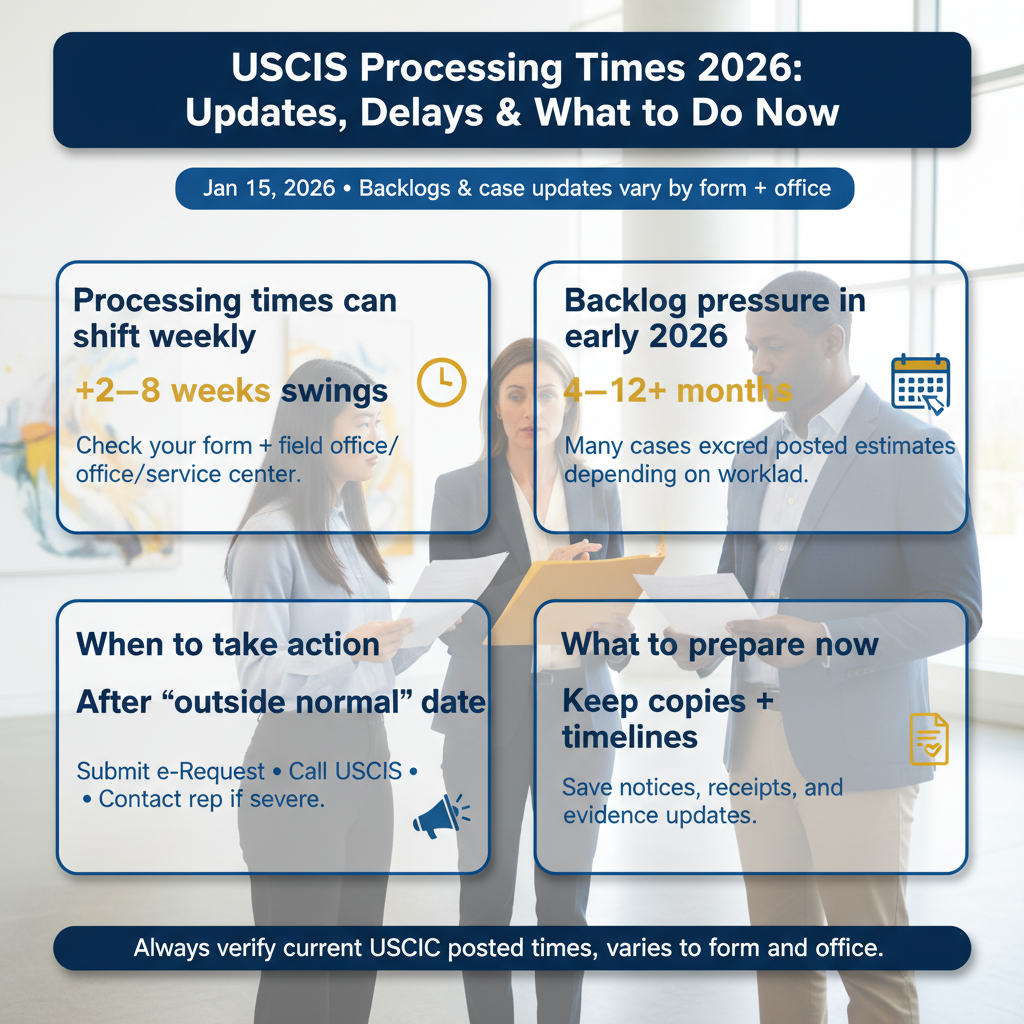
We’re seeing increased public attention on USCIS backlogs and case updates in early 2026. The reporting that sparked this guide is: USCIS Processing Times and Updates for 2026 (USCIS).
Important: USCIS processing times change frequently and vary by form type, service center/field office, workload, and whether USCIS issues a Request for Evidence (RFE). For the most current official figures, use USCIS Processing Times and your USCIS online account.
Need Help? Our Orlando immigration team is ready to assist. Call +1 786-791-3106 for a free consultation, or message us online. Se Habla Español.
What This News Means for Immigrants in Orlando and Across Florida
Why this news is showing up now
In 2026, USCIS processing times remain one of the biggest stress points for immigrants and U.S. families. This topic is trending because:
- Backlog pressure continues. Even when overall inventories improve, certain forms and certain locations can slow down due to staffing, surges in filings, and shifting priorities.
- More people are tracking cases online. USCIS has expanded digital tools, which makes fluctuations in timelines more visible (and anxiety-inducing).
- Work authorization and travel documents are time-sensitive. Delays with Form I-765 (EAD) and Form I-131 (Advance Parole) can affect jobs, school, travel, and family emergencies.
- Family-based demand remains high. Many Central Florida families are pursuing Form I-130 and Form I-485 to reunite and stabilize status—so even small processing changes have big real-life consequences.
Reminder: “Processing time” is not a guarantee. It is a statistical estimate based on recently completed cases, and your case may be faster or slower depending on facts, completeness, and USCIS workload.
How it can affect Florida residents
Florida is one of the most immigration-diverse states in the country, and Central Florida has grown rapidly along the I-4 corridor. That means USCIS field operations and appointment availability can directly impact local families.
- If your case is in Orlando... your interview scheduling, biometrics timing, and in-person requests can depend on the Orlando-area workload and staffing.
- For Central Florida residents... delays can affect employment continuity, driver’s license renewals (depending on status), and travel plans.
- The Orlando USCIS Field Office... may have different interview queues than other Florida locations, and your case could be transferred for workload balancing.
- Orange County families often have mixed-status households; a delayed receipt notice or RFE response can ripple into school, health insurance, and financial planning.
Warning: Do not assume you can “wait it out” without a plan. Missing an RFE deadline, biometrics appointment, or interview notice can lead to denial—even if the delay was not your fault.
What USCIS Processing Times and Updates for 2026 Is (and Why It Matters)
A plain-English definition
“USCIS processing times” are USCIS’s published estimates for how long it typically takes to complete certain applications and petitions—such as a family petition (Form I-130), a green card application (Form I-485), naturalization (Form N-400), or work authorization (Form I-765).
In 2026, “updates” usually refer to changes in:
- Estimated time ranges shown on the USCIS processing times tool
- How USCIS calculates “case inquiry date” (when you can submit an “outside normal processing time” request)
- Policy adjustments that affect evidence requirements, interviews, or adjudication steps
- Operational changes such as staffing, digitization, and workload transfers
Key terms you need to know
- Receipt Notice (Form I-797C): Proof USCIS accepted your filing and assigned a receipt number.
- Biometrics: Fingerprints/photo/signature appointment used for background checks.
- RFE (Request for Evidence): USCIS letter requesting missing or additional documents. Respond by the deadline on the notice.
- NOID (Notice of Intent to Deny): A more serious notice explaining why USCIS plans to deny unless you respond with strong evidence.
- Interview: Many cases require an in-person or sometimes waived interview; family-based Adjustment of Status cases frequently involve interviews.
- Case Inquiry Date: The earliest date USCIS says you may ask about a delay (varies by form and location).
- Priority Date: Your place in line for certain visa categories (especially family preference and employment-based categories). Immediate relatives of U.S. citizens generally do not wait on a visa number, but many others do.
- Adjustment of Status: Applying for a green card inside the U.S. (often using Form I-485).
- Consular Processing: Completing the immigrant visa process through a U.S. consulate abroad (often after Form I-130 approval and National Visa Center processing).
Important: Processing time is only one part of the overall timeline. For many people, the biggest “wait” can be the visa availability line tied to the Priority Date (tracked through the Department of State Visa Bulletin).
Current Immigration Law: The Foundation
USCIS processing times are operational, but your eligibility and required evidence come from federal law and regulations. Understanding the legal foundation helps you avoid preventable delays and denials.
Federal requirements
Most family and employment immigration is governed by the Immigration and Nationality Act (INA) and related federal regulations, including:
- INA § 201–203 (family- and employment-based immigrant visa categories and numerical limits)
- INA § 245 (rules for Adjustment of Status using Form I-485)
- INA § 212 (grounds of inadmissibility—health, criminal, immigration violations, public charge-related issues, etc.)
- INA § 237 (grounds of deportability)
- 8 CFR § 103 (USCIS filing, evidence, and adjudication procedures)
- 8 CFR § 245 (regulations implementing adjustment of status)
Common USCIS forms that drive processing-time questions in 2026 include:
- Form I-130 (Petition for Alien Relative)
- Form I-485 (Application to Register Permanent Residence or Adjust Status)
- Form I-765 (Application for Employment Authorization)
- Form I-131 (Application for Travel Document / Advance Parole)
- Form I-864 (Affidavit of Support under INA § 213A)
- Form N-400 (Application for Naturalization)
USCIS instructions and filing addresses change. Always verify at: USCIS official website and USCIS Forms.
Florida-specific considerations
Immigration is federal, but Florida residents face practical, local issues that can affect timelines and outcomes:
- Address stability matters. If you move along the I-4 corridor (Orlando–Kissimmee–Lakeland–Tampa), file your address change promptly (USCIS Form AR-11 online) to avoid missed notices.
- Local appointment availability. Biometrics and interviews are scheduled based on local capacity. If the Orlando area is heavily booked, you may see longer waits for in-person steps.
- State-level documentation needs. Some Florida benefits or IDs depend on current immigration documentation. Delays in EAD/green card production can create real-life complications.
- Mixed-status families. In Orange County and across Central Florida, many households include U.S. citizens, permanent residents, and undocumented relatives—making timing and strategy critical.
Need Help? Our Orlando immigration team is ready to assist. Call +1 786-791-3106 for a free consultation, or message us online. Se Habla Español.
How to Track USCIS Processing and Push Your Case Forward: A Complete Step-by-Step Guide
The goal in 2026 is not just to “wait”—it’s to manage your case proactively, reduce the chance of an RFE, and know when you can escalate appropriately. Below is a practical, legally safe roadmap.
1) Confirm what you filed and where it is being processed
Start by identifying your exact form(s), filing category, and the office handling the case. Processing times can differ drastically for the same form depending on the service center or field office.
- Form type: Form I-130, Form I-485, Form I-765, Form I-131, etc.
- Filing basis: Immediate relative, family preference, employment, asylum-based, etc.
- Office: Service Center vs. Field Office (especially for Adjustment of Status interviews)
Documents to gather:
- USCIS receipt notice(s) (Form I-797C) for each application/petition
- A copy of the full filing packet (everything submitted)
- Proof of delivery (FedEx/UPS/USPS tracking and delivery confirmation)
- Any prior USCIS notices (RFEs, biometrics notices, interview notices)
2) Create (or update) your USCIS online account and enable alerts
USCIS case updates can arrive by mail and online. Online accounts help you catch changes early—especially if mail is delayed or misdelivered.
Documents/info to gather:
- Receipt number(s) for each case
- Email address and phone number for alerts
- Secure storage plan for passwords and 2-factor authentication
Reminder: Even with an online account, USCIS often treats mailed notices as the official notice. Keep your address updated and check your mailbox regularly.
3) Check the official USCIS processing time tool the right way
Use the official tool at USCIS Processing Times. The key is selecting:
- The correct form
- The correct form category (example: “Immediate relative” vs. “Family preference”)
- The correct office (service center or field office)
Documents/info to gather:
- Your receipt notice (shows the office code in the receipt number and/or notice text)
- Your filing date
- Any transfer notices
Important: USCIS provides a “case inquiry date.” If your case is not yet past that date, USCIS may reject an “outside normal processing time” request.
4) Respond to RFEs/NOIDs quickly and strategically
In 2026, one of the most common reasons cases stall is an RFE response that is incomplete, disorganized, or late. Treat an RFE like a deadline-driven legal brief.
Documents to gather (varies by case, common examples):
- Copy of the RFE/NOID notice (every page)
- Identity documents (passport biographic page, birth certificate with certified translation if needed)
- Status documents (I-94, prior approvals, EADs)
- Relationship evidence for Form I-130/Form I-485 (joint lease, joint bank, insurance, photos, affidavits)
- Financial evidence for Form I-864 (tax transcripts, W-2s/1099s, pay stubs, employment letter)
- Any court dispositions or certified records (if criminal history exists)
Warning: Do not send “extra” documents that contradict prior filings. Consistency matters. If something changed (job loss, new address, separation), address it directly with an explanation and supporting evidence.
5) Know when and how to escalate: service requests, expedite, and congressional help
If your case is beyond the posted “case inquiry date,” you may submit an “outside normal processing time” request through USCIS. In limited situations, you can request an expedite (for example, severe financial loss, urgent humanitarian reasons, or compelling U.S. government interests).
Documents to gather for escalation:
- Proof your case is outside normal time (screenshots/printout of the USCIS processing time page)
- For expedite: evidence of urgency (eviction notice, medical letters, employer letter, deployment orders, etc.)
- Proof of identity and receipt numbers
- Timeline summary (dates filed, biometrics, RFEs, responses)
You may also consider contacting your U.S. Representative or Senator for a congressional inquiry. This does not guarantee approval, but it can help clarify what is pending.
6) Prepare for the next step before USCIS asks (interview, medical, or final decision)
Many Adjustment of Status cases require an interview at a field office. If your case is in Orlando, you should prepare as if the interview notice could arrive with limited lead time.
Documents to gather (common for Form I-485 interviews):
- Government-issued IDs (passports, driver’s license/state ID)
- Original civil documents (birth certificates, marriage/divorce certificates)
- Updated relationship evidence (last 6–12 months)
- Updated financial evidence (latest tax transcript, pay stubs)
- Medical exam in sealed envelope if required (USCIS-designated civil surgeon)
- Any prior immigration documents (I-94, approvals, EAD/AP)
Reminder: If USCIS waives your interview, you still must be eligible and your file must be complete. Interview waivers are discretionary and can change.
Practical Steps You Can Take Today
If you’re worried about USCIS processing times in 2026, the best approach is to reduce avoidable delays and be ready to act when the case reaches a decision point.
Actionable checklist (do these now)
- Track every receipt number weekly (and after any major life change like moving or changing jobs).
- Keep a single “USCIS folder” with your complete filing copy, notices, and proof of delivery.
- Update your address immediately after moving to avoid missed RFEs/interviews (especially common for renters along the I-4 corridor).
- Pre-build an RFE response kit (updated tax transcript, pay stubs, relationship evidence, translations).
- Calendar deadlines the moment a notice arrives—do not wait. Treat USCIS deadlines like court deadlines.
- Plan for travel carefully if you have a pending Form I-485. Leaving without proper authorization can create serious problems.
- Check visa availability if your category uses a Priority Date via the Department of State resources at U.S. Department of State.
Document preparation guidance
The fastest cases are usually the best-prepared cases. USCIS delays often come from missing translations, unclear copies, or incomplete financial and relationship evidence.
- Use clear scans, consistent names, and consistent dates across all forms.
- Provide certified translations when required (with translator certification).
- Organize evidence with a cover letter and labeled exhibits (especially for marriage-based filings).
- Keep proof of lawful entry (I-94) if you are filing Adjustment of Status.
Timeline expectations (realistic planning for 2026)
Processing times vary widely. As a planning tool, many applicants experience a multi-stage timeline:
- Receipt notices: often within weeks, but sometimes longer during surges.
- Biometrics: can be scheduled within weeks to a few months depending on capacity.
- EAD/AP (if filed): timing varies; plan financially in case work authorization takes longer than expected.
- Interviews: field-office dependent; if your case is in Orlando, interview timing can shift based on local volume.
- Final decision: may be same-day at interview, or weeks/months after if additional review is needed.
Important: If you are counting on a benefit by a specific date (new job start, travel, school enrollment), speak with an immigration attorney early so you can evaluate expedite options and backup plans.
Need Help? Our Orlando immigration team is ready to assist. Call +1 786-791-3106 for a free consultation, or message us online. Se Habla Español.
How Imigrar Helps Immigrants in Orlando
At Imigrar, we help individuals and families in Orlando, Orange County, and across the I-4 corridor—and we serve clients nationwide. Our mission is simple: Keep Families Together.
USCIS processing delays can feel random, but many slowdowns are preventable with the right strategy: correct form selection, strong evidence from the start, fast RFE responses, and smart escalation when appropriate.
- We review your case for eligibility risks (inadmissibility, prior immigration history, unlawful presence, prior denials).
- We prepare filings to reduce RFEs and delays (organized exhibits, clear legal theory, consistent documentation).
- We help you track milestones and respond quickly to USCIS notices.
- We advise on travel and work authorization while a case is pending.
- We coordinate with consular processing steps when needed through the Department of State.
We offer a free consultation. Call +1 786-791-3106. Se Habla Español.
Frequently Asked Questions
Q: How do I know if I’m eligible to file Form I-485 for Adjustment of Status in 2026?
A: Eligibility depends on your immigration category and your personal history. Many people qualify if they were inspected and admitted or paroled, have an immediately available visa number (or are an immediate relative of a U.S. citizen), and are not barred by specific rules. Some issues—like certain immigration violations or criminal history—can complicate eligibility. Before filing, confirm your I-94 record, your category, and whether any inadmissibility grounds under INA § 212 may apply.
Q: Will long USCIS processing times affect my current immigration status?
A: It depends. If you are maintaining a separate nonimmigrant status (like F-1, H-1B, etc.), you generally must keep complying with that status unless your attorney advises otherwise. If you filed a properly supported Form I-485, you may be in a “period of authorized stay” while it’s pending, but that is not the same as having a nonimmigrant status. Important: Leaving the U.S. while Form I-485 is pending without proper travel authorization can create serious problems.
Q: Where can I check the most accurate USCIS processing times for my form?
A: Use the official tool at USCIS Processing Times. Select the correct form, category, and office. Then note the “case inquiry date.” You can also use your USCIS online account for case status updates and document delivery.
Q: What documents most commonly cause delays or RFEs in family-based cases like Form I-130 and Form I-485?
A: The most common issues are missing civil documents (birth/marriage/divorce certificates), missing or insufficient financial sponsorship evidence for Form I-864, weak proof of a bona fide marriage, missing translations, and inconsistent addresses/dates across forms. A well-organized filing with labeled evidence can reduce the risk of an RFE.
Q: How much does it cost to file, and do delays increase costs?
A: USCIS filing fees vary by form and can change. Check the current fee schedule directly on USCIS official website before filing. Delays can increase indirect costs (lost wages if EAD is delayed, extra medical exams if they expire, additional document requests, travel changes). Planning ahead and filing correctly the first time is often the most cost-effective approach.
Q: What happens if USCIS denies my case after a long wait?
A: The next steps depend on the type of case and the reason for denial. Some denials allow a motion to reopen/reconsider, an appeal, or re-filing with corrected evidence. In some situations, a denial may trigger removal proceedings, where the case could be handled in immigration court under EOIR. If you receive a denial, speak with counsel immediately and keep every page of the decision notice. For court-related information, see Executive Office for Immigration Review.
Q: Can I request an expedite if my work permit is taking too long?
A: Sometimes. Expedite requests are discretionary and typically require evidence such as severe financial loss to a person or company, urgent humanitarian reasons, or other compelling factors. Provide documentation (job offer, letter from employer, bills, eviction notice, medical letters). Warning: Expedite is not automatic and not available for every case type, but a well-documented request can help in the right circumstances.
Common Mistakes (and How to Avoid Them)
Mistake #1: Using the wrong processing-time category or office
Many people check the processing time for the wrong category (for example, selecting a different eligibility basis) or the wrong office (service center vs. field office). That leads to confusion and premature escalation attempts.
- How to avoid it: Match your receipt notice details to the exact category in the USCIS tool and confirm whether your case was transferred.
Mistake #2: Treating RFEs like “optional” paperwork
RFEs are a major reason cases extend far beyond normal times. A late or weak response can result in denial.
- How to avoid it: Respond early, include a cover letter, organize exhibits, and send exactly what USCIS asked for (plus clarifying evidence when appropriate).
Mistake #3: Moving in Central Florida without updating USCIS
Moves are common in Orlando and Orange County. Missed notices can cause missed biometrics or interviews—and that can lead to denial.
- How to avoid it: Update your address immediately, monitor your online account, and keep mail forwarding active.
USCIS Updates in 2026: Where to Get Reliable Information
With processing times in the news, misinformation spreads quickly. Stick to primary sources and official tools:
- USCIS official website (policy updates, alerts, forms, fees)
- USCIS Processing Times (time ranges and inquiry dates)
- USCIS Forms (current editions and instructions)
- U.S. Department of State (Visa Bulletin, consular processing information)
- Executive Office for Immigration Review (immigration court information if proceedings are involved)
Reminder: If you receive a notice that you don’t understand, do not guess. A small mistake can add months—or lead to a denial.
Need Help? Our Orlando immigration team is ready to assist. Call +1 786-791-3106 for a free consultation, or message us online. Se Habla Español.

Closing: What to Do Next if You’re Stuck in USCIS Processing in 2026
USCIS processing times in 2026 can be unpredictable, but your response doesn’t have to be. The best strategy is to (1) file correctly, (2) track your case consistently, (3) respond quickly to any RFE/NOID, and (4) escalate only when the case is truly outside normal time or there is a legitimate expedite basis.
If your case is in Orlando, if you’re preparing for an interview at the Orlando USCIS Field Office, or if your family is trying to reunite across Central Florida and the I-4 corridor, we can help you build a clear plan and reduce avoidable delays.
Need legal guidance now? Call Imigrar at +1 786-791-3106 for a free consultation, or message us online. Se Habla Español. Our goal is to Keep Families Together.


