


The reporting that sparked this guide
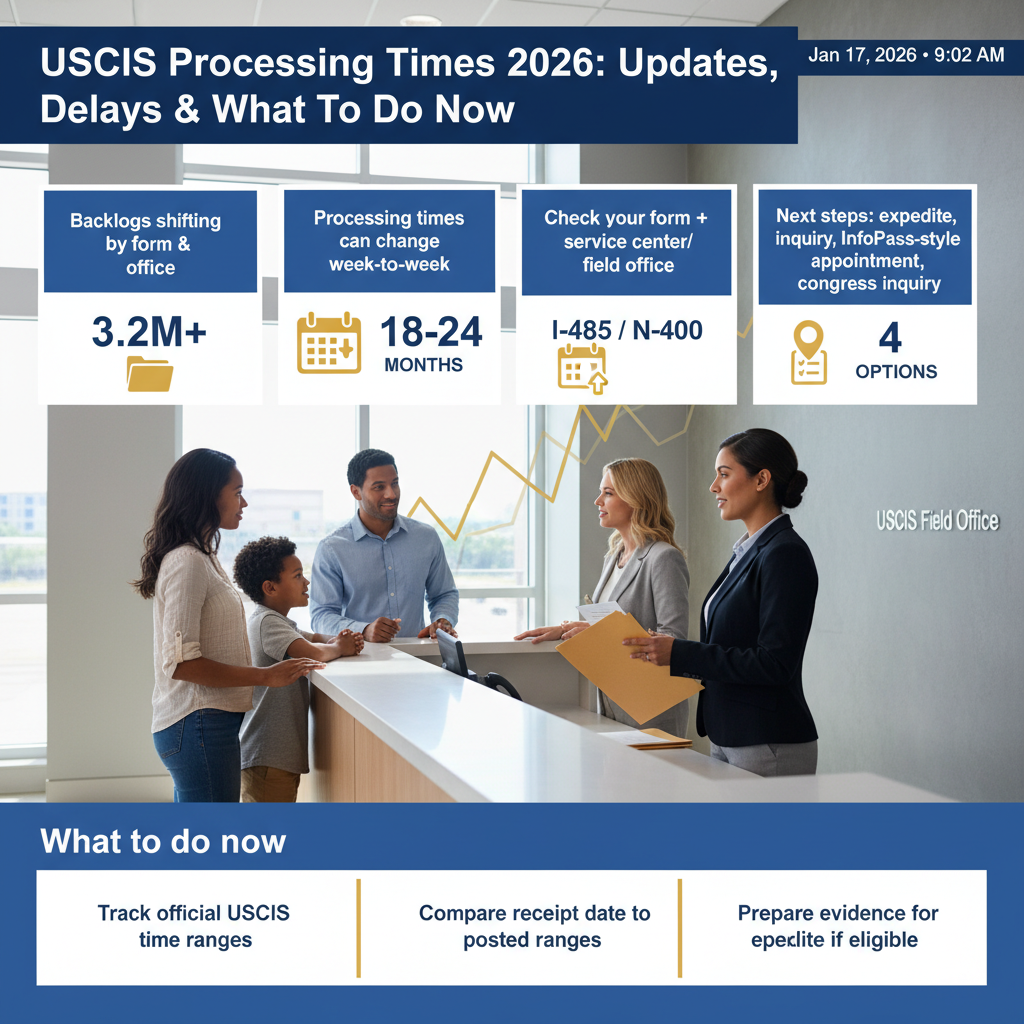
This article is informed by publicly available updates and coverage circulating about USCIS case backlogs and processing time changes in 2026, including: USCIS Processing Times and Updates for 2026 (USCIS).
Reminder: USCIS processing times can change quickly by form type, service center/field office, and your case’s facts. Always verify your specific form and office using USCIS Processing Times and your USCIS online account.
Need Help? Our Orlando immigration team is ready to assist. Call +1 786-791-3106 for a free consultation, or message us online. Se Habla Español.
What This News Means for Immigrants in Orlando and Across Florida
Why this news is showing up now
Processing times are trending in immigration news because USCIS publishes rolling estimates and periodically adjusts internal workflows, staffing, interview policies, and digitization efforts. In 2026, many families and employers are also feeling the “real-world impact” of timelines: expiring work permits, travel plans, school schedules, and family emergencies.
Important: “Longer processing times” does not always mean USCIS is doing something wrong in your case. A case can be delayed for reasons that are fixable—like missing evidence, a biometrics issue, a background check delay, or a mismatch between your mailing address and your online account.
The reason this topic is appearing in headlines is that more people are checking:
- Whether USCIS is meeting its posted targets;
- How long it takes to receive receipts, biometrics, and interview notices;
- When they can request help (service request, congressional inquiry, expedite request);
- How delays affect Adjustment of Status, work authorization, and travel authorization.
How it can affect Florida residents
For Central Florida residents—especially along the I-4 corridor (Orlando, Kissimmee, Sanford, and surrounding areas)—processing times can shape daily life. If your case is in Orlando, small delays can snowball into bigger problems: missed job start dates, lapses in employment authorization, or inability to travel for urgent family reasons.
The Orlando USCIS Field Office can have different timelines than other Florida offices, and family-based cases may move differently than employment-based cases. Additionally, cases can be routed through various service centers even if you live in Orange County.
Warning: If you move without updating your address, you can miss an appointment notice and risk denial for “abandonment.” Address updates should be made promptly using your USCIS online account and the official change-of-address process.
What USCIS Processing Times and Updates for 2026 Is (and Why It Matters)
A plain-English definition
USCIS “processing times” are estimates of how long it takes USCIS to make a decision on a specific form type, at a specific office, based on recent historical data. In other words, it’s a benchmark—not a promise—showing when most cases are completed.
In 2026, USCIS continues using online tools and internal metrics to show:
- Typical time ranges for adjudication (e.g., months);
- A date when you can submit an “outside normal processing time” request;
- Differences by form category (family, employment, humanitarian) and office.
Why it matters: immigration planning is time-sensitive. Work permits expire, children “age out,” and travel needs don’t wait. Knowing how to interpret processing times helps you decide what to file, when to file, and how to avoid preventable delays.
Key terms you need to know
- Receipt Notice: The confirmation USCIS received your filing and assigned a receipt number.
- Biometrics Appointment: Fingerprints/photo appointment used for identity and background checks.
- RFE (Request for Evidence): USCIS asks for missing documents or clarification.
- NOID (Notice of Intent to Deny): USCIS plans to deny unless you respond convincingly.
- Priority Date: Your “place in line” for visa availability in certain categories (often employment-based or family preference categories).
- Adjustment of Status: Applying for a green card from inside the U.S. (commonly using Form I-485).
- Consular Processing: Completing the immigrant visa process through a U.S. consulate abroad.
- Service Center vs. Field Office: Service centers often handle paper adjudications; field offices often conduct interviews.
- Expedite Request: A request to speed up a case for qualifying urgent reasons (not guaranteed).
- 90-day window: A common planning concept for renewals/filings; some benefits allow early filing around 90+ days (varies by form).
Reminder: The USCIS processing-time tool is not the same as the Department of State Visa Bulletin. If your case depends on a Priority Date becoming current, you must also track visa availability.
Current Immigration Law: The Foundation
USCIS processing times don’t exist in a vacuum. They are shaped by statutory eligibility rules, security screening requirements, numerical visa caps, and procedural rules in federal regulations. Understanding the legal framework helps you avoid filings that are incomplete or premature.
Federal requirements
Key legal authorities include:
- The Immigration and Nationality Act (INA), including eligibility for family-based immigration and Adjustment of Status (e.g., INA § 245) and inadmissibility grounds (INA § 212).
- Federal regulations at 8 C.F.R., which govern how applications are filed, processed, and decided (including interviews, RFEs, and motions).
- USCIS policy guidance and form instructions, which are binding in practice for evidence requirements and filing procedures.
Common forms affected by processing-time shifts include:
- Form I-130 (Petition for Alien Relative)
- Form I-485 (Application to Register Permanent Residence or Adjust Status)
- Form I-765 (Application for Employment Authorization)
- Form I-131 (Application for Travel Document / Advance Parole)
- Form N-400 (Application for Naturalization)
- Form I-751 (Petition to Remove Conditions on Residence)
- Form I-129 (Petition for a Nonimmigrant Worker)
For official instructions and updates, use the USCIS official website and the form library at USCIS Forms.
Florida-specific considerations
Immigration law is federal, but Florida residents face practical local considerations:
- If your case is in Orlando, your interview (if required) may be scheduled at the Orlando USCIS Field Office. Interview scheduling can be impacted by local volume and staffing.
- For Central Florida residents in Orange County and the I-4 corridor, address stability matters. Frequent moves can cause missed mail and appointment notices.
- Interactions with state and local systems (DMV, employment verification, school enrollment) often depend on timely receipt of EADs, extension notices, or I-94 records.
Warning: If you have immigration court proceedings (removal proceedings), your strategy may involve both USCIS and the immigration court system. Court timelines are separate and handled by the Executive Office for Immigration Review.
Need Help? Our Orlando immigration team is ready to assist. Call +1 786-791-3106 for a free consultation, or message us online. Se Habla Español.
How to Check and Respond to USCIS Processing Times in 2026: A Complete Step-by-Step Guide
Below is a practical roadmap you can use in 2026 to track your case, reduce delays, and take the right action at the right time—without guessing.
1) Identify your exact form, category, and office
USCIS processing times depend on three things: the form, the category, and the office (service center or field office). For example, Form I-130 for a spouse may differ from Form I-130 for a parent, and Form I-485 may differ by eligibility category.
Documents to gather:
- Receipt notice(s) (Form I-797C) showing your receipt number
- A copy of the full filing package (what you submitted)
- Your passport biographic page and current immigration document (I-94, visa, etc.)
- Any prior USCIS notices (RFEs, appointment notices, interview notices)
2) Check the official USCIS Processing Times tool (and interpret it correctly)
Use USCIS Processing Times to select your form and office. Note the “estimated time range” and the date when you can inquire about your case.
Important: The “inquiry date” is often more useful than the general range. It tells you when USCIS considers your case outside normal time.
Documents to gather:
- A screenshot/PDF of the processing-time page for your form and office (for your records)
- Your receipt date (from your I-797C)
- Your USCIS online account login (if available)
3) Track your case status and make sure USCIS can reach you
Many delays are avoidable. Confirm USCIS has your current mailing address and that you are receiving notices. If you have an online account, link your case and turn on notifications.
If your case is in Orlando, also plan for local logistics: interview day travel, parking, and document organization—because missing an interview can cause denial.
Documents to gather:
- Proof of your current address (lease, utility bill)
- USCIS account confirmation/printout (if you have one)
- Any returned mail envelopes (if USCIS mail was undeliverable)
4) Prepare for common delay triggers (RFE/NOID, biometrics, medical exam)
In 2026, RFEs remain one of the biggest reasons cases slow down. Another common issue is biometrics scheduling or rescheduling. For green card cases, the medical exam (often a sealed envelope) can also be a timing issue depending on when USCIS requests it.
Warning: Never ignore an RFE or NOID. Late or incomplete responses can lead to denial, and refiling can be more expensive and risky.
Documents to gather:
- RFE/NOID letter (read every line and deadline)
- Updated supporting evidence (tax transcripts, pay stubs, bank statements, relationship evidence)
- Certified translations for any non-English documents
- Proof of legal entry and status (if applicable)
5) Take action when your case is outside normal processing time
Once your case passes the USCIS inquiry date, you can typically submit an “outside normal processing time” service request through USCIS channels. If that fails, other options may include:
- Follow-up service requests with documentation
- Requesting assistance from a congressional office (especially for urgent humanitarian situations)
- Submitting an expedite request when criteria are met
Important: Expedites are discretionary. You generally need strong evidence (financial loss, urgent humanitarian reasons, nonprofit interest, U.S. government interest, etc.).
Documents to gather:
- Proof your case is beyond the inquiry date (screenshot + receipt date)
- Evidence supporting urgency (doctor letters, employer letters, eviction notices, travel emergency proof)
- Prior service request confirmations
6) Plan for “linked” timelines: work permits, travel, and visa availability
Processing times don’t just affect the main application. They affect related benefits. For example, a pending Form I-485 may allow filing Form I-765 and Form I-131. If those are delayed, employment and travel can be impacted.
If your path involves consular processing, you also need to monitor the U.S. Department of State process and visa availability at U.S. Department of State.
Documents to gather:
- Your current EAD/AP expiration dates (if applicable)
- Employer HR deadlines and start dates
- Family travel needs and supporting proof
- Visa Bulletin category and Priority Date tracking notes
Practical Steps You Can Take Today
Whether you just filed or you’ve been waiting for months, these steps can reduce the chance of delays and put you in the best position to respond quickly.
Actionable checklist (do these now)
- Create or log into your USCIS online account and confirm your email/phone notifications are active.
- Download and save PDFs of every notice (receipt, biometrics, RFE, interview notice). Keep a “USCIS folder” on your phone and computer.
- Confirm your address is current. If you moved, update USCIS immediately and keep proof of the update.
- Build a “rapid response” evidence packet: updated pay stubs, tax transcript, proof of relationship/shared life, and translations.
- If you are renewing a work permit, plan early. Many applicants aim to file within a practical 90-day window or earlier when allowed by the form instructions.
- If you have a pending Adjustment of Status case, avoid international travel without proper authorization (such as Advance Parole), unless your category allows it.
Document preparation guidance
Delays often come from avoidable evidence gaps. In 2026, USCIS continues emphasizing document clarity and completeness. Your documents should be:
- Legible scans (no cut-off edges)
- Consistent names/dates across records (or explained with affidavits)
- Translated with a proper translator certification when not in English
- Organized so an officer can quickly verify eligibility
Timeline expectations (planning without panic)
USCIS timelines can vary widely. A realistic approach is to plan in phases:
- Phase 1: Receipt notice and initial case intake
- Phase 2: Biometrics/background checks (if required)
- Phase 3: RFE/interview (if required)
- Phase 4: Decision and document production (approval notice, card)
Reminder: If your case relies on a Priority Date, your processing time may be “paused” by visa availability even if USCIS is ready to decide.
Need Help? Our Orlando immigration team is ready to assist. Call +1 786-791-3106 for a free consultation, or message us online. Se Habla Español.
How Imigrar Helps Immigrants in Orlando
At Imigrar, we help clients in Orlando, across Central Florida, and nationwide navigate USCIS delays with a strategy—not guesswork. Our legal team focuses on building strong filings upfront and responding quickly when USCIS asks for more information.
- Case review to confirm the correct category, eligibility, and timing
- Front-loaded evidence preparation to reduce RFEs
- RFE/NOID response strategy and document organization
- Interview preparation for the Orlando USCIS Field Office
- Guidance on expedite requests when appropriate
We know that processing delays are not just “administrative”—they affect jobs, family unity, and peace of mind. Our mission is to Keep Families Together.
Se Habla Español. We offer a free consultation to help you understand your options and next steps.
Frequently Asked Questions
Q: How do I know if I’m eligible to file Form I-485 (Adjustment of Status) while waiting?
A: Eligibility depends on your immigration category, lawful entry, visa availability (if applicable), and whether any inadmissibility issues apply. Many immediate relatives of U.S. citizens can file Form I-485 if they entered lawfully and meet requirements, but each case is different. If you’re unsure, get a legal screening before filing—an incorrect filing can lead to denial and lost fees.
Q: Will a long USCIS processing time affect my current immigration status?
A: It can. Some filings place you in a “period of authorized stay,” while others do not. For example, a pending Adjustment of Status application may allow you to remain in the U.S. while it’s pending, but it does not automatically grant work authorization unless you obtain an EAD (often via Form I-765). If you’re in a nonimmigrant status (like F-1 or H-1B), you may need to maintain that status depending on your strategy. Talk to an attorney before making changes like quitting school or switching jobs.
Q: What is a normal timeline for Form I-130 or Form I-485 in 2026?
A: There is no single “normal” timeline in 2026. Processing depends on the form category, the service center/field office, and whether USCIS issues an RFE or requires an interview. The best practice is to check your form and office using USCIS Processing Times and track the “inquiry date.” If your case is in Orlando, interview scheduling at the Orlando USCIS Field Office can influence the overall timeline.
Q: What documents most commonly delay cases when USCIS asks for more evidence?
A: Common RFE triggers include missing civil documents (birth/marriage/divorce certificates), insufficient financial sponsorship evidence (for example, incomplete tax records for an affidavit of support), unclear relationship evidence in marriage cases, and missing translations. Important: Always respond by the deadline and submit exactly what is requested, organized and labeled.
Q: What costs should I expect when delays happen?
A: Delays can increase indirect costs (missed work, travel changes, needing updated documents). Direct costs may include obtaining new certified copies, translations, medical exams, or legal fees for RFE/NOID responses. USCIS filing fees are typically not refunded if a case is denied. Before refiling, confirm the reason for denial and whether a motion or appeal is better.
Q: What happens if USCIS denies my case after a long wait?
A: A denial can have serious consequences, including loss of filing fees and potential immigration enforcement risks depending on your status history. Your options may include refiling, filing a motion to reopen/reconsider, or pursuing consular processing—depending on the case type. If you are in removal proceedings, you may need to coordinate with the immigration court system under Executive Office for Immigration Review. Speak with an attorney immediately to evaluate deadlines and strategy.
Q: Can I expedite my case because I’ve been waiting a long time?
A: Waiting alone usually is not enough. Expedite requests typically require evidence of severe financial loss, urgent humanitarian reasons, or other qualifying criteria. If you have an emergency (medical crisis, job loss with proof, urgent travel need), gather documentation and request an expedite through USCIS channels. An attorney can help present the request clearly and persuasively.
Common Mistakes (and How to Avoid Them)
Mistake #1: Trusting social media timelines instead of your form-and-office data
Your friend’s case timeline may be irrelevant if their case type, category, or office is different. Avoid panic and focus on your receipt date, your office, and the USCIS inquiry date. Use USCIS Processing Times.
Mistake #2: Responding to an RFE with partial evidence (or disorganized evidence)
RFEs are not “suggestions.” They are a test of eligibility. Send a complete response with a cover letter, an index, and clearly labeled exhibits. Keep proof of delivery. Warning: Missing the deadline—even by one day—can lead to denial.
Mistake #3: Letting work authorization or travel plans lapse without a strategy
If you rely on an EAD or Advance Parole, track expiration dates and plan renewals early. Don’t assume USCIS will finish before your documents expire. If you are planning travel, confirm whether you have the correct authorization; leaving the U.S. without it can cause a pending Adjustment of Status case to be considered abandoned in many situations.
Additional Official Resources (Bookmark These)
- USCIS official website
- USCIS Processing Times
- USCIS Forms
- U.S. Department of State
- Executive Office for Immigration Review
Reminder: If your case involves consular processing, you may also need the Department of State’s guidance and the National Visa Center process (through the Department of State resources above).
Need Help? Our Orlando immigration team is ready to assist. Call +1 786-791-3106 for a free consultation, or message us online. Se Habla Español.

Closing: Get a Plan for Your 2026 USCIS Timeline
USCIS processing times in 2026 are a moving target—but you are not powerless. The most effective approach is to (1) confirm your form/category/office, (2) build a complete evidence record, (3) respond fast to requests, and (4) escalate correctly when your case is truly outside normal processing time.
If your case is in Orlando or you live in Orange County or anywhere along the I-4 corridor, Imigrar can help you create a timeline strategy that protects your work, your travel plans, and your family’s stability—while keeping your filing accurate and strong.
Need help now? Call +1 786-791-3106 for a free consultation or message us online. Se Habla Español.


