


The reporting that sparked this guide
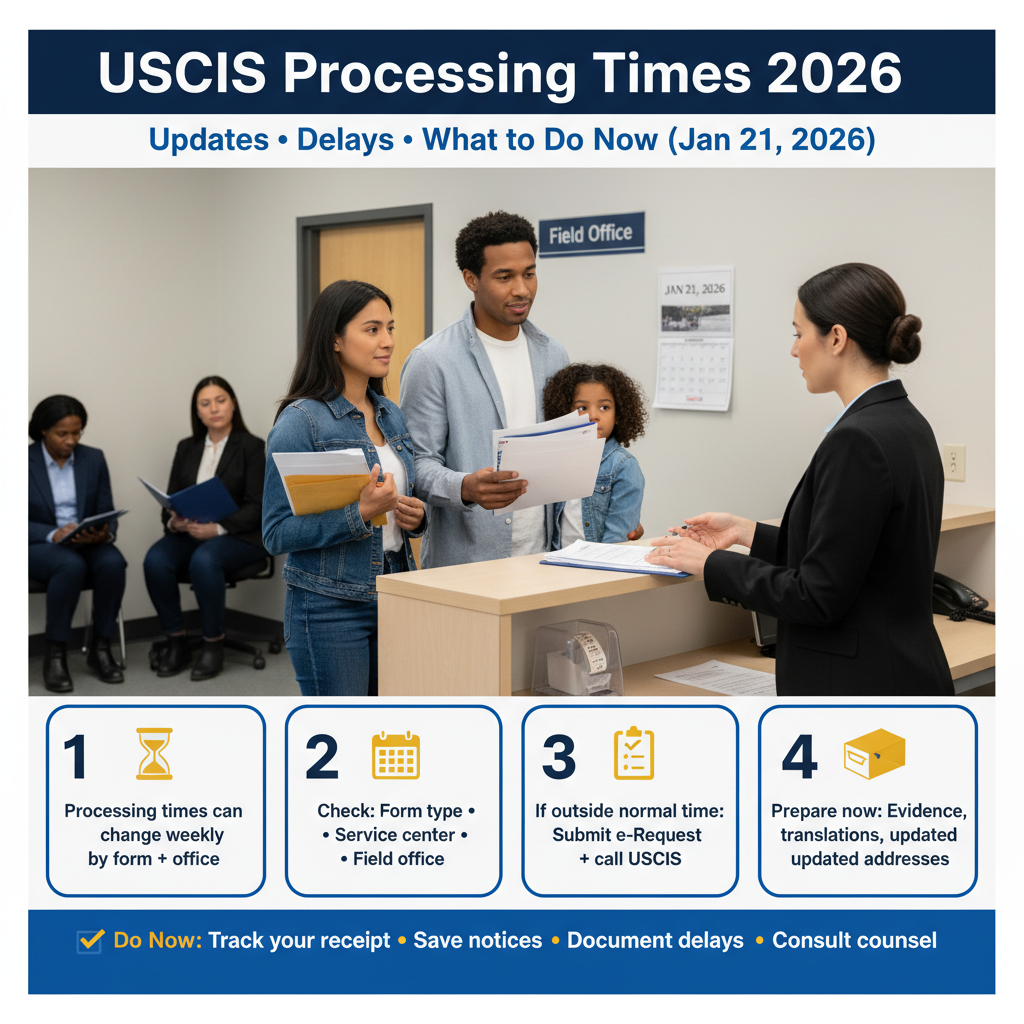
The reporting that sparked this guide is based on ongoing USCIS-related processing time updates and public-facing announcements tracked through: USCIS Processing Times and Updates for 2026 (USCIS).
Reminder: USCIS processing times can change frequently by form type, service center, field office, and case complexity. This article explains how to read those updates, what they mean in 2026, and what practical steps you can take—especially if your case is in Orlando or elsewhere in Florida.
Need Help? Our Orlando immigration team is ready to assist. Call +1 786-791-3106 for a free consultation, or message us online. Se Habla Español.
What This News Means for Immigrants in Orlando and Across Florida
Why this news is showing up now
USCIS processing times are a constant topic, but they become “trending” when many applicants notice the same thing at once: cases taking longer (or occasionally moving faster) than expected. In 2026, several forces continue to shape timelines:
- Workload shifts between USCIS service centers and field offices.
- Interview and staffing capacity at local offices like the Orlando USCIS Field Office.
- Security checks and identity verification that can add unpredictable time.
- Policy and operational updates that change how quickly certain forms are reviewed.
- Downstream backlogs tied to visas (for consular processing) and immigration court schedules (for people in proceedings).
Important: “Processing time” is not a promise. It is a rolling estimate based on recently completed cases. Your timeline may be shorter or longer depending on your facts and whether USCIS issues a Request for Evidence (RFE).
How it can affect Florida residents
For Central Florida residents—especially along the I-4 corridor (Orlando, Kissimmee, Sanford, and surrounding Orange County communities)—processing times can affect everyday life in very real ways:
- Work authorization gaps if an Employment Authorization Document (EAD) renewal is delayed.
- Travel plans if Advance Parole is pending and you must travel for family emergencies.
- Family separation when consular processing or waiver timelines stretch out.
- Status maintenance risks for students, workers, and visitors trying to stay compliant while a case is pending.
- Financial strain from repeated medical exams, document renewals, or missed job opportunities.
If your case is in Orlando, delays can also be driven by local interview availability and the pace at which the Orlando USCIS Field Office schedules in-person appointments, biometrics reuse decisions, and interviews for Adjustment of Status cases.
What USCIS Processing Times and Updates for 2026 Is (and Why It Matters)
A plain-English definition
“USCIS processing times” are USCIS’s published estimates for how long it takes to complete certain immigration applications and petitions—such as family petitions, green card applications, work permits, naturalization, and humanitarian benefits.
In plain terms: USCIS processing times help you estimate how long you might wait for a decision, an interview, a work permit, or a green card—so you can plan employment, travel, and family needs.
USCIS publishes these estimates on its official tool: USCIS Processing Times.
Key terms you need to know
- Receipt Notice: The I-797 notice confirming USCIS received your filing and assigned a receipt number.
- Service Center: A USCIS facility that processes many applications (often by mail), such as family petitions or EADs.
- Field Office: A local USCIS office (like the Orlando USCIS Field Office) that typically handles interviews and many green card adjudications.
- RFE (Request for Evidence): A letter requesting additional documents. RFEs almost always add time.
- NOID (Notice of Intent to Deny): A warning that USCIS plans to deny unless you respond with strong evidence.
- Priority Date: The “place in line” date for certain family- and employment-based categories. Your Priority Date matters most when visa numbers are limited.
- Adjustment of Status: Applying for a green card from inside the U.S., commonly using Form I-485.
- Consular Processing: Completing immigrant visa processing through a U.S. embassy/consulate abroad after petition approval.
- Case Outside Normal Processing Time: A threshold USCIS uses to decide when you may submit a service request.
- 90-day window: A common timing concept in immigration (for example, certain renewals or eligibility windows). Whether it applies depends on the benefit type.
- 180 days: Another critical timing concept that appears in multiple contexts (for example, some EAD automatic extension rules or job portability rules in certain employment-based cases). The exact rule depends on your category.
Warning: Many applicants confuse a “processing time estimate” with a “deadline.” Processing times are estimates; deadlines (like responding to an RFE) are strict and missing them can lead to denial.
Current Immigration Law: The Foundation
Processing times are an operational reality, but your eligibility and the rules USCIS applies come from federal law and regulations. Understanding the legal foundation helps you avoid mistakes that cause delays or denials.
Federal requirements
Most USCIS benefits are governed by the Immigration and Nationality Act (INA) and federal regulations in Title 8 of the Code of Federal Regulations (8 C.F.R.). Common legal touchpoints include:
- INA § 201–203 (immigrant visa allocation and preference categories—impacts Priority Date movement).
- INA § 245 (rules for Adjustment of Status and eligibility for Form I-485).
- INA § 212 (inadmissibility grounds—medical, criminal, immigration violations, fraud/misrepresentation).
- INA § 237 (deportability grounds—can affect people already in the U.S.).
- 8 C.F.R. § 103 (USCIS procedures, evidence, and adjudications).
USCIS form instructions and policy guidance also matter. Always start with official sources: USCIS official website and USCIS Forms.
Important: Even if processing times are long, you must still maintain lawful status when required, respond to USCIS notices on time, and avoid unauthorized travel or employment.
Florida-specific considerations
Immigration law is federal, but Florida residents often face practical, location-specific issues that can impact how delays affect them:
- Local USCIS workload: The Orlando USCIS Field Office interview capacity can influence Form I-485 case timelines.
- Mobility and address changes: Many families move within the I-4 corridor (Orange County, Osceola, Seminole, Polk). Address changes must be updated promptly with USCIS to prevent missed notices.
- Driver’s license and employment timing: Florida agencies may require unexpired proof of lawful status or work authorization; USCIS delays can create real-life barriers.
- Storm and emergency disruptions: Hurricane season can affect mail delivery, biometrics appointments, and travel—build buffer time into your plan.
If your case is in Orlando, planning around biometrics, interview scheduling, and mail reliability is critical to avoid avoidable delays.
Need Help? Our Orlando immigration team is ready to assist. Call +1 786-791-3106 for a free consultation, or message us online. Se Habla Español.
How to Track and Respond to USCIS Processing Times: A Complete Step-by-Step Guide
The goal in 2026 is not just to “wait.” It’s to track your case intelligently, prevent delays you can control, and escalate appropriately when your case is truly outside normal timeframes.
1) Identify your exact case type, form, and processing location
USCIS processing times depend on three key variables: (1) the form, (2) the category, and (3) the office handling it (service center or field office).
Common forms that people monitor in 2026 include: Form I-130 (family petition), Form I-485 (green card inside the U.S.), Form I-765 (EAD/work permit), Form I-131 (Advance Parole), Form N-400 (naturalization), and Form I-751 (remove conditions).
- Required documents / info to gather:
- Your USCIS receipt number(s) (from I-797 receipt notice).
- The form number(s) filed (e.g., Form I-130, Form I-485).
- The category/classification (immediate relative, preference category, etc.).
- The office listed on your receipt notice (service center code) or your local field office.
- Your Priority Date (if applicable).
Reminder: If you filed multiple forms together (for example, Form I-485 with Form I-765 and Form I-131), each form can move on a different timeline.
2) Use the official USCIS Processing Times tool correctly
Go to the official tool: USCIS Processing Times. Select your form, then select the category and the office.
- Required documents / info to gather:
- Form type and category (from your filing copy).
- Office/service center (from your receipt notice).
- A calendar to track milestones (receipt date, biometrics date, RFE response date).
The tool often shows:
- An estimated time range (example: “X months”).
- A “case inquiry date” (the date when you can submit an “outside normal processing time” request).
Important: The “case inquiry date” is often more useful than the general range because it tells you when USCIS will accept an escalation request.
3) Track your case status and notices—then respond fast to RFEs
In 2026, one of the biggest reasons cases slow down is not USCIS alone—it’s missed mail, incomplete responses, or late responses.
- Required documents / info to gather:
- USCIS online account access (if available) and receipt numbers.
- Copies of everything filed (full packet, exhibits, translations).
- Any USCIS notices received (biometrics, RFE, interview notice).
If USCIS issues an RFE or NOID:
- Read the notice carefully and respond to exactly what USCIS requests.
- Respond within the deadline listed on the notice (this is not flexible).
- Send a well-organized response with a cover letter and labeled exhibits.
Warning: Missing an RFE deadline can lead to denial—even if you were otherwise eligible.
4) Protect your ability to work and travel while waiting
Long processing times matter most when they affect work and travel. Many applicants with pending Adjustment of Status rely on: Form I-765 (EAD) and Form I-131 (Advance Parole).
- Required documents / info to gather:
- Your current EAD (front/back copy) and expiration date.
- Proof of pending case (receipt notices).
- Any prior immigration documents (I-94, visas, approvals).
- Travel plans and emergency documentation (if expedite is needed).
Important: Travel without Advance Parole (when required) can be treated as abandoning a pending Form I-485. Always confirm your specific situation before traveling.
Reminder: Some EAD categories may qualify for automatic extensions under specific rules, often tied to timely filing and category matching. Because the rules are technical and can change, confirm eligibility before relying on an auto-extension—especially if your employer uses E-Verify.
5) Escalate the right way when your case is truly delayed
If your case is beyond the “case inquiry date” shown in the processing times tool, you may submit a service request for “outside normal processing time.”
- Required documents / info to gather:
- Receipt notice(s) and receipt number(s).
- Screenshot or printout of the USCIS “case inquiry date.”
- Timeline summary (receipt date, biometrics, RFE dates, responses).
- Evidence of hardship if you may request expedite (job loss risk, medical emergency, etc.).
If USCIS does not resolve the delay after proper steps, additional options may include:
- Submitting an additional case inquiry if eligible.
- Requesting an expedite (only when criteria are met).
- Seeking help through a congressional inquiry (your U.S. Representative or Senator).
- In limited situations, exploring federal litigation strategies (case-specific; consult counsel).
Warning: Escalation should be strategic. Repeated, unfocused inquiries can waste time and may not move your case if it is still within normal timeframes.
6) Prepare for interview or final adjudication (especially in Orlando)
Many cases—especially family-based Form I-485—may require an interview at the local field office. If your case is in Orlando, you should prepare as if the interview notice could arrive with limited lead time.
- Required documents / info to gather:
- Government-issued IDs (passport, driver’s license, etc.).
- All original civil documents (birth/marriage/divorce certificates).
- Updated relationship evidence (for marriage-based cases).
- Updated financial evidence (if Form I-864 is involved).
- Updated medical exam if required (Form I-693, when applicable).
Important: If you move within Orange County or elsewhere in Florida, file your address change promptly. Missing an interview notice can cause denial for abandonment.
Practical Steps You Can Take Today
Processing times in 2026 can feel unpredictable, but you can still control many factors that commonly cause delays. Here is an actionable checklist you can start today.
- Checklist item #1: Create a single “USCIS case folder” (digital + paper) with every filing, notice, and delivery confirmation.
- Checklist item #2: Track key dates: receipt date, biometrics date, any RFE issue date, RFE response delivery date, and the “case inquiry date.”
- Checklist item #3: Review your forms for consistency (names, dates of birth, addresses, A-number). Small mismatches can trigger RFEs.
- Checklist item #4: Prepare updated evidence monthly (pay stubs, lease, insurance, bank statements, school records) so you’re ready for an interview.
- Checklist item #5: Plan renewals early. If your EAD is expiring, do not wait until the last minute—processing times can shift.
- Checklist item #6: If you must travel, confirm whether you need Advance Parole and whether your travel could affect Adjustment of Status.
- Checklist item #7: If your case is close to being outside normal processing time, prepare a clean timeline summary and evidence packet for a service request.
Document preparation guidance: USCIS delays often happen when documents are incomplete or unclear. Use:
- Clear scans (no cut-off edges), and keep originals safe.
- Certified translations for any non-English documents.
- Consistent formatting and naming conventions (e.g., “Exhibit A – Marriage Certificate”).
- Proof of delivery for mailed filings and RFE responses.
Timeline expectations (2026 reality check): Depending on the form and office, you may see:
- EAD/Advance Parole: timelines vary widely by category and workload.
- Family-based Form I-130: timelines vary by relationship and processing location.
- Form I-485 (family-based): often depends heavily on local field office interview capacity.
- Form N-400: depends on field office scheduling and background checks.
Always confirm your specific estimate using the official USCIS tools and your receipt notice details.
Need Help? Our Orlando immigration team is ready to assist. Call +1 786-791-3106 for a free consultation, or message us online. Se Habla Español.
How Imigrar Helps Immigrants in Orlando
At Imigrar, we help individuals and families navigate USCIS processing delays with a strategy—not guesswork. Our mission is to Keep Families Together, and we serve clients in Orlando, throughout Central Florida, and nationwide.
Here’s how we support you when processing times are changing in 2026:
- Case planning: We map out the fastest lawful path based on your goals (family unity, work authorization, travel, permanent residence, citizenship).
- Front-loaded filings: We prepare organized packets designed to reduce RFEs and avoidable delays.
- RFE/NOID responses: We respond with targeted evidence and clear legal arguments when needed.
- Interview preparation: If your case is in Orlando, we help you prepare for the Orlando USCIS Field Office interview with realistic practice and document checklists.
- Delay strategies: When appropriate, we help with service requests, expedite requests, and other escalation options.
Se Habla Español. We can assist you in English or Spanish.
If you’re worried about timing, work authorization, travel, or a pending green card case, we invite you to contact our team for a free consultation.
Frequently Asked Questions
Q: How do I know if I’m eligible to file a case inquiry for USCIS delays?
A: Use the official tool at USCIS Processing Times and locate your “case inquiry date” for your form, category, and office. If your receipt date is earlier than the inquiry date, you’re generally eligible to submit an “outside normal processing time” request. Reminder: You must select the correct office and category, or the inquiry date will be wrong.
Q: Will checking processing times or submitting inquiries hurt my immigration status?
A: Checking processing times does not affect your status. Submitting a legitimate service request generally does not “hurt” your case, but it also may not speed it up if you are still within normal timeframes. Important: What can hurt your status is missing deadlines, working without authorization, or traveling when Advance Parole is required during Adjustment of Status.
Q: How long will my Form I-130 or Form I-485 take in 2026?
A: There is no single answer because timelines vary by category, office, and case facts. For example, a marriage-based Form I-485 in Orlando may depend on the Orlando USCIS Field Office interview schedule, while a standalone Form I-130 may depend on the assigned service center. The best approach is to (1) confirm your processing office on the receipt notice, (2) check the official tool, and (3) plan for potential RFEs and interview scheduling.
Q: What documents do I need to avoid delays and RFEs?
A: The exact list depends on your benefit, but common RFE triggers include missing civil documents, weak relationship evidence, and incomplete financial sponsorship. For family cases, strong packets often include: identity documents, proof of lawful entry (when required), marriage certificate, divorce decrees (if any), joint documents, photos, affidavits (when helpful), and complete sponsor evidence for Form I-864. Warning: Submitting inconsistent addresses or dates across forms can trigger delays.
Q: How much does it cost to file, and do delays increase costs?
A: USCIS filing fees vary by form and can change. Always confirm current fees and filing addresses on USCIS Forms. Delays can increase real-life costs (renewing documents, medical exams, lost work time), even when USCIS fees don’t change. If you’re budgeting, plan for copies, translations, mailing with tracking, and potential renewals if your case extends longer than expected.
Q: What happens if my case is denied after a long wait?
A: A denial can have serious consequences depending on your current status and whether you are in removal proceedings. Some denials can be challenged through motions (Motion to Reopen/Reconsider), appeals (for certain forms), or refiling—while others require a different strategy. If you are in immigration court, coordination with Executive Office for Immigration Review procedures may be necessary. Important: Do not assume you have “nothing to do” after a denial—timelines to respond can be short.
Q: My family member is abroad—do USCIS processing times control everything?
A: Not always. USCIS times cover the petition stage (like Form I-130). After approval, many cases move to the Department of State for National Visa Center (NVC) processing and consular interviews. That stage is tracked through the U.S. Department of State. Your overall timeline depends on both USCIS and consular availability, plus visa category limits and your Priority Date.
Common Mistakes (and How to Avoid Them)
Mistake #1: Using the wrong office/category when checking processing times
USCIS estimates can look dramatically different depending on the office and category selected. If you choose the wrong category, you may think your case is “late” when it’s not—or miss the moment you can submit an inquiry.
How to avoid it: Match the form, category, and office exactly as shown on your receipt notice. If your case is in Orlando, confirm whether the case is at a service center (initial stages) or the Orlando USCIS Field Office (interview/adjudication).
Mistake #2: Waiting too long to renew an EAD or to plan for travel
In 2026, EAD and travel document timing can shift. Waiting until the last moment can create job interruptions or prevent urgent travel.
How to avoid it: Track expiration dates and file renewal-eligible applications as early as permitted. Keep copies of receipts, and speak with counsel if you might qualify for an expedite in an emergency.
Mistake #3: Responding to RFEs with partial or disorganized evidence
RFEs are not just “more paperwork.” They are a second chance to prove eligibility. A weak response can lead to denial.
How to avoid it: Respond with a structured packet: cover letter, index, labeled exhibits, and direct answers to each RFE item. Send with tracking and keep proof of delivery.
Additional Official Resources (Bookmark These)
- USCIS official website
- USCIS Processing Times
- USCIS Forms
- U.S. Department of State
- Executive Office for Immigration Review
Reminder: If you are in removal proceedings, USCIS timelines may not be the only clock that matters—court dates and filing deadlines can control your options.
Need Help? Our Orlando immigration team is ready to assist. Call +1 786-791-3106 for a free consultation, or message us online. Se Habla Español.

Closing: Don’t Let USCIS Processing Times Decide Your Future
USCIS processing times in 2026 are a moving target—but you are not powerless. The strongest approach is to file correctly the first time, track your case using official tools, respond quickly to notices, and escalate strategically when your case is truly outside normal processing time.
If your case is in Orlando, if you live in Orange County or along the I-4 corridor, or if you are anywhere in Florida and worried about delays affecting your job, travel, or family unity, Imigrar is here to help.
Need guidance now? Call Imigrar at +1 786-791-3106 for a free consultation, or message us online. Se Habla Español.


