


The reporting that sparked this guide
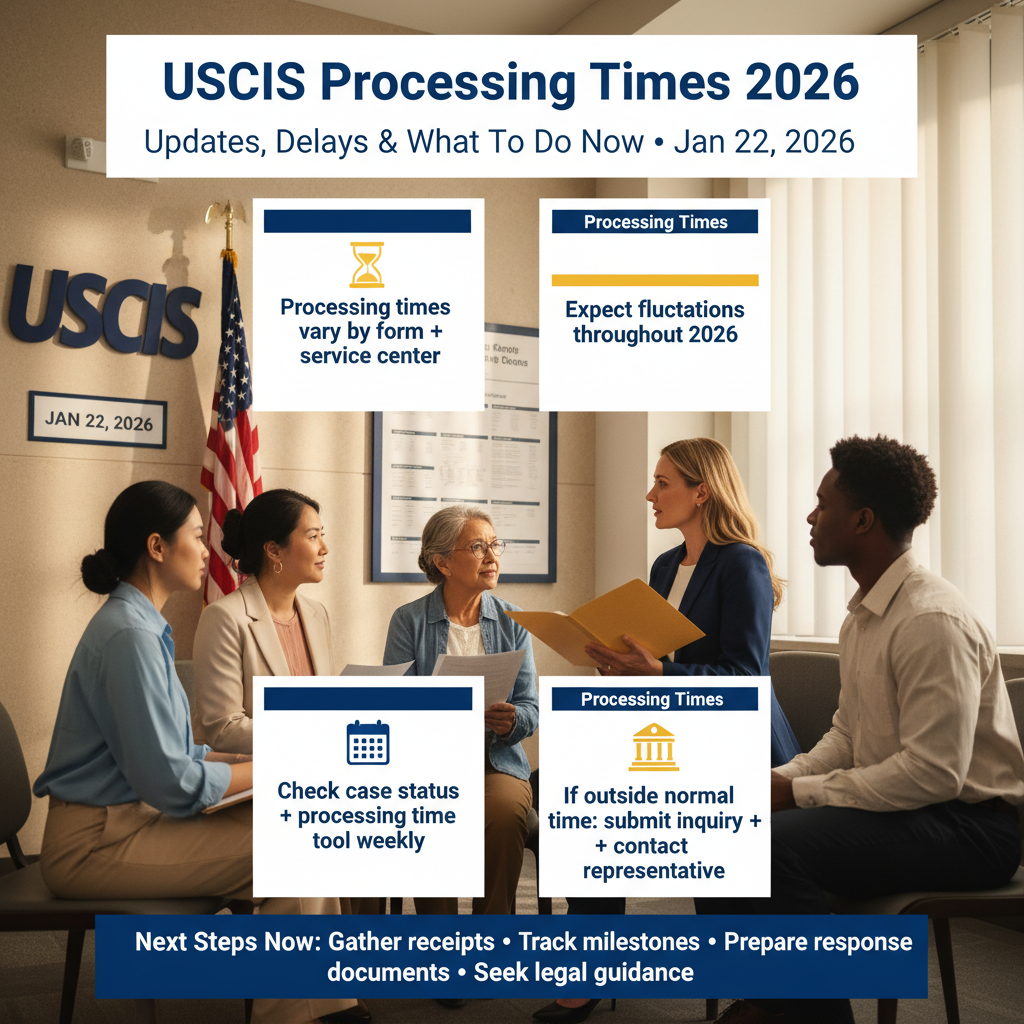
The reporting that sparked this guide is based on this USCIS-related news trend and official updates referenced across USCIS tools and announcements: USCIS Processing Times and Updates for 2026 (USCIS).
Important: USCIS processing times change frequently by form type, service center, and field office. This article explains how to interpret the 2026 updates, what they mean for real families, and what you can do today—especially if your case is in Orlando or elsewhere in Florida.
Need Help? Our Orlando immigration team is ready to assist. Call +1 786-791-3106 for a free consultation, or message us online. Se Habla Español.
What This News Means for Immigrants in Orlando and Across Florida
Why this news is showing up now
USCIS processing times are trending in 2026 because more applicants are tracking delays in real time—often after filing key benefits like a family petition (Form I-130), a green card application through Adjustment of Status (Form I-485), work permits (Form I-765), travel documents (Form I-131), naturalization (Form N-400), and removal-of-conditions cases (Form I-751).
In 2026, USCIS continues to publish estimated time ranges and “case inquiry dates” through its official tools. Applicants are paying close attention because:
- Many families rely on an EAD (work permit) to keep income stable while a green card case is pending.
- Travel plans depend on advance parole (or a valid visa), and travel without authorization can create serious consequences.
- Long waits can affect eligibility windows, evidence freshness, and even whether a child “ages out” of eligibility.
- USCIS has continued operational changes (digital processing expansion, shifting workloads among service centers, and evolving interview practices) that can move timelines up or down.
Reminder: “Processing time” is not a promise. It’s an estimate based on recent completions. Two people filing the same form on the same day can still have very different timelines depending on background checks, RFEs, interviews, and office workload.
How it can affect Florida residents
Florida applicants often see processing time differences depending on whether the case is handled by a USCIS service center (for many petitions) or a field office (for interviews and many Form I-485 decisions). For Central Florida residents, local factors matter:
- If your case is in Orlando... your interview (if required) may be scheduled through the Orlando USCIS Field Office, and local appointment availability can affect your timeline.
- For Central Florida residents... travel for biometrics or interviews may involve the I-4 corridor (Orlando, Kissimmee, Sanford, and surrounding Orange County communities).
- Some applicants relocate within Florida; address changes can delay notices and appointments if not updated quickly.
Warning: Missing a biometrics appointment, interview, or RFE deadline can cause denial—even if the original delay was USCIS-related. Processing time news is useful, but your best protection is proactive case management.
What USCIS Processing Times and Updates for 2026 Is (and Why It Matters)
A plain-English definition
“USCIS processing times” are USCIS’s published estimates for how long it takes to complete certain immigration applications and petitions. In 2026, USCIS continues to provide these estimates through its online tool: USCIS Processing Times.
The updates for 2026 generally refer to:
- Changes in estimated time ranges for specific forms (for example, Form I-130 or Form I-485).
- Changes in the “receipt date for a case inquiry” (the date after which you may submit an “outside normal processing time” request).
- Operational shifts (digital intake, staffing, workload transfers, and policy adjustments) that indirectly affect how quickly cases move.
In practical terms: these updates can influence when you can work, travel, reunite with family, or become a U.S. citizen.
Key terms you need to know
- Receipt Notice: The I-797 notice confirming USCIS accepted your filing and assigned a receipt number.
- Service Center: A USCIS facility that processes many petitions (often without interviews), such as family petitions and EAD/AP in many categories.
- Field Office: A local USCIS office (like Orlando) that handles interviews and certain case decisions.
- RFE (Request for Evidence): USCIS asks for more documents. RFEs pause progress until USCIS receives and reviews your response.
- NOID (Notice of Intent to Deny): USCIS plans to deny unless you respond with strong evidence by the deadline.
- Biometrics: Fingerprints and photo appointment used for background checks.
- Priority Date: The “place in line” date for certain family- and employment-based categories (often tied to the filing date). Priority Date is crucial for visa availability and timing.
- Adjustment of Status: Applying for a green card from inside the U.S. (typically using Form I-485). Adjustment of Status timelines often depend on interviews, background checks, and visa availability.
- Case Inquiry Date: The date USCIS says you may submit a request if your case is still pending beyond normal times.
- Premium Processing: Faster processing for certain employment-based forms (not available for most family-based green cards). Eligibility and availability vary.
Need Help? Our Orlando immigration team is ready to assist. Call +1 786-791-3106 for a free consultation, or message us online. Se Habla Español.
Current Immigration Law: The Foundation
Processing times are not just “administrative delays”—they sit on top of a legal framework that sets eligibility, procedures, and limits. Key legal authorities include:
- The Immigration and Nationality Act (INA), including INA § 201–203 (immigrant visa categories and numerical limits) and INA § 245 (adjustment of status rules).
- Federal regulations at 8 C.F.R. (including 8 C.F.R. § 103 on USCIS procedures and filings, and 8 C.F.R. § 245 on adjustment of status).
- USCIS policy guidance and instructions published on the USCIS official website.
Federal requirements
Regardless of where you live, USCIS requires properly filed forms, correct fees (or approved fee waivers where allowed), identity documents, and eligibility evidence. Common filings affected by 2026 processing time shifts include:
- Form I-130 (Petition for Alien Relative)
- Form I-485 (Application to Register Permanent Residence or Adjust Status)
- Form I-765 (Application for Employment Authorization)
- Form I-131 (Application for Travel Document)
- Form I-751 (Petition to Remove Conditions on Residence)
- Form N-400 (Application for Naturalization)
- Form I-129F (Petition for Alien Fiancé(e))
You can verify the latest editions and instructions at USCIS Forms.
Important: USCIS can reject a filing for technical reasons (wrong fee, missing signature, outdated edition, incorrect filing address). A rejection can cost weeks or months and may create status risks depending on your situation.
Florida-specific considerations
Immigration law is federal, but Florida residents often face practical issues that affect timelines:
- Address stability: Moves within Orange County or along the I-4 corridor can cause missed notices if you don’t update USCIS promptly.
- Local appointment availability: Biometrics and interviews are scheduled based on capacity. If the Orlando USCIS Field Office has high demand, interviews may be set further out.
- State documentation: Name variations on Florida IDs, birth certificates, or foreign documents can trigger RFEs if not explained with consistent evidence.
Reminder: If you are in removal proceedings, your case may involve the immigration court system and the Executive Office for Immigration Review. That is separate from USCIS processing times, but the two systems can interact (for example, asylum or adjustment filings depending on jurisdiction).
For consular processing and immigrant visa issuance abroad, the U.S. Department of State plays a major role in timelines after USCIS approves certain petitions.
How to Track and Respond to USCIS Processing Times: A Complete Step-by-Step Guide
1) Identify your form type, category, and where it’s being processed
Start by confirming which form you filed and which office is handling it. This matters because processing times vary widely by form and location.
- Look at your I-797 receipt notice and find the receipt number and “received date.”
- Confirm whether your case is at a service center or a field office.
- For family-based cases, confirm whether you are doing consular processing or Adjustment of Status with Form I-485.
Documents to gather for Step 1:
- Copy of your I-797 receipt notice(s)
- Copy of the filed form package (or at least the signed forms)
- Government-issued photo ID (passport, state ID)
- Any prior USCIS notices (biometrics, RFEs, transfer notices)
2) Check the official USCIS processing time tool (the right way)
Use the official tool at USCIS Processing Times. Select:
- Your form (e.g., Form I-130, Form I-485, Form N-400)
- Your category (for example, immediate relative vs. preference category)
- Your office (service center or field office)
Pay attention to two outputs:
- The estimated time range (for example, “X months to Y months”)
- The “receipt date for a case inquiry”
Important: Don’t compare your case to a friend’s case unless the form, category, and office match. Even then, RFEs and background checks can create major differences.
Documents to gather for Step 2:
- Your exact filing category (as listed on the receipt notice)
- Office code or location information from your receipt (if applicable)
- Notes on any case transfers or reassignments
3) Track your case status and set alerts for every notice
USCIS case status updates can be checked online. Create a tracking routine:
- Check status weekly (not hourly—frequent checks won’t speed anything up).
- Ensure your mailing address is correct and consistent.
- Save PDF copies of every notice and upload them to a secure folder.
Warning: Many serious problems happen because a notice goes to an old address. If you move in Orange County or anywhere in Florida, update USCIS immediately and keep proof of the update.
Documents to gather for Step 3:
- All USCIS notices received to date (I-797 series)
- Proof of address (lease, utility bill) if you recently moved
- USCIS online account access information (if you have one)
4) Prepare for common delay triggers (RFEs, biometrics, interviews)
In 2026, many “processing time” frustrations come from predictable issues. The biggest are RFEs, missed biometrics, and interview rescheduling.
- RFEs: Often about missing civil documents, insufficient financial sponsorship, unclear divorce history, or incomplete translations.
- Biometrics: If you miss it, USCIS may consider the application abandoned.
- Interviews: If your interview is at the Orlando USCIS Field Office, prepare early and bring organized originals.
Reminder: RFEs and NOIDs have strict deadlines. If USCIS gives you a deadline of 90-day window (or another timeframe listed on the notice), you must respond exactly as instructed. Some cases also involve time-sensitive rules like 180 days in certain immigration contexts—always confirm which deadline applies to your form and category.
Documents to gather for Step 4:
- Birth certificates (with certified translations if not in English)
- Marriage certificate, divorce decrees, annulments, death certificates (as applicable)
- Financial sponsorship evidence (often includes tax returns, W-2s, pay stubs)
- Proof of relationship (photos, leases, joint accounts) for marriage-based cases
- Medical exam documentation if required (often tied to Form I-485)
5) If you’re outside normal time, submit the right inquiry—or escalate strategically
If your case is past the “receipt date for a case inquiry,” you may submit an “outside normal processing time” request through USCIS channels. This is not guaranteed to speed up the case, but it can trigger review.
- Confirm you are truly outside the listed inquiry date for your form and office.
- Submit a concise inquiry with your receipt number and a clear issue statement.
- If there is an urgent need (serious medical issue, safety issue, severe financial loss), discuss expedite options with counsel.
Warning: Expedite requests are discretionary. Submitting weak expedite requests repeatedly can waste time and distract from building the strongest case record.
Documents to gather for Step 5:
- Receipt notice and case status screenshots
- Evidence supporting urgency (doctor letters, employer letters, eviction notices, etc.)
- Timeline summary (filing date, biometrics date, RFE dates, responses)
6) Keep your case “approval-ready” while you wait
Many cases get delayed because USCIS requests updated documents late in the process. While waiting:
- Keep passports valid and renew early if needed.
- Maintain continuous evidence of a bona fide marriage for marriage-based cases.
- Update tax filings and keep pay stubs available for sponsorship.
- Prepare for interview questions and document production.
Important: If you are relying on a work permit, track renewal windows carefully. Some categories have automatic extensions; others do not. Plan early so you don’t lose employment authorization.
Documents to gather for Step 6:
- Updated joint documents (leases, insurance, bank statements)
- Updated employment and income evidence
- Passport renewal receipts (if applicable)
- Copies of prior filings and any prior immigration history records
Practical Steps You Can Take Today
Processing time updates are useful only if you turn them into an action plan. Here is a practical checklist you can start today.
- Check your exact office and category in the USCIS Processing Times tool—don’t guess.
- Create a case timeline (filing date, receipts, biometrics, any RFE/response dates, interview date if scheduled).
- Scan and back up everything (forms, exhibits, notices) in a secure folder.
- Prepare for an RFE before it happens by collecting civil documents and relationship/financial evidence.
- Update your address immediately if you move—especially common for renters along the I-4 corridor.
- Track work/travel authorization expiration and plan renewals early.
- Review visa bulletin issues if your case depends on visa availability and a Priority Date.
Timeline expectations (realistic, not rosy): In 2026, some applicants see faster movement on certain steps (like biometrics scheduling or EAD issuance in some categories), while others experience delays due to local interview backlogs, security checks, or evidence issues. The best approach is to assume variability and keep your file strong.
Document preparation guidance: Use consistent names and dates across all documents. If your documents contain variations (two surnames, different spellings, missing middle names), prepare a clear explanation and supporting evidence. This single step prevents many RFEs.
Need Help? Our Orlando immigration team is ready to assist. Call +1 786-791-3106 for a free consultation, or message us online. Se Habla Español.
How Imigrar Helps Immigrants in Orlando
At Imigrar, we help individuals and families understand what USCIS processing time updates mean for their specific case—and what to do next. Delays aren’t just inconvenient; they can affect employment, family stability, and lawful status planning. Our approach is built around our tagline: Keep Families Together.
- We analyze your receipt notices, category, and office assignment to determine whether your case is truly outside normal times.
- We prepare “approval-ready” filings designed to reduce RFEs, including well-organized exhibits and clear legal explanations.
- We help clients in Orlando and nationwide plan around EAD/AP timing, interview readiness, and evidence updates.
- We advise on escalation options (inquiries, expedite strategies when appropriate) and risk management.
Se Habla Español. If you’re worried about delays at the Orlando USCIS Field Office or a service center, we can help you build a plan that fits your family and your timeline.
Call +1 786-791-3106 for a free consultation or message us online.
Frequently Asked Questions
Q: How do I know if I’m eligible to submit an “outside normal processing time” inquiry?
A: Check the “receipt date for a case inquiry” for your exact form, category, and office in the USCIS Processing Times tool. If your receipt date is earlier than the inquiry date, you may be eligible to submit a request. Important: If you recently received an RFE or your case was transferred, USCIS may treat the timeline differently, so it’s wise to confirm strategy before escalating.
Q: Will checking the USCIS processing time tool or case status more often make my case faster?
A: No. Tracking is useful for planning, but it doesn’t speed adjudication. What can help is preventing delays: responding to RFEs on time, attending biometrics/interviews, and keeping evidence organized. Reminder: Missing a deadline—even by one day—can lead to denial.
Q: Can processing delays affect my immigration status if I’m waiting for Adjustment of Status?
A: It depends on your situation. Many Form I-485 applicants are in a “period of authorized stay” while the application is pending, but that does not automatically fix every status issue. If you filed while in valid status, or if you have a category that forgives certain overstays (such as many immediate relative cases), the analysis changes. Warning: Travel, unauthorized work, or certain criminal issues can create serious risks. Get individualized legal advice before making decisions based on “processing time averages.”
Q: What documents most commonly cause RFEs and slow down processing in 2026?
A: The most common issues include missing or unclear civil documents (birth/marriage/divorce), insufficient financial sponsorship evidence, inconsistent addresses or names, and weak proof of a bona fide marriage. For Form I-485, medical exam and admissibility-related documents can also be critical. A well-organized filing with a clear index and labeled exhibits can reduce delays significantly.
Q: How much does it cost to file, and do delays increase the cost?
A: USCIS filing fees vary by form and can change. Always confirm current fees and instructions on the USCIS official website and the USCIS Forms page before filing. Delays can increase indirect costs (renewing work permits, obtaining updated documents, travel changes, time off work). In some cases, refiling after a rejection or denial can be far more expensive than doing it correctly the first time.
Q: What happens if my case is denied after a long wait?
A: The consequences depend on the form and your status. Some denials can be refiled; others may allow a motion to reopen/reconsider or an appeal (with strict deadlines). If you are out of status, a denial can trigger unlawful presence issues or referral to immigration court in some contexts. Important: If you receive a denial or a NOID, speak with an immigration attorney immediately to protect deadlines and options.
Q: If my case is in Orlando, should I expect an interview at the Orlando USCIS Field Office?
A: Many Form I-485 cases are interview-based, though USCIS can waive interviews in some situations depending on category and case history. Naturalization (Form N-400) typically requires an interview and civics/English testing (with exceptions). If your case is in Orlando, plan for local scheduling realities in Orange County and keep originals ready even if you previously uploaded copies.
Q: Does my Priority Date affect USCIS processing time estimates?
A: Yes—indirectly. USCIS processing time estimates measure how long USCIS takes to process the form, but if your category requires visa availability, your Priority Date and the visa bulletin can control when a final decision can be issued. For consular processing, USCIS approval is only one step; the U.S. Department of State and the National Visa Center timeline also matter.
Common Mistakes (and How to Avoid Them)
Mistake #1: Assuming the “average processing time” is your personal deadline
Many applicants panic when they pass the low end of a posted range. The more important number is the “receipt date for a case inquiry.” Use the official tool and compare your receipt date correctly. If you’re not outside the inquiry date, focus on keeping your case strong and ready.
Mistake #2: Responding to RFEs with disorganized or incomplete evidence
An RFE response should be treated like a legal brief: clear, labeled, and complete. Include a cover letter, exhibit list, and copies of what USCIS requested. Warning: If USCIS asks for a specific document and you send “something close,” you may still be denied.
Mistake #3: Moving or traveling without planning for notices and authorization
Moves are common for families along the I-4 corridor, but address changes can cause missed biometrics or interviews. Travel can be even riskier. If you have a pending Adjustment of Status case, leaving the U.S. without proper authorization can lead to abandonment of Form I-485 in many situations. Always confirm travel rules before booking flights.
Need Help? Our Orlando immigration team is ready to assist. Call +1 786-791-3106 for a free consultation, or message us online. Se Habla Español.
USCIS Processing Times in 2026: What to Watch Next
While USCIS time ranges can move month to month, there are consistent “pressure points” to watch in 2026:
- Field office interview capacity: If the Orlando USCIS Field Office experiences increased demand, interview scheduling may extend timelines for Form I-485 and Form N-400.
- Work permit timing: EAD timelines remain critical for family stability. Plan renewals and track category-specific rules.
- Evidence standards: USCIS continues to scrutinize identity, relationship, and admissibility evidence. Strong filings reduce delays.
- Interagency steps: Some cases depend on Department of State processing after USCIS approval. Monitor consular steps at U.S. Department of State.
- Proceedings overlap: If immigration court is involved, coordinate strategy with EOIR timelines: Executive Office for Immigration Review.
Important: The most reliable way to “speed up” a case is to prevent avoidable delays: file correctly, respond quickly, and keep your evidence updated.
External Official Resources (Save These Links)

Closing: Don’t Let Processing Delays Control Your Future
USCIS processing time updates in 2026 can feel overwhelming—especially when your ability to work, travel, or reunite with family is on the line. The key is to treat “processing time” as a planning tool, not a prediction. If you’re in Orlando, Orange County, or anywhere along the I-4 corridor, local scheduling realities can matter—but smart preparation matters even more.
If you want help interpreting your timeline, preparing an RFE-proof filing, or building a strategy to address delays, Imigrar is here for you.
Need Help? Our Orlando immigration team is ready to assist. Call +1 786-791-3106 for a free consultation, or message us online. Se Habla Español.


