


The reporting that sparked this guide
This article is based on publicly available updates and discussions about USCIS processing backlogs and timelines, as reflected in:
USCIS Processing Times and Updates for 2026 (USCIS)
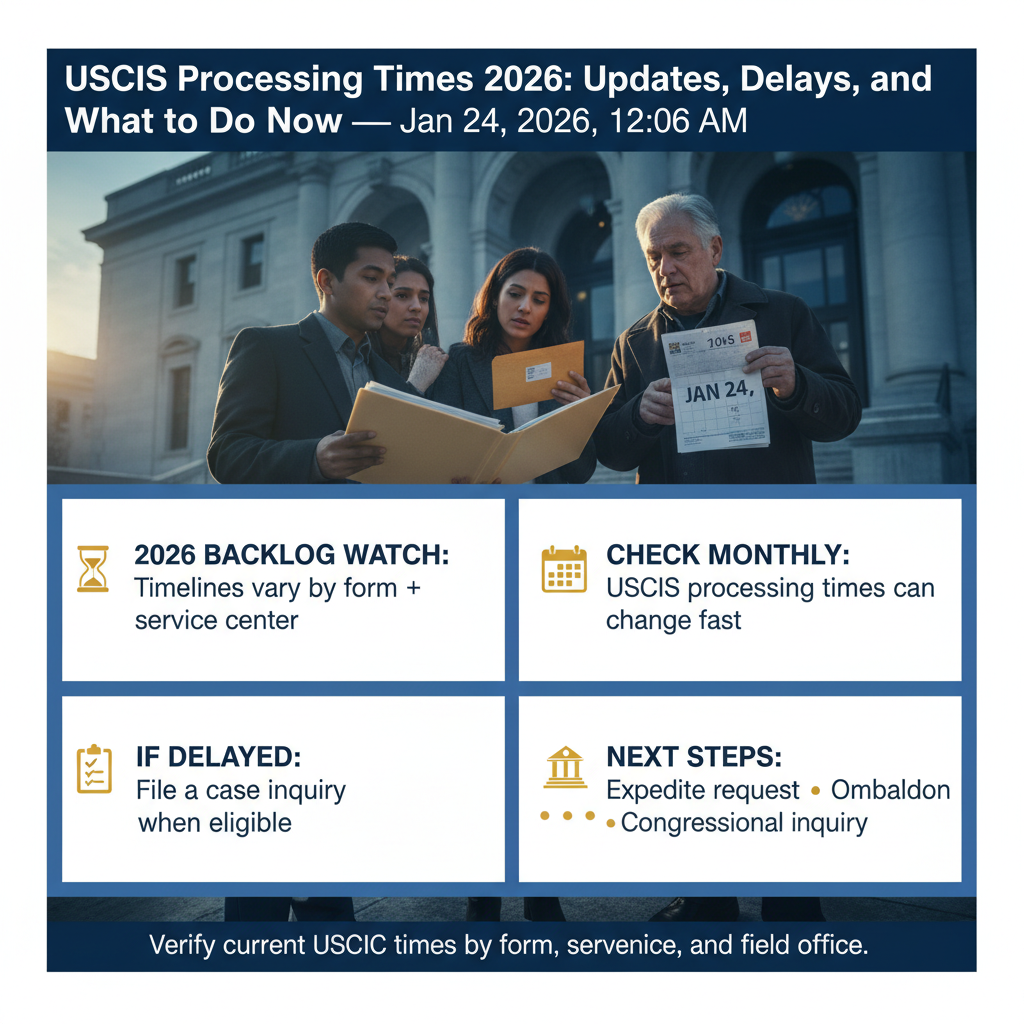
Reminder: USCIS timelines can change quickly by form type, service center, and field office. Always verify current estimates using the official USCIS tools linked below.
Need Help? Our Orlando immigration team is ready to assist. Call +1 786-791-3106 for a free consultation, or message us online. Se Habla Español.
What This News Means for Immigrants in Orlando and Across Florida
Why this news is showing up now
USCIS processing times are “trending” in 2026 because delays (and sudden improvements) are affecting real-life milestones: getting a first work permit, renewing an EAD, attending a green card interview, traveling on advance parole, or taking the Oath of Allegiance for naturalization.
Several forces typically drive processing-time shifts:
- Workload surges (seasonal filing spikes, humanitarian programs, policy changes, and increased Requests for Evidence).
- Staffing and resource allocation across service centers and field offices.
- Security checks and interagency vetting that can extend timelines even when a case is otherwise complete.
- Operational changes such as expanded online filing, new biometrics scheduling patterns, and internal triage priorities.
Important: “USCIS processing time” is not one number. It varies by (1) form, (2) eligibility category, (3) where you live, and (4) which USCIS office is handling your case.
How it can affect Florida residents
For Central Florida residents—especially along the I-4 corridor (Orlando, Kissimmee, Sanford, Lake Mary, and surrounding communities)—processing times can shape day-to-day stability:
- Employment: Delays in EAD approval can interrupt work authorization, job offers, promotions, and professional licensing.
- Family unity: Slow family-based cases can prolong separation or delay Adjustment of Status for spouses and children.
- Travel: Advance parole delays can prevent urgent travel for family emergencies.
- Driver’s licenses and IDs: Florida requirements often depend on valid status documents and unexpired proof of lawful presence.
- Interview scheduling: The Orlando area can see fluctuations in interview availability depending on the Orlando USCIS Field Office workload.
If your case is in Orlando, timing matters not only for USCIS deadlines, but also for practical life events—lease renewals, school enrollment, healthcare coverage, and employer onboarding.
What USCIS Processing Times and Updates for 2026 Is (and Why It Matters)
A plain-English definition
“USCIS processing times” are USCIS’s published estimates of how long it takes to decide a specific application or petition—such as a family petition, work permit, green card application, or naturalization request.
In plain terms: processing times are the “line length” for your case type at the office handling it. They help you understand:
- When you might receive a receipt notice, biometrics appointment, interview, or final decision
- When you can submit an “outside normal processing time” inquiry
- How to plan work, travel, and family milestones realistically
Key terms you need to know
- Receipt Notice: The USCIS notice (often Form I-797) confirming your case was received and providing a receipt number.
- Biometrics: Fingerprints/photo/signature appointment used for background checks.
- RFE (Request for Evidence): A notice asking for missing or additional documents. RFEs often add weeks or months.
- NOID (Notice of Intent to Deny): A warning that USCIS plans to deny unless you respond convincingly.
- Service Center vs. Field Office: Service centers mostly process paper-based adjudications; field offices handle interviews and many local adjudications.
- Priority Date: The date your immigrant petition was filed (or labor certification filed, if applicable). Your Priority Date controls visa availability in many categories.
- Adjustment of Status: The process to apply for a green card from inside the U.S., typically using Form I-485.
- Consular Processing: The process to get an immigrant visa through a U.S. consulate abroad, usually after an I-130 or I-140 approval and National Visa Center processing.
- 90-day window (common naturalization timing concept): Many applicants can file for naturalization up to 90 days before the 3-year or 5-year residency requirement is met.
- 180 days (common employment-based concept): AC21 portability rules may allow job changes after certain I-485 stages—often discussed in connection with 180 days after filing or after I-140 approval, depending on the scenario.
Warning: People often rely on social media “average timelines.” These can be misleading because USCIS times differ by office and category. Use official tools and case-specific strategy.
Need Help? Our Orlando immigration team is ready to assist. Call +1 786-791-3106 for a free consultation, or message us online. Se Habla Español.
Current Immigration Law: The Foundation
Processing times are an administrative reality, but your eligibility and legal pathway are grounded in federal immigration law and regulations. Understanding the “why” behind your form type helps you avoid delays and file correctly the first time.
Federal requirements
Most USCIS benefits are governed by the Immigration and Nationality Act (INA) and federal regulations in Title 8 of the Code of Federal Regulations (8 C.F.R.). Examples include:
- INA § 201, § 202, § 203: Immigrant visa availability, numerical limits, and preference categories (ties directly to your Priority Date).
- INA § 245: Adjustment of Status rules (commonly filed on Form I-485).
- INA § 204: Family- and employment-based immigrant petitions (including Form I-130 for family cases).
- INA § 316 and § 319: Naturalization requirements (5-year rule and 3-year rule for spouses of U.S. citizens).
- 8 C.F.R. § 103: General USCIS filing procedures, evidence requirements, and adjudication standards.
USCIS publishes official instructions for each form and procedural updates on the USCIS official website and the USCIS Forms library.
Florida-specific considerations
Immigration law is federal, but your Florida “experience” depends on local logistics and state-level systems:
- Local USCIS operations: The Orlando USCIS Field Office may schedule interviews and oath ceremonies based on local capacity.
- Mail and address stability: Frequent moves in Orange County and along the I-4 corridor can cause missed notices if you don’t update your address promptly.
- Driver license/REAL ID timing: Florida DHSMV documentation requirements can create urgency around EAD, green card, or I-797 validity.
- Immigration court coordination: If you are in removal proceedings, your strategy may involve the Executive Office for Immigration Review and USCIS filings running in parallel.
Important: Your form choice matters. A small filing mistake on Form I-130 or Form I-485 can trigger an RFE, a rejection, or months of delay.
How to Track and Respond to USCIS Processing Times in 2026: A Complete Step-by-Step Guide
This step-by-step guide is designed for people who want to (1) understand their expected timeline, (2) reduce avoidable delays, and (3) know when and how to escalate appropriately.
1) Identify your exact case type, category, and office
Processing times only make sense when you match your case to the correct USCIS “bucket.” For example, Form I-130 has different timing depending on whether the petitioner is a U.S. citizen or permanent resident and whether the beneficiary is inside or outside the U.S.
Documents to gather:
- USCIS receipt notice (Form I-797) with receipt number
- A copy of the filed application/petition packet (or PDF submission confirmation)
- Your eligibility category (immediate relative, family preference, employment-based, asylum-based, etc.)
- Any transfer notices (USCIS sometimes moves cases between centers)
If your case is in Orlando, confirm whether your case is at a service center (paper adjudication) or at the Orlando USCIS Field Office (interview/adjudication). This affects the timeline dramatically.
2) Check the official USCIS processing-time tool (the right way)
USCIS provides an official tool where you select your form and office to see estimated times and an inquiry date.
Use these official links:
Documents/info to gather:
- Your form number (example: Form I-130, Form I-485, Form I-765, Form N-400)
- The office listed on your receipt notice (or the “office” USCIS indicates online)
- Your receipt date (the “received date” on the I-797)
Reminder: The tool often shows a range and a date when you’re allowed to inquire. Being “past the average” is not the same as being “outside normal processing time.”
3) Compare your case timeline to the visa bulletin (if applicable)
For categories controlled by visa availability (family preference and employment-based), your case may be “ready” but cannot be finalized until a visa number is available. That’s where your Priority Date and the Visa Bulletin matter.
Documents/info to gather:
- Your Priority Date (from I-797 approval notice or filing receipt)
- Your preference category (e.g., F2A, F1, EB-2, EB-3)
- Your country of chargeability (often your country of birth)
Use the U.S. Department of State website to access the monthly Visa Bulletin and understand whether your date is “current.”
Warning: Many applicants confuse “I-130 approved” with “green card available.” Approval is often only step one.
4) Prevent delays: respond correctly to biometrics, RFEs, and interview notices
In 2026, many “processing time problems” come from avoidable disruptions: missed biometrics, incomplete RFE responses, or interview rescheduling.
Documents to prepare (as applicable):
- Government-issued photo ID and appointment notice for biometrics
- RFE letter and a copy of everything USCIS requested
- Updated relationship evidence for marriage cases (leases, insurance, photos, children’s birth certificates)
- Tax returns, pay stubs, and financial evidence for affidavit of support issues
Important: If USCIS gives a response deadline, treat it as absolute. Missing an RFE deadline can lead to denial.
5) Use the correct escalation options when you are truly outside normal time
If you are past the “inquiry date” shown in the processing-time tool, you may be able to submit a service request. If that fails, other escalation paths may apply depending on your circumstances.
Documents/info to gather:
- Receipt number and receipt date
- Screenshot or printout showing your case is outside normal processing time
- Any urgent-impact documentation (job loss, medical emergency, deployment orders)
- History of prior inquiries and responses
Potential escalation tools include:
- USCIS “outside normal processing time” service request (when eligible)
- Requesting an expedite (only for qualifying urgent situations)
- Congressional inquiry (through your U.S. representative or senator)
- Ombudsman assistance (case-specific, limited circumstances)
Warning: Expedite requests are discretionary and require evidence. Submitting weak expedite requests can waste time and create confusion.
6) If you’re filing in 2026: build a “delay-resistant” packet from day one
The fastest case is the case that doesn’t get rejected and doesn’t receive an RFE. A well-prepared filing helps USCIS adjudicate without back-and-forth.
Documents checklist (varies by case type):
- Correct edition of each form (download from USCIS Forms)
- Proof of lawful entry (if applicable), identity documents, and civil documents with certified translations
- Clear filing fee payment method and correct fee amount
- Organized exhibits with a cover letter and table of contents
- Evidence tailored to eligibility requirements (not just “more documents”)
Reminder: A rejected filing (for fee, signature, or wrong form edition) can set you back weeks—sometimes months—especially during high-volume periods.
7) Know what to do after a decision (approval, RFE, or denial)
Processing times don’t end at “a decision.” You may need to plan next steps: NVC processing, green card production, oath scheduling, or motions/appeals if denied.
Documents to gather:
- USCIS decision notice (approval/denial)
- Any underlying evidence and your full filing copy
- For consular cases: NVC case number and invoice ID (if issued)
- For denial strategy: the denial reasoning, deadlines for motions/appeals
Important: Denials often have strict deadlines and specific procedural options. Don’t assume you can “just refile” without consequences.
Need Help? Our Orlando immigration team is ready to assist. Call +1 786-791-3106 for a free consultation, or message us online. Se Habla Español.
Practical Steps You Can Take Today
Even when USCIS is slower than expected, there are concrete actions you can take to protect your status, reduce delays, and avoid preventable denials.
Actionable checklist (do these this week)
- Check your case status and confirm your mailing address is current with USCIS.
- Create a case timeline (receipt date → biometrics → RFE response date → interview date).
- Download and save copies of everything you filed and every notice received.
- Prepare renewal strategies early (EAD/AP renewals, extensions, or bridging options).
- Track your Priority Date if you are in a preference category and monitor the Visa Bulletin monthly.
- Plan for travel carefully—do not depart the U.S. if your situation requires advance parole and you don’t have it.
- Consult a qualified immigration attorney if you receive an RFE, NOID, or denial, or if you are in removal proceedings.
Document preparation guidance
USCIS delays often come from evidence issues. In 2026, a “clean” packet is one of the best ways to avoid months of back-and-forth.
- Identity and civil documents: Keep passports, birth certificates, marriage/divorce documents, and name-change records organized and translated.
- Proof of relationship (family cases): Joint lease/mortgage, joint bank accounts, insurance policies, photos over time, affidavits (when helpful), and evidence of shared life.
- Proof of lawful entry/status (when relevant): I-94 record, visa pages, admission stamp, prior approvals.
- Financial sponsorship: Tax transcripts, W-2s, pay stubs, employment verification letters.
Reminder: Sending disorganized documents can slow review. Use labels, exhibit tabs, and a cover letter.
Timeline expectations for 2026 (planning guidance)
Because processing times vary, it’s smarter to plan in “ranges” and build buffers:
- EAD/Advance Parole: Plan for several months in many categories; file renewals as early as allowed for your category.
- Family-based Adjustment of Status: Often depends on local field office interview capacity; Orlando scheduling can fluctuate.
- Naturalization (Form N-400): Many applicants see meaningful variation by field office; plan around travel and work obligations.
Important: If you are eligible to file naturalization within the 90-day window, filing strategically can help you reach the finish line sooner—if your record is clean and your evidence is strong.
How Imigrar Helps Immigrants in Orlando
At Imigrar, we help clients in Orlando, Central Florida, and nationwide navigate USCIS delays with a strategy focused on results and family stability—aligned with our tagline: Keep Families Together.
Our team helps you:
- Choose the correct pathway (family, employment, humanitarian, naturalization) and avoid category mistakes
- Prepare strong filings for Form I-130, Form I-485, Form I-765, Form I-131, Form N-400, and more
- Respond to RFEs/NOIDs with organized, legally persuasive evidence
- Prepare for interviews at the Orlando USCIS Field Office
- Evaluate expedite options and timing-sensitive strategies
Se Habla Español. We know that understanding the process in your preferred language can reduce stress and prevent mistakes.
Free consultation: Call us at +1 786-791-3106 to discuss your timeline, your risks, and the fastest compliant plan for your situation.
Frequently Asked Questions
Q: Am I eligible to file Form I-485 if USCIS processing times are long?
A: Processing times do not determine eligibility. Eligibility for Adjustment of Status under INA § 245 generally depends on factors like lawful admission/parole, visa availability (if required), and admissibility. Some applicants may be barred or may need waivers. If you’re unsure, consult an attorney before filing—an ineligible filing can lead to denial and, in some cases, risk of enforcement consequences.
Q: Will a long USCIS timeline affect my current immigration status?
A: It depends on what you filed and what status you currently hold. For example, some applicants who file Form I-485 may be in a “period of authorized stay” while the application is pending, even if a prior nonimmigrant status expires. Others must maintain their nonimmigrant status to avoid problems. Important: Do not assume you are “safe” just because something is pending—get case-specific advice.
Q: How can I estimate my timeline if my case is handled by the Orlando USCIS Field Office?
A: Start with the official tool at USCIS Processing Times and select your form and “Orlando FL Field Office” (when available). Then add real-world buffers for biometrics rescheduling, RFEs, and interview availability. For Central Florida residents, interview timing can be the biggest variable in family-based green card cases.
Q: What documents are most likely to trigger an RFE and slow my case?
A: Common RFE triggers include missing civil documents (birth/marriage/divorce records), weak proof of a bona fide marriage for Form I-130/Form I-485, incomplete financial sponsorship evidence, missing translations, and unclear eligibility evidence (entry proof, prior immigration history). A well-organized filing with a cover letter and labeled exhibits reduces RFE risk.
Q: How much does it cost to file USCIS applications in 2026?
A: Costs vary by form and can change. You should confirm current fees directly on the USCIS Forms page and the specific form instructions. Costs may include USCIS filing fees, biometrics (if required), medical exam fees (for many Form I-485 cases), translation costs, and attorney fees if you choose representation. We can review total expected costs during a free consultation.
Q: What happens if USCIS denies my case after a long wait?
A: A denial can have different consequences depending on the application and your current status. Some denials allow refiling; others may allow a motion to reopen/reconsider or an appeal. Deadlines can be strict, and a denial may also trigger unlawful presence or removal risk in certain situations. Warning: Don’t ignore a denial notice—speak with an attorney immediately to preserve options and meet deadlines.
Q: Can I travel while my Form I-485 is pending if USCIS is delayed?
A: Many applicants should not travel internationally without approved advance parole (often requested with Form I-131), unless they hold certain statuses that allow travel without abandoning the application. Traveling without proper authorization can be treated as abandoning the I-485. Always get individualized advice before booking travel.
Common Mistakes (and How to Avoid Them)
Mistake #1: Relying on unofficial timeline averages and panicking too early
Social media timelines often mix different categories, offices, and years. Instead, use the official tool and track the “inquiry date.” If you’re not outside normal time, focus on strengthening your file and staying ready for USCIS requests.
Mistake #2: Missing notices because of address changes
In fast-growing areas like Orange County, people move often. If you miss a biometrics or interview notice, it can add months. Keep your address updated and monitor mail closely. Maintain copies of every notice.
Mistake #3: Submitting incomplete RFE responses
An RFE is not an invitation to “send what you have.” It’s a checklist from USCIS. Respond with a structured packet that answers every point, includes a cover letter, and provides clear, labeled evidence. If you’re unsure, get legal help—RFEs are one of the biggest drivers of delay and denial.
Official Resources to Bookmark (2026)
For accurate updates and planning, use these official sources:
- USCIS official website
- USCIS Processing Times
- USCIS Forms
- U.S. Department of State (Visa Bulletin and consular processing info)
- Executive Office for Immigration Review (immigration court information)
Reminder: If your case involves both USCIS and a U.S. consulate abroad, expect additional steps beyond USCIS approval, including National Visa Center processing and consular interview scheduling.
Need Help? Our Orlando immigration team is ready to assist. Call +1 786-791-3106 for a free consultation, or message us online. Se Habla Español.
Putting It All Together for 2026: A Realistic Strategy
USCIS processing times in 2026 are best approached as a planning problem and an evidence problem—not just a waiting problem.
For Central Florida residents, especially if the Orlando USCIS Field Office is involved, your best strategy is:
- File correctly and completely the first time
- Stay ready for biometrics/interview scheduling
- Respond to RFEs quickly and thoroughly
- Track Priority Date and visa availability (when applicable)
- Escalate only when you qualify (outside normal time or true urgent need)
Important: If you have a complex history—prior denials, unlawful presence, arrests, removal proceedings, or prior marriages—your case needs individualized legal analysis. Delays can magnify risk if you make the wrong move.

Closing: Get a Case Plan You Can Trust
USCIS timelines can feel unpredictable, but your preparation and strategy don’t have to be. If you’re waiting on a decision, planning a 2026 filing, or worried your case is stuck, Imigrar can help you understand your options and take the next step with confidence.
Need help now? Call Imigrar at +1 786-791-3106 for a free consultation, or message us online. Se Habla Español. We’re based in Orlando, Florida, and we serve clients nationwide.


