


The reporting that sparked this guide
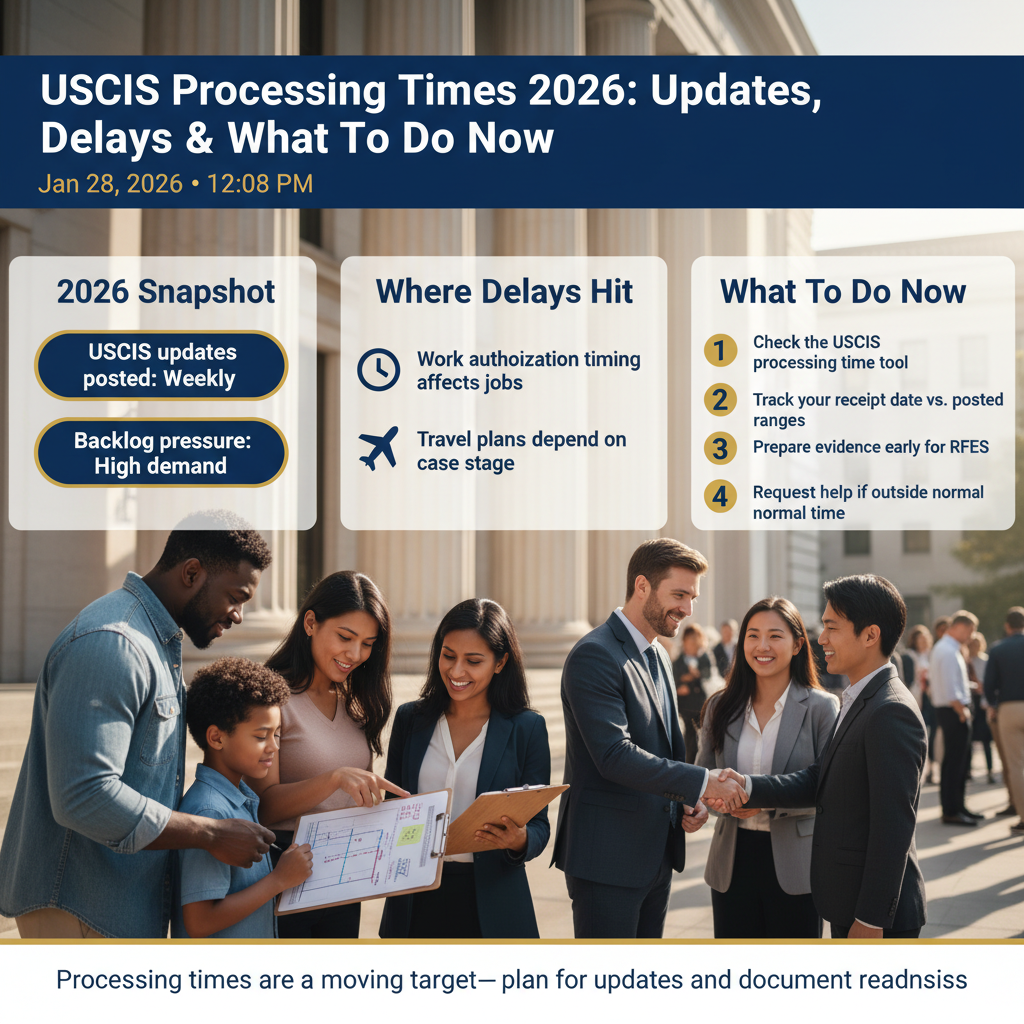
Immigration processing times are a moving target—and they matter because they determine when you can work, travel, reunite with family, or finally become a U.S. citizen. The reporting that sparked this guide is: USCIS Processing Times and Updates for 2026 (USCIS).
Reminder: USCIS updates its public processing-time tools frequently. Always cross-check your specific form, category, and office using the official tools linked throughout this article.
Need Help? Our Orlando immigration team is ready to assist. Call +1 786-791-3106 for a free consultation, or message us online. Se Habla Español.
What This News Means for Immigrants in Orlando and Across Florida
Why this news is showing up now
USCIS processing times are trending in 2026 because more applicants are tracking delays—and because even small USCIS workflow changes can significantly impact real-life plans: starting a job, traveling for emergencies, renewing a driver’s license, or keeping a family together.
Several factors commonly drive processing-time fluctuations:
- USCIS workload shifts (more filings in certain categories, humanitarian surges, or seasonal spikes).
- Staffing and resource allocation at service centers and field offices.
- Security checks and interagency clearances that can slow final decisions.
- Policy and form changes (new evidence requirements, fee updates, or form editions).
- Interview capacity at field offices, which directly affects many Adjustment of Status and naturalization cases.
In plain terms: processing times are “news” because they change—and when they change, your timeline changes.
How it can affect Florida residents
Florida is one of the country’s busiest immigration hubs, and Central Florida continues to grow. If your case is in Orlando or anywhere along the I-4 corridor (Orlando–Kissimmee–Lakeland–Tampa), the speed of local appointments and interviews can shape your results.
Here’s how USCIS processing time updates in 2026 can affect Florida residents:
- Work authorization timing: delays in Form I-765 can postpone your legal ability to work.
- Travel timing: delays in Form I-131 (Advance Parole) can trap applicants in the U.S. during emergencies abroad.
- Family reunification: longer timelines for Form I-130 can keep spouses, children, and parents separated.
- Green card backlogs: slowdowns can affect Form I-485 interview scheduling at the field office.
- Citizenship planning: slower Form N-400 processing can push back voting eligibility and passport plans.
Important: Processing times are not just “how long USCIS takes.” They also affect your strategy—what you file, when you file, and what you do while waiting.
What USCIS Processing Times and Updates for 2026 Is (and Why It Matters)
A plain-English definition
“USCIS processing times” are USCIS’s published estimates for how long it takes to process a specific immigration form (for example, Form I-130 or Form I-485) at a specific USCIS office (service center or field office).
In 2026, “updates” typically refer to changes in:
- USCIS’s posted time ranges (for example, “80% of cases completed within X months”)
- USCIS internal workflows (interview waivers, centralized intake, digitization)
- How USCIS calculates and displays those times
- Case inquiry rules (when you can request help because your case is “outside normal processing time”)
These updates matter because they help you answer practical questions: When will I get my receipt? When can I work? When might my interview be? When should I escalate or request assistance?
Key terms you need to know
- Receipt Notice: Proof USCIS accepted your filing and created a case number (typically Form I-797C).
- Biometrics: Fingerprints/photo appointment used for background checks (often at an ASC).
- RFE (Request for Evidence): USCIS request for more documents; can significantly extend timelines.
- NOID (Notice of Intent to Deny): A warning that USCIS may deny unless you respond effectively.
- Service Center: USCIS facility that processes many petitions (often without interviews), such as I-130 or I-765.
- Field Office: Local USCIS office handling interviews and many final decisions (for Orlando-area cases, this can include the Orlando USCIS Field Office depending on your address and case type).
- Priority Date: Your “place in line” for certain immigrant visas (especially family preference and employment categories). Priority Date controls when you can move forward based on visa availability.
- Adjustment of Status: The process of applying for a green card from inside the U.S., commonly using Form I-485.
- Case Outside Normal Processing Time: A threshold USCIS uses to decide when you may submit an inquiry.
- Premium Processing: Faster processing for certain employment filings (not available for most family-based I-130/I-485 cases).
Warning: A posted processing time is not a guarantee. Two cases filed the same day can move very differently depending on background checks, evidence quality, interview scheduling, and category-specific backlogs.
Current Immigration Law: The Foundation
USCIS processing times happen within a legal framework that includes federal statutes, regulations, and agency policy. While processing-time “news” is operational, your eligibility and obligations are legal—and those rules don’t change just because timelines do.
Federal requirements
Key federal authorities that govern many USCIS benefits include:
- Immigration and Nationality Act (INA) (8 U.S.C. §§ 1101 et seq.), which sets eligibility for family-based immigration, naturalization, inadmissibility, and more.
- 8 C.F.R. (Department of Homeland Security regulations) governing procedures for filings, evidence, interviews, and adjudications.
- 5 U.S.C. § 552 (FOIA) and administrative law principles that can affect record requests and agency action.
Processing-time impacts show up in real filings such as:
- Form I-130 (family petition)
- Form I-485 (Adjustment of Status)
- Form I-765 (work permit)
- Form I-131 (travel document/Advance Parole)
- Form N-400 (naturalization)
- Form I-751 (remove conditions on residence)
- Form I-129 (many employment nonimmigrant categories)
For official guidance and updates, always start at the USCIS official website, and confirm form editions and instructions via USCIS Forms.
Florida-specific considerations
Immigration law is federal, but Florida residents face practical, local issues that processing delays can amplify:
- Driver’s license/ID timing: Delays in EADs or receipt notices can complicate DMV documentation for some applicants.
- Employment verification: Employers must comply with federal I-9 rules; delayed EADs can disrupt onboarding and re-verification timelines.
- Local interview availability: The Orlando USCIS Field Office’s interview capacity can affect Form I-485 and Form N-400 scheduling.
- Travel risks: For Central Florida residents with family abroad, waiting on Advance Parole can be especially stressful during hurricanes, medical emergencies, or urgent caregiving needs.
If your case is in Orlando, it’s essential to plan around local appointment availability and ensure your address updates are handled correctly to avoid missed interview notices.
Need Help? Our Orlando immigration team is ready to assist. Call +1 786-791-3106 for a free consultation, or message us online. Se Habla Español.
How to Track and Respond to USCIS Processing Times in 2026: A Complete Step-by-Step Guide
1) Identify your exact case type, form, and processing office
Processing time is only meaningful when it matches your specific filing. Many people accidentally check the wrong office or category and panic—or wait too long.
- First, confirm the form: e.g., Form I-130, Form I-485, Form I-765, Form N-400.
- Then, confirm the category: immediate relative vs preference category; employment-based; asylum-based; etc.
- Finally, confirm the office: service center (often listed on receipt notice) or field office (often based on your ZIP code for interview-based cases).
Documents to gather:
- USCIS receipt notices (Form I-797C) for each filing
- A copy of the full filing package you sent (or attorney copy)
- Any prior USCIS notices (RFEs, biometrics notices, interview notices)
- Proof of current address (lease, utility bill) in case you need to update USCIS
2) Check USCIS’s official processing-time tools (and interpret them correctly)
USCIS publishes processing estimates by form and office. Use: USCIS Processing Times.
Focus on two numbers:
- “Estimated time range” (a span showing variability)
- “Receipt date for a case inquiry” (the key date that tells you when USCIS will accept an “outside normal processing time” request)
Important: Your case being older than the “estimated time range” doesn’t always mean USCIS will take action. The inquiry date is the practical trigger.
Documents to gather:
- Receipt date(s) from your Form I-797C
- Office/service center listed on your receipt
- Screenshot/PDF of the processing time page (for your records)
3) Create (or update) your USCIS online account and turn on case notifications
In 2026, applicants benefit from using a USCIS online account to track case status changes and messages. While not every form is fully “online-managed,” an account can still help you monitor updates.
Documents to gather:
- Receipt numbers for each pending case
- Email/phone for notifications
- Copies of identity documents (sometimes helpful for account recovery)
Reminder: Keep your login secure. Many delays and headaches start with missed messages or unauthorized changes.
4) Prevent delays by proactively “cleaning up” common case blockers
USCIS delays often come from avoidable issues. Before you escalate, confirm your case is not stuck because of something you can fix.
Documents and items to review:
- Any RFE/NOID deadlines and your proof of response delivery
- Civil documents (birth/marriage/divorce) with certified translations if needed
- Medical exam timing for Form I-485 (Form I-693) based on current USCIS rules
- Affidavit of Support completeness for family cases (Form I-864)
- Criminal/court dispositions if any arrests/charges exist (even if dismissed)
Warning: If you move, file an address change promptly (often Form AR-11) and update each pending receipt number. Missed interview notices can lead to denials.
5) Submit an “outside normal processing time” inquiry (when eligible)
If your receipt date is earlier than USCIS’s posted “case inquiry date,” you can usually submit an e-request. This is one of the most practical steps when delays become unreasonable.
Documents to gather:
- Receipt number(s)
- Receipt date(s)
- Office/service center information
- Summary of what you are requesting (status update, action on pending case)
- Any urgent impact documentation (job offer, medical emergency), if applicable
Important: An inquiry does not guarantee immediate approval. It often triggers a review, a status update, or sometimes an RFE.
6) Request expedited processing (only when you meet USCIS criteria)
Expedite requests are discretionary and typically require strong evidence of urgent need. Common expedite bases can include severe financial loss, urgent humanitarian reasons, or significant public interest considerations.
Documents to gather (examples):
- Employer letter explaining financial loss and start date (for EAD expedites)
- Medical records and doctor letters (for urgent travel or caregiving)
- Eviction notices, utility shutoff notices, or critical bills (financial hardship evidence)
- Proof of relationship to the person abroad (birth certificate, marriage certificate)
- Any prior USCIS notices relevant to the request
Warning: Expedite requests are not “faster because you ask.” Weak expedite filings can waste time and sometimes create confusion. Strategy matters.
7) If delays persist, consider higher-level options (with legal guidance)
When a case is extremely delayed, options may include congressional assistance, DHS Ombudsman support (if available), or—rarely—federal litigation (mandamus/APA). These are case-specific decisions.
Documents to gather:
- Complete timeline of filings and notices
- Copies of all submissions and delivery confirmations
- Evidence of harm caused by delay (employment, medical, family)
- Any prior inquiries and USCIS responses
If your case is in Orlando, we also evaluate whether the delay is tied to local interview backlogs at the Orlando USCIS Field Office or to service-center adjudications elsewhere.
Need Help? Our Orlando immigration team is ready to assist. Call +1 786-791-3106 for a free consultation, or message us online. Se Habla Español.
Practical Steps You Can Take Today
Whether you just filed or you’ve been waiting for months, you can take steps right now to reduce risk and increase your chance of smooth processing in 2026.
Actionable checklist
- Check your office and category on USCIS Processing Times and save a screenshot monthly.
- Track every receipt number in one spreadsheet: filing date, receipt date, biometrics date, RFE date, response date, and any interview notice date.
- Prepare for an RFE before it happens: organize civil documents, translations, tax returns, pay stubs, and proof of relationship.
- Do a “travel risk audit”: if you filed Adjustment of Status with Form I-485, do not leave the U.S. without valid Advance Parole unless your situation fits a narrow exception. Get legal advice first.
- Update your address immediately after moving; missed mail is a top cause of denials for “failure to appear.”
- Plan around key timing rules like 180 days (common threshold in certain portability contexts) and any 90-day window rules that may apply to your benefit type. Ask a lawyer which deadlines apply to your specific category.
Document preparation guidance
Strong documentation can reduce RFEs and speed decisions. For many family and Adjustment of Status cases, prioritize:
- Identity documents: passports, birth certificates (with certified translation if needed)
- Relationship evidence (for marriage cases): joint lease, joint bank, insurance, photos, messages, travel records
- Financial sponsorship: recent tax transcripts, W-2s, pay stubs, employment verification letters for Form I-864
- Prior immigration records: I-94 history, visa pages, prior notices
- Certified court dispositions for any arrests/charges
Important: Submitting disorganized or inconsistent evidence often triggers RFEs that add months (sometimes longer) to processing.
Timeline expectations for 2026 (realistic planning)
USCIS timelines vary widely by form, category, and office. In 2026, a realistic approach is to:
- Expect variability even within the same case type.
- Plan for at least one “delay event” (biometrics rescheduling, RFE, or interview queue).
- Use the “case inquiry date” as your escalation marker—not social media averages.
For Central Florida residents, interview-based cases may depend on local capacity. If your case is in Orlando, your timeline can be influenced by the Orlando USCIS Field Office’s scheduling and any transfers between offices.
How Imigrar Helps Immigrants in Orlando
At Imigrar, we focus on building strong, well-documented filings and guiding clients through delays with a clear plan—not guesswork. Our mission is to Keep Families Together, and we serve clients in Orlando, across Florida, and nationwide.
Here’s how we help with USCIS processing delays and 2026 updates:
- Case strategy and timeline planning: We map your case stages (receipts, biometrics, EAD/AP, interview, decision) and identify risk points early.
- RFE/NOID prevention and response: We prepare filings to reduce RFEs and respond effectively if USCIS requests more evidence.
- Delay escalation: We advise when and how to submit inquiries and expedite requests with strong supporting evidence.
- Interview preparation: For Form I-485 and Form N-400 interviews, we prepare you for questions, documents, and common pitfalls.
- Orlando-focused guidance: If your case is in Orlando, we help you plan around local field office realities and appointment logistics.
We offer a free consultation to discuss your situation and next steps. Se Habla Español.
Frequently Asked Questions
Q: How do I know if I’m eligible to file an inquiry about USCIS processing delays?
A: Compare your receipt date to the “Receipt date for a case inquiry” listed for your form and office on USCIS Processing Times. If your receipt date is earlier than that inquiry date, you can usually submit an “outside normal processing time” request. Keep your Form I-797C receipt notice handy and confirm you selected the correct office and category.
Q: Can long processing times affect my immigration status while I’m waiting?
A: It depends on what you filed and your current status. For many people filing Adjustment of Status on Form I-485, the pending application can provide a period of authorized stay—but it does not automatically give you permission to work or travel. Work permission generally requires an approved Form I-765 EAD, and travel typically requires approved Form I-131 Advance Parole. Always confirm how delays impact your specific situation with legal counsel.
Q: What are the most common timeline stages for Form I-130 and Form I-485 in 2026?
A: A typical family-based path includes: (1) filing Form I-130, (2) filing Form I-485 if eligible to adjust in the U.S., (3) biometrics, (4) EAD/AP processing (Form I-765/Form I-131), (5) interview at the field office (often the Orlando USCIS Field Office for local residents), and (6) decision. Delays often occur at the EAD/AP stage or while waiting for interview scheduling.
Q: What documents should I prepare to avoid an RFE that slows my case?
A: Prepare clear copies of identity documents (passport, birth certificate), relationship evidence (for marriage cases), and financial sponsorship documentation (tax transcripts, W-2s, pay stubs) for Form I-864. If any prior marriages exist, include divorce decrees. If there were arrests or charges, include certified dispositions. If documents are not in English, include certified translations. Organized, consistent evidence reduces the risk of USCIS issuing an RFE that adds months to your processing time.
Q: What does it cost to deal with USCIS delays—do I pay extra fees to speed up my case?
A: Usually, you do not pay USCIS an extra fee just to request an inquiry or expedite (though some categories have paid Premium Processing, mainly employment-based). Costs often come from practical needs caused by delays (renewals, new filings, document procurement, translations) and, if you choose, attorney fees for case management and escalation. Always verify current filing fees and form editions through USCIS Forms and the USCIS official website.
Q: What happens if USCIS denies my application after a long wait?
A: The next step depends on what was denied and why. Some denials can be reopened with a motion (Form I-290B) or refiled with corrected evidence; others may require an appeal or new strategy. In certain situations, a denial can also trigger removal proceedings or referral to immigration court—where the Executive Office for Immigration Review oversees hearings. If you receive a denial, consult an immigration attorney immediately to protect deadlines and evaluate options.
Q: If my Priority Date is not current, can USCIS processing times still matter?
A: Yes. If your Priority Date is not current, you may not be able to file Form I-485 yet (or USCIS may not be able to approve it), depending on your category and the Visa Bulletin. Track immigrant visa availability through the U.S. Department of State. Processing times still matter for underlying petitions like Form I-130 or employment petitions, and for planning when you can file the next step.
Common Mistakes (and How to Avoid Them)
Mistake #1: Checking the wrong processing-time category or office
USCIS processing times vary by office and subcategory. People often select the wrong field office, wrong service center, or wrong form category and assume their case is “late.”
- How to avoid it: Use your receipt notice to identify the processing center, and confirm your category (immediate relative vs preference; employment vs family; etc.). Save a screenshot of the correct selection.
Mistake #2: Traveling while Adjustment of Status is pending without proper authorization
Leaving the U.S. while Form I-485 is pending can create serious problems if you do not have a valid Advance Parole document or another qualifying exception.
- How to avoid it: Do not travel until you have approved Form I-131 (Advance Parole) or you have confirmed with counsel that travel is legally safe.
Mistake #3: Missing an RFE or interview notice because of an address problem
USCIS mail issues are a major reason cases get denied for “abandonment” or “failure to appear.”
- How to avoid it: File address updates promptly, track mail, and keep copies of all notices. If you move along the I-4 corridor (for example, between Orange County and Polk County), confirm whether your field office jurisdiction changes and whether it affects your interview location.
Additional Official Resources to Track in 2026
These authoritative links help you stay current and verify rules directly:
- USCIS official website
- USCIS Processing Times
- USCIS Forms
- U.S. Department of State (Visa Bulletin and consular processing information)
- Executive Office for Immigration Review (immigration court information)
Reminder: Always cross-check any online advice with official sources—especially when deadlines like 180 days or a 90-day window may apply to your specific immigration path.
Need Help? Our Orlando immigration team is ready to assist. Call +1 786-791-3106 for a free consultation, or message us online. Se Habla Español.

Closing: Take Control of Your USCIS Timeline in 2026
USCIS processing times in 2026 may feel unpredictable, but you are not powerless. The best outcomes usually come from (1) filing a complete, consistent package the first time, (2) tracking your case using the right office/category, and (3) escalating strategically when you are truly outside normal processing time.
If your case is in Orlando—or if you live anywhere in Central Florida, including Orange County and communities along the I-4 corridor—local interview scheduling and mail reliability can play an outsized role. The earlier you build a plan, the fewer surprises you face.
Need personalized help? Imigrar is here to support you and your family with clarity, strategy, and compassion—so you can move forward with confidence and keep your life on track.
Need Help? Our Orlando immigration team is ready to assist. Call +1 786-791-3106 for a free consultation, or message us online. Se Habla Español.


