


The reporting that sparked this guide
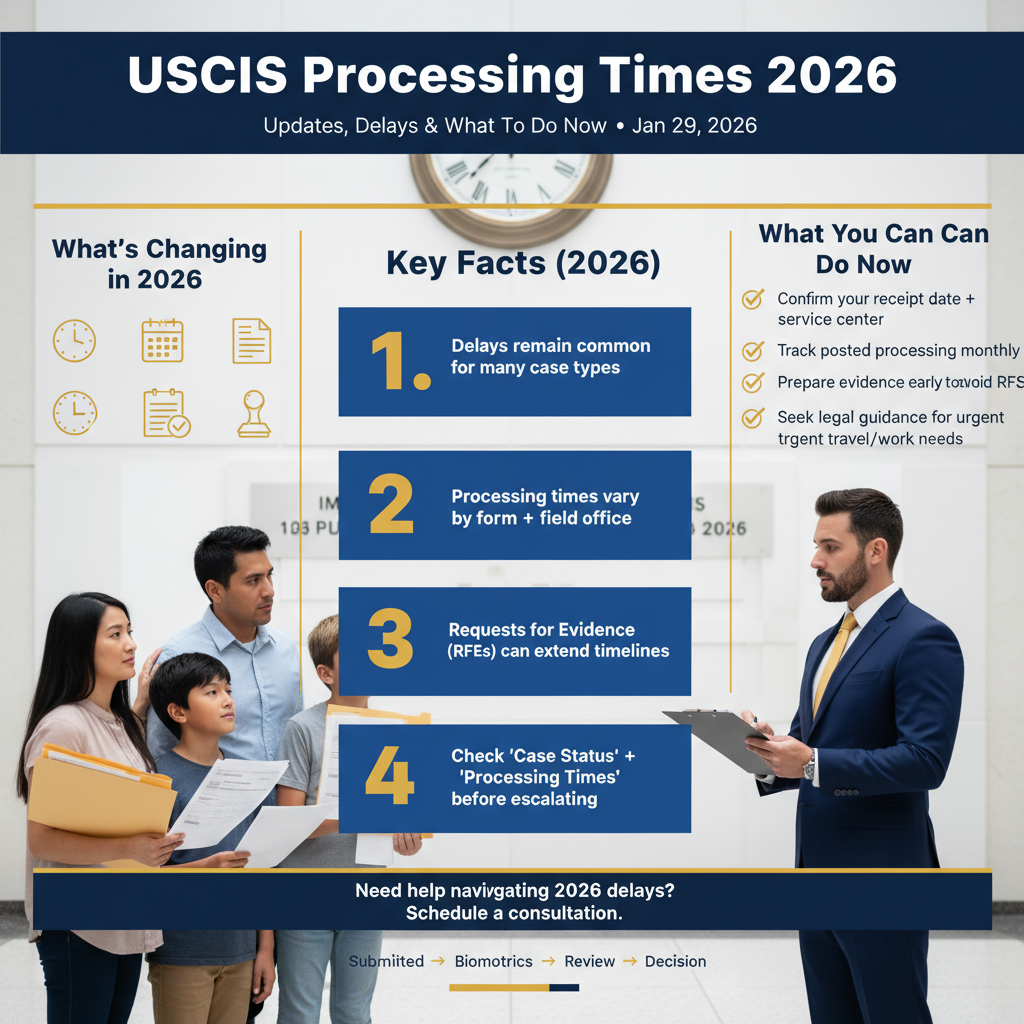
The reporting that sparked this guide: USCIS Processing Times and Updates for 2026 (USCIS)
Need Help? Our Orlando immigration team is ready to assist. Call +1 786-791-3106 for a free consultation, or message us online. Se Habla Español.
What This News Means for Immigrants in Orlando and Across Florida
Why this news is showing up now
USCIS processing times are a “moving target” because they depend on staffing, funding, security checks, interview capacity at field offices, policy changes, and the volume of filings USCIS receives. In 2026, many applicants are noticing that timelines can shift month-to-month—sometimes improving for certain forms while slowing for others.
USCIS publishes official processing-time information and tools that help applicants understand what is “normal” for a specific form type and office. The most reliable starting point is the official USCIS processing times portal: USCIS Processing Times.
Important: “Processing time” is not a guarantee. It’s a statistical estimate based on recent case completions. Your case can be faster or slower depending on evidence, background checks, interview needs, or requests for more documents (RFEs).
How it can affect Florida residents
For Central Florida residents—especially along the I-4 corridor (Orlando, Kissimmee, Sanford, Lakeland, Tampa)—processing-time changes can affect:
- Work authorization timing for applicants filing Adjustment of Status (often tied to Form I-765).
- Travel plans for applicants waiting on advance parole (often tied to Form I-131).
- Family stability when a spouse or parent’s case is delayed (common with Form I-130 and Form I-485 combinations).
- Driver’s license/renewals, employment onboarding, and school/benefits planning (which often depend on valid immigration documentation).
- Interview scheduling at field offices, including the Orlando USCIS Field Office, which can influence final approval timing.
If your case is in Orlando, processing speed can be affected by local interview capacity and case volume. For Orange County families, even small delays can have real consequences—especially when a work permit renewal or travel document is urgent.
What USCIS Processing Times and Updates for 2026 Is (and Why It Matters)
A plain-English definition
USCIS “processing times” are estimates of how long it takes USCIS to make a decision on a specific immigration filing (petition or application). In 2026, USCIS updates these estimates periodically based on real completion data. That means the “time remaining” for your case can change even if you did everything right.
Processing times matter because they help you:
- Plan your life: work, travel, school, and family events.
- Know when you can submit an inquiry if your case is outside normal time.
- Reduce risk by filing renewals and extensions early (when allowed).
- Avoid gaps in authorization, especially where deadlines like 180 days of automatic extension eligibility may apply in certain work-permit renewal categories.
Key terms you need to know
- Receipt Notice: The I-797 notice showing USCIS received your filing and assigned a receipt number.
- Biometrics: Fingerprints/photo appointment used for identity and background checks.
- RFE (Request for Evidence): USCIS asks for missing or additional documents; this almost always adds delay.
- NOID (Notice of Intent to Deny): USCIS plans to deny unless you respond with sufficient evidence.
- Interview: Many family-based Adjustment of Status cases require an interview at a field office (often Orlando for Central Florida residents).
- Priority Date: The place in line for certain immigrant categories. Your Priority Date controls when you can move forward if a visa number is limited.
- Visa Bulletin: Monthly Department of State chart showing which Priority Date is current. See U.S. Department of State.
- Case “outside normal processing time”: A threshold USCIS sets where you may submit a service request.
- 90-day window: A common planning concept for renewals (file ~90 days before expiration when rules allow), though some categories allow earlier filing.
Reminder: Some timelines are driven by law (like visa availability), while others are administrative (like interview scheduling). Understanding the difference helps you plan realistically.
Current Immigration Law: The Foundation
USCIS processing times sit on top of a legal framework that includes statutes, regulations, and agency policy. While processing speed can change, the eligibility rules generally come from federal law.
Federal requirements
Many of the most common family and work pathways are governed by the Immigration and Nationality Act (INA), including:
- INA § 201–203 (family- and employment-based immigrant visa categories and numerical limits).
- INA § 204 (petitioning rules, including family petitions).
- INA § 245 (rules for Adjustment of Status inside the U.S., typically filed using Form I-485).
- INA § 212 (inadmissibility grounds that can trigger extra review, waivers, or denial).
Common filings that interact heavily with processing time trends include:
- Form I-130 (Petition for Alien Relative)
- Form I-485 (Application to Register Permanent Residence or Adjust Status)
- Form I-765 (Application for Employment Authorization)
- Form I-131 (Application for Travel Document)
- Form N-400 (Application for Naturalization)
- Form I-751 (Petition to Remove Conditions on Residence)
Always confirm the latest requirements and filing addresses at the USCIS official website and locate forms at USCIS Forms.
Florida-specific considerations
Florida does not set immigration eligibility rules (those are federal), but Florida residents often face practical, case-shaping issues such as:
- Local field office interview backlogs (for Central Florida, this can mean scheduling at the Orlando USCIS Field Office).
- Address changes due to frequent moves along the I-4 corridor—missing a USCIS notice can cause a denial.
- State-level documentation needs (driver’s license, employment verification) that depend on timely EADs and receipt notices.
Warning: If you move, you generally must update your address with USCIS promptly (often within 10 days). Missing biometrics or an interview notice can severely delay your case or lead to denial for abandonment.
Need Help? Our Orlando immigration team is ready to assist. Call +1 786-791-3106 for a free consultation, or message us online. Se Habla Español.
How to Check and Respond to USCIS Processing Times in 2026: A Complete Step-by-Step Guide
1) Identify your exact form type, category, and office
Processing times vary by form and by the office handling your case (service center or field office). Start by identifying:
- The form number (example: Form I-130, Form I-485)
- The category (example: spouse of U.S. citizen, parent of U.S. citizen, employment-based, etc.)
- Where it’s being processed (shown on your receipt notice)
Documents to gather:
- USCIS Receipt Notice (Form I-797) for each filing
- A copy of your full submission packet (or at least your cover letter and forms)
- Any RFE/NOID notices you received
- Government-issued ID (passport biographic page, driver’s license)
2) Use the official USCIS Processing Times tool correctly
Go to the official portal: USCIS Processing Times. Select your form, category, and office. USCIS may show:
- An estimated time range (example: “X months to Y months”), or
- A “case inquiry date” (the date when you can ask USCIS about delays).
Important: Many people misread the tool. The “case inquiry date” is often more useful than the general range—because it tells you when USCIS considers your case late enough to request help.
Documents to gather:
- Your receipt date (from the I-797)
- Your receipt number (for tracking)
- Any online account screenshots (if you have a USCIS online account)
3) Track your case status and watch for “silent” delays
Use the case status tracker and your USCIS online account. Some delays are not obvious until you realize a step never happened (like biometrics reuse, interview scheduling, or card production).
- Case status: “Case Was Received,” “Biometrics Scheduled,” “Interview Was Scheduled,” etc.
- Mail notices: USCIS still sends many critical notices by mail.
If your case is in Orlando, interview scheduling can be the longest “quiet” period—nothing changes online until an interview notice is generated.
Documents to gather:
- Copies of all USCIS notices received by mail
- Proof of your current address (lease, utility bill)
- USPS informed delivery screenshots (if available)
4) Respond fast and correctly to RFEs, NOIDs, biometrics, and interview notices
In 2026, one of the most common reasons cases run long is not USCIS speed—it’s incomplete responses or missed appointments.
- RFE: Provide exactly what’s requested. Organize evidence with tabs and a cover letter.
- NOID: Treat as urgent; legal strategy matters.
- Biometrics: Attend on the scheduled date; rescheduling can add months.
- Interview: Prepare thoroughly; bring originals and updated evidence.
Warning: Missing an interview or biometrics appointment can lead to denial for abandonment. If you must reschedule, do it immediately and keep proof.
Documents to gather (typical examples):
- RFE/NOID letter and deadline page
- Civil documents (birth, marriage, divorce, death certificates)
- Updated relationship evidence (for marriage cases): joint lease, bank statements, insurance, photos
- Tax returns and W-2s/1099s (often relevant for sponsorship and bona fides)
- Original passports and current immigration documents (I-94, EAD, etc.)
5) Know when and how to escalate: service requests, expedite, InfoPass-style help, congressional inquiry, mandamus
If USCIS processing times move and your case is now outside normal time, you may have options. The correct option depends on your facts.
- Service request: When your case is beyond the USCIS inquiry date.
- Expedite request: For severe financial loss, urgent humanitarian reasons, nonprofit cultural/social interests, U.S. government interests, or clear USCIS error.
- Congressional inquiry: Your U.S. Representative or Senator’s office may request an update.
- Ombudsman assistance: In some situations, the DHS Ombudsman can help with stuck cases.
- Mandamus lawsuit: A federal court action that may be appropriate for unreasonable delay (not a guarantee of approval, but can force action).
Important: Escalation should be strategic. Poorly timed expedite requests or incomplete submissions can waste time or create inconsistent records.
Documents to gather (for escalation):
- Receipts and case status history
- Proof of urgency (job offer, eviction notice, medical records, letters from employer)
- Evidence of USCIS error (if applicable)
- Any prior service request numbers and responses
6) Plan for the “next step” after approval: card production, visa issuance, naturalization scheduling
Processing time doesn’t end at “approved.” Many applicants need to plan for:
- Green card production and delivery (and correcting errors quickly)
- Consular processing steps (if outside the U.S.)
- Removal of conditions (Form I-751) timelines later
- Naturalization (Form N-400) timing and travel planning
If your case is in Orlando, keep an eye on mail delivery and address accuracy—especially in large apartment complexes common in Orange County.
Documents to gather:
- Approval notice(s)
- Green card/EAD card tracking and delivery confirmation
- Passport stamps (if any) and I-94 records
Practical Steps You Can Take Today
Processing times may change in 2026, but strong preparation reduces delays you can control. Here’s an actionable checklist for families and individuals in Orlando and across Florida.
- 1) Build a “USCIS master file”: Keep one folder (digital + paper) with every filing, receipt, notice, and tracking number.
- 2) Track deadlines immediately: Calendar biometrics, interview dates, and RFE deadlines the day you receive them.
- 3) Prepare for renewals early: If you have an EAD, plan around the 90-day window concept (or earlier where permitted) to avoid work gaps. Some categories may qualify for automatic extensions up to 180 days with a timely filed renewal—confirm your category’s rules.
- 4) Keep address updates current: Moving along the I-4 corridor is common. Update USCIS right away to avoid missing mail.
- 5) Use official tools only: Confirm forms and instructions at USCIS Forms and policy updates at USCIS official website.
- 6) Prepare relationship evidence continuously (marriage cases): Don’t wait until the interview. Keep monthly statements, photos, and shared bills.
- 7) If you’re in removal proceedings, coordinate strategy: Immigration Court timelines can affect USCIS options. See Executive Office for Immigration Review.
Timeline expectations (general planning): In 2026, many applicants should plan for multi-month timelines for EAD/travel documents and potentially a year or longer for green card decisions depending on category, office, and visa availability. Your Priority Date and the Visa Bulletin can be decisive for certain categories (see U.S. Department of State).
Need Help? Our Orlando immigration team is ready to assist. Call +1 786-791-3106 for a free consultation, or message us online. Se Habla Español.
How Imigrar Helps Immigrants in Orlando
At Imigrar, we help clients in Orlando, Orange County, and throughout Florida—and we serve families nationwide. When processing times shift, the best results usually come from doing two things at once: (1) filing a strong, well-documented case from the start, and (2) responding quickly and strategically when USCIS requests anything.
Our team supports clients with:
- Family petitions (Form I-130) and green card filings (Form I-485)
- Work permit and travel document planning (Form I-765, Form I-131)
- RFE/NOID responses and interview preparation at the Orlando USCIS Field Office
- Processing-time strategy: service requests, expedite packets, and escalation options when appropriate
- Long-term planning for Adjustment of Status, consular processing, and naturalization
Reminder: Small mistakes can add months. A missing signature, outdated edition date, incorrect fee, or weak supporting evidence can turn a “normal” case into a long delay.
Call us for a free consultation at +1 786-791-3106. Se Habla Español. Tagline: Keep Families Together.
Frequently Asked Questions
Q: Am I eligible to file Form I-485 if USCIS processing times are long in 2026?
A: Eligibility for Form I-485 depends on the law (for example, INA § 245), not on how long USCIS is taking. In many family cases, you must have a qualifying basis (like an approved or concurrently filed Form I-130), be inspected/admitted or paroled (with some exceptions), and have a visa available if your category is subject to limits. Processing time changes do not change eligibility—but they do change planning (work/travel documents, renewals, and evidence updates).
Q: How do USCIS processing times affect my current immigration status?
A: It depends on what you filed and your current status. Filing Adjustment of Status may place you in a period of authorized stay while the application is pending, but it does not automatically give you permission to work or travel—those usually require approvals of Form I-765 and Form I-131. If you are maintaining a separate nonimmigrant status (like H-1B or F-1), delays may influence whether you should keep maintaining that status as a backup. Get legal advice for your specific facts.
Q: What’s the best way to estimate my timeline in 2026?
A: Use the official tools and your receipt notice details. Start with USCIS Processing Times for your form, category, and office. Then track your case status and milestones (biometrics, RFE, interview). If your case is family-based and a visa is limited, also monitor your Priority Date using the Visa Bulletin at U.S. Department of State.
Q: What documents most commonly cause delays when missing?
A: Missing or inconsistent civil documents and sponsorship/relationship evidence cause many RFEs. Common examples include: incorrect or missing birth certificates, missing divorce decrees, incomplete translations, insufficient proof of a real marriage (for spousal cases), and incomplete financial sponsorship documents when required. Always follow the latest USCIS instructions on USCIS Forms and consider a legal review before filing.
Q: How much does it cost to file, and do delays increase costs?
A: Filing costs depend on the forms you submit and your category. USCIS fees can change, so confirm current fees on the USCIS official website. Delays can increase indirect costs (renewing work permits, obtaining updated documents, missing work opportunities, or paying for additional legal work to respond to RFEs/NOIDs). Planning early—especially around the 90-day window for renewals—can reduce emergency expenses.
Q: What happens if my case is denied after a long wait?
A: A denial can have serious consequences, including loss of work authorization, loss of authorized stay tied to a pending application, or referral to removal proceedings in some situations. Options may include filing a motion to reopen/reconsider, refiling, appealing (where allowed), or pursuing a different pathway. If you are placed in Immigration Court, information about the court system is available at Executive Office for Immigration Review. Talk to an immigration attorney immediately to protect your options and deadlines.
Q: Can I travel while my Form I-485 is pending if processing times are slow?
A: Many applicants should not travel internationally while Form I-485 is pending unless they have valid advance parole (often through Form I-131) or another travel authorization that preserves eligibility. Traveling without proper authorization can be treated as abandoning the application in many cases. Because rules and exceptions depend on your status and category, get individualized legal guidance before booking travel.
Common Mistakes (and How to Avoid Them)
Mistake #1: Relying on social media timelines instead of your real category and office
Comparing your case to someone else’s can be misleading. Processing times vary by form type, category, and office. Always check your specific combination using USCIS Processing Times.
Mistake #2: Submitting incomplete evidence and “hoping it’s enough”
A weak initial filing often leads to an RFE, which can add months. For example, a marriage-based case with limited joint documents can trigger deeper scrutiny. Build your evidence from the start and keep it updated for the interview—especially if your case is in Orlando and you expect an in-person appointment.
Mistake #3: Missing notices because of address changes or mail issues
In Central Florida, moves are common—new jobs, new leases, changing roommates. But USCIS deadlines are strict. Missing a biometrics appointment or interview can cause denial. Update your address promptly and keep proof.
Need Help? Our Orlando immigration team is ready to assist. Call +1 786-791-3106 for a free consultation, or message us online. Se Habla Español.

Closing: What to Do Next if You’re Worried About USCIS Timelines in 2026
USCIS processing times in 2026 may continue to shift, but you still have power over the parts you can control: filing the right forms, submitting strong evidence, meeting every deadline, and escalating strategically when a case is truly outside normal time.
If your case is in Orlando, or you live in Orange County or anywhere along the I-4 corridor, we can help you plan around local interview timing and avoid preventable delays—so your family can move forward with confidence.
Need help now? Call Imigrar at +1 786-791-3106 for a free consultation, or message us online. Se Habla Español. Keep Families Together.


