


The reporting that sparked this guide
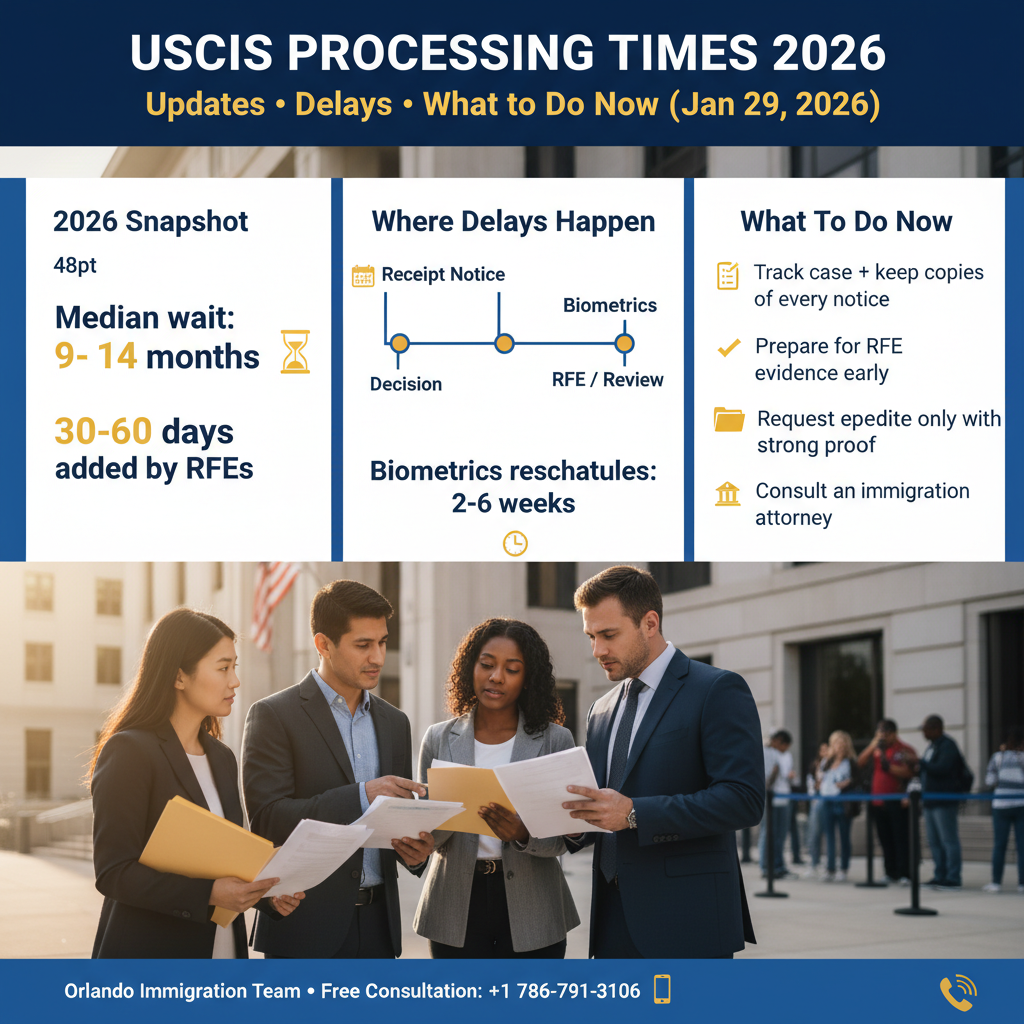
The reporting that sparked this guide: USCIS Processing Times and Updates for 2026 (USCIS)
Need Help? Our Orlando immigration team is ready to assist. Call +1 786-791-3106 for a free consultation, or message us online. Se Habla Español.
What This News Means for Immigrants in Orlando and Across Florida
Why this news is showing up now
USCIS processing times are always moving, but they tend to become “trending” when applicants feel the impact in real life: longer waits for work permits, delayed green card interviews, more Requests for Evidence (RFEs), and shifting service center workloads. In 2026, USCIS continues to emphasize digital filing expansion, internal workflow changes, and targeted backlogs reduction—but many families still experience uneven timelines depending on the form type, the office handling the case, and whether additional screening or evidence is required.
Important: “Processing time” is not a promise. It is an estimate based on recent case completions. Your timeline can be shorter or longer depending on your facts, your filing quality, and where your case is processed.
For applicants in Florida, processing time news matters because:
- Florida has high volumes of family-based filings and employment-based applicants.
- Central Florida continues to grow, increasing demand for local field office appointments.
- Many applicants rely on timely EADs (work permits) to keep jobs and support families.
How it can affect Florida residents
If you live in Orlando, Orange County, or along the I-4 corridor (including Kissimmee, Sanford, Lake Mary, Winter Park, and nearby areas), USCIS timing changes can affect:
- Adjustment of Status interview scheduling at the Orlando USCIS Field Office
- How quickly you receive an EAD/AP combo card after filing Form I-485
- When you can travel using Advance Parole (if eligible)
- How soon a family petition like Form I-130 is approved
- When you can request help using USCIS “outside normal processing time” tools
Warning: A delay in one step often creates a domino effect. For example, a delayed Form I-765 (EAD) can impact employment; a delayed Form I-485 can affect eligibility for naturalization timelines later.
What USCIS Processing Times and Updates for 2026 Is (and Why It Matters)
A plain-English definition
“USCIS processing times” are USCIS’s published estimates for how long it typically takes to decide a specific immigration application or petition—like a family petition, work permit, green card application, or naturalization. These estimates are posted by form type and by office (service center or field office).
In 2026, the “updates” piece matters because USCIS regularly recalculates these estimates based on recent case completions, staffing, and workflow. That means your case strategy should be built around real-time processing data—not assumptions from last year.
The best official place to check is: USCIS Processing Times.
Key terms you need to know
- Receipt Notice (Form I-797C): Proof USCIS received your filing and assigned a receipt number.
- Biometrics: Fingerprints/photo appointment used for background checks (sometimes reused).
- RFE (Request for Evidence): USCIS asks for additional documents before deciding.
- NOID (Notice of Intent to Deny): USCIS plans to deny unless you respond with strong evidence.
- Interview: In-person appointment (often for Adjustment of Status and naturalization).
- Priority Date: The place in line for certain visa categories; critical in many family- and employment-based cases.
- Visa Bulletin: Department of State monthly chart showing when immigrant visas are available; see U.S. Department of State.
- Service Center vs. Field Office: Many petitions are processed at service centers; interviews and some decisions occur at field offices (like Orlando).
- Expedite Request: A request to speed up processing in limited circumstances (not guaranteed).
Reminder: A “processing time” is not the same as your “case age.” Your case might move quickly until it hits a bottleneck (like an RFE) and then pause.
Current Immigration Law: The Foundation
USCIS processing times are administrative, but your eligibility and required steps are grounded in federal immigration law. The core statutes and regulations include:
- Immigration and Nationality Act (INA), including family-based immigration and adjustment provisions (e.g., INA § 201, § 203, § 245).
- Federal regulations in Title 8 of the Code of Federal Regulations (8 C.F.R.), including rules for filing, evidence, interviews, and adjudications.
- USCIS policy guidance and the USCIS Policy Manual (official interpretive guidance).
Federal requirements
Most applicants will interact with USCIS through specific forms and evidence standards. Common filings impacted by processing times include:
- Form I-130 (Petition for Alien Relative)
- Form I-485 (Application to Register Permanent Residence or Adjust Status)
- Form I-765 (Application for Employment Authorization)
- Form I-131 (Application for Travel Document / Advance Parole)
- Form N-400 (Application for Naturalization)
- Form I-751 (Petition to Remove Conditions on Residence)
USCIS publishes official instructions and filing addresses and increasingly supports online filing where available. Always verify directly through: USCIS official website and USCIS Forms.
Important: Many delays are preventable. Incomplete forms, missing translations, outdated edition dates, and insufficient financial sponsorship evidence commonly trigger RFEs and longer processing.
Florida-specific considerations
Immigration law is federal, but Florida residents can face local and practical issues that affect case strategy:
- If your case is in Orlando... your interview scheduling may depend on the workload at the Orlando USCIS Field Office.
- For Central Florida residents... travel to biometrics or interviews can be impacted by I-4 corridor traffic—plan ahead and arrive early.
- Address stability matters: frequent moves in Orange County and surrounding areas can lead to missed notices if you don’t update USCIS promptly.
Reminder: If you move, you generally must update your address with USCIS (often via AR-11 online). Missing an appointment notice can lead to denial or administrative closure depending on the form.
Need Help? Our Orlando immigration team is ready to assist. Call +1 786-791-3106 for a free consultation, or message us online. Se Habla Español.
How to Check and Respond to USCIS Processing Times in 2026: A Complete Step-by-Step Guide
1) Identify your form type, category, and where it’s being processed
Start by confirming exactly what you filed and which office is handling it. Processing times differ dramatically by:
- Form type (e.g., Form I-130 vs. Form I-485)
- Category (immediate relative vs. preference category; employment category; asylum-based, etc.)
- Office (service center vs. field office)
Required documents/information to gather:
- A copy of your Form I-797C Receipt Notice (receipt number)
- The form you filed (PDF copy of the submission)
- Any USCIS online account screenshots (if applicable)
- Your current mailing address and email/phone on file
Important: The first three letters of your receipt number (e.g., IOE, MSC, LIN, SRC, WAC) often indicate the intake type or center—but cases can be transferred. Always rely on the most recent USCIS notices.
2) Use the official USCIS Processing Times tool correctly
Go to USCIS Processing Times and select:
- Your form number
- Your form category (if prompted)
- Your field office or service center (if prompted)
Required documents/information to gather:
- Receipt number (to cross-check your case type)
- The office listed on your receipt or transfer notice
- A record of the “Receipt date for a case inquiry” shown by the tool
Reminder: The tool typically shows (1) an estimated time range and (2) a specific “case inquiry date.” That inquiry date is critical—it tells you when USCIS considers your case outside normal time.
3) Track your case status and watch for RFEs, biometrics, and interview notices
Processing times don’t matter if you miss a deadline. Many delays happen because USCIS sends a notice and the applicant doesn’t respond correctly or on time.
Use:
- USCIS online case status (with receipt number)
- Your USCIS online account (if your case is linked)
- USPS Informed Delivery (optional) to monitor mail delivery
Required documents/information to gather:
- All USCIS notices received so far (RFEs, biometrics, interview)
- Your biometrics appointment notice (if issued)
- Any prior immigration documents (I-94, visas, EADs, prior approvals)
Warning: RFEs have strict deadlines. Missing an RFE deadline can lead to denial even if you were otherwise eligible. Keep a calendar and save proof of delivery.
4) If you’re outside normal processing time, submit a case inquiry the right way
If the USCIS tool shows your receipt date is earlier than the “case inquiry date,” you may be eligible to submit an “outside normal processing time” request.
Required documents/information to gather:
- Receipt number
- Filing date and receipt date
- Screenshot/printout of the processing time page showing inquiry eligibility
- Any urgent impact evidence (job offer, medical letter, financial harm documentation)
Important: Submitting multiple inquiries too frequently can be counterproductive. Focus on one clear inquiry with well-organized information.
5) Consider expedite requests only when you meet USCIS criteria
Expedites are discretionary and typically require strong proof, such as severe financial loss, urgent humanitarian reasons, nonprofit interests, U.S. government interests, or clear USCIS error.
Required documents/information to gather:
- Employer letter describing specific financial loss (not general inconvenience)
- Medical documentation (if humanitarian)
- Evidence of critical travel need (if applicable and eligible)
- Proof your filing is otherwise complete and eligible
Warning: An expedite request is not a substitute for eligibility. If your filing is weak or incomplete, expediting can trigger faster scrutiny and an RFE/denial.
6) Protect your work authorization and travel plans while you wait
Many families in Florida rely on EAD renewals or initial EADs. If you are eligible for an automatic extension category, you may be able to keep working while the renewal is pending—but not everyone qualifies.
Required documents/information to gather:
- Current EAD card (front/back)
- Receipt notice for pending Form I-765 (if filed)
- Your I-94 record and passport biographic page
- Copies of any prior approvals/denials
Reminder: Do not travel internationally while an Adjustment of Status application is pending unless you have valid Advance Parole (or another travel authorization) and you understand the risks. For many applicants, leaving without Advance Parole can be treated as abandoning Form I-485.
7) Escalate strategically: Ombudsman, congressional help, or immigration court context
When delays become extreme, there may be additional escalation options depending on the case type:
- USCIS Ombudsman assistance (for certain systemic delays)
- Congressional inquiry through your U.S. Representative or Senator
- If you are in removal proceedings, coordination with EOIR and DHS counsel may be necessary
Helpful official references include:
- Executive Office for Immigration Review (immigration court information)
- U.S. Department of State (consular processing and Visa Bulletin)
Important: If you have a court case, your strategy must align with court deadlines and hearing dates. A pending USCIS filing does not automatically stop removal proceedings.
Need Help? Our Orlando immigration team is ready to assist. Call +1 786-791-3106 for a free consultation, or message us online. Se Habla Español.
Practical Steps You Can Take Today
Processing times are partly outside your control. But many of the most painful delays come from preventable issues: incomplete packets, missing translations, unclear relationship evidence, and missed deadlines. Here’s an actionable plan you can start today.
Actionable checklist (do this now)
- Check your form’s current estimate and inquiry date using USCIS Processing Times and save a screenshot for your records.
- Create a “USCIS master folder” (digital + paper) with: receipt notices, filings, evidence, and every notice you receive.
- Confirm your address is correct with USCIS and that your name is on the mailbox. If you move along the I-4 corridor, update immediately.
- Prepare for an RFE before it happens: gather updated pay stubs, tax transcripts, relationship evidence, and translations.
- If you filed Form I-485, track your EAD/AP plan: when you may need to renew, whether an automatic extension applies, and employer I-9 needs.
- If consular processing applies, monitor the Visa Bulletin and consular steps through U.S. Department of State.
Document preparation guidance
Strong filings reduce the chance of an RFE and help USCIS adjudicate faster. For many family-based cases, high-impact evidence includes:
- Clear identity documents (passports, birth certificates) with certified translations
- Proof of lawful entry (I-94, visa stamps) where required
- Relationship evidence (marriage certificate, joint lease, joint bank accounts, photos, affidavits)
- Financial sponsorship evidence (tax transcripts, W-2s, pay stubs, employment verification)
- Complete prior immigration history (prior filings, notices, court documents if any)
Important: “More documents” is not always better. The goal is clear, organized evidence that matches legal requirements. Poorly organized filings can slow review.
Timeline expectations (real-world planning)
Because USCIS timelines vary, plan your life around ranges and milestones—not a single date:
- Biometrics: often weeks to months after filing (or reused)
- EAD/Advance Parole: can vary widely; plan for the possibility of extended waits
- Interviews: field office dependent; the Orlando USCIS Field Office schedule can fluctuate
- RFEs: can add months—respond quickly and completely
Reminder: Some deadlines are strict even while you wait. For example, many applicants must respond to RFEs within the deadline listed, and certain benefits may have a 90-day window or other time-limited rules depending on the benefit type.
Warning: If you accrue unlawful presence or fall out of status, the consequences can be severe. In some contexts, triggers and bars may apply after 180 days or more of unlawful presence. Get legal advice before making travel or filing decisions.
How Imigrar Helps Immigrants in Orlando
At Imigrar, we help families and individuals nationwide from our Orlando, Florida base. Our mission is to Keep Families Together. USCIS delays can be stressful, but a well-built case and a smart follow-up plan can reduce unnecessary waiting and protect your status.
We assist with:
- Family petitions and green cards: Form I-130, Form I-485, consular processing planning
- Work permits and travel documents: Form I-765, Form I-131
- Naturalization: Form N-400 (including complex history and prior issues)
- Removal of conditions: Form I-751 (including waiver cases)
- RFE/NOID responses and interview preparation
If your case is in Orlando, we can help you prepare for what the local process often looks like, how to organize your interview packet, and how to avoid common issues that cause rescheduling or additional review.
We offer a free consultation. Call +1 786-791-3106 or message us online. Se Habla Español.
Need Help? Our Orlando immigration team is ready to assist. Call +1 786-791-3106 for a free consultation, or message us online. Se Habla Español.
Frequently Asked Questions
Q: Am I eligible to file an “outside normal processing time” request in 2026?
A: You may be eligible if your receipt date is earlier than the “Receipt date for a case inquiry” shown for your form and office on the USCIS Processing Times page. Save a screenshot, then submit a request through USCIS’s online tools or by following the instructions in your USCIS account. If you’re unsure which office is handling your case, review your receipt or any transfer notice first.
Q: How do USCIS processing delays affect my immigration status?
A: It depends on what you filed and your current status. A pending Adjustment of Status filing (like Form I-485) can place you in a “period of authorized stay,” but it does not automatically give you work authorization or travel permission. If you are in a temporary status (like F-1, H-1B, or TPS), you may need to maintain that status depending on your strategy. Warning: Do not assume you are protected—get individualized legal advice.
Q: How long will my Form I-130 or Form I-485 take in 2026?
A: Timelines vary by category and office. Immediate relative Form I-130 petitions and concurrent filings with Form I-485 can move differently than preference categories with a Priority Date wait. The most reliable approach is to check your specific form and office using the official tool, then plan around ranges and milestones (biometrics, EAD/AP, interview). If your case is in Orlando, local interview capacity can influence the final stage.
Q: What documents most commonly cause RFEs and delays?
A: The most frequent issues we see include missing certified translations, incomplete financial sponsorship evidence, unclear proof of lawful entry (when required), and weak relationship evidence for marriage-based cases. For example, if you file Form I-485 and the Affidavit of Support packet is incomplete or inconsistent, USCIS may issue an RFE that adds months. Organize documents clearly and submit legible copies.
Q: How much does it cost to file, and do delays increase the cost?
A: USCIS filing fees vary by form and can change. Always confirm the current fee on USCIS Forms before filing. Delays can increase indirect costs—such as having to renew an EAD, obtain updated medical exams (if required), or replace expired supporting documents. Legal fees depend on complexity, history, and whether RFEs/NOIDs occur.
Q: What happens if USCIS denies my case after a long wait?
A: The next steps depend on the form type and the reason for denial. Some denials can be addressed with a motion to reopen/reconsider, an appeal (in limited contexts), or refiling with stronger evidence. If the denial affects your lawful presence or places you at risk of removal proceedings, you should speak with counsel immediately. If your matter intersects with immigration court, you may need to coordinate with processes under Executive Office for Immigration Review.
Q: Can I travel while my green card case is pending?
A: If you filed Form I-485, traveling without Advance Parole can be risky and may be treated as abandonment of your application in many situations. Some applicants may travel with certain valid nonimmigrant statuses, but the rules are fact-specific. Before leaving the U.S., confirm you have the right document (often via Form I-131) and understand re-entry risks.
Q: Does an expedite request guarantee faster approval?
A: No. Expedite requests are discretionary. USCIS may deny the expedite even if you have a real hardship, or it may ask for more evidence. If granted, it may speed up one part of the case (like an EAD) but not the entire green card process. Strong documentation and a clear narrative matter.
Common Mistakes (and How to Avoid Them)
Mistake #1: Relying on social media timelines instead of your office-specific processing time
Your friend’s case in another state—or even another Florida field office—may move at a different speed. Always verify your form and office using the official tool.
How to avoid it: Save your own processing time screenshots and track your case milestones monthly.
Mistake #2: Submitting an incomplete packet that triggers an RFE
RFEs are one of the biggest reasons cases extend far beyond normal processing time. Missing translations, unclear copies, and inconsistent answers are common triggers.
How to avoid it: Use a document checklist, label exhibits, and ensure every required item is included before filing—especially for Form I-130 and Form I-485 packages.
Mistake #3: Missing deadlines or appointments (biometrics/interview/RFE)
A missed appointment can cause months of delay—or denial. In Central Florida, traffic and scheduling conflicts are real obstacles.
How to avoid it: Build buffers into your schedule, monitor mail closely, and keep your address updated. If you must reschedule, follow USCIS instructions immediately and keep proof.
Official Resources You Should Bookmark (2026)
- USCIS official website
- USCIS Processing Times
- USCIS Forms
- U.S. Department of State
- Executive Office for Immigration Review
Planning Notes for Orlando and Central Florida Applicants (2026)
If your case is in Orlando, assume that interview and appointment availability can fluctuate. For Central Florida residents, the I-4 corridor can turn an on-time plan into a late arrival—especially during morning rush hours. Treat every USCIS appointment like a flight: arrive early, bring originals, and bring a full copy of your submission.
Important: Bring government-issued ID, appointment notice, and any requested originals. If your filing involves Adjustment of Status, also bring updated relationship and financial evidence even if it was already submitted—USCIS officers often want current proof.
Need Help? Our Orlando immigration team is ready to assist. Call +1 786-791-3106 for a free consultation, or message us online. Se Habla Español.
Closing: Get a 2026 Processing-Time Strategy You Can Trust
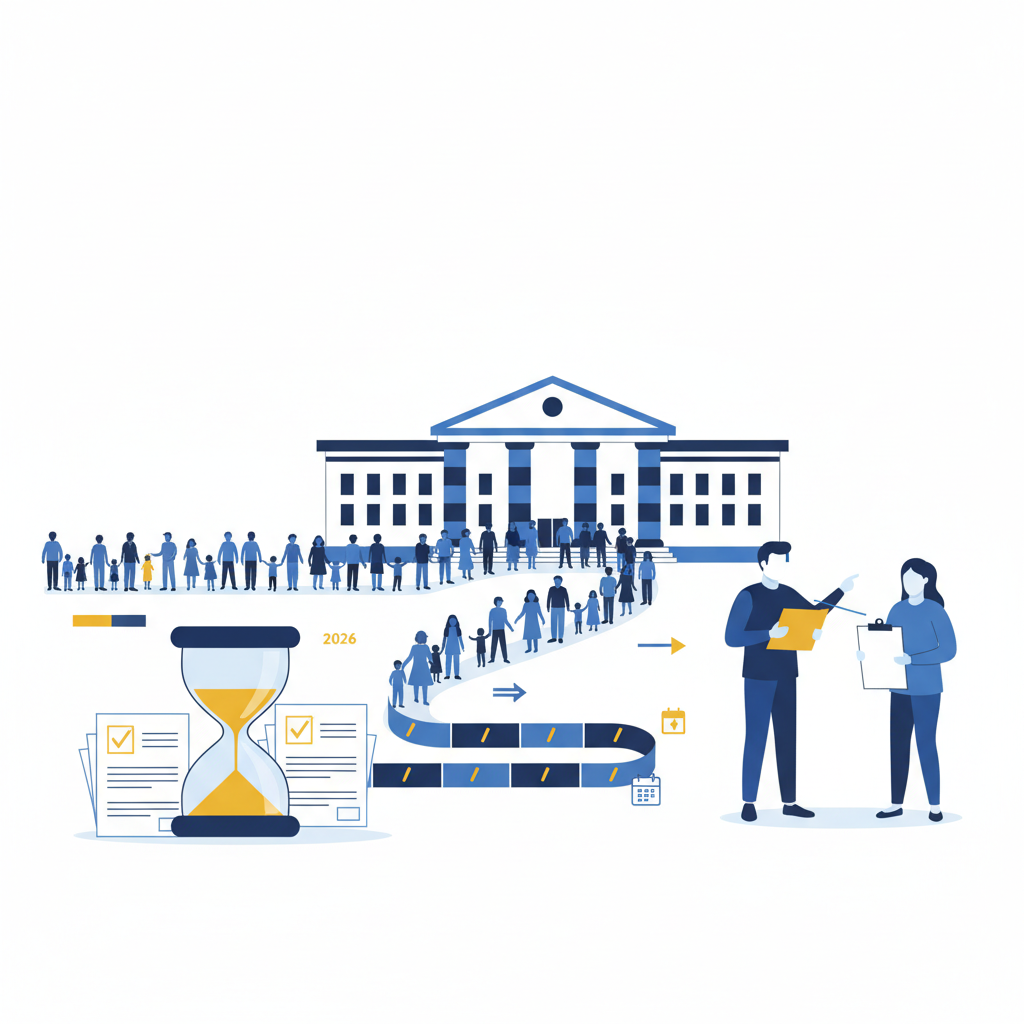
USCIS processing times in 2026 can change quickly, and the best results usually come from two things: (1) a complete, well-documented filing, and (2) smart follow-up at the right time using official tools. Whether you’re waiting on Form I-130, Form I-485, a work permit, or naturalization, you don’t have to navigate delays alone.
Call Imigrar at +1 786-791-3106 for a free consultation, or message us online. We’re based in Orlando and serve clients nationwide. Se Habla Español.


