


The reporting that sparked this guide
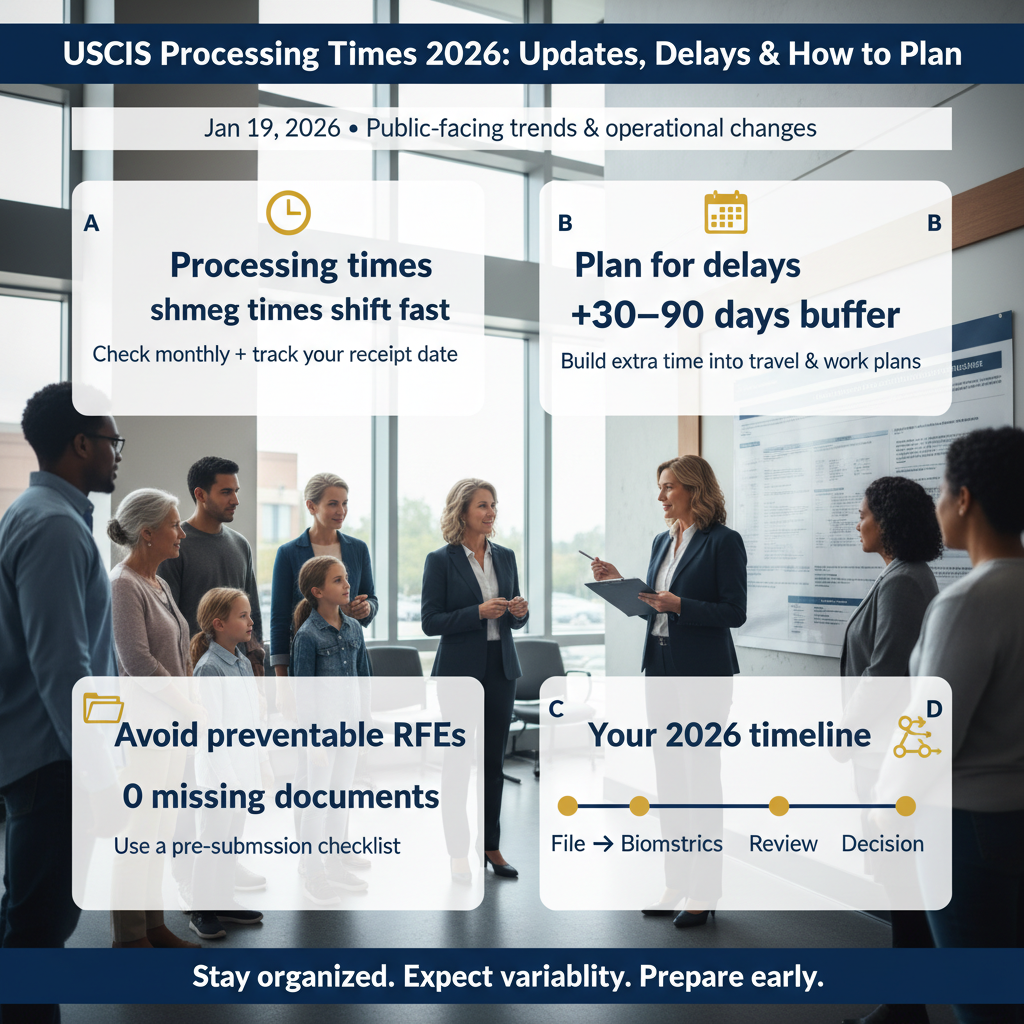
This article is based on the latest public-facing updates and ongoing coverage related to USCIS processing time trends and agency operational changes affecting immigration applicants in 2026.
USCIS Processing Times and Updates for 2026 (USCIS)
Reminder: USCIS processing times can change quickly based on workload, staffing, policy updates, and field office capacity. For the most current numbers, use the official tools linked throughout this guide.
Need Help? Our Orlando immigration team is ready to assist. Call +1 786-791-3106 for a free consultation, or message us online. Se Habla Español.
What This News Means for Immigrants in Orlando and Across Florida
Why this news is showing up now
USCIS processing times are a “moving target,” and they are trending in immigration news for 2026 because:
- Demand remains high across family-based cases (like Form I-130), employment cases, humanitarian filings, and naturalization.
- Backlog management continues as USCIS balances new filings with older cases, while also handling increased interview and security screening workloads.
- USCIS has expanded online tools and continues refining how it publishes “processing time” estimates, including case inquiry dates and service-request eligibility.
- Policy and operational adjustments can shift where cases are adjudicated (for example, moving workloads between service centers or emphasizing certain case types).
Important: “Processing time” is not a guaranteed deadline. It is a statistical estimate based on how long USCIS took to complete certain percentages of cases recently. Your case may be faster or slower depending on complexity, evidence, background checks, and local office capacity.
How it can affect Florida residents
For Florida residents—especially in Central Florida along the I-4 corridor—processing time changes can affect real-life decisions: when you can work, travel, renew documents, or reunite with family. Here are common examples we see at Imigrar:
- Adjustment of Status applicants (often using Form I-485) may wait longer for interviews at certain field offices, which can delay green card approval.
- Work authorization timing can affect job offers and financial stability, especially when Form I-765 processing slows or when RFEs (Requests for Evidence) occur.
- Travel planning can be disrupted if Form I-131 (Advance Parole) is delayed and an applicant leaves the U.S. without valid permission.
- Naturalization applicants may see fluctuating N-400 timelines depending on the local field office’s interview capacity.
If your case is in Orlando... it may be influenced by the Orlando-area USCIS field office scheduling capacity, interview backlogs, and the volume of filings from Orange County and nearby counties. For Central Florida residents, even small changes in USCIS workflow can have big ripple effects—especially for families trying to “time” school years, travel, and work transitions.
What USCIS Processing Times and Updates for 2026 Is (and Why It Matters)
A plain-English definition
“USCIS processing times” are USCIS’s published estimates for how long it typically takes to adjudicate (approve, deny, or otherwise decide) a specific form type at a specific USCIS office (service center or field office). In 2026, USCIS continues to publish these estimates through its official online tool:
USCIS updates these estimates periodically based on recent case completion data. These updates matter because they help you:
- Plan when you might receive a receipt notice, biometrics appointment, interview, work permit, travel document, or final decision.
- Know when you can submit a case inquiry (for example, “outside normal processing time”).
- Reduce risk—by filing correctly, responding to evidence requests promptly, and avoiding gaps in status.
Key terms you need to know
- Receipt Notice: USCIS confirmation that your filing was received and accepted (often Form I-797 Notice of Action).
- Biometrics: Fingerprints/photo/signature appointment used for background checks.
- RFE (Request for Evidence): USCIS asks for missing documents or clarification. RFEs commonly add weeks or months.
- NOID (Notice of Intent to Deny): USCIS indicates it plans to deny unless you respond with strong evidence.
- Priority Date: The “place in line” date for certain immigrant visa categories, often tied to the filing date of a petition (e.g., family or employment). Priority Date controls visa availability in many cases.
- Adjustment of Status: The process of applying for a green card from inside the U.S., often using Form I-485. Many applicants also file Form I-765 and Form I-131 together.
- Consular Processing: Getting an immigrant visa through a U.S. consulate abroad, coordinated with the U.S. Department of State.
- Service Center vs. Field Office: Service centers often handle paper adjudications; field offices often handle interviews (like many Form I-485 and N-400 cases).
- Case Inquiry Date: The date after which USCIS says you may request an update if no decision has been made (shown in the processing times tool).
Warning: Processing time estimates are not individualized legal advice. If you have arrests, prior removals, unlawful presence, or misrepresentation concerns, timelines and outcomes can change dramatically and may require a legal strategy.
Current Immigration Law: The Foundation
USCIS processing times exist within a legal framework that defines eligibility, admissibility, and procedures. The “clock” may be influenced by statutory requirements, security checks, and visa availability.
Federal requirements
Key federal authorities include:
- Immigration and Nationality Act (INA) (8 U.S.C. § 1101 et seq.), which governs immigrant classifications, admissibility, and many benefits.
- 8 C.F.R. (Code of Federal Regulations) provisions that implement USCIS procedures (for example, rules for adjustment, affidavits of support, and employment authorization).
- INA § 245 (Adjustment of Status) and related provisions that control who may file Form I-485 and under what conditions.
- INA § 213A (Affidavit of Support) which governs financial sponsorship for many family-based cases using Form I-864.
USCIS forms are published and updated on the agency’s official forms page. Always use the current edition and filing address:
Common forms affected by processing time changes include:
- Form I-130 (Petition for Alien Relative)
- Form I-485 (Application to Register Permanent Residence or Adjust Status)
- Form I-765 (Application for Employment Authorization)
- Form I-131 (Application for Travel Document)
- Form N-400 (Application for Naturalization)
- Form I-751 (Petition to Remove Conditions on Residence)
- Form I-129F (Petition for Alien Fiancé(e))
Florida-specific considerations
Immigration law is federal, but Florida residents can face practical, local impacts that affect timing and case strategy:
- The Orlando USCIS Field Office (and nearby field offices) may have different interview scheduling availability than other parts of the country.
- Address stability matters in Central Florida’s high-mobility rental market. Missing a biometrics or interview notice because of a move can cause serious delays.
- State-level documentation realities (like obtaining certified court dispositions from Florida clerks, or retrieving older records from other states) can slow case preparation.
- For Orange County and the I-4 corridor, high population growth can increase appointment demand and mail delivery variability, making proactive case tracking essential.
Reminder: If you move, you generally must update your address with USCIS promptly (typically within 10 days under federal rules). An address error is one of the fastest ways to turn a normal timeline into a long delay.
Need Help? Our Orlando immigration team is ready to assist. Call +1 786-791-3106 for a free consultation, or message us online. Se Habla Español.
How to Track and Respond to USCIS Processing Time Changes: A Complete Step-by-Step Guide
This step-by-step guide is designed for immigrants and families who want to understand 2026 processing time updates and take the right actions without accidentally harming their case.
1) Identify your exact form type, category, and office
Processing times depend on three things: (1) the form, (2) the category/classification, and (3) where USCIS is processing it (service center or field office). Start by confirming:
- Your form number (example: Form I-130 vs. Form I-485)
- Your category (example: immediate relative spouse vs. family preference category)
- Your office (shown on receipt notice; sometimes cases are transferred)
Documents to gather for this step:
- USCIS receipt notice(s) (Form I-797) for each pending form
- A copy of the full filing packet you submitted (or attorney copy)
- Any transfer notices or biometric appointment notices
- Passport biographic page and current immigration documents (if applicable)
2) Use USCIS’s official processing time tools (and interpret them correctly)
Go to the official tool and select your form and office:
USCIS may display:
- A time range (for example, “X months to Y months”)
- Or a completion time for a percentage of cases
- A case inquiry date (the earliest date you can ask USCIS to investigate)
Important: Many applicants misread processing times as “how long my case will take from today.” Instead, treat it as a benchmark and focus on the case inquiry date to know when you can take action.
Documents to gather for this step:
- Receipt date for each form (from your I-797)
- USCIS online account login (if you have one)
- Case numbers for all related filings (I-130, I-485, I-765, I-131, etc.)
3) Check your case status and account notices weekly (not daily)
USCIS case status updates can lag behind internal movement. Still, you should monitor:
- Case status online
- USCIS online account documents tab (if you filed online or added your case)
- Mail carefully (many critical notices still arrive by mail)
Reminder: Checking too frequently can increase anxiety without improving outcomes. Weekly checks are usually enough unless you are near an interview date, an RFE deadline, or a travel emergency.
Documents to gather for this step:
- USCIS online account access (email/phone recovery set up)
- Copy of any RFE/NOID (if received)
- Your calendar with deadlines highlighted (RFE response dates, biometrics, interviews)
4) Prepare for RFEs and interviews before USCIS asks
One of the biggest drivers of delays in 2026 remains incomplete initial filings and weak supporting evidence. You can reduce risk by preparing “RFE-proof” evidence early.
Examples:
- For family cases (Form I-130 / Form I-485): prepare strong bona fide marriage evidence, updated joint documents, and clear relationship timelines.
- For naturalization: confirm continuous residence, physical presence, tax filing history, and selective service registration (if required).
- For Form I-751: compile joint evidence across the entire conditional residence period, not just a few recent documents.
Documents to gather for this step (examples):
- Certified marriage certificate/divorce decrees (if applicable)
- Joint lease/mortgage, bank statements, insurance, tax returns
- Children’s birth certificates (if any)
- Photos, travel records, messages (organized and labeled)
- Updated medical exam if needed (for certain Form I-485 scenarios)
5) Take the “right” escalation steps when you are actually eligible
If you are past the published case inquiry date, you may be able to request help. Options include:
- Submit an “outside normal processing time” request through USCIS tools
- Call USCIS Contact Center for certain urgent issues
- Request an expedite (only if you meet criteria and can prove it)
- Seek help from your congressional representative for prolonged delays
Warning: Escalating too early or without a clear basis can waste time and may not move your case. Focus on eligibility and documentation.
Documents to gather for this step:
- Proof you are beyond the case inquiry date (screenshot or printout)
- Evidence supporting expedite (job loss notice, medical letters, financial harm proof)
- Copies of all USCIS notices and prior service request numbers
- Proof of identity (passport/ID) for inquiries
6) Protect your ability to work and travel while waiting
Processing time changes matter most when they affect your ability to work or travel. Depending on your case type, you may need to:
- Renew your EAD early (where eligible) to avoid gaps
- Avoid international travel if you do not have valid Advance Parole or another travel-authorizing status
- Maintain your underlying nonimmigrant status when required (for some categories)
Important: Many applicants assume a pending Adjustment of Status application automatically allows travel. It usually does not. Leaving without proper authorization can be treated as abandoning Form I-485 in many situations.
Documents to gather for this step:
- Current EAD card (front/back) and category code
- Advance Parole document (if approved) or valid visa/status documentation
- I-94 record (if applicable)
- Employment letters and pay stubs (for renewals or expedites)
7) Get legal guidance for complex timelines (visa bulletin, inadmissibility, removal)
Some delays are “normal,” while others are red flags. Consider a legal review if:
- Your Priority Date is current but your case is not moving
- You receive an RFE/NOID and the requested evidence is difficult
- You have any arrest history, prior immigration violations, or removal proceedings
- Your case involves consular processing and administrative processing delays
Removal proceedings are handled in immigration court under EOIR, not USCIS. If court is involved, timelines and strategy change:
Documents to gather for this step:
- All USCIS receipts, notices, and filings
- Any immigration court documents (NTA, hearing notices)
- Certified dispositions for any criminal cases
- Travel history and prior visa/entry records
Need Help? Our Orlando immigration team is ready to assist. Call +1 786-791-3106 for a free consultation, or message us online. Se Habla Español.
Practical Steps You Can Take Today
Processing time updates are useful only if you convert them into a plan. Here is a practical checklist you can start today—especially helpful if your case is in Orlando or anywhere in Florida where mail delays and address changes are common.
- Checklist item #1: Build a “USCIS master file” (paper + digital). Include every receipt, notice, and a full copy of what you filed. Label by form: Form I-130, Form I-485, Form I-765, Form I-131.
- Checklist item #2: Track your case inquiry date monthly. Print/screenshot the processing time page for your form/office so you can prove when you became eligible to inquire.
- Checklist item #3: Pre-assemble “RFE response” evidence. Don’t wait. Create folders for identity, relationship, financial sponsorship, and status documents.
- Checklist item #4: Confirm your address is correct everywhere. USPS, USCIS online account, and your attorney (if represented). Missing one notice can add months.
- Checklist item #5: Plan for work/travel gaps. If your EAD expires soon, prepare renewal strategy early. If travel is necessary, consult counsel before booking.
- Checklist item #6: Budget for government fees and medicals. Fees can change; always verify on USCIS official website.
Timeline expectations (general planning guidance):
- Receipt notices: often within weeks (varies by filing method and lockbox workload).
- Biometrics: often within weeks to a few months (varies by ASC capacity).
- Work/travel documents: can range from a few months to longer depending on category and workload.
- Interviews: field office-dependent; The Orlando USCIS Field Office may schedule based on local capacity and case type.
Important: If you receive an RFE, the deadline is strict. Many RFEs allow a fixed response period (commonly up to 87 days depending on the notice). Do not assume you have a flexible timeline.
Reminder: Some immigration benefits have their own critical windows. For example, certain renewals and filings must be timed carefully; missing a 90-day window (where applicable) can create complications. Also, certain rules can trigger consequences if you remain in the U.S. without status or authorization for extended periods—talk to counsel if you are approaching 180 days of unlawful presence or more, because it can affect future admissibility in some scenarios.
How Imigrar Helps Immigrants in Orlando
At Imigrar, we focus on practical, family-centered immigration solutions aligned with our tagline: Keep Families Together. Processing time volatility in 2026 makes good case preparation more important than ever—because the best way to “speed up” many cases is to avoid preventable delays.
How our team supports you:
- Case strategy and timeline planning: We map out likely milestones (receipts, biometrics, EAD/AP, interview) and build a plan for work and travel.
- Front-loaded evidence: We help prepare strong filings to reduce RFEs—especially for marriage-based green cards and Form I-751 cases.
- Interview preparation: If an interview is expected at The Orlando USCIS Field Office, we help you prepare documents, practice questions, and understand what USCIS is evaluating.
- RFE/NOID response support: We organize legal arguments and evidence in a way USCIS can review efficiently.
- Nationwide representation: Although we’re based in Orlando, we serve clients across the U.S. depending on case type and jurisdiction.
Se Habla Español. We offer a free consultation so you can understand where your case stands and what steps make sense next.
Need Help? Our Orlando immigration team is ready to assist. Call +1 786-791-3106 for a free consultation, or message us online. Se Habla Español.
Frequently Asked Questions
Q: Do USCIS processing times affect my eligibility for a green card or citizenship?
A: Processing times usually do not change the legal eligibility rules, which are set by the INA and regulations. However, delays can affect your practical eligibility in certain situations—such as maintaining continuous residence for naturalization, keeping valid evidence updated, or ensuring a medical exam remains acceptable. If eligibility depends on timing (like maintaining status, or meeting a filing window), talk to an attorney to avoid accidental problems.
Q: Will a pending Form I-130 protect me from deportation or give me legal status?
A: A pending Form I-130 alone generally does not grant lawful status or protect you from removal. It is a petition that establishes a qualifying relationship. Whether you can stay, work, or adjust status depends on your current status, how you entered, and other factors. If you are in proceedings, your case may involve EOIR: Executive Office for Immigration Review.
Q: How do I estimate my timeline for Adjustment of Status with Form I-485 in 2026?
A: Start with the official tool: USCIS Processing Times. Select Form I-485 and your local field office (often where the interview is held). Then plan around milestones: receipts, biometrics, possible EAD/AP adjudication, and interview scheduling. If your case is in Orlando, interview timing can be influenced by local appointment availability. Also consider whether your Priority Date is current (if applicable) and whether USCIS issues an RFE.
Q: What documents should I prepare to avoid delays caused by RFEs?
A: It depends on your filing, but common “delay prevention” documents include: identity documents (passport, birth certificate with certified translation), proof of lawful entry (I-94), relationship evidence for marriage cases (joint finances, lease, insurance, photos), and financial sponsorship evidence (tax returns, W-2s, pay stubs for Form I-864). Use the latest edition from USCIS Forms and follow the instructions carefully.
Q: How much does it cost to file, and can fees change in 2026?
A: USCIS filing fees vary by form and can change. Always confirm current fees and fee waiver eligibility (if applicable) directly on USCIS official website. Also budget for related costs such as medical exams for certain Form I-485 cases, translations, passport photos, and obtaining certified court records. If cost is a barrier, legal planning can help you avoid re-filing due to preventable mistakes.
Q: Does checking my case status or submitting multiple service requests speed things up?
A: Usually not. Frequent checks do not accelerate adjudication. Submitting service requests before you are eligible (before the case inquiry date) can lead to standard responses and wasted time. A better approach is to monitor your case weekly, document your timeline, and escalate only when you meet criteria—especially if you can show urgent harm or you are beyond the inquiry date.
Q: What happens if USCIS denies my application after a long wait?
A: The consequences depend on what was denied and your underlying status. A denial can sometimes be followed by a motion to reopen/reconsider, an appeal (for certain forms), or a new filing—but deadlines are strict and options vary. In some cases, a denial can trigger removal proceedings or create unlawful presence concerns. If you receive a denial, consult an attorney immediately to evaluate next steps and deadlines.
Q: Can I travel while my Form I-485 is pending?
A: Many applicants need an approved Advance Parole document (often from Form I-131) to travel while Form I-485 is pending. Traveling without proper authorization can be treated as abandoning the application in many cases. There are exceptions for certain valid nonimmigrant statuses, but it is highly fact-specific. Get legal advice before traveling.
Common Mistakes (and How to Avoid Them)
Mistake #1: Using processing times as a promise instead of a planning tool
Processing times are estimates, not guarantees. Applicants sometimes panic at month-to-month changes and take unhelpful actions (duplicate filings, premature inquiries, or incomplete expedite requests). How to avoid it: Track the case inquiry date, keep your evidence updated, and escalate only when eligible.
Mistake #2: Moving in Central Florida and forgetting to update USCIS
Address changes are a major cause of missed biometrics and interview notices—especially for renters in Orange County and along the I-4 corridor. How to avoid it: Update USCIS promptly, update USPS mail forwarding, and keep a stable mailing plan (for example, a trusted family address) when appropriate.
Mistake #3: Traveling or changing jobs without understanding immigration consequences
Some applicants travel without Advance Parole or change jobs without confirming whether it affects their underlying status or pending case. How to avoid it: Before travel or major job changes, get a legal review of your current status, pending forms, and any portability rules that may apply.
Additional Official Resources (Bookmark These)
- USCIS official website
- USCIS Processing Times
- USCIS Forms
- U.S. Department of State
- Executive Office for Immigration Review

Closing: Get a 2026 Processing-Time Plan That Protects Your Family
USCIS processing time updates in 2026 can feel unpredictable, but you can still take control of what matters most: filing correctly, preparing strong evidence, responding on time, and protecting your ability to work and travel while your case is pending.
If your case is in Orlando or anywhere in Florida, our team can help you build a clear, realistic timeline and avoid the common mistakes that lead to months of unnecessary delay.
Need Help? Our Orlando immigration team is ready to assist. Call +1 786-791-3106 for a free consultation, or message us online. Se Habla Español.


