


The reporting that sparked this guide
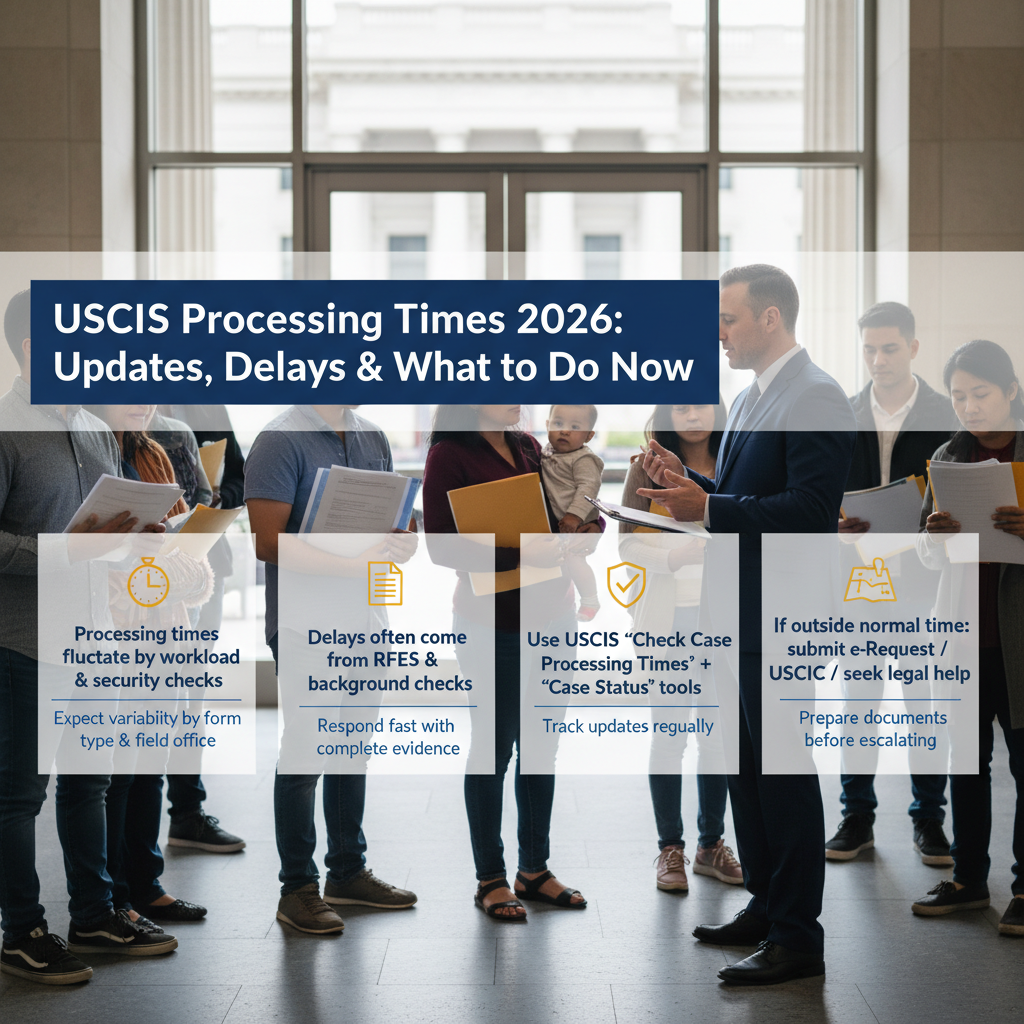
The reporting that sparked this guide comes from: USCIS Processing Times and Updates for 2026 (USCIS).
Important: This article is educational and reflects publicly available USCIS guidance and tools. Processing times can change quickly based on workload, staffing, security checks, and policy updates. Always verify your category using USCIS Processing Times and your case portal.
Need Help? Our Orlando immigration team is ready to assist. Call +1 786-791-3106 for a free consultation, or message us online. Se Habla Español.
What This News Means for Immigrants in Orlando and Across Florida
Why this news is showing up now
USCIS processing times are trending in 2026 because more applicants are checking timelines in real time—and because USCIS continues to publish and refine tools that show how long cases may take by form type, category, and office. For many families, the difference between a case taking 6 months vs. 16 months affects:
- When a spouse can work (often tied to an EAD based on a pending Form I-485)
- When a child “ages out” of eligibility (especially where a Priority Date matters)
- Whether an applicant can travel (Advance Parole vs. consular processing timing)
- Whether a person can safely renew a benefit within a 90-day window or needs earlier planning
Reminder: USCIS “processing time” is not a promise. It’s a statistical estimate based on how long USCIS took to complete certain percentages of cases. Still, it’s one of the most practical planning tools available.
How it can affect Florida residents
Florida has one of the largest immigrant populations in the United States, and Central Florida—especially the I-4 corridor—sees high demand for family-based immigration, employment-based cases, humanitarian filings, and naturalization. If your case is in Orlando or you’re filing based on an Orlando address, your experience may be shaped by:
- The Orlando USCIS Field Office interview capacity (for green cards and citizenship interviews)
- Biometrics scheduling at local Application Support Centers (ASCs)
- Mail and intake routing to USCIS lockboxes and national service centers
- Regional trends such as seasonal filing surges and staffing changes
For Central Florida residents, even small delays can have big consequences—like gaps in work authorization, postponed family reunification, or missing a strategic filing date. Planning around USCIS timelines in 2026 is not just “nice to have”—it is risk management.
What USCIS Processing Times and Updates for 2026 Is (and Why It Matters)
A plain-English definition
USCIS processing times are estimates of how long USCIS expects to take to make a decision on a specific application or petition. In 2026, “updates” typically refer to:
- Changes to posted time ranges on the USCIS processing time tool
- Policy adjustments affecting evidence requests, interviews, or adjudication sequencing
- Operational changes (staffing, digitization, interview scheduling patterns)
- New or revised filing instructions and editions on USCIS Forms
Why it matters: your immigration plan often depends on timing—when you can work, travel, petition relatives, or avoid unlawful presence. A realistic timeline can help you avoid preventable denials and delays.
Key terms you need to know
- Receipt Notice: The notice confirming USCIS accepted your filing and assigned a receipt number (critical for tracking).
- Biometrics: Fingerprints/photo appointment used for identity and background checks.
- RFE (Request for Evidence): USCIS asks for missing or additional documents. Responding late can lead to denial.
- NOID (Notice of Intent to Deny): USCIS plans to deny unless you overcome specific issues with evidence and legal argument.
- Adjustment of Status: Applying for a green card from inside the U.S., typically using Form I-485.
- Priority Date: Your place in line for certain family- and employment-based green cards (especially when visa numbers are limited).
- Service Center vs. Field Office: Service centers often adjudicate petitions; field offices often conduct interviews (not always, but often).
- Case Outside Normal Processing Time: A status where you may submit an e-request through USCIS if your case exceeds posted norms.
Warning: A “fast” processing time estimate does not mean your case will be fast if your filing is incomplete, inconsistent, or triggers additional screening. Clean filings are still the best strategy.
Current Immigration Law: The Foundation
USCIS processing times exist within a legal framework set by Congress, regulations, and agency policy. Understanding the basics helps you make better decisions when a case is delayed.
Federal requirements
Most benefits USCIS processes are grounded in the Immigration and Nationality Act (INA), implemented through federal regulations in Title 8 of the Code of Federal Regulations (8 C.F.R.). Examples:
- Family-based immigration (INA §§ 201, 203, 204): Often filed with Form I-130 (Petition for Alien Relative).
- Adjustment of Status (INA § 245): Often filed with Form I-485.
- Naturalization (INA §§ 316, 319): Often filed with Form N-400 (not an I-form, but a common timeline concern).
- Employment authorization (8 C.F.R. § 274a): Often filed with Form I-765.
- Travel document / Advance Parole: Often filed with Form I-131.
USCIS publishes official guidance, forms, and updates at the USCIS official website. Visa availability for consular processing and many green card categories is managed with the U.S. Department of State at U.S. Department of State.
If your case involves immigration court or removal proceedings, timelines may also be affected by the immigration court system under the Executive Office for Immigration Review.
Florida-specific considerations
Immigration law is federal, but Florida residents face local realities that impact processing and case strategy:
- High demand for appointments and interviews in major metro areas
- Address stability challenges (moving along the I-4 corridor can trigger missed notices if you don’t update USCIS)
- Disaster-related disruptions (hurricane season can affect mail, biometrics, and interview attendance)
Reminder: If you move, you generally must update your address with USCIS (often via AR-11 online) to avoid missing biometrics, RFE/NOID, or interview notices—missed notices can cause denial.
Need Help? Our Orlando immigration team is ready to assist. Call +1 786-791-3106 for a free consultation, or message us online. Se Habla Español.
How to Track and Improve Your USCIS Timeline in 2026: A Complete Step-by-Step Guide
The most effective way to respond to changing USCIS processing times is to (1) choose the correct strategy for your category and (2) build a filing that avoids delays. Below is a practical, end-to-end workflow.
1) Identify your case type, office, and “real” timeline baseline
Start by identifying exactly what you filed (or plan to file), which category you’re in, and which office is processing it. USCIS processing times vary widely depending on these details.
- Check the tool: USCIS Processing Times
- Verify your form edition and category on USCIS Forms
- Confirm whether your case is at a service center or field office (the receipt notice often helps)
Documents to gather (baseline check):
- USCIS receipt notice(s) with receipt number(s)
- Copy of the full filing package you submitted (or draft package)
- Any RFE/NOID notices already received
- Proof of delivery (FedEx/USPS tracking) if recently filed
If your case is in Orlando, your interview (if required) is typically connected to The Orlando USCIS Field Office. That office’s scheduling capacity can shape the last phase of certain cases like Adjustment of Status and naturalization.
2) Build a “delay-proof” filing strategy before you submit (or before you respond)
Many delays come from avoidable issues: missing signatures, wrong fees, outdated forms, weak evidence, or inconsistent information across forms.
Documents to gather (pre-filing quality control):
- Passport biographic page and all U.S. visas/entry stamps
- I-94 record (if applicable) and entry evidence
- Birth certificate with certified translation if not in English
- Marriage certificate/divorce decrees (if family-based)
- Prior immigration notices (approvals/denials/NTAs if any)
- Two passport-style photos (when required by the form instructions)
Important: USCIS rejects filings for technical errors. A rejection is not a “denial,” but it can cost you weeks or months and may disrupt eligibility in time-sensitive situations (like expiring status or filing within a 90-day window for certain renewals).
3) File the correct combination of forms to reduce waiting gaps
Your timeline may improve when filings are coordinated correctly. A common example is family-based cases where an applicant may be eligible to file Form I-130 and Form I-485 together (concurrent filing) depending on category and visa availability. Another example is requesting work and travel authorization while an Adjustment of Status case is pending.
Common form “bundles” (case-specific):
- Form I-130 + Form I-485 (when eligible) + Form I-765 + Form I-131
- Form I-130 alone (consular processing path) + later National Visa Center steps (Department of State)
- Form N-400 for citizenship (with strong travel/tax/residence documentation)
Documents to gather (to support the filing bundle):
- Proof of U.S. petitioner status (passport, naturalization certificate, green card)
- Evidence of a bona fide marriage (if applicable): joint lease, bank accounts, insurance, photos, children’s birth certificates
- Medical exam (when required for Form I-485) per USCIS instructions
- Affidavit of Support evidence (income, tax returns) when required
Warning: Not everyone can file Form I-485. Some people must use consular processing, and some may be barred due to status issues, unlawful presence, or other inadmissibility concerns. Get legal advice before assuming you qualify.
4) Track your case actively and respond fast to USCIS notices
In 2026, the difference between a smooth case and a delayed case often comes down to how quickly you respond to USCIS communications—and whether your response is complete.
Documents to gather (tracking and response readiness):
- USCIS online account access (if created) and saved login details
- All notices scanned as PDFs (receipt, biometrics, RFE/NOID, interview)
- A document checklist mapped to the specific notice deadline
- Mailing proof for any response (tracking + a full copy)
Reminder: Many USCIS notices have strict deadlines. Missing an RFE/NOID response deadline can lead to denial. If you receive an RFE, do not “partially respond” unless the notice allows it—send a complete, organized response with tabs and a cover letter.
5) Use the right escalation tools when you’re truly outside normal time
If your case exceeds posted norms, USCIS offers limited ways to request help. The key is using the correct tool at the correct time with the correct evidence.
Documents to gather (escalation packet):
- Receipt notice and current case status printout
- Screenshot/printout of the relevant processing time page
- Evidence of urgent harm (job offer, medical need, family emergency) if requesting expedite
- Prior service request numbers (if any)
Potential options include:
- Submitting an e-request for “case outside normal processing time” (when eligible)
- Requesting an expedite (must meet criteria; evidence-driven)
- Requesting an InfoPass-style appointment when available/appropriate (USCIS processes vary)
Warning: Expedite requests are discretionary and often denied without strong documentation. Also, expediting one form does not automatically expedite related forms.
6) Prepare for interview (or interview waiver) with consistency and proof
Some cases require interviews; others may be waived. Either way, your file must “tell one consistent story.” In Orlando, interview scheduling can be a major timeline driver—especially for family-based green cards and naturalization.
Documents to gather (interview readiness):
- Original civil documents (birth/marriage/divorce certificates)
- Updated evidence of relationship or eligibility since filing
- Updated employment/income evidence if support is an issue
- Government IDs and passports for all applicants
Important: If you cannot attend an interview, reschedule properly. Missing an interview without following instructions can cause denial.
Practical Steps You Can Take Today
Processing time updates can feel out of your control—but your preparation is not. Here is an actionable checklist for 2026 that reduces delays and protects your options.
Actionable checklist (do these now)
- Check your processing time category using USCIS Processing Times and confirm you selected the correct form and office.
- Create a “master file” (digital + paper) with every form, exhibit, notice, and mailing proof.
- Calendar deadlines for biometrics, RFEs, and renewals—do not rely on memory.
- Update your address immediately after moving to avoid missed notices (especially common along the I-4 corridor).
- Renew work authorization early when allowed—many categories should not wait until the last moment. If your renewal is tied to a 90-day window or another rule, plan ahead.
- Prepare for travel carefully: leaving the U.S. during a pending Adjustment of Status can be risky without proper authorization.
- Respond to RFEs fast and fully—aim to respond well before the deadline, not on the last day.
Document preparation guidance
Organize evidence like an auditor would: clear labels, consistent dates, and no contradictions. If a name, date, or address differs across documents, include an explanation and supporting proof.
- Use a cover letter and table of contents for major filings and RFE responses
- Provide certified translations for non-English documents
- Submit clear copies unless USCIS specifically requests originals
- Keep proof of delivery for every package sent to USCIS
Timeline expectations in 2026 (planning ranges, not promises)
Timelines vary drastically by form, category, and office. As a planning approach:
- Receipts: often within days to weeks after delivery (varies by lockbox load)
- Biometrics: commonly within weeks to a few months, but can vary
- RFEs: can arrive at any stage; responding promptly can prevent months of additional delay
- Interviews: often the longest “last mile” for field-office-based cases
Reminder: Some applicants also face visa-number backlogs where the Priority Date controls when a green card can be approved—USCIS processing speed alone can’t overcome visa unavailability.
Need Help? Our Orlando immigration team is ready to assist. Call +1 786-791-3106 for a free consultation, or message us online. Se Habla Español.
How Imigrar Helps Immigrants in Orlando
At Imigrar, we help individuals and families navigate USCIS processing realities with a strategy-first approach: correct eligibility analysis, strong documentation, consistent filings, and proactive case management. Our mission is simple: Keep Families Together.
If your case is in Orlando, we can help you prepare for the practical issues that frequently cause delays—missing documents, inconsistent prior history, interview readiness, and late responses to USCIS notices. We also help clients across Florida and nationwide.
- Family-based petitions (Form I-130) and green cards through Adjustment of Status (Form I-485)
- Work permits (Form I-765) and travel documents (Form I-131) planning while cases are pending
- Naturalization (N-400) preparation and interview support
- RFE/NOID responses with organized evidence and legal argument
- Case tracking and escalation planning when cases are outside normal time
We offer a free consultation. Call +1 786-791-3106. Se Habla Español.
Frequently Asked Questions
Q: How do I know if I’m eligible to file Form I-485 instead of doing consular processing?
A: Eligibility for Adjustment of Status depends on your immigration category, how you last entered the U.S., whether a visa number is available (often controlled by your Priority Date), and whether any bars or inadmissibility issues apply. Many immediate relatives of U.S. citizens can file Form I-485 if they were inspected/admitted or paroled, but each case is fact-specific. If you are unsure, get legal advice before filing—an incorrect Form I-485 can be denied and may create additional risks.
Q: Will checking USCIS processing times change my case or make it faster?
A: No. Checking the tool does not speed up your case. However, it helps you determine when you can submit a “case outside normal processing time” request and helps you plan around work authorization, travel, and life decisions. Use USCIS Processing Times and track your case status through your receipt number.
Q: How do USCIS processing times affect my immigration status while I’m waiting?
A: It depends on what you filed. A pending application can sometimes provide a period of authorized stay (for example, a properly filed Form I-485 generally allows you to remain while it is pending), but it does not automatically give work authorization or travel permission. Warning: Traveling without the correct authorization can cause serious problems. Also, some people must maintain an underlying nonimmigrant status while certain applications are pending. Get case-specific advice.
Q: What timelines should I expect in 2026 for Form I-130 and Form I-485?
A: Timelines vary by category and office. Form I-130 may be processed by a service center, while Form I-485 often involves biometrics and potentially an interview at a field office like The Orlando USCIS Field Office. The best practice is to (1) check your exact form/category at USCIS Processing Times, and (2) plan for additional time if you anticipate an RFE or interview rescheduling. Use posted times as a planning range—not a guarantee.
Q: What documents are most likely to trigger an RFE and slow processing?
A: Common RFE triggers include missing civil documents (birth/marriage/divorce certificates), missing or insufficient financial evidence for support where required, unclear proof of lawful entry (for Adjustment of Status), incomplete translations, and inconsistencies across forms (different addresses, dates, or prior names). The solution is a “front-loaded” filing: organized evidence, a clear cover letter, and consistent answers across every form.
Q: How much does it cost to file—and can delays increase costs?
A: Filing costs vary by form and are set by USCIS (and sometimes change). Always confirm current fees and fee rules on the USCIS official website and the specific form page at USCIS Forms. Delays can increase costs indirectly—such as needing additional document renewals, new medical exams (if required), or legal help to respond to an RFE/NOID. Planning early can reduce the likelihood of expensive rework.
Q: What happens if my case is denied after a long wait?
A: A denial can have different consequences depending on what you filed and your current status. Some denials can be refiled; others may be appealable or reopenable; some may place you at risk of removal proceedings. If you receive a denial, do not assume it’s the end—read the decision carefully, note deadlines, and speak with an attorney immediately. If immigration court becomes involved, information about proceedings is available through Executive Office for Immigration Review, but legal counsel is strongly recommended.
Common Mistakes (and How to Avoid Them)
Mistake #1: Filing the wrong form edition or incorrect fee
USCIS may reject a package if you use an outdated edition, forget a signature, or include the wrong payment. That rejection can cost weeks and may affect time-sensitive eligibility.
How to avoid it: Download forms only from USCIS Forms, confirm the edition date, and double-check the fee instructions on USCIS official website.
Mistake #2: Assuming processing times are the same everywhere
Processing times depend on the form, category, and office. Two people filing the same form can have very different outcomes if one is routed to a different center or needs an interview at a busier field office.
How to avoid it: Always select the correct office in the USCIS tool and keep copies of your receipt notices. If your case is in Orlando, plan for the realities of The Orlando USCIS Field Office scheduling.
Mistake #3: Responding to an RFE with disorganized or incomplete evidence
An RFE response is not just “send what you have.” It’s a legal and factual presentation. Incomplete responses can lead to denial and more delays.
How to avoid it: Follow the notice exactly, include a cover letter, tabbed exhibits, and send it early with tracking. Maintain a complete copy of what you sent.
Need Help? Our Orlando immigration team is ready to assist. Call +1 786-791-3106 for a free consultation, or message us online. Se Habla Español.

Closing: Take Control of Your 2026 USCIS Timeline
USCIS processing time updates in 2026 are a reminder that waiting is only one part of the journey. The other part is preparation: choosing the right process, filing correctly, responding quickly, and escalating appropriately when a case is truly outside normal time.
If your case is in Orlando, if you live in Orange County, or if you’re anywhere along the I-4 corridor, we can help you create a plan that protects your work authorization, your family’s stability, and your long-term immigration goals.
Need help now? Call Imigrar at +1 786-791-3106 for a free consultation, or message us online. Se Habla Español. Our mission is to Keep Families Together.


