


The reporting that sparked this guide
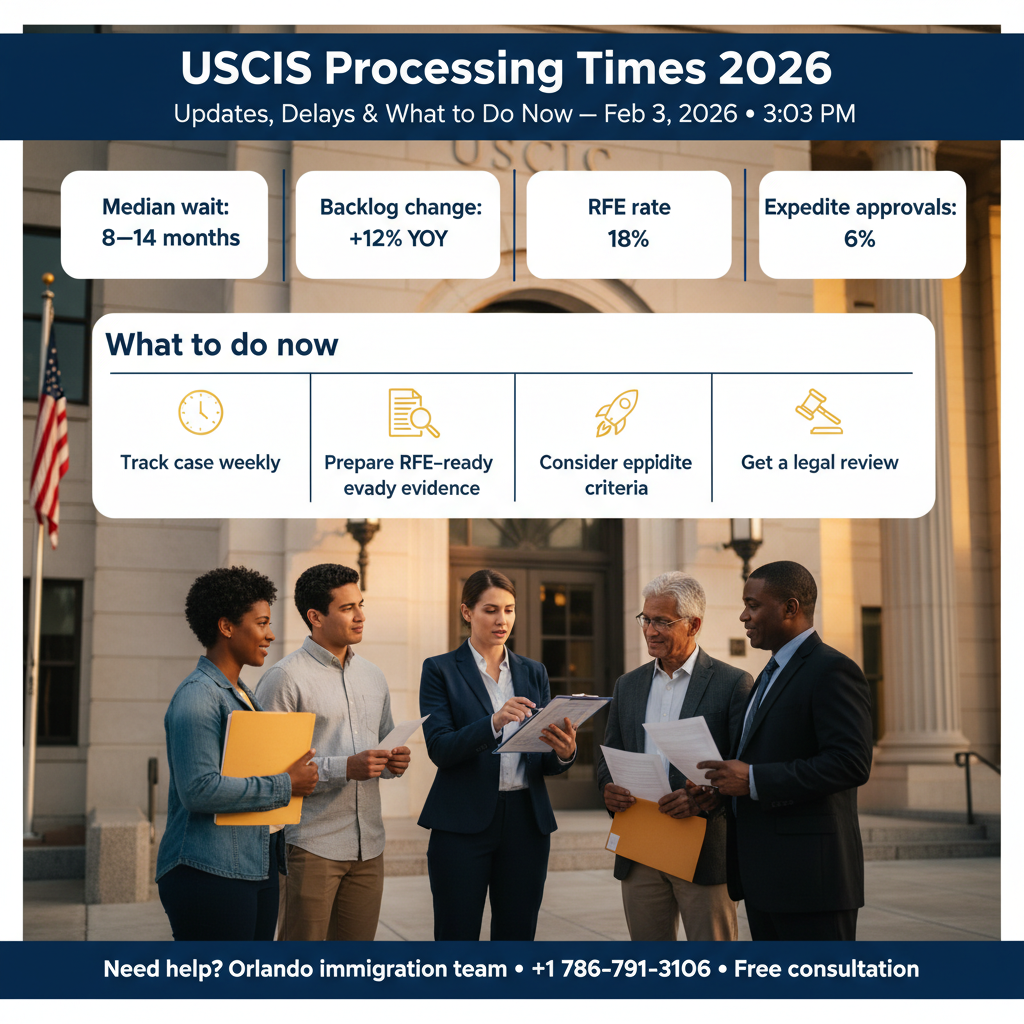
The reporting that sparked this guide: USCIS Processing Times and Updates for 2026 (USCIS)
Need Help? Our Orlando immigration team is ready to assist. Call +1 786-791-3106 for a free consultation, or message us online. Se Habla Español.
What This News Means for Immigrants in Orlando and Across Florida
Why this news is showing up now
USCIS processing times are a moving target—and in 2026, they’re trending again because more applicants are actively tracking delays, work permits, interview scheduling, and family-based green card timelines. USCIS publishes time ranges by form type and office, and those ranges can change month to month based on:
- Application volume (including humanitarian filings and family petitions)
- Staffing and budget allocation
- Security checks and background screening workflows
- Policy and operational changes (for example, interview waivers or new evidence standards)
- Local field office capacity (including the Orlando area)
Important: “Processing time” is not a promise. It’s a historical estimate, and individual cases can be faster or slower depending on evidence, admissibility issues, and whether USCIS issues a Request for Evidence (RFE).
To track official ranges, use USCIS Processing Times and compare your receipt date to the “Case Inquiry Date” listed for your form and office.
How it can affect Florida residents
For Central Florida residents—especially along the I-4 corridor (Orlando, Kissimmee, Sanford, and nearby Orange County communities)—processing time shifts can directly impact:
- Adjustment of Status timelines for spouses, parents, and children of U.S. citizens
- When you can receive your work permit (EAD) and travel document (Advance Parole)
- Interview scheduling at The Orlando USCIS Field Office
- Naturalization timing (including travel plans and job requirements)
- Employer planning for work-authorized employees
If your case is in Orlando, local scheduling realities matter: two people with identical filings can see different timelines depending on whether the case is handled by a service center, the National Benefits Center, or the local field office.
What USCIS Processing Times and Updates for 2026 Is (and Why It Matters)
A plain-English definition
“USCIS processing times” are USCIS’s published estimates for how long it takes to adjudicate (decide) a specific immigration form—such as a family petition, a green card application, a work permit, or a citizenship application. In 2026, “updates” refers to the periodic changes USCIS makes to those estimates based on recent case completion data and operational capacity.
These times matter because they help you plan real life—work, travel, school, family reunification, and legal status strategy. They also help you decide when it’s appropriate to:
- Submit an e-request
- Call USCIS
- Seek congressional assistance
- Consider a mandamus lawsuit (in limited cases, with legal advice)
Key terms you need to know
- Receipt Notice (Form I-797C): Proof USCIS received your filing; includes receipt number and received date.
- Case Inquiry Date: The date USCIS says you can submit an “outside normal processing time” inquiry.
- RFE (Request for Evidence): USCIS asks for more documents; this almost always extends your timeline.
- NOID (Notice of Intent to Deny): USCIS plans to deny unless you respond with strong evidence.
- Biometrics: Fingerprints/photo appointment used for background checks (sometimes reused).
- Priority Date: Your place in line for visa availability in many categories (especially family preference and employment-based).
- Adjustment of Status: Applying for a green card inside the U.S. (often using Form I-485).
- Consular Processing: Immigrant visa interview abroad through the U.S. Department of State.
- Service Center vs. Field Office: Service centers adjudicate many forms; field offices handle interviews and local adjudications (like many Form I-485 cases).
Reminder: Your “processing time” may be tied to the office listed on your receipt notice—this is why two applicants in the same city can see different timeframes.
Need Help? Our Orlando immigration team is ready to assist. Call +1 786-791-3106 for a free consultation, or message us online. Se Habla Español.
Current Immigration Law: The Foundation
USCIS processing is “operations,” but the adjudications are governed by federal law. Understanding the legal foundation helps you avoid delays caused by missing eligibility elements.
Federal requirements
Key legal authorities include:
- The Immigration and Nationality Act (INA), including INA § 245 for Adjustment of Status and INA § 316 for naturalization requirements.
- Federal regulations at 8 C.F.R. (for example, 8 C.F.R. § 245 for adjustment and 8 C.F.R. § 103 for USCIS procedures).
- USCIS policy guidance (Policy Manual) and form instructions.
Common USCIS filings affected by processing times in 2026 include:
- Form I-130 (Petition for Alien Relative)
- Form I-485 (Application to Register Permanent Residence or Adjust Status)
- Form I-765 (Application for Employment Authorization)
- Form I-131 (Application for Travel Document / Advance Parole)
- Form N-400 (Application for Naturalization)
- Form I-129 (Nonimmigrant worker petitions—varies by category)
- Form I-751 (Remove conditions on residence)
- Form I-589 (Asylum) and related employment authorization timelines
Warning: Filing the right form is not enough—USCIS can delay or deny for missing signatures, incorrect fees, outdated editions, insufficient evidence, or eligibility issues (like unlawful entry for many Form I-485 applicants who do not qualify for an exception).
Always confirm forms and instructions on the USCIS official website and download from USCIS Forms.
Florida-specific considerations
Immigration law is federal, but Florida residents face practical, location-based issues that affect timelines and strategy:
- The Orlando USCIS Field Office may have different interview queues than other Florida offices.
- Mailing logistics matter—use trackable delivery and keep complete copies of everything.
- For Central Florida residents, travel plans (including cruises departing Florida ports) can be risky while an Form I-131 Advance Parole is pending. Get legal advice before leaving the U.S.
- If you’re in removal proceedings, your path may involve the Executive Office for Immigration Review (Immigration Court), which can change how and where certain applications are filed and adjudicated.
If your case is in Orlando and you receive an interview notice, plan for time off work, childcare, and document organization early—rescheduling can add months.
How to Track and Respond to USCIS Processing Times: A Complete Step-by-Step Guide
1) Identify your form type, category, and the office processing your case
Start by confirming exactly what you filed and where USCIS is processing it. Your receipt notice (Form I-797C) typically indicates:
- Form number (for example, Form I-130 or Form I-485)
- Receipt number and “Received Date”
- Which USCIS office is handling your case (service center or field office)
Documents to gather:
- Receipt notice(s) for every pending form
- Copy of the full filing (what you sent)
- Any USCIS online account screenshots (if applicable)
- Prior notices: biometrics, RFEs, interview notices
2) Check official processing time ranges and the “Case Inquiry Date”
Go to USCIS Processing Times, select your form, and then select your office (or service center) exactly as listed on your receipt.
USCIS typically shows:
- A time range (example: “X months to Y months”)
- A “Case Inquiry Date” (when you can ask USCIS why it’s taking so long)
Reminder: The “Case Inquiry Date” is more important than the range. If your receipt date is earlier than the inquiry date, you may be eligible to submit an “outside normal processing time” request.
Documents to gather:
- Receipt date and receipt number
- Office/service center name
- A timeline list of any USCIS actions (biometrics date, RFE response date, etc.)
3) Track your case status and set evidence-ready “milestones”
Use USCIS Case Status Online and/or your USCIS online account to monitor updates. While USCIS status messages can be generic, they still help you identify milestones such as:
- Biometrics scheduled or reused
- RFE issued / response received
- Interview scheduled (common for Form I-485 and Form N-400)
- Card/notice production
Build a “milestone folder” so you can respond quickly if USCIS requests something with short notice.
Documents to gather:
- Government-issued ID (passport, driver’s license)
- Updated proof of address in Orange County (or your current county)
- Any new civil documents (marriage certificate, divorce decree, birth certificates)
- Updated relationship evidence if marriage-based (leases, bank statements, insurance)
4) Respond correctly to RFEs/NOIDs and avoid preventable delays
RFEs and NOIDs are major drivers of longer processing times in 2026. A strong response often requires more than simply “sending what you have.” You should:
- Answer every item USCIS requests
- Follow the notice instructions exactly (address, barcodes, deadlines)
- Organize evidence with a cover letter and labeled exhibits
Warning: Missing an RFE/NOID deadline can lead to denial. Some notices give short windows; others allow more time. If you move, update your address quickly to avoid missing mail.
Documents to gather:
- The full RFE/NOID notice (all pages)
- Evidence requested (tax transcripts, pay stubs, joint documents, translations)
- Certified translations for non-English documents
- Proof of timely delivery (USPS/UPS/FedEx tracking)
5) Use the right escalation tools (e-request, call, InfoPass-style appointment, or congressional help)
If your case is beyond the “Case Inquiry Date,” you may take escalation steps. Common options include:
- Submit an “outside normal processing time” service request (e-request)
- Call USCIS Contact Center and request a Tier 2 callback when appropriate
- Request an in-person appointment (when USCIS allows/when necessary)
- Seek help from a U.S. Senator or Representative’s constituent services office
For Central Florida residents, congressional offices can sometimes help obtain clearer status updates, especially when USCIS has exceeded published timeframes. Results vary and are not guaranteed.
Documents to gather:
- Receipt notices and A-Number (if any)
- Proof your case is outside normal time (screenshot of inquiry date)
- Any urgent-impact evidence (job offer, medical need, family emergency)
- Signed privacy release (for congressional inquiries)
6) Consider expedite requests (when eligible) and plan for common outcomes
USCIS may consider expediting certain applications under limited criteria (for example, severe financial loss, urgent humanitarian reasons, or compelling U.S. government interests). Expedites are discretionary.
Expedite requests are most commonly discussed for Form I-765 (EAD) and sometimes Form I-131 (Advance Parole), but they can apply in other contexts too.
Important: Even when an expedite is accepted for review, USCIS may request evidence and still deny the expedite. The underlying application continues processing normally.
Documents to gather:
- Evidence of financial loss (eviction notice, past-due bills, employer letter)
- Medical documentation (if humanitarian)
- Proof of pending application (receipt notice)
- Any time-sensitive travel documentation (if applicable)
7) Prepare for the decision stage: approval, denial, or additional review
In 2026, many cases are approved without interview (depending on category and discretion), while others require interviews at the local office. When a decision comes, you may see:
- Approval notice and card production
- Interview scheduled, then approval
- RFE/NOID before a final decision
- Denial, which may trigger appeal/motion options or refiling strategy
If denied, the next step depends on the form and reason. Some denials allow motions (Form I-290B), some suggest refiling, and some may place someone at risk of removal proceedings depending on status history.
Documents to gather:
- Decision notice (every page)
- Your full filing copy and evidence list
- Any prior immigration history documents (I-94, prior approvals, court records)
- Consultation notes and timeline summary
Need Help? Our Orlando immigration team is ready to assist. Call +1 786-791-3106 for a free consultation, or message us online. Se Habla Español.
Practical Steps You Can Take Today
Processing times can feel out of your control, but there are concrete steps you can take today to reduce risk and avoid preventable delays—especially if your case is in Orlando or you expect an interview at The Orlando USCIS Field Office.
- Checklist item #1: Create a “USCIS Master File” (digital + paper) with every receipt, notice, and your full submission copy.
- Checklist item #2: Verify your mailing address is correct everywhere. File AR-11 (change of address) when you move, and update your USCIS online account if you have one.
- Checklist item #3: Track your case using the receipt number and compare your receipt date to the “Case Inquiry Date” on USCIS Processing Times.
- Checklist item #4: Prepare for an RFE before it happens: keep updated tax returns/transcripts, pay stubs, and relationship evidence (if marriage-based).
- Checklist item #5: If you filed Form I-485, plan for work/travel gaps: EAD/AP timing can shift. Avoid international travel without approved Advance Parole unless your status allows it.
- Checklist item #6: If you have a Priority Date (family preference or employment-based), monitor visa availability and strategy with counsel—timing depends on visa bulletin movement and eligibility.
- Checklist item #7: Keep a “proof of presence” folder (leases, bills, school records) in case USCIS asks for updated evidence at interview.
Timeline expectations (general guidance): In 2026, many applicants experience multi-month waits for biometrics reuse/appointments, then additional months for interviews or adjudication depending on form type and office workload. Some cases move quickly; others slow down after an RFE or background check. The most reliable way to estimate your next step is to track your specific form and office on the official USCIS tools.
Reminder: If you are counting days for a benefit (for example, certain eligibility rules tied to continuous residence for naturalization), keep careful travel records. For some applicants, time outside the U.S. can affect eligibility. Speak with counsel before extended travel.
Document preparation guidance: Keep civil documents current and legible. If a document is not in English, obtain a proper certified translation. If you’re applying for a marriage-based benefit, maintain ongoing evidence showing a real shared life (not just a wedding photo album).
How Imigrar Helps Immigrants in Orlando
At Imigrar, we help clients in Orlando, across Florida, and nationwide navigate USCIS processing delays with a strategy-first approach. Our work focuses on protecting families and reducing unnecessary setbacks—consistent with our tagline: Keep Families Together.
- Case “health checks” to identify why a case may be delayed (missing evidence, office routing, prior immigration issues)
- RFE/NOID response preparation with organized exhibits and legal argument where appropriate
- Adjustment and family-based filings, including Form I-130 and Form I-485 packages designed to reduce RFEs
- Interview preparation for The Orlando USCIS Field Office (what to bring, what to expect, how to answer clearly)
- Escalation guidance: service requests, congressional inquiries, and expedite requests (when justified)
We offer a free consultation by phone. Se Habla Español.
Need Help? Our Orlando immigration team is ready to assist. Call +1 786-791-3106 for a free consultation, or message us online. Se Habla Español.
Frequently Asked Questions
Q: How do I know if I’m eligible to file an “outside normal processing time” inquiry?
A: Compare your receipt notice “Received Date” to the “Case Inquiry Date” listed for your form and office on USCIS Processing Times. If your receipt date is earlier than the inquiry date, you can typically submit a service request. Reminder: If you recently responded to an RFE, USCIS may “reset” internal review timing—save proof of when USCIS received your RFE response.
Q: Can a pending Form I-130 or Form I-485 affect my current immigration status?
A: It depends. A pending application does not automatically give lawful status. Some filings may place you in a “period of authorized stay” (especially certain pending Adjustment of Status cases), but that is not the same as having a nonimmigrant status. Warning: Overstays, unauthorized employment, and prior immigration violations can affect eligibility. Get legal advice tailored to your entry history and category.
Q: What are realistic USCIS timelines in 2026 for work permits and travel documents?
A: Timelines vary significantly by eligibility category and workload. Many applicants file Form I-765 and Form I-131 together with Form I-485, but adjudication can still take months and may not match older expectations. The best practice is to track your specific form and office on the USCIS tools and plan financially for a delay. If you face severe financial loss, you may explore an expedite request with evidence.
Q: What documents reduce delays for marriage-based green cards in Orlando?
A: Strong, organized evidence reduces RFEs and helps interviews go smoothly. Typical documents include: joint lease/mortgage, joint bank statements, insurance policies naming each other, utility bills, joint tax filings or transcripts, proof of children (if any), photos across time, travel records together, and affidavits if needed. For Central Florida residents, also bring updated proof of address in Orange County and any new documents since filing.
Q: How much does it cost to file, and do USCIS fees change?
A: USCIS filing fees vary by form and can change by regulation. Always confirm current fees and fee rules directly on the USCIS official website and the form page on USCIS Forms. Important: Incorrect fees can cause rejection, which can seriously affect timing and deadlines. Attorney fees are separate and depend on case complexity.
Q: What happens if USCIS denies my case after a long wait?
A: First, read the denial notice carefully—USCIS usually explains the legal basis and whether you can appeal or file a motion (often using Form I-290B in certain contexts). Some cases are best addressed by refiling with stronger evidence; others require immediate legal action due to status consequences. Warning: A denial can create serious risk if you have no other lawful status. Speak with an immigration attorney before taking the next step.
Q: If my case is in Orlando, will I definitely have an interview at the local field office?
A: Not always. Some cases are adjudicated without interview depending on category, evidence strength, and USCIS discretion. However, many Form I-485 and Form N-400 cases do involve an interview. If you receive an interview notice for The Orlando USCIS Field Office, start preparing immediately—bring originals, updated documents, and be ready to clarify any inconsistencies.
Q: Does being in immigration court change USCIS processing times?
A: It can. If you are in removal proceedings, some benefits are handled differently, may require coordination with the court, or may fall under the jurisdiction of the Executive Office for Immigration Review. Timing can be affected by hearing schedules, prosecutorial discretion policies, and whether USCIS or the court has authority over the application. Get case-specific legal guidance.
Common Mistakes (and How to Avoid Them)
Mistake #1: Assuming the posted time range is a deadline USCIS must meet
USCIS processing time ranges are estimates, not guarantees. Avoid planning life events (international travel, job changes, school enrollment) based solely on the low end of the range. Use the “Case Inquiry Date” and maintain a buffer.
Mistake #2: Filing incomplete packages that trigger RFEs (or rejections)
Missing signatures, outdated form editions, wrong fees, missing translations, or weak relationship evidence can add months. Build a checklist for each form—especially for Form I-130 and Form I-485—and keep a complete copy of what you filed.
Mistake #3: Traveling or changing plans without understanding the consequences
Leaving the U.S. while an Adjustment of Status case is pending can be risky without approved Advance Parole (and even then, there are exceptions and risks). Warning: Some travel can be treated as abandoning the application. Always confirm with legal counsel before travel, especially for Central Florida residents taking cruises or last-minute trips.
Additional official resources to monitor in 2026
- USCIS official website (policy updates, alerts, and announcements)
- USCIS Processing Times (office-by-office estimates and inquiry dates)
- USCIS Forms (current editions, instructions, and filing addresses)
- U.S. Department of State (consular processing, immigrant visa guidance, and visa bulletin resources)
- Executive Office for Immigration Review (immigration court information for cases in proceedings)
Planning notes for 2026: timelines, windows, and “when to worry”
Many immigrants ask for a single “normal” timeline. In reality, your timeline depends on your form, category, background checks, evidence quality, and office workload. Still, there are planning rules that help:
- Important: If you receive an RFE/NOID, treat it as urgent and respond well before the deadline.
- Reminder: If you must renew certain benefits, do it early. Some renewals have recommended early-filing windows; talk to counsel about your specific category.
- 180 days: Many applicants use “about six months” as a planning marker for certain work authorization and renewal strategies, but your case may differ. Always verify your category rules and filing instructions.
- 90-day window: Certain processes in immigration law involve a 90-day window (for example, some renewal planning or timing considerations depending on benefit type). Confirm the rule that applies to your specific application before acting.
If your case is in Orlando and you have been waiting longer than the posted inquiry date, it may be time to escalate strategically—without making moves that could complicate your eligibility.
Orlando-focused guidance: how to prepare for a USCIS interview
For Central Florida residents, interviews at The Orlando USCIS Field Office are a key moment where preparation can reduce delays. If your case is in Orlando and you receive an interview notice:
- Arrive early and bring the interview notice and government ID.
- Bring originals of all civil documents submitted (birth, marriage, divorce, passports).
- Bring updated evidence since filing (new lease, recent bank statements, new baby’s birth certificate, etc.).
- Review your forms before the interview so answers match what was filed.
- If anything changed (address, job, travel, prior citations/arrests), talk to an attorney before the interview.
Warning: Inconsistent answers or missing originals can lead to additional review, a second interview, or an RFE—each of which can extend processing times significantly.
Closing: take control where you can
USCIS processing times in 2026 are dynamic. While you can’t control USCIS workload, you can control the strength of your filing, how quickly you respond to notices, and whether you escalate at the right time using the right tools. For many families in Orlando, Orange County, and the I-4 corridor, a well-prepared strategy can be the difference between a smooth approval and months of avoidable delay.
Need Help? Our Orlando immigration team is ready to assist. Call +1 786-791-3106 for a free consultation, or message us online. Se Habla Español.

Closing CTA: Speak with Imigrar
If you’re worried about USCIS delays, an RFE, an interview at The Orlando USCIS Field Office, or a long-pending Form I-130 / Form I-485 case, we can help you build a clear plan.
Call Imigrar at +1 786-791-3106 for a free consultation, or message us online. Se Habla Español. Our mission is to Keep Families Together.


