


The reporting that sparked this guide
The reporting that sparked this guide comes from: USCIS Processing Times and Updates for 2026 (USCIS).
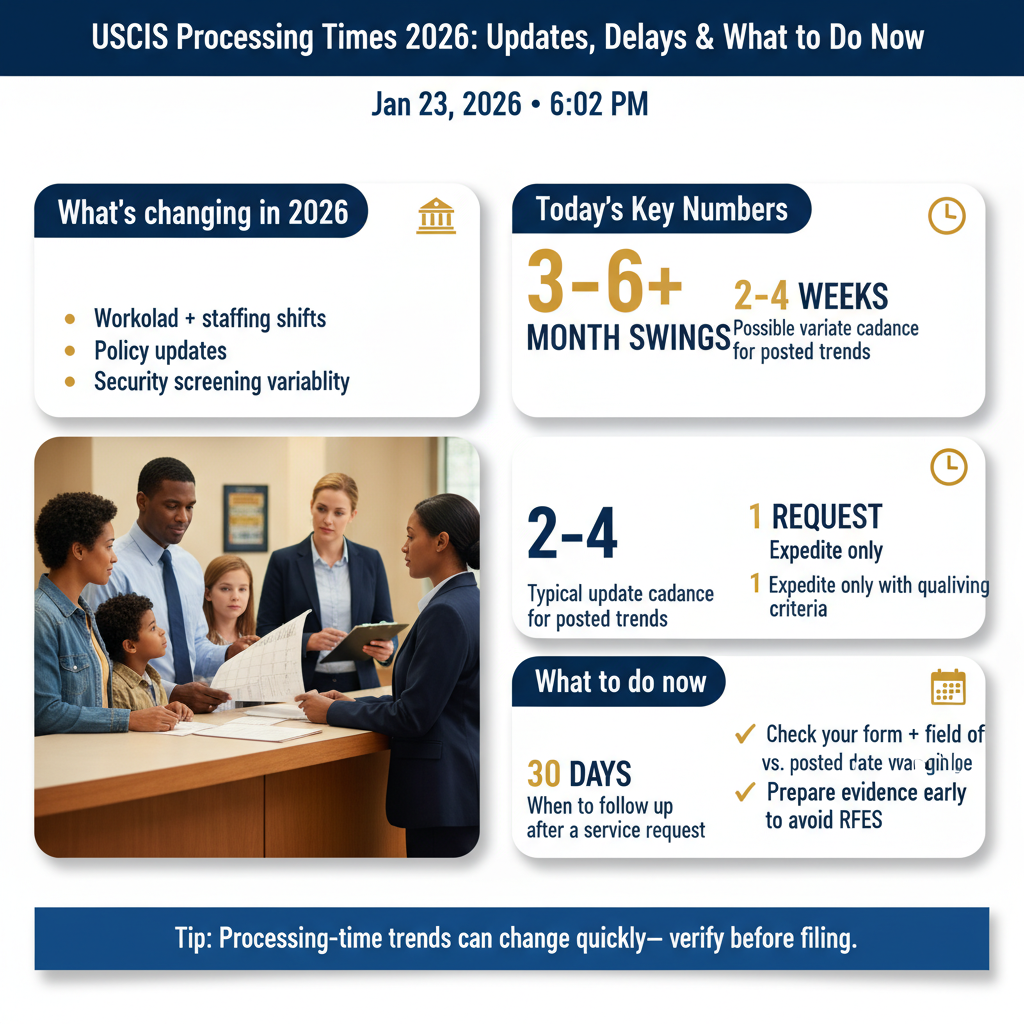
Reminder: USCIS processing time trends can change quickly based on workload, staffing, policy updates, and security screening. This article explains how to read 2026 processing-time updates, how to plan your case, and what you can do if your case stalls.
Need Help? Our Orlando immigration team is ready to assist. Call +1 786-791-3106 for a free consultation, or message us online. Se Habla Español.
What This News Means for Immigrants in Orlando and Across Florida
Why this news is showing up now
USCIS processing times are a “trending” topic in 2026 because many families and employers are seeing uneven timelines across different form types and offices. Even when the law hasn’t changed, the time it takes USCIS to make a decision can dramatically affect:
- When you can work (via EADs)
- When you can travel (via advance parole)
- When you can become a lawful permanent resident (green card approval)
- Whether you risk aging out, losing eligibility, or triggering unlawful presence issues
USCIS has also continued to expand online filing, adjust internal workflows, and publish more detailed processing-time metrics. That’s helpful—but it can be confusing if you don’t know what the numbers mean or how they apply to your specific case.
Important: A posted processing time is not a guarantee. It is a statistical estimate that can vary by field office, service center, form category, and even your interview or background-check timeline.
How it can affect Florida residents
For Central Florida residents, timelines often depend on where your case is handled (a USCIS service center vs. The Orlando USCIS Field Office). If your case is in Orlando, your wait time may be influenced by local interview capacity, staffing, and the volume of family-based and humanitarian filings in the region.
Florida also has a large immigrant population and high demand for family-based immigration. Along the I-4 corridor (including Orange County), it’s common to see families juggling:
- Pending Form I-130 family petitions
- Pending Form I-485 Adjustment of Status applications
- Requests for work authorization and travel documents while waiting
- Consular processing through the U.S. Department of State
Warning: If you move within Florida (or out of state) while your case is pending, you must update USCIS promptly—address changes can cause missed mail, rescheduled interviews, and avoidable delays.
What USCIS Processing Times and Updates for 2026 Is (and Why It Matters)
A plain-English definition
“USCIS processing times” are USCIS’s published estimates for how long it takes to process a specific application or petition. In 2026, USCIS continues to publish processing time ranges and related metrics (such as “case inquiry date” or “estimated time range”) to help applicants understand when a case may be considered outside normal processing.
These updates matter because processing time is not just an inconvenience—it affects real-life decisions: whether you can accept a job, renew a driver’s license, travel for emergencies, or reunite with family.
Key terms you need to know
- Receipt Notice (I-797C): Proof USCIS received your filing and assigned a receipt number.
- Biometrics: Fingerprints/photo appointment used for identity and background checks.
- RFE (Request for Evidence): USCIS asks for more documents. RFEs often add months.
- NOID (Notice of Intent to Deny): USCIS plans to deny unless you respond persuasively.
- Service Center: USCIS facility that processes many filings without interviews.
- Field Office: Local office (like Orlando) that often conducts interviews for Adjustment of Status.
- Priority Date: The place in line for certain visa categories; critical in family preference and employment-based cases.
- Case Inquiry Date: The date after which you can submit an “outside normal processing time” request.
- 180 days: A common planning benchmark used in immigration contexts (for example, some employment portability rules and practical planning horizons), but not a universal USCIS guarantee.
- 90-day window: A common deadline concept in immigration planning (for example, some renewals and time-sensitive filings). Always verify the exact rule for your form and category.
Reminder: Two people can file the same form and still see different processing times based on category, location, background checks, and whether USCIS issues an RFE.
Current Immigration Law: The Foundation
Processing-time “news” is about timing and agency operations, but your eligibility is governed by federal immigration law. Understanding the legal foundation helps you avoid mistakes that cause delays or denials.
Federal requirements
Most family- and employment-based immigration is governed by the Immigration and Nationality Act (INA), including:
- INA § 201–203 (visa allocation and preference categories)
- INA § 204 (petition process, including family petitions like Form I-130)
- INA § 245 (Adjustment of Status eligibility and limitations, typically filed on Form I-485)
- INA § 212 (inadmissibility grounds that can affect approvals and trigger RFEs/denials)
- INA § 237 (deportability grounds that can affect strategy if there are prior issues)
USCIS implements these laws through federal regulations (primarily in 8 C.F.R.) and policy guidance. For official resources, start with the USCIS official website and the USCIS Policy Manual.
Common forms affected by 2026 processing-time shifts include:
- Form I-130 (Petition for Alien Relative)
- Form I-485 (Application to Register Permanent Residence or Adjust Status)
- Form I-765 (Application for Employment Authorization)
- Form I-131 (Application for Travel Document)
- Form N-400 (Application for Naturalization)
- Form I-751 (Petition to Remove Conditions on Residence)
- Form I-129 (Nonimmigrant Worker petitions, where applicable)
Important: Always download the latest edition of a form and instructions from USCIS Forms. Using an outdated edition or wrong filing address can cause rejections and major delays.
Florida-specific considerations
Immigration law is federal, but Florida residents face practical, local factors that influence how processing delays affect daily life:
- If your case is in Orlando... your interview scheduling and rescheduling may depend on local field office capacity.
- For Central Florida residents... travel time and logistics matter for biometrics, medical exams, and interviews—especially along the I-4 corridor.
- State-level interactions (DMV/driver’s license, employment onboarding, school enrollment) often depend on having valid proof of status or a pending benefit.
Warning: A pending application does not automatically grant lawful status. Some filings provide authorized stay or protection from accrual of unlawful presence depending on the category; others do not. Timing strategy should be reviewed carefully.
How to Track and Respond to USCIS Processing Times: A Complete Step-by-Step Guide
The most effective way to deal with 2026 processing time changes is to (1) track your case correctly, (2) anticipate USCIS requests, and (3) escalate only when appropriate. Below is a practical system our team uses with clients.
1) Identify your exact form, category, and office handling the case
USCIS processing times are only meaningful if you select the correct form and category. For example, Form I-485 processing times vary by underlying basis (family vs. employment) and by field office.
Documents to gather:
- USCIS receipt notice(s) (Form I-797C) for each filing
- Copy of the full application packet you submitted (or confirmation if filed online)
- Any USCIS online account screenshots/confirmations
- Biometrics appointment notice (if already scheduled)
Tip for Orlando: If you are in Orange County or nearby counties, your interview is often at The Orlando USCIS Field Office, but some steps (like initial intake) may occur at a service center. Knowing which is which avoids confusion.
2) Use the official USCIS Processing Times tool the right way
Go to USCIS Processing Times and select:
- Form type (example: Form I-130, Form I-485)
- Form category (example: immediate relative vs. family preference)
- Office (service center or field office)
USCIS usually shows an estimated time range and a “receipt date for a case inquiry.” That inquiry date is critical—it tells you when USCIS considers a case outside normal processing for that selection.
Documents to gather:
- Your receipt date (from I-797C)
- Your selected category and office screenshot (for your records)
- Any prior service requests or inquiry confirmations
Reminder: If you choose the wrong category or office, you may think your case is “late” when it isn’t—or miss the right time to escalate.
3) Track your case status and notices weekly (not daily)
Use the USCIS case status tool and/or your USCIS online account to track updates. Daily checking can increase anxiety without changing outcomes; weekly tracking is usually enough unless you’re in a time-sensitive situation.
Documents to gather:
- Receipt numbers for all related filings (I-130, I-485, I-765, I-131, etc.)
- USCIS online account login information (securely stored)
- A timeline spreadsheet (receipt date, biometrics date, RFE date, response date)
Important: Many delays come from missed notices. Ensure USCIS has your current address and that you check your mail consistently.
4) Prepare for the “delay multipliers”: RFEs, biometrics, medical exams, and interviews
In 2026, cases often slow down when USCIS needs more evidence, when biometrics are delayed, or when medical exams are missing/expired. Plan around these common friction points:
- RFE/NOID responses must be complete, organized, and timely.
- Biometrics scheduling can vary; rescheduling can add weeks or months.
- Medical exams (Form I-693 for many Form I-485 cases) must be done by a USCIS-designated civil surgeon.
- Interviews at field offices (including Orlando) depend on local capacity.
Documents to gather:
- Identity documents (passport biographic page, birth certificate + certified translation if needed)
- Relationship evidence (for family cases): photos, joint leases, joint bank statements, insurance, affidavits
- Financial evidence (as applicable): tax returns, pay stubs, employer letters
- Medical exam documentation (sealed envelope if required)
- Any prior immigration records (I-94, prior approvals, notices to appear, etc.)
Warning: Responding to an RFE with “some” documents is often worse than responding with a complete, well-labeled package. Partial responses can lead to denial.
5) Submit a case inquiry or service request when eligible
If your case is past the USCIS “case inquiry date,” you may submit an “outside normal processing time” request through USCIS channels. This does not guarantee immediate action, but it can prompt review.
Documents to gather:
- Receipt notice(s)
- Screenshot of the processing time page showing your inquiry date
- Proof of urgent need (if requesting expedited handling): medical letters, employer letters, travel emergencies, etc.
- Copies of any prior inquiries and responses
Important: Expedite requests are discretionary and require strong evidence. A “normal” delay is usually not enough by itself.
6) Escalate strategically: InfoPass-style appointments, congressional help, Ombudsman, or litigation
If ordinary inquiries fail, there are higher-level options—each with pros/cons and eligibility considerations:
- Request a field office appointment (where available) for urgent issues (travel, proof of status, urgent documentation).
- Seek congressional assistance through your U.S. Representative/Senator (often helpful for stuck cases).
- Consider the DHS Office of the Citizenship and Immigration Services Ombudsman for systemic delays.
- In some situations, a federal mandamus lawsuit may be an option if USCIS unreasonably delays adjudication.
Documents to gather:
- Complete case history and timeline
- Copies of all filings, RFEs, and responses
- Proof of harm caused by delay (job loss risk, medical hardship, family separation)
- Any communications with USCIS
Reminder: Not every delay is “unreasonable” legally. A lawyer can help evaluate whether escalation helps—or backfires.
7) Keep your case “approval-ready” while you wait
Many 2026 delays are not solved by repeated inquiries—they’re solved by being ready when USCIS finally picks up the file. That means:
- Renew work/travel documents early when eligible
- Update your address immediately after moving
- Keep new relationship/financial evidence organized (for interviews)
- Maintain lawful status where required (especially for nonimmigrant-based strategies)
Documents to gather:
- Renewal eligibility calendar (set reminders 6–8 months ahead when possible)
- Updated joint documents (leases, utilities, insurance, children’s records)
- Updated employment letters/pay stubs (if relevant)
- Copies of travel history and current I-94 (if applicable)
Important: If you travel internationally while Form I-485 is pending without proper permission (advance parole in many cases), you may abandon the application. Get legal advice before traveling.
Need Help? Our Orlando immigration team is ready to assist. Call +1 786-791-3106 for a free consultation, or message us online. Se Habla Español.
Practical Steps You Can Take Today
If you’re worried about USCIS processing times in 2026, the best approach is proactive. Here’s a practical checklist you can start today—especially helpful for families in Orlando, Orange County, and across Central Florida.
Actionable checklist (do these now)
- Check your category and office in the USCIS Processing Times tool and record the inquiry date.
- Create a case timeline (receipt dates, biometrics, RFEs, responses, interview notices).
- Scan and back up your entire filing (PDF copies of every form and exhibit).
- Set reminders for renewals and time-sensitive actions (think in a 90-day window for planning, but verify your form’s rules).
- Update your address immediately after moving and confirm USCIS updated it.
- Prepare an “RFE-ready” folder with identity, relationship, and financial documents.
- Do not ignore mail from USCIS—many deadlines are strict and missing them can result in denial.
Document preparation guidance
USCIS delays often happen because the file is incomplete or inconsistent. These document practices reduce RFEs and speed review:
- Use clear labels (Exhibit A, Exhibit B) and a table of contents.
- Provide certified translations for foreign-language documents.
- Submit legible copies; avoid cut-off scans.
- For family cases, provide “real-life” evidence over time (not just a few photos).
- Keep originals available for interview (especially at The Orlando USCIS Field Office).
Timeline expectations (realistic planning for 2026)
USCIS processing times vary widely, but you can plan your life with a few practical assumptions:
- Expect variable timelines depending on office and category; check official estimates often.
- RFEs commonly add weeks to months after you respond.
- Interviews can be scheduled with limited notice—keep your calendar flexible.
- For many applicants, the “waiting” phase is best used to prepare for interview and keep documents updated.
Reminder: For consular processing cases, USCIS petition approval is only one step. National Visa Center (NVC) processing and embassy/consulate interview scheduling are handled under the U.S. Department of State, which has its own timelines.
How Imigrar Helps Immigrants in Orlando
At Imigrar, we help families and individuals nationwide, with a strong focus on Orlando and Central Florida. Our work is guided by our mission: Keep Families Together.
Processing-time uncertainty in 2026 makes it more important than ever to file correctly the first time, respond to USCIS effectively, and escalate strategically when appropriate. We help clients with:
- Case strategy to minimize delays and reduce RFE risk
- Family-based filings like Form I-130 and Form I-485 (Adjustment of Status)
- Work/travel authorization planning while cases are pending
- Interview preparation for The Orlando USCIS Field Office
- Complex issues like inadmissibility, prior immigration history, or status complications
We offer a free consultation to help you understand your options and build a plan around current USCIS processing times. Se Habla Español.
Need Help? Our Orlando immigration team is ready to assist. Call +1 786-791-3106 for a free consultation, or message us online. Se Habla Español.
Frequently Asked Questions
Q: Does a long USCIS processing time mean my case has a problem?
A: Not necessarily. Many cases are delayed due to workload, background checks, or local interview scheduling—especially when a field office (like Orlando) has heavy demand. However, long delays can also result from RFEs, missing documents, or inconsistencies. A good step is to compare your receipt date to the official “case inquiry date” on USCIS Processing Times and confirm you selected the correct category and office.
Q: Am I eligible to submit an “outside normal processing time” request?
A: You may be eligible if your receipt date is earlier than the “receipt date for a case inquiry” shown in the USCIS processing-time tool for your form/category/office. If you are not yet past that date, USCIS typically will not treat the case as overdue. Reminder: Eligibility to inquire is different from eligibility to expedite.
Q: How do processing delays impact my immigration status?
A: It depends on what you filed and your current status. Some applicants remain in valid nonimmigrant status while a benefit is pending; others rely on a pending Adjustment of Status application for authorized stay. Warning: A pending application is not always the same as lawful status. If you’re unsure, talk to an immigration attorney before traveling, changing jobs, or letting a status expire.
Q: What documents should I keep ready while waiting in 2026?
A: Keep a complete copy of everything filed, plus updated supporting documents. For family cases, keep ongoing relationship evidence (leases, bank statements, insurance, photos over time). For work/travel documents, keep renewal planning notes and prior approvals. Also keep identity documents and certified translations ready. If your case is in Orlando, keep originals organized for a possible interview at The Orlando USCIS Field Office.
Q: How much does it cost to deal with USCIS delays?
A: USCIS generally does not charge a fee to check processing times or submit certain inquiries, but you may incur costs for document requests, translations, medical exams, and legal help. If you need to refile due to a rejection or denial, filing fees can be significant. Important: Avoid “cheap fixes” that create expensive problems—like filing the wrong form or submitting incomplete evidence.
Q: What happens if my application is denied after a long wait?
A: The next step depends on the form type and reason for denial. Some denials allow motions to reopen/reconsider or appeals; others require refiling or pursuing a different strategy. In certain situations, a denial can trigger removal proceedings, which are handled by the immigration court system under the Executive Office for Immigration Review. If you receive a denial or NOID, speak with counsel immediately—deadlines can be short.
Q: Can I expedite my case because I’ve been waiting more than 180 days?
A: Waiting more than 180 days alone usually is not enough to expedite. Expedite requests are discretionary and typically require strong evidence of severe financial loss, urgent humanitarian reasons, nonprofit cultural/social interest, U.S. government interests, or clear USCIS error. A lawyer can help you present the strongest possible expedite package and determine whether it’s worth pursuing.
Q: How do I know whether my case is at a service center or the Orlando field office?
A: Your receipt notice often indicates where USCIS is processing the case (service center codes) and later notices may indicate transfer or interview scheduling at a field office. For many Form I-485 cases, the interview (if required) is scheduled at the local field office serving your address—often Orlando for Orange County and nearby areas. If you’re uncertain, an attorney can interpret your notices and help you track the correct office in the processing-time tool.
Common Mistakes (and How to Avoid Them)
Mistake #1: Using the wrong category or office in the processing-time tool
Many people panic because they selected the wrong category (for example, immediate relative vs. family preference) or the wrong office. This can make your case look “late” when it’s not—or hide that it truly is overdue.
- How to avoid it: Match the category to your filing basis and confirm whether your case is handled by a service center or field office.
Mistake #2: Treating an RFE like a “quick paperwork request”
RFEs are often the difference between approval and denial. A rushed, disorganized response can lead to denial even if you were eligible.
- How to avoid it: Respond with a complete, indexed package; address every point; include translations; keep proof of delivery.
Mistake #3: Traveling or changing plans without understanding the consequences
Processing delays tempt people to travel, change jobs, or move—sometimes in ways that create immigration problems.
- How to avoid it: Before traveling or making major changes, confirm how it affects your pending filings (especially Adjustment of Status on Form I-485).
Official Resources to Monitor in 2026
For the most reliable updates, use official government sources:
- USCIS official website
- USCIS Processing Times
- USCIS Forms
- U.S. Department of State (visa bulletin, consular processing info)
- Executive Office for Immigration Review (immigration court info if applicable)
Reminder: Social media and forums can be useful for community support, but they are not authoritative. Always verify with official sources or qualified legal counsel.
Need Help? Our Orlando immigration team is ready to assist. Call +1 786-791-3106 for a free consultation, or message us online. Se Habla Español.
Closing: Build a 2026 Processing-Time Plan That Protects Your Family
USCIS processing times in 2026 can feel unpredictable—but you are not powerless. When you track the right metrics, keep your case organized, and respond strategically, you reduce delays and protect your eligibility.
If you’re waiting on Form I-130, Form I-485, or another immigration benefit—and you’re unsure what the latest processing updates mean for your family—Imigrar is here to help.
Need help now? Call +1 786-791-3106 for a free consultation or message us online. Se Habla Español. We serve Orlando, Orange County, and clients nationwide—because our mission is to Keep Families Together.


