


The reporting that sparked this guide
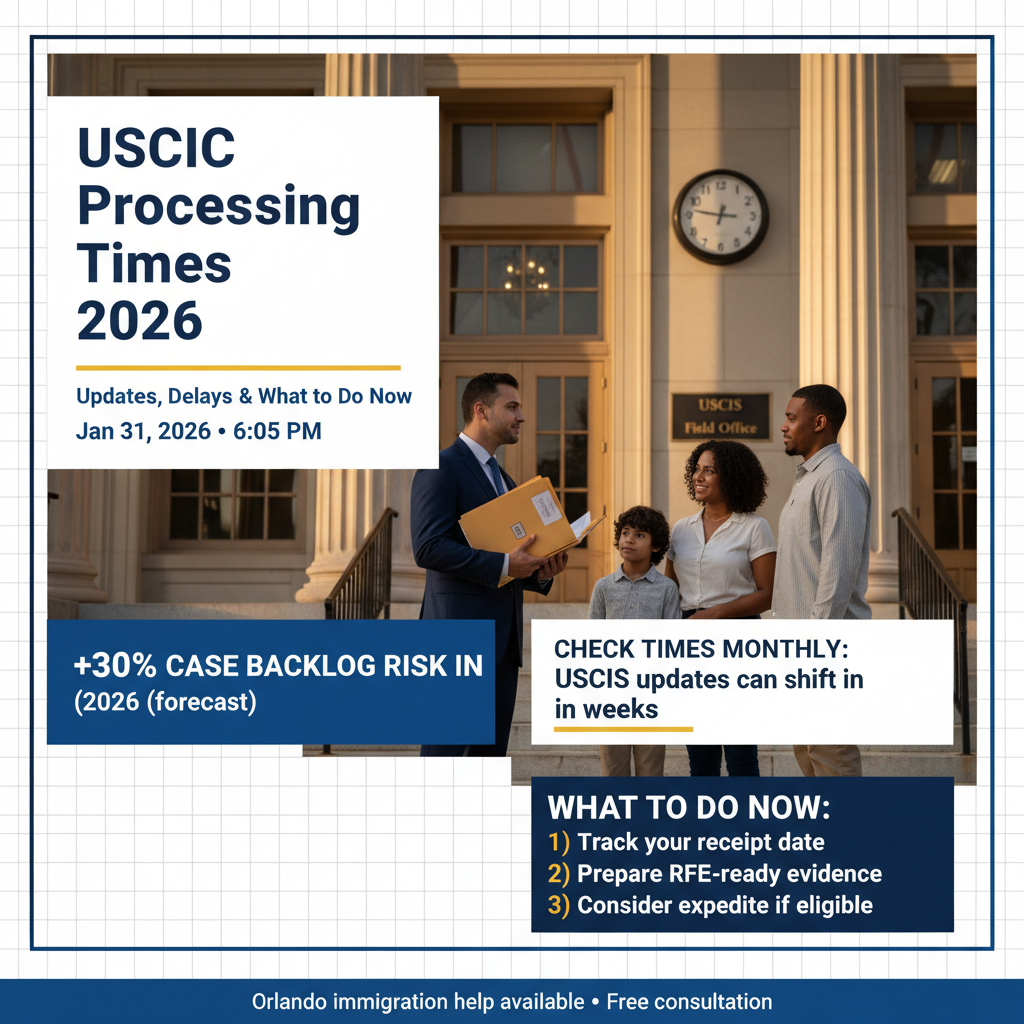
The reporting that sparked this guide: USCIS Processing Times and Updates for 2026 (USCIS)
Need Help? Our Orlando immigration team is ready to assist. Call +1 786-791-3106 for a free consultation, or message us online. Se Habla Español.
What This News Means for Immigrants in Orlando and Across Florida
Why this news is showing up now
USCIS processing times are always a major concern, but they are especially “newsworthy” heading into 2026 because families, workers, and employers are feeling the real-world impact of delays on: Adjustment of Status filings, work permits (EADs), travel permits (Advance Parole), green card renewals, naturalization, and humanitarian cases.
USCIS regularly updates its public processing-time tools and internal workflows. As filing volumes change, staffing levels shift, and new policy guidance is issued, the estimated timelines for common forms can move up or down. In 2026, many applicants are also watching:
- How quickly USCIS schedules biometrics and interviews
- Whether certain case types are being prioritized
- How online filing and digitization affect speed and accuracy
- How “case transfer” practices influence where your file is adjudicated
Important: “Processing time” is not a promise. It is an estimate based on recent completions at a specific USCIS office or service center. Two cases filed the same day can move at different speeds based on facts, background checks, requests for evidence, interview availability, and more.
How it can affect Florida residents
Florida residents often experience USCIS timelines differently depending on where the case is handled (service center vs. field office) and whether an interview is required. If your case is in Orlando, your application may be impacted by:
- Local interview capacity at The Orlando USCIS Field Office
- Population growth across Orange County and the I-4 corridor (Orlando–Kissimmee–Sanford)
- High demand for family-based immigration and naturalization
- Case transfers to other USCIS offices to balance workload
For Central Florida residents, delays can have practical consequences: expired driver’s licenses, gaps in employment authorization, postponed international travel, and prolonged family separation. Employers may also face compliance and staffing problems when EADs are delayed.
Reminder: If you are depending on an EAD or Advance Parole, plan early. Waiting until the last minute can create avoidable risk.
What USCIS Processing Times and Updates for 2026 Is (and Why It Matters)
A plain-English definition
“USCIS processing times” are USCIS’s public estimates of how long it is taking, on average, to complete certain immigration applications and petitions. These estimates are displayed by:
- Form type (example: Form I-130, Form I-485, Form N-400)
- Category (example: family-based, employment-based, asylum-based)
- Office handling the case (service center or field office)
USCIS updates these estimates periodically based on recently completed cases. The updates matter because they influence how applicants plan their lives, jobs, and travel—and whether they can take action when a case is delayed beyond normal timeframes.
Key terms you need to know
- Receipt Notice: The USCIS notice confirming your filing was received and giving you a receipt number.
- Biometrics: Fingerprints/photo/signature appointment used for identity and background checks.
- Request for Evidence (RFE): USCIS asks for additional documents before deciding your case.
- Notice of Intent to Deny (NOID): USCIS indicates it plans to deny unless you respond successfully.
- Interview: In-person (or sometimes remote) appointment, often required for Adjustment of Status and naturalization.
- Priority Date: The date that controls your place in line for certain immigrant visas (especially employment-based and some family categories). Your Priority Date interacts with the Visa Bulletin.
- Visa Bulletin: Department of State monthly chart showing visa availability by category and country.
- Case Outside Normal Processing Time: When your case is later than the posted USCIS timeframe and you can submit an inquiry.
Warning: A faster posted processing time does not guarantee your case will be faster. Security checks, missing documents, and interview backlogs can still cause delays.
Need Help? Our Orlando immigration team is ready to assist. Call +1 786-791-3106 for a free consultation, or message us online. Se Habla Español.
Current Immigration Law: The Foundation
USCIS processing times don’t exist in a vacuum. They are shaped by the legal framework that governs eligibility, evidence, interviews, background checks, and visa availability. The main laws and authorities include:
- The Immigration and Nationality Act (INA), including INA §§ 201–203 (visa allocation), INA § 245 (adjustment), INA § 316 (naturalization requirements), and INA § 204 (family/employment petitions).
- Federal regulations in Title 8 of the Code of Federal Regulations (8 C.F.R.), including rules for filings, interviews, and evidence.
- USCIS policy guidance and the USCIS Policy Manual.
You should always cross-check your case type with official resources like the USCIS official website and USCIS’s form instructions.
Federal requirements
Federal law generally requires USCIS to:
- Verify identity and conduct background/security checks
- Confirm eligibility under the correct statutory category
- Ensure the filing includes required evidence and fees
- Follow procedural requirements for RFEs/NOIDs
In practical terms, that means your filing quality can directly affect how quickly your case moves. Common forms that drive family and employment timelines include:
- Form I-130 (Petition for Alien Relative)
- Form I-485 (Application to Register Permanent Residence or Adjust Status)
- Form I-765 (Application for Employment Authorization)
- Form I-131 (Application for Travel Document / Advance Parole)
- Form I-864 (Affidavit of Support)
- Form N-400 (Application for Naturalization)
- Form I-751 (Remove Conditions on Residence)
- Form I-90 (Replace/Renew Green Card)
To confirm current editions and instructions, use USCIS Forms.
Florida-specific considerations
Immigration is federal law, but Florida-specific realities can influence your case strategy and timeline. For example:
- Document access: Some applicants in Florida may need extra time to obtain certified records from other states or countries.
- Mobility and address changes: Central Florida’s frequent moves (housing changes, seasonal work) can create missed USCIS notices if address updates are not filed promptly.
- Local interview availability: The Orlando USCIS Field Office interview calendar can affect how quickly Adjustment of Status and Form N-400 interviews are scheduled.
Reminder: If you move, you generally must update your address with USCIS promptly (often within 10 days under federal regulation). Missing a biometrics or interview notice can cause denials or closures.
For processing-time estimates and “outside normal time” inquiries, use: USCIS Processing Times.
How to Track and Respond to USCIS Processing Times in 2026: A Complete Step-by-Step Guide
The most effective way to deal with USCIS processing-time uncertainty in 2026 is to (1) track your case correctly, (2) proactively prevent delays, and (3) escalate appropriately when a case is truly stuck.
1) Identify your case type, form, and the office handling it
Start by confirming exactly what you filed and where it is being processed. Many applicants only know “I filed for my spouse” or “I filed for my work permit,” but the specific form and category matter.
- Required documents / information:
- USCIS receipt notice(s) (Form I-797C) with receipt number
- Copy of the full filing package (or at least the forms and supporting evidence list)
- USCIS online account access (if you created one)
- Any transfer notices (case moved to another office)
If your case is in Orlando and interview-based, the field office often matters more than the service center. If your case is service-center based (many Form I-130 and Form I-765 filings), the service center listed on your receipt or transfer notice is key.
2) Check the official USCIS processing-time tool the right way
Go to the official tool: USCIS Processing Times. Then select:
- Form type (example: Form I-485)
- Form category (example: family-based adjustment)
- Office (service center or field office)
- Required documents / information:
- Receipt number
- Form and category
- Office listed on receipt/transfer notice
- Date you filed
Important: USCIS often shows a range or a “case inquiry date.” That date is critical because it tells you when you can submit an “outside normal processing time” request.
3) Build a case timeline and anticipate the next milestone
Processing-time stress decreases when you map your case into milestones. A typical family-based Adjustment of Status might involve:
- Receipt notices (within weeks)
- Biometrics appointment
- EAD/Advance Parole (timelines vary)
- Interview scheduling at the local field office (often the biggest variable)
- Decision and green card production
- Required documents / information:
- Calendar of key dates (filing date, biometrics date, RFE deadlines)
- Copies of any USCIS notices
- Passport validity dates and travel needs
- Employment start dates (if job offer depends on EAD)
For cases that depend on visa availability (some family and most employment categories), also track the Department of State’s Visa Bulletin at U.S. Department of State. Your Priority Date may be the real “clock,” not just USCIS’s internal pace.
4) Prevent delays: submit a “decision-ready” package and respond fast to RFEs
In 2026, many delays still come from avoidable issues: missing translations, incomplete financial evidence, inconsistent addresses, or unclear relationship proof.
- Required documents / preparation checklist:
- Certified civil documents (birth/marriage/divorce certificates)
- Certified translations (if not in English)
- Proof of lawful entry (if applicable) and identity documents
- Proof of relationship for Form I-130 (photos, joint lease, joint bank, insurance, children’s birth certificates, affidavits)
- Financial sponsorship evidence for Form I-864 (tax returns, W-2s/1099s, pay stubs, employment letter)
- Medical exam timing strategy (when to submit Form I-693, if applicable under current USCIS guidance)
Warning: An RFE pauses the case. Late responses can lead to denial. Track every deadline and aim to respond well before the due date.
5) If your case is delayed, escalate in the correct order
When your case passes the “case inquiry date,” you can submit an online service request. If that fails, there are additional options depending on your situation.
- Required documents / information:
- Receipt number and filing date
- Evidence of urgency (job offer, medical need, family emergency)
- Copies of prior service requests and USCIS responses
- Any RFE/NOID response proof (delivery confirmation)
Possible escalation paths include:
- USCIS service request (outside normal processing time)
- InfoPass / field office appointment (limited availability; varies by office)
- Expedite request (requires qualifying criteria and evidence)
- Congressional inquiry through your U.S. Representative or Senator
- Ombudsman request (when appropriate)
If your case is in Orlando, sometimes delays relate to interview scheduling capacity. A well-documented inquiry—showing you are past normal time and have complied with all requests—can help move the file to review.
6) Prepare for interview or final adjudication (especially in Orlando)
For many applicants, the interview is the “make or break” step. Interview readiness can prevent post-interview delays and reduce the chance of an RFE or a second interview.
- Required documents for interview day (common examples):
- Government-issued photo IDs and passports
- Original civil documents (and certified translations)
- Updated relationship evidence (for marriage cases)
- Updated financial documents (recent pay stubs, employment letters)
- All USCIS notices and copies of what you filed
- If applicable: certified court dispositions for any arrests/charges
Important: The Orlando USCIS Field Office may ask for updated documents since filing, especially if many months have passed. Bring a well-organized binder and be prepared to explain any changes (address, job, travel, family).
7) If denied, act within the correct deadline and protect your status
A denial can have serious consequences depending on your current status and whether you are in removal proceedings. Some denials can be addressed through:
- Motions to reopen/reconsider
- Appeals (for certain forms)
- Refiling with corrected evidence
- Immigration court strategy if a Notice to Appear is issued
- Required documents / information:
- Denial notice (full copy)
- Complete filing history and evidence submitted
- Any RFE/NOID and your response
- Proof of current lawful status (if any) and I-94 records
Warning: Deadlines can be short and strict. Some motions must be filed within 30 days (or other specified time) depending on the form and decision type. Get legal advice quickly.
Need Help? Our Orlando immigration team is ready to assist. Call +1 786-791-3106 for a free consultation, or message us online. Se Habla Español.
Practical Steps You Can Take Today
Here is a practical, 2026-ready checklist to reduce delays and protect your ability to work, travel, and keep your family together.
- 1) Create (or update) your USCIS online account. Make sure you can receive electronic notices and upload responses when available.
- 2) Track your “case inquiry date” monthly. Use the official tool at USCIS Processing Times and save screenshots for your records.
- 3) Prepare an “RFE-ready” document folder. Keep updated pay stubs, bank statements, lease/mortgage, insurance, school records, and relationship evidence in one place.
- 4) Plan for renewals early. For many benefits, filing early avoids gaps. If an EAD is critical, don’t wait until the last minute.
- 5) Update USCIS after moving. Address issues are a top cause of missed biometrics/interviews. Update promptly and keep confirmation.
- 6) If you have travel needs, do not travel without authorization. Many applicants in Adjustment of Status need Advance Parole before leaving the U.S. (with limited exceptions).
- 7) If you have any arrest or court history, get certified dispositions now. Waiting can add months.
Timeline expectations in 2026: Every case is unique, but you should generally expect variability between service centers and field offices. For Central Florida residents, interview-based cases can feel slower if interview slots are limited. The best practice is to plan your life around ranges rather than single dates.
Reminder: If your application depends on visa availability, USCIS speed is only one factor. Your Priority Date and the Visa Bulletin can control when you can file or when USCIS can approve.
How Imigrar Helps Immigrants in Orlando
At Imigrar, our mission is to Keep Families Together. We help clients in Orlando, across Orange County, throughout Central Florida, and nationwide navigate USCIS processing times with a strategy that reduces delays and strengthens approvals.
Our team can help you:
- Confirm eligibility and choose the correct filing path (family, employment, humanitarian)
- Prepare “decision-ready” filings for Form I-130 and Form I-485 with strong evidence
- Develop an EAD/Advance Parole plan to avoid work and travel disruptions
- Respond to RFEs/NOIDs with organized, persuasive submissions
- Prepare for interviews at The Orlando USCIS Field Office
- Escalate delayed cases appropriately and ethically
We offer a free consultation. Call +1 786-791-3106 or message us online. Se Habla Español.
Frequently Asked Questions
Q: Can USCIS processing times in 2026 affect my eligibility for a green card?
A: Processing times usually don’t change “eligibility,” but they can affect outcomes if delays cause you to miss deadlines or lose supporting evidence. For example, if an RFE is issued and you miss the response deadline, USCIS can deny the case. Also, if you must maintain a separate nonimmigrant status while waiting, a long delay may increase the risk of falling out of status. Talk to a lawyer if your strategy depends on timing—especially with Adjustment of Status and employment-based cases tied to a job.
Q: Will a pending case protect my immigration status while USCIS is delayed?
A: It depends on what you filed and your current status. A pending Form I-485 can place you in a “period of authorized stay,” but it is not the same as having a valid nonimmigrant status. For many people, the pending adjustment application helps prevent unlawful presence from accruing, but it does not automatically give work authorization or travel permission. If you are unsure, get individualized advice because the consequences can be serious.
Q: How do I know if my case is outside normal processing time?
A: Use the official tool at USCIS Processing Times. Select your form, category, and office. USCIS will show a “case inquiry date.” If your receipt date is earlier than that inquiry date, you can generally submit an online inquiry. Keep copies of the results and your service request confirmation.
Q: What documents most commonly cause delays or RFEs?
A: Common RFE triggers include missing certified translations, incomplete financial sponsorship evidence for Form I-864, unclear relationship evidence for Form I-130, missing identity/entry documents, and missing certified court dispositions for any criminal or traffic-related arrests. A “decision-ready” packet with a table of contents and clear labeling can reduce delays.
Q: How much does it cost to file, and can delays increase total cost?
A: USCIS filing fees vary by form and can change, so always confirm on the USCIS official website. Delays can increase indirect costs—like needing additional document updates, new medical exams (if required), replacement documents, or extra legal work responding to RFEs. Planning early and filing correctly can reduce these extra expenses.
Q: What happens if USCIS denies my case after a long wait?
A: A denial can lead to loss of fees, the need to refile, or—depending on your status��possible enforcement consequences. Some denials allow a motion to reopen/reconsider or an appeal, but deadlines are strict. If you receive a denial, do not assume it is final without reviewing options. If you are in removal proceedings, your case may involve the immigration court system under the Executive Office for Immigration Review.
Q: If my case is in Orlando, can the local field office timeline be different from the USCIS website?
A: The USCIS tool already factors in the office you select, but real-life scheduling (especially interviews) can still vary. The Orlando USCIS Field Office may experience seasonal fluctuations and capacity constraints. If you are past the inquiry date, you can request action. If you are not past the inquiry date, focus on being interview-ready and keeping your documents updated.
Common Mistakes (and How to Avoid Them)
Mistake #1: Using the wrong processing-time office or category
Many applicants check the wrong office (service center instead of field office) or the wrong category. That can cause unnecessary panic—or false confidence. How to avoid it: Match the office to your receipt/transfer notice and select the correct category (family-based vs. employment-based, etc.).
Mistake #2: Waiting until the last minute to renew work authorization or travel permission
In 2026, even “normal” timelines can fluctuate. Waiting can create gaps in work authorization or missed travel. How to avoid it: Plan early, track expiration dates, and consult counsel about the best time to file. Keep a calendar and set reminders well ahead of deadlines like 180 days or any applicable 90-day window for specific filings.
Mistake #3: Ignoring address changes and missing notices
Missed biometrics or interview appointments can lead to denial or closure. How to avoid it: Update your address promptly, keep proof, and monitor both mail and your USCIS online account. For Central Florida residents who move along the I-4 corridor, this is especially important.
Need Help? Our Orlando immigration team is ready to assist. Call +1 786-791-3106 for a free consultation, or message us online. Se Habla Español.
Official Resources to Monitor in 2026
Use official sources to avoid misinformation and scams:
- USCIS official website (policy updates, account access, case tools)
- USCIS Processing Times (office-specific estimates and inquiry dates)
- USCIS Forms (current editions, instructions, filing addresses)
- U.S. Department of State (Visa Bulletin and consular processing guidance)
- Executive Office for Immigration Review (immigration court information if applicable)
Warning: Be cautious about unofficial “guaranteed approval” services or paid expediting offers. USCIS decisions are based on law and evidence, not shortcuts.

Closing: What to Do Next If You’re Worried About USCIS Timelines
USCIS processing times in 2026 may continue to shift, but you still have control over the most important factors: filing accuracy, evidence strength, deadline management, and smart escalation when your case is truly outside normal time.
If your case is in Orlando—or anywhere in Florida—and delays are affecting your ability to work, travel, or keep your family together, get a plan tailored to your facts.
Need Help? Our Orlando immigration team is ready to assist. Call +1 786-791-3106 for a free consultation, or message us online. Se Habla Español.


