


The journey to securing immigration benefits in the United States often involves a significant waiting period. For immigrants and their families in Orlando, Central Florida, and across the nation, understanding and navigating USCIS processing times is crucial for effective planning and managing expectations. As we move further into 2026, the U.S. Citizenship and Immigration Services (USCIS) continues to update its processing time estimates, reflecting evolving caseloads, policy adjustments, and operational efficiencies.
At Imigrar, an immigration law firm based in Orlando, Florida, our mission is to "Keep Families Together." We understand the anxiety and uncertainty that come with long processing times. This comprehensive guide provides you with the latest insights into USCIS processing times for 2026, offering practical advice, step-by-step instructions, and expert guidance to help you through your immigration journey.
Need Help? Our Orlando immigration team is ready to assist. Call +1 786-791-3106 for a free consultation, or message us online. Se Habla Español.
The reporting that sparked this guide:
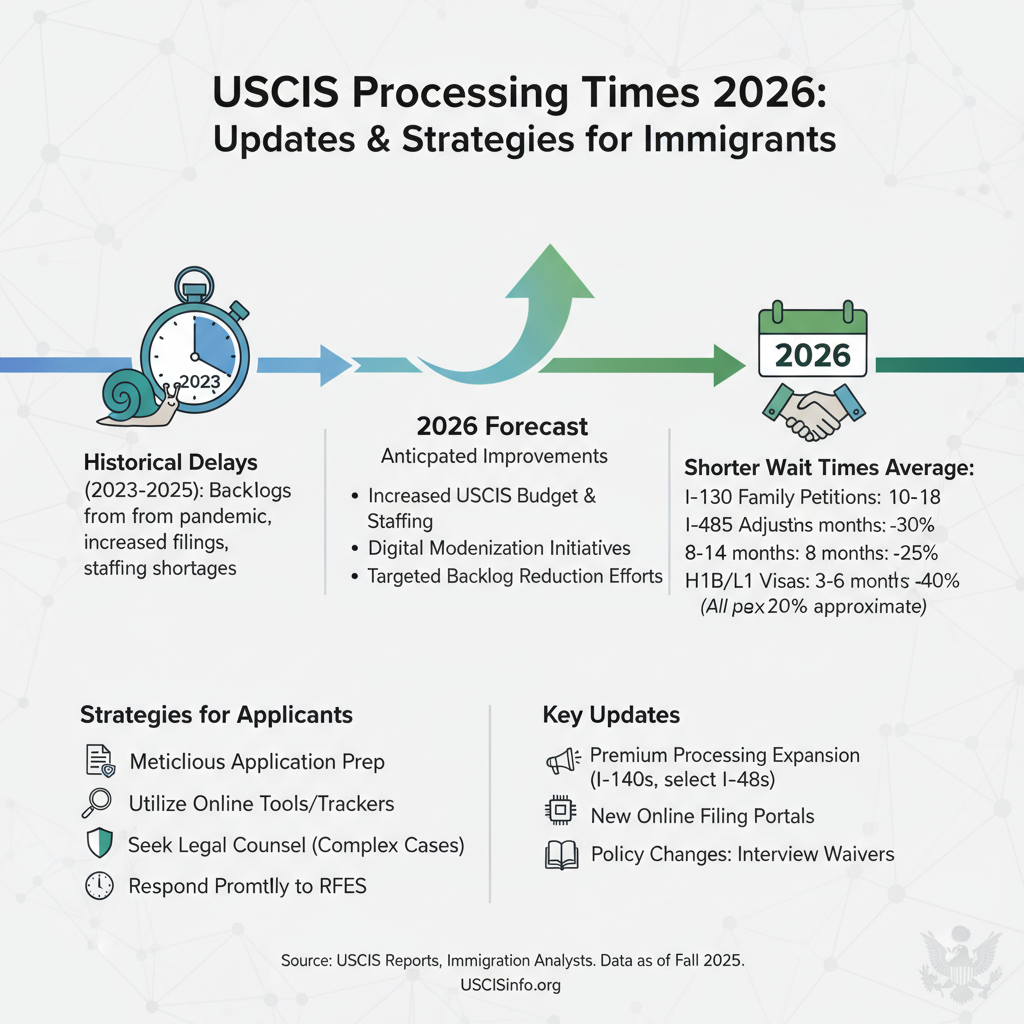
USCIS Processing Times and Updates for 2026 (USCIS)
What This News Means for Immigrants in Orlando and Across Florida
The continuous updates to USCIS processing times are more than just numbers; they are a direct reflection of the ongoing challenges and efforts within the U.S. immigration system. For individuals and families in Orlando and throughout Florida, these updates can significantly impact life plans, employment opportunities, and family reunification goals.
Why this news is showing up now
USCIS regularly updates its processing times, typically on a monthly basis, to reflect the most current data on how long it's taking to process various forms at different service centers and field offices. The "news" around processing times is a constant, dynamic narrative because the factors influencing these times are constantly shifting. For 2026, these updates are particularly critical as USCIS continues to address backlogs accumulated during the pandemic, adapt to new technological implementations, and respond to fluctuating application volumes. Economic shifts, legislative proposals, and even global events can all play a role in how quickly or slowly applications are processed. Therefore, staying informed is not a one-time check but an ongoing process.
How it can affect Florida residents
Florida, with its large and diverse immigrant population, is uniquely sensitive to changes in USCIS processing times. Here's how these updates can specifically impact residents:
- Family Reunification: For families in Orlando and Central Florida sponsoring relatives, longer processing times for forms like Form I-130 (Petition for Alien Relative) mean extended periods of separation from loved ones, often for years.
- Employment Stability: Individuals waiting for work permits (Form I-765) or employment-based green cards may face job insecurity, delayed promotions, or even loss of employment if their authorizations expire before renewals are processed. This is a significant concern for professionals working along the I-4 corridor.
- Travel Restrictions: Delays in advance parole documents (Form I-131) can prevent individuals from traveling internationally to visit sick family members or attend important events, creating immense personal hardship.
- Naturalization Delays: Those seeking U.S. citizenship via Form N-400 may experience prolonged waits for interviews and oath ceremonies, postponing their ability to vote or fully participate as citizens.
- Local Field Office Impact: The Orlando USCIS Field Office handles interviews for many adjustment of status and naturalization cases. National trends in processing times often correlate with local office caseloads, meaning longer waits for interviews in Orange County and surrounding areas.
- Planning Uncertainty: Businesses and individuals alike struggle with planning when immigration timelines are unpredictable. This affects everything from hiring decisions to personal financial investments.
Understanding these impacts is the first step in preparing for your immigration journey. Imigrar is here to provide clarity and strategic guidance every step of the way.
What USCIS Processing Times Are (and Why It Matters)
At its core, "USCIS processing times" refers to the estimated period it takes for USCIS to process and make a decision on an immigration application or petition. It's a critical metric for anyone navigating the U.S. immigration system, providing a general idea of how long one might expect to wait from the date an application is received until a final decision is made.
A plain-English definition
Think of USCIS processing times as a speedometer for your immigration case. It tells you the average speed at which USCIS is moving through similar applications. It's not a guarantee, but an estimate based on historical data – specifically, how long it took to complete 80% of cases adjudicated in the past few months. These times vary significantly depending on the type of form (e.g., green card, work permit, citizenship), the specific USCIS service center or field office handling the case, and numerous other factors.
Why do they matter? Because these estimates dictate the pace of your life. They determine when you can start a new job, when you can travel, when your family can be reunited, or when you can finally become a U.S. citizen. Delays can mean lost opportunities, increased stress, and prolonged separation from loved ones. Monitoring these times is essential for managing expectations and knowing when it's appropriate to inquire about a delayed case.
Key terms you need to know
Navigating USCIS processing times requires understanding specific terminology:
- Receipt Date: The date USCIS officially receives your application or petition. This is usually the starting point for calculating your processing time. You'll find this on your Form I-797C, Notice of Action.
- Notice Date: The date USCIS issues a notice regarding your case, such as a receipt notice, an RFE, or an approval.
- Priority Date: For certain visa categories (primarily family-sponsored and employment-based categories subject to annual limits), this is the date your petition was filed. It determines your place in the visa queue and when you become eligible for a green card. You must have a current Priority Date according to the U.S. Visa Bulletin before you can file for **Adjustment of Status** or receive an immigrant visa.
- Case Status Online: An online tool on the USCIS website where you can enter your 13-digit receipt number to check the current status of your application.
- Service Request: A formal inquiry submitted to USCIS when your case is taking longer than the posted processing times for your specific form and office.
- Adjudication: The process by which USCIS reviews an application and makes a decision (approval, denial, Request for Evidence).
- Field Office vs. Service Center: Service Centers (e.g., California, Nebraska, Texas, Vermont) typically handle mailed applications and petitions that don't require an interview. Field Offices (like the Orlando USCIS Field Office) handle interviews for applications such as Adjustment of Status (Form I-485) and Naturalization (Form N-400), as well as other local services. Processing times can differ significantly between these locations.
- Adjustment of Status (AOS): The process of applying for a green card while you are physically present in the United States. This typically involves filing Form I-485.
- Consular Processing: The process of applying for an immigrant visa at a U.S. embassy or consulate abroad to come to the U.S. as a lawful permanent resident.
- Biometrics Appointment: An appointment at an Application Support Center (ASC) where USCIS collects fingerprints, photos, and a signature to conduct background checks. This is a common step in many immigration processes.
Current Immigration Law: The Foundation for Processing Times
While processing times are administrative estimates, they are inherently tied to the underlying federal immigration laws that govern eligibility and procedures. The framework for U.S. immigration is primarily established by the Immigration and Nationality Act (INA), alongside various regulations, presidential proclamations, and judicial decisions.
Federal requirements
Every immigration application, from a simple work permit renewal to a complex green card petition, must meet specific federal requirements outlined in the INA and its accompanying regulations. These requirements dictate who is eligible for which benefit, what evidence must be provided, and the procedural steps that USCIS must follow. For instance:
- Family-Based Immigration: Sections of the INA, particularly INA § 201-204, define family relationships that qualify for sponsorship (e.g., U.S. citizens sponsoring spouses, children, parents, or siblings; lawful permanent residents sponsoring spouses and unmarried children). Processing times for Form I-130 are heavily influenced by the visa category, the country of origin, and the annual visa limits (quotas).
- Employment-Based Immigration: INA § 203(b) outlines categories for employment-based visas, requiring employers to demonstrate a need for foreign workers and often necessitating a labor certification from the Department of Labor.
- Adjustment of Status: INA § 245 sets forth the general conditions for Adjustment of Status (filing Form I-485), including requirements for lawful entry, maintaining status, and being admissible to the U.S.
- Naturalization: INA § 316 and INA § 319 detail the eligibility criteria for becoming a U.S. citizen, such as continuous residence, physical presence, good moral character, and English/civics knowledge. The processing of Form N-400 depends on meeting these stringent requirements.
Any changes in federal policy, such as new regulations regarding public charge, changes in interview requirements, or shifts in national security priorities, can directly impact the complexity of case review and, consequently, the processing times.
Florida-specific considerations
It's important to clarify that immigration law itself is federal; there are no "Florida-specific immigration laws" that dictate processing times. However, the operational realities of immigration in Florida can influence how federal processing times are experienced locally:
- Orlando USCIS Field Office: This office, located at 5448 Hoffner Ave, Orlando, FL 32812, serves a significant portion of Central Florida. Its caseload volume for interviews (for Form I-485 and Form N-400) and local inquiries can lead to localized variations in processing times compared to national averages or other field offices. For instance, if the Orlando office is experiencing a surge in filings or staffing shortages, its interview scheduling might lag behind other regions.
- High Volume of Cases: Florida is one of the states with the largest immigrant populations. This high volume of applications and petitions submitted from Florida residents to various service centers and the local field office can contribute to longer processing queues.
- Diverse Caseload: The diversity of Florida's immigrant communities means the Orlando office handles a wide array of case types, from Cuban Adjustment Act cases to family petitions from Latin America and beyond, each with its own processing nuances.
While the laws are federal, the practical implementation and the local administrative burden can create unique challenges for immigrants in Orlando, Orange County, and the broader Florida area. Always refer to the official USCIS official website for the most accurate and up-to-date information on forms and requirements.
Need Help? Our Orlando immigration team is ready to assist. Call +1 786-791-3106 for a free consultation, or message us online. Se Habla Español.
How to Track and Understand Your USCIS Case: A Complete Step-by-Step Guide
Staying informed about the status of your immigration application is crucial. While waiting can be frustrating, knowing how to accurately track your case and interpret USCIS processing times empowers you to plan and take action when necessary.
1) Understand Your Application Type and Relevant Processing Center
Before you can track anything, you need to know what you've filed and where it's being processed. Different forms are handled by different USCIS Service Centers (e.g., California, Nebraska, Texas, Vermont) or local Field Offices (like the Orlando USCIS Field Office). Your receipt notice (Form I-797C) will indicate which center is handling your case.
- Common Forms and Their Initial Processing Locations:
- Form I-130 (Petition for Alien Relative): Often processed at Nebraska, Texas, or California Service Centers, depending on the petitioner's residence.
- Form I-485 (Application to Register Permanent Residence or Adjust Status): Often initially processed at National Benefits Center (NBC), then transferred to a local Field Office (e.g., Orlando) for interview.
- Form I-765 (Application for Employment Authorization): Generally processed at the Service Center handling your primary application (e.g., I-485) or a dedicated center.
- Form I-131 (Application for Travel Document - Advance Parole): Often processed alongside Form I-485 at NBC or a Service Center.
- Form N-400 (Application for Naturalization): Typically processed by the local Field Office (Orlando for Central Florida residents) after an initial review at a Service Center.
2) Locate Your Receipt Number and Check USCIS Online Case Status
Once your application is filed, USCIS sends a Receipt Notice (Form I-797C). This notice contains your unique 13-character receipt number, which is essential for tracking your case online. The receipt number usually starts with three letters (e.g., EAC, WAC, LIN, SRC, NBC, IOE), followed by 10 numbers.
- How to Use the Online Tool:
- Visit the USCIS Case Status Online page.
- Enter your 13-character receipt number exactly as it appears on your notice.
- Click "Check Status."
3) Navigate the Official USCIS Processing Times Tool
This is where you can compare your case's progress against USCIS's published estimates.
- Steps to Check Processing Times:
- Go to the official USCIS Processing Times page.
- Select the Form you filed (e.g., I-485, Application to Register Permanent Residence or Adjust Status).
- Select the Form Category (e.g., "Family-based adjustment applicants").
- Select the Field Office or Service Center that is processing your case. For many adjustment of status and naturalization cases in Central Florida, this will be the "Orlando Field Office." For other forms, it might be "National Benefits Center," "California Service Center," etc.
- Click "Get processing time."
- Interpreting the Results: USCIS provides a range (e.g., "8 Months to 10.5 Months"). This means that 80% of cases for that form type at that location are completed within that timeframe, starting from the Receipt Date. Your case could be faster or slower.
4) Understand Your "Inquiry Date" and When to Contact USCIS
The processing times tool will also indicate an "estimated case completion date" or an "inquiry date." This is the earliest date you can formally inquire about your case if it is taking longer than the posted processing times. Do not contact USCIS before this date unless there's an emergency or specific instruction.
- How to Submit an "Outside Normal Processing Time" Inquiry:
- Once your Receipt Date has passed the "inquiry date" shown on the USCIS processing times page, you can submit an e-Request online via the USCIS e-Request portal.
- Provide your receipt number and details of your application.
- USCIS will typically respond within a few weeks, providing an update or explaining the delay. Important: Submitting an inquiry does not guarantee faster processing, but it prompts USCIS to review your case.
5) Prepare for Potential Biometrics, Interviews, and RFEs
During the processing period, you may receive notices for specific actions:
- Biometrics Appointment: You'll receive a notice (Form I-797C) with a date, time, and location (often an Application Support Center, ASC). Bring the notice and a valid photo ID.
- Request for Evidence (RFE): USCIS may send an RFE if they need more information or documents to make a decision. Respond promptly and thoroughly by the deadline specified in the notice.
- Interview: For applications like Adjustment of Status (Form I-485) or Naturalization (Form N-400), an interview at your local Field Office (e.g., Orlando) is often required. You'll receive a notice with the date, time, and a list of documents to bring.
- Required Documents for Interview (General): Original versions of all documents submitted with your application, including birth certificates, marriage certificates, passports, financial documents, and any RFE responses.
6) Consider Legal Assistance for Complex or Delayed Cases
If your case is severely delayed, you've received an RFE you don't understand, or you face an interview, consulting an experienced immigration attorney is highly recommended. An attorney can:
- Help you understand the reasons for delays and available remedies.
- Respond to RFEs effectively.
- Prepare you for interviews and attend with you.
- File a Writ of Mandamus in federal court if USCIS fails to act on your case after an unreasonable delay.

Practical Steps You Can Take Today
While you cannot directly control USCIS processing times, there are many proactive steps you can take to ensure your case proceeds as smoothly and efficiently as possible. These actions can help prevent unnecessary delays and position your application for success.
Actionable Checklist for Immigrants in Orlando and Beyond:
- Double-check all forms for accuracy and completeness before


