


The journey through the U.S. immigration system can often feel like navigating a complex maze, with one of the most significant challenges being the unpredictable nature of application processing times. As we move further into 2026, the United States Citizenship and Immigration Services (USCIS) continues to release updated processing timelines for various immigration forms and petitions. For immigrants in Orlando, across Florida, and nationwide, understanding these updates is crucial for planning your future and managing expectations.
At Imigrar, an immigration law firm based in Orlando, Florida, our mission is to "Keep Families Together." We understand the anxiety and uncertainty that come with waiting for a decision on your immigration case. This comprehensive guide aims to demystify USCIS processing times, explain the latest updates for 2026, and provide you with actionable steps to navigate your immigration journey effectively.
Need Help? Our Orlando immigration team is ready to assist. Call +1 786-791-3106 for a free consultation, or message us online. Se Habla Español.
The reporting that sparked this guide:
USCIS Processing Times and Updates for 2026 (USCIS)
What This News Means for Immigrants in Orlando and Across Florida
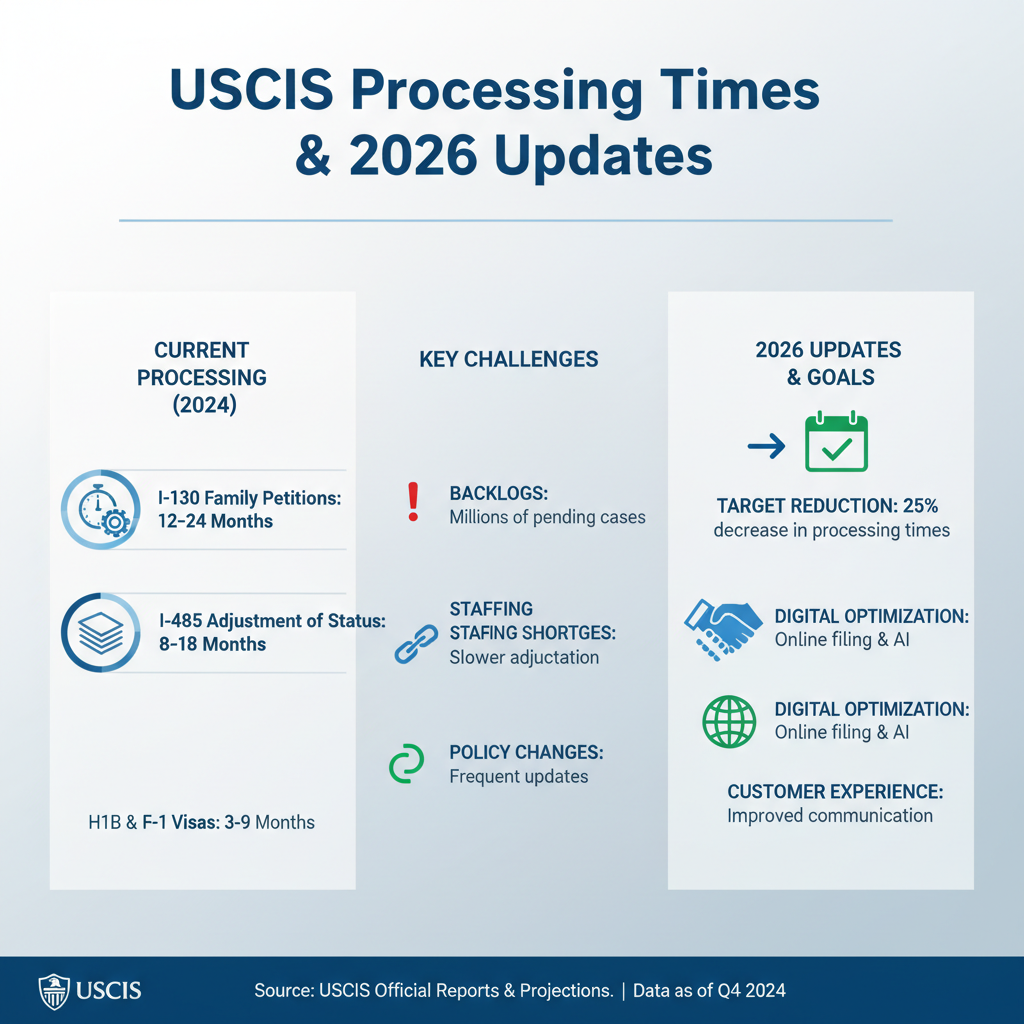
The regular updates to USCIS processing times are more than just numbers on a website; they are critical indicators that directly impact the lives and plans of hundreds of thousands of individuals and families. For those seeking to reunite with loved ones, pursue employment opportunities, or become U.S. citizens, these timelines dictate the pace of their dreams.
Why this news is showing up now
USCIS, the federal agency responsible for processing most immigration benefits, operates under immense pressure, balancing high application volumes with resource constraints and evolving policy directives. Updates to processing times are a continuous effort by the agency to provide transparency and manage public expectations. In 2026, these updates reflect a combination of factors:
- Caseload Fluctuations: The sheer volume of new applications and petitions filed directly impacts how quickly USCIS can process them. Changes in global events, economic conditions, and legislative actions can cause significant spikes or dips in filings.
- Staffing and Budget: USCIS's ability to process cases is heavily dependent on its workforce and funding. Increases or decreases in staffing levels, as well as budget allocations, directly correlate with processing efficiency.
- Technological Advancements: USCIS continues to invest in modernizing its systems. While initially, these transitions might cause minor disruptions, the long-term goal is to streamline operations and potentially reduce processing times.
- Policy Adjustments: New immigration policies or changes in existing regulations can necessitate adjustments in processing protocols, which can temporarily affect timelines.
- Strategic Goals for 2026: USCIS often sets internal goals for efficiency and backlogs. The 2026 updates are likely part of their ongoing efforts to meet these targets, reduce backlogs, and improve customer service.
How it can affect Florida residents
Florida is a vibrant hub for immigrants from across the globe, with a significant concentration of diverse communities. The impact of USCIS processing times on Florida residents is profound:
- Orlando USCIS Field Office: For individuals living in Orlando and Central Florida, the local USCIS Field Office handles interviews for Adjustment of Status (Form I-485), naturalization (Form N-400), and other local services. Processing times at this specific office are crucial for local applicants. Delays here can mean longer waits for interviews, green cards, and citizenship ceremonies.
- Economic Impact: Delays in employment-based petitions (like Form I-140 or Form I-765 for work authorization) can affect Florida's economy, impacting businesses that rely on immigrant workers and individuals who need to work to support their families in Orange County and beyond.
- Family Reunification: For the many families along the I-4 corridor and throughout Florida who are awaiting approval of family-based petitions (e.g., Form I-130, Form I-485), extended processing times can mean prolonged separation or uncertainty about their future together.
- Legal Planning: Attorneys at Imigrar use these updated processing times to advise clients on realistic expectations, plan for potential extensions of status, and prepare for any necessary follow-up actions.
- Community Well-being: The emotional toll of long waits can be substantial. Understanding the current landscape helps manage stress and allows individuals to plan their lives more effectively, even if it means preparing for a longer wait.
What USCIS Processing Times Are (and Why It Matters)
At its core, understanding USCIS processing times is about managing expectations and making informed decisions about your immigration journey. These times are not merely statistics; they are a direct reflection of how long you can expect to wait for a decision on your application or petition.
A plain-English definition
USCIS processing times represent the estimated period it takes for the agency to process a particular type of application or petition from the date it is received until a decision is made. These times are not fixed guarantees but rather averages or ranges based on historical data. They are typically calculated as the time it took to process 80% of completed cases over the past six months for a specific form type at a specific service center or field office. The "processing time" you see is often a median or an 80th percentile estimate.
Important: Your individual case might be processed faster or slower than the posted times due to various factors unique to your application, such as the completeness of your documentation, complexity of your case, or responses to Requests for Evidence (RFEs).
Key terms you need to know
Navigating USCIS processing times requires familiarity with several key terms:
- Receipt Date: This is the date USCIS officially received your application or petition. You'll find this date on your Form I-797C, Notice of Action. Your processing time begins from this date.
- Priority Date: Primarily relevant for family-sponsored and employment-based immigrant visas that are subject to annual quotas. The Priority Date is usually the date USCIS receives your Form I-130 or Form I-140. Your green card application (Form I-485 or consular processing) cannot be approved until your Priority Date becomes "current" according to the Department of State's Visa Bulletin.
- Current Date: Refers to when a specific Priority Date becomes available for a green card application based on your preference category and country of chargeability.
- Notice of Action (Form I-797): This official document from USCIS confirms receipt of your application, provides your Receipt Number, and may contain other important information such as appointment notices or approvals.
- Service Center: USCIS has several service centers (e.g., California, Nebraska, Texas, Vermont) that process mail-in applications for specific form types. The service center assigned to your case depends on the type of form and your geographic location.
- Field Office: Local USCIS offices (like the Orlando USCIS Field Office) handle interviews for applications such as Adjustment of Status (Form I-485), naturalization (Form N-400), and provide other in-person services.
- Adjustment of Status: The process by which an eligible immigrant already in the U.S. can apply for permanent resident status (a green card) without having to return to their home country for visa processing. This typically involves filing Form I-485.
- Consular Processing: The process by which an eligible immigrant living outside the U.S. applies for an immigrant visa at a U.S. embassy or consulate in their home country. Once approved, they enter the U.S. as a permanent resident.
- Request for Evidence (RFE): A notice from USCIS asking for additional documents or information to support your application. Responding promptly and completely to an RFE is critical to avoid delays or denial.
- Notice of Intent to Deny (NOID): A notice from USCIS indicating their intent to deny your application unless you provide additional information or clarification within a specified timeframe.
Need Help? Our Orlando immigration team is ready to assist. Call +1 786-791-3106 for a free consultation, or message us online. Se Habla Español.
Current Immigration Law: The Foundation of Processing Times
USCIS processing times are not arbitrary; they are governed by a complex framework of federal immigration laws and regulations. The Immigration and Nationality Act (INA) is the primary body of law that dictates eligibility requirements, visa categories, and the overall structure of the U.S. immigration system. Understanding this foundation helps to grasp why some applications take longer than others.
Federal requirements
The INA sets forth the fundamental requirements for various immigration benefits. For example, it defines the annual numerical limitations (quotas) for most family-sponsored and employment-based immigrant visas. These quotas mean that even if you are eligible, you might have to wait years for a visa to become available, regardless of how quickly USCIS processes your initial petition. This is where your Priority Date becomes critical, as mentioned earlier.
Key federal statutes and administrative procedures that influence processing times include:
- Immigration and Nationality Act (INA): The overarching law that establishes the categories of immigrants, nonimmigrants, grounds of inadmissibility, and procedures for obtaining immigration benefits.
- Administrative Procedure Act (APA): While not specific to immigration, the APA governs how federal agencies develop and issue regulations, which can impact how USCIS processes applications.
- Mandates for Efficiency: Congress often includes provisions in appropriations bills or other legislation that encourage or mandate USCIS to improve efficiency and reduce backlogs.
- Fee Structure: USCIS is largely fee-funded. The fees collected for applications fund the agency's operations, including staffing and technology. Changes in fee structures can impact resource availability.
Common forms and their associated legal frameworks:
- Form I-130, Petition for Alien Relative: Governed by INA sections related to family-sponsored immigration (e.g., INA §201, §203). Processing times depend heavily on the visa category (immediate relative vs. preference categories) and the applicable Priority Date.
- Form I-485, Application to Register Permanent Residence or Adjust Status: Governed by INA §245. This form can only be approved if a visa is immediately available (for immediate relatives) or if the applicant's Priority Date is current (for preference categories).
- Form I-765, Application for Employment Authorization: Governed by INA §274A and regulations outlining eligibility for work permits. Delays here can prevent individuals from working legally.
- Form I-140, Immigrant Petition for Alien Worker: Governed by INA §203(b) for employment-based immigration. Processing often depends on the specific preference category (EB-1, EB-2, EB-3, etc.).
- Form N-400, Application for Naturalization: Governed by INA §310-337, outlining eligibility requirements for U.S. citizenship.
You can always find the most up-to-date information on forms and legal requirements directly on the USCIS official website.
Florida-specific considerations
While federal law dictates the overall framework, the high volume of immigration applications originating from Florida can have localized impacts on processing times. Florida is home to a significant immigrant population, particularly from Latin America and the Caribbean, leading to a high caseload for local USCIS offices and the national service centers that process applications from this region.
- Orlando USCIS Field Office Caseload: The Orlando office, serving a large portion of Central Florida including Orange County, Seminole County, and Osceola County, processes a substantial number of interviews for Form I-485 and Form N-400. High demand can lead to longer wait times for interview scheduling compared to less populated areas.
- Language Access: Due to Florida's diverse population, there's a greater demand for services in multiple languages, especially Spanish. USCIS provides resources for non-English speakers, but this demographic factor is a consideration in local processing. Imigrar proudly offers services in both English and Spanish (Se Habla Español) to meet this need.
- State-level Support Services: While Florida does not have its own immigration laws affecting federal processing, various state and local organizations (including non-profits and legal aid groups) provide support to immigrants, which can indirectly help in preparing complete applications and reducing potential delays.
Reminder: No state laws can supersede federal immigration law or directly alter USCIS processing times. However, local resources and the volume of local applications are factors.
How to Check Your USCIS Processing Times: A Complete Step-by-Step Guide
Understanding where your application stands is crucial. USCIS provides an online tool to check processing times, but interpreting the information correctly is key.
1) Understand Where to Find Official Processing Times
Always rely on the official USCIS website for processing times. Unofficial sources may provide outdated or inaccurate information. The dedicated page for processing times is your go-to resource.
- Action: Bookmark the official USCIS Processing Times page.
2) Identify Your Application Type and Service Center/Field Office
Before you can check, you need to know two critical pieces of information from your Form I-797C, Notice of Action:
- Form Type: The specific USCIS form number you filed (e.g., Form I-130, Form I-485, Form I-765, Form N-400).
- Service Center or Field Office: The USCIS Service Center (e.g., Nebraska, Texas) or Field Office (e.g., Orlando) that is processing your application. This is usually indicated by the first three letters of your Receipt Number (e.g., "LIN" for Nebraska Service Center, "SRC" for Texas Service Center, "ORL" for Orlando Field Office).
- Required Documents: Your Form I-797C, Notice of Action (Receipt Notice) is essential.
3) Navigate the USCIS Processing Times Tool
Once you have the necessary information, go to the USCIS Processing Times page:
- Step 1: Select the "Form" type from the first dropdown menu (e.g., "I-485 - Application to Register Permanent Residence or Adjust Status").
- Step 2: Select the "Field Office or Service Center" from the second dropdown menu (e.g., "Orlando Field Office" or "Nebraska Service Center").
- Step 3: Click "Get processing time."
4) Interpret the Data: What the Numbers Mean for You
The results page will display a range of months (e.g., "6.5 Months to 10 Months"). This range typically represents the time it took for USCIS to complete 80% of similar cases. It might also show a "Case Inquiry Date," which is the date you can inquire about your case if it has exceeded normal processing times.
- Example: If the posted time for your Form I-485 at the Orlando Field Office is "10 Months to 16.5 Months," and your Receipt Date is February 14, 2025, you can expect a decision sometime between December 2025 and June 2026.
- Case Inquiry Date: If the tool shows a "Case Inquiry Date" of July 1, 2025, and your Receipt Date is before that, you may be eligible to submit an "Outside Normal Processing Times" inquiry.
- Required Information: Your Receipt Date from your Form I-797C.
5) Track Your Case Status Regularly
While the processing times tool gives you an estimate, tracking your individual case status provides real-time updates on its progress. You will need your Receipt Number.
- Action: Visit the USCIS Case Status Online page.
- Step 1: Enter your 13-character Receipt Number (e.g., "LIN2600012345").
- Step 2: Click "Check Status."
- What you'll see: Updates like "Case Was Received," "Request for Evidence Sent," "Interview Was Scheduled," or "Card Was Produced."
- Required Information: Your Receipt Number.
6) Know When and How to Submit an "Outside Normal Processing Times" Inquiry
If your case has been pending longer than the posted processing times (i.e., your Receipt Date is earlier than the "Case Inquiry Date" listed for your form and office), you may be able to submit an inquiry.
- Action: Go to the USCIS e-Request page.
- Step 1: Select "Case outside normal processing time."
- Step 2: Fill out the required information, including your Receipt Number, form type, and Receipt Date.
- What to expect: USCIS will review your inquiry and usually respond within 30 days, often with an update on your case or an explanation for the delay. This inquiry is not a guarantee of immediate action but can sometimes prompt movement on stalled cases.
- Required Information: Your Receipt Number, form type, Receipt Date, and personal details.
Need Help? Our Orlando immigration team is ready to assist. Call +1 786-791-3106 for a free consultation, or message us online. Se Habla Español.

Practical Steps You Can Take Today to Navigate Processing Times
While you cannot directly control USCIS processing times, you can take proactive steps to ensure your application is as strong as possible and to manage the waiting period effectively. These actions can help prevent unnecessary delays and keep your case moving forward.
Actionable Checklist:
- Consult with an Experienced Immigration Attorney: This is arguably the most crucial step. An attorney from Imigrar can help you understand the latest 2026 updates, prepare a complete and accurate application, and guide you through any challenges.
- Gather and Organize All Required Documents Meticulously: Missing or incorrect documents are a primary cause of delays. Use the USCIS checklist for your specific form and organize everything clearly.
- Keep Copies of Everything: Maintain a complete file of your entire application, including all forms, supporting documents, and USCIS notices.
- Respond to RFEs and NOIDs Promptly and Thoroughly: If you receive a Request for Evidence (RFE) or a Notice of Intent to Deny (NOID), address it immediately. These notices typically come with strict deadlines (e.g., 87 days to respond).
- Update Your Address with USCIS: If you move, promptly file Form AR-11, Alien's Change of Address Card, online and update your address for any pending applications. Failure to do so can result in missed notices and case abandonment.
- Monitor Your Case Status Online Regularly: Use the USCIS Case Status Online tool to track your application's progress.
- Be Prepared for Interviews: For applications like Adjustment of Status (Form I-485) or Naturalization (Form N-400), prepare thoroughly for your interview. Review your application, understand the questions, and bring all original documents requested.
- Maintain Your Underlying Status (if applicable): If you are applying for Adjustment of Status while on a nonimmigrant visa (e.g., H-1B, F-1), ensure you maintain your legal status until your Adjustment of Status is approved, or until your separate Form I-765 (Employment Authorization Document) or Form I-131 (Advance Parole) is approved, if applicable.
- Manage Expectations: Immigration processes can be lengthy. While frustrating, patience is key. Focus on what you can control.
Document preparation guidance
The quality and completeness of your documentation significantly impact your processing time. Here’s how to ensure your documents are in order:
- Follow Instructions Exactly: Each USCIS form comes with specific instructions. Read them thoroughly and follow every detail, including how to assemble your petition.
- Provide All Supporting Evidence: Do not omit any requested documents. If a document doesn't apply to you, explain why in a cover letter.
- Certified Translations: Any document not in English must be accompanied by a complete English translation certified by a translator as accurate and competent.
- Legible


