

The journey through the U.S. immigration system is often marked by anticipation and, at times, considerable waiting. For individuals and families in Orlando, across Florida, and throughout the nation, understanding USCIS processing times is not just a matter of curiosity—it's crucial for planning lives, careers, and futures. As we move further into 2026, the United States Citizenship and Immigration Services (USCIS) continues to update its processing time estimates, reflecting evolving operational capacities, policy adjustments, and application volumes. These updates can significantly impact your immigration path, whether you’re applying for a family-based green card, employment authorization, or naturalization.
At Imigrar, an immigration law firm based in Orlando, Florida, we understand the profound importance of these updates. Our mission is to "Keep Families Together," and that means providing clear, accurate, and actionable information to help you navigate these complex processes. This comprehensive guide will break down the latest USCIS processing time updates for 2026, explain what they mean for you, and equip you with the knowledge to manage your application effectively.
Need Help? Our Orlando immigration team is ready to assist. Call +1 786-791-3106 for a free consultation, or message us online. Se Habla Español.
NEWS SOURCE REFERENCE SECTION
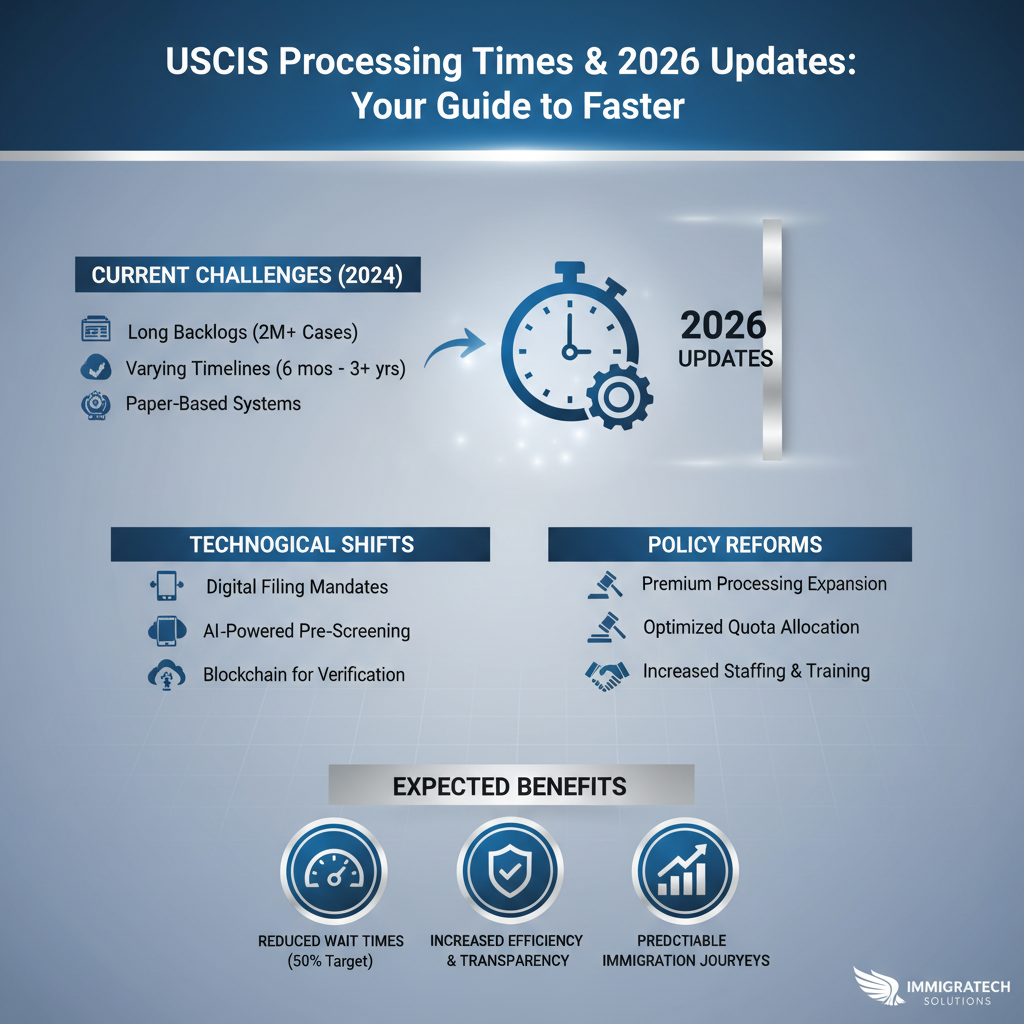
The reporting that sparked this guide: USCIS Processing Times and Updates for 2026 (USCIS)
What This News Means for Immigrants in Orlando and Across Florida
The regular adjustments to USCIS processing times are more than just bureaucratic statistics; they are direct indicators of how quickly your American dream might materialize. For the thousands of immigrants and their families residing in Orlando and throughout the Sunshine State, these updates can dictate everything from job opportunities to family reunification schedules. Understanding these shifts is paramount for effective planning and managing expectations.
Why this news is showing up now
USCIS continually reviews and updates its processing time charts. This isn't a one-time event but an ongoing process that reflects several dynamic factors. In 2026, these updates are particularly significant as USCIS continues to fine-tune its operations post-pandemic, implements new digital processing initiatives, and responds to fluctuating application volumes. Economic conditions, changes in immigration policy, staffing levels at service centers and field offices (including the busy Orlando USCIS Field Office), and the complexity of individual cases all contribute to the published processing ranges. These regular updates aim to provide the public with the most current and realistic expectations for how long their applications will take, helping to reduce uncertainty where possible.
How it can affect Florida residents
Florida is home to one of the largest and most diverse immigrant populations in the United States. For residents along the I-4 corridor, in Miami, Tampa, and especially here in Orlando, changes in USCIS processing times have direct and profound consequences:
- Family Reunification: For those with pending Form I-130 (Petition for Alien Relative) or Form I-485 (Application to Register Permanent Residence or Adjust Status), longer processing times mean extended separations from loved ones or prolonged periods of uncertainty about their future together. Conversely, faster times can bring immense relief and expedite family unity.
- Employment and Economic Stability: Delays in processing Form I-765 (Application for Employment Authorization) can directly impact an individual’s ability to work legally, support their family, and contribute to Florida’s economy. Many Orlando businesses rely on a diverse workforce, and efficient processing benefits both employees and employers.
- Travel and Mobility: Applicants waiting on Form I-131 (Application for Travel Document, including Advance Parole) might face restrictions on international travel, affecting visits to home countries for emergencies or family events.
- Mental and Emotional Well-being: The stress of prolonged waiting periods and unpredictable timelines can take a significant toll on applicants and their families. Clearer, more stable processing times, even if longer, can help manage anxiety.
- Planning and Decision-Making: Knowing approximate timelines allows individuals to make informed decisions about housing, education, career moves, and other critical life choices in Central Florida.
The impact is felt keenly by families in Orange County and surrounding areas, who often rely on these updates to plan everything from school enrollment for their children to securing long-term housing. At Imigrar, we closely monitor these updates to provide our clients with the most current and accurate advice, helping them navigate these critical periods with confidence.
What USCIS Processing Times Is (and Why It Matters)
Understanding USCIS processing times is fundamental to anyone navigating the U.S. immigration system. It's the estimated duration USCIS expects to take to review and make a decision on an immigration application or petition. These times are not guarantees but rather a range based on historical data and current workload. They are published to give applicants a general idea of when they can expect a decision.
A plain-English definition
Simply put, USCIS processing times refer to the average amount of time it takes for USCIS to process a particular type of immigration application or petition from the moment they receive it until they make a final decision. Think of it like waiting for a package: you get an estimated delivery window, but various factors (like the shipping method or unexpected delays) can affect the actual arrival time. Similarly, USCIS provides a window, but individual cases can vary.
These times are broken down by application type (e.g., green card, work permit), the specific USCIS service center or field office handling the case (like the Orlando USCIS Field Office), and sometimes even by the specific category within an application type. For example, a family-based green card might have different processing times depending on whether the petitioner is a U.S. citizen or a lawful permanent resident, and whether the beneficiary is an immediate relative or falls into a preference category.
Key terms you need to know
To effectively monitor your case and understand the processing updates, familiarize yourself with these critical terms:
- Receipt Date: This is the date USCIS officially received your application or petition. It's usually printed on your Form I-797C, Notice of Action (your receipt notice). This is the starting point for calculating your processing time.
- Priority Date: Primarily relevant for preference categories of family-sponsored and employment-based visas, this is the date your petition (e.g., Form I-130 or Form I-140) was filed and received by USCIS. It determines your place in the visa queue and is crucial for understanding when an immigrant visa might become available to you, according to the Visa Bulletin published by the U.S. Department of State.
- Processing Time Range: USCIS typically provides a range (e.g., "10.5 to 14 months") indicating the time it takes to process 80% of cases for a specific form and service center/field office. Your case should ideally fall within this range.
- Case Status: This refers to the current stage of your application, which you can check online using your receipt number. Common statuses include "Case Was Received," "Fingerprint Review Was Completed," "Interview Was Scheduled," or "Card Was Mailed."
- Normal Processing Time: This is the published processing time range. If your case falls outside this range (i.e., it has been pending longer than the upper end of the range), you may be eligible to submit an "outside normal processing time" inquiry.
- Inquiry Date: This is the date, based on the published processing times, when you can submit an inquiry to USCIS about your case if it is taking longer than the stated "normal processing time."
- Service Request: An official request made to USCIS (online or via phone) to inquire about a case that is outside normal processing times, or for other issues like not receiving a notice.
- Expedite Request: A request to USCIS to process an application faster than usual due to urgent circumstances, such as severe financial loss, urgent humanitarian reasons, or national interest.
Understanding these terms is your first step toward proactively managing your immigration journey. USCIS processing times matter because they offer transparency and allow you to anticipate potential delays or advancements, enabling better planning for your life in Florida.
Need Help? Our Orlando immigration team is ready to assist. Call +1 786-791-3106 for a free consultation, or message us online. Se Habla Español.
Current Immigration Law: The Foundation
The framework for all immigration processes, including how applications are processed and their associated timelines, is rooted in federal law. The primary legislation governing U.S. immigration is the Immigration and Nationality Act (INA). While there aren't specific laws dictating exact processing times for every application, the INA and subsequent regulations establish the procedures and requirements that USCIS must follow, which indirectly influence how long cases take.
Federal requirements
Under the INA, USCIS is tasked with adjudicating immigration benefits in a timely and fair manner. Key federal requirements and aspects that affect processing include:
- Application Filing: Every application or petition, such as Form I-130 for family relatives or Form I-485 for adjustment of status, must be filed correctly with all required supporting documentation and fees. Incomplete applications often lead to Requests for Evidence (RFEs) or denials, significantly extending processing times.
- Statutory Limits (where applicable): While many application types do not have strict statutory processing deadlines, some do. For instance, certain asylum applications or petitions for special immigrant juveniles have general timeframes for initial review. However, these are often broad and subject to case complexity and workload.
- Background Checks and Biometrics: A mandatory part of most immigration processes involves background checks and biometric appointments (fingerprints, photos, signature). These steps, which are conducted by the FBI and other agencies, are outside USCIS's direct control and can contribute to overall processing times. For Central Florida residents, the local Application Support Centers (ASCs) handle these appointments.
- Visa Availability: For many immigrant visa categories (family preference, employment-based), a visa must be numerically available before a green card can be issued. This is determined by the U.S. Department of State's Visa Bulletin, which reflects demand and annual caps set by Congress. Even if USCIS processes your petition quickly, you might still have to wait years for your Priority Date to become current.
- Public Charge Rule: While the 2019 "public charge" rule was rescinded, the underlying principle that applicants should not become a "public charge" remains part of the INA. Applicants for adjustment of status must demonstrate they are not likely to become primarily dependent on government assistance.
All USCIS forms and instructions are available on the USCIS official website. It is critical to use the most current version of any form and follow all instructions meticulously.
Florida-specific considerations
While immigration law is federal, the practical application and experience can vary slightly by location due to local factors. Florida, with its large and growing immigrant population, has specific considerations:
- High Volume: Florida is a major destination for immigrants, leading to a high volume of applications processed through the various USCIS service centers and the Orlando USCIS Field Office. High volume can sometimes lead to longer processing times compared to less populous areas.
- Local Field Office Operations: The Orlando USCIS Field Office handles interviews for adjustment of status, naturalization, and other benefits for residents of Orange County and surrounding areas. The efficiency and backlog at this specific office can directly affect local applicants.
- State-Level Support Services: While Florida does not have its own immigration laws (as that's a federal domain), state and local non-profits and community organizations often provide crucial support services, such as language assistance, which can indirectly help applicants navigate the federal process more smoothly.
- Advocacy and Policy Impact: Florida's political landscape and state-level discussions on immigration can influence federal policy and resource allocation, potentially impacting processing efficiencies over time.
Understanding this legal foundation and the local context is essential for any immigrant in Florida. It underscores the importance of thorough preparation and, often, professional legal guidance to navigate the system effectively.
How to Monitor and Expedite Your USCIS Application Process: A Complete Step-by-Step Guide
Once you’ve submitted your immigration application or petition, the waiting begins. But waiting doesn't mean being passive. Proactively monitoring your case status and understanding when and how to inquire about delays can significantly empower you. Here’s a complete step-by-step guide for residents in Orlando and beyond.
1) Understand Your Application Type and Form
Before you can effectively monitor your case, you must clearly identify which specific application or petition you filed. Different forms are processed at different locations (service centers vs. field offices) and have distinct processing timeframes. Knowing your form is the first step to checking the correct information.
- Action: Review your records to confirm the exact USCIS form number (e.g., Form I-130, Form I-485, Form I-765, Form N-400 for naturalization) and the date USCIS received it (your Receipt Date).
- Required Information/Documents:
- Your copy of the submitted application/petition.
- Form I-797C, Notice of Action (Receipt Notice) – this document confirms USCIS received your application and contains your Receipt Date and Receipt Number.
- The specific type of benefit sought (e.g., family-based green card, employment authorization).
2) Locate Your Receipt Number
Your 13-character Receipt Number is your unique identifier within the USCIS system. It’s essential for checking your case status online and making any inquiries. This number typically starts with three letters (e.g., EAC, WAC, LIN, SRC, NBC, IOE) followed by ten digits.
- Action: Find your Receipt Number on your Form I-797C, Notice of Action. This notice is usually mailed to you a few weeks after USCIS receives your application. If you filed online, your receipt number might be available in your USCIS online account.
- Required Information/Documents:
- Form I-797C, Notice of Action (Receipt Notice).
- Your USCIS online account login details (if you filed online).
3) Check USCIS Online Processing Times
USCIS provides an online tool that allows you to check the estimated processing times for various forms at different service centers and field offices. This is your primary resource for understanding the expected wait.
- Action: Visit the official USCIS Processing Times page.
- Select your Form type from the dropdown menu (e.g., "I-485, Application to Register Permanent Residence or Adjust Status").
- Select the Form Category (if applicable, e.g., "Family-based adjustment applicants").
- Select the Field Office or Service Center that is processing your case. For many Orlando residents, this could be the "National Benefits Center" (NBC) initially, or the "Orlando Field Office" for interviews. Your Form I-797C should indicate the service center.
The tool will display a Processing Time Range (e.g., "80% of cases are completed within 10.5 to 14 months") and an Inquiry Date. Important: Always compare the current processing times to your Receipt Date.
- Required Information/Documents:
- Your specific USCIS form type.
- The service center or field office indicated on your Form I-797C.
- Your Receipt Date.
4) Monitor Your Case Status Online
Beyond processing times, checking your individual case status provides real-time updates on your application's journey. This tool tells you if your biometrics were processed, an interview was scheduled, or a decision was made.
- Action: Go to the USCIS Case Status Online tool. Enter your 13-character Receipt Number and click "Check Status."
You’ll see the latest action taken on your case, such as "Case Was Received," "Fingerprint Review Was Completed," "Interview Was Scheduled," or "Card Was Mailed To Me." Make sure to read the full description for any additional instructions or information.
- Required Information/Documents:
- Your 13-character Receipt Number.
5) Know When to Submit an "Outside Normal Processing Time" Inquiry
If your case has been pending longer than the upper end of the published Processing Time Range for your specific form and office, you are generally eligible to submit an inquiry. This is crucial for proactive follow-up.
- Action: First, confirm your Receipt Date is earlier than the Inquiry Date listed on the USCIS processing times tool. If it is, you can submit an "e-Request" online.
- Visit the USCIS e-Request page.
- Select "Case Outside Normal Processing Time."
- Provide your Receipt Number, application type, and personal details.
USCIS will then review your case and typically respond within 15-30 days, often with an explanation for the delay or an update on when to expect a decision.
- Required Information/Documents:
- Your Receipt Number and Receipt Date.
- Confirmation that your case is indeed outside the normal processing time.
- Personal identifying information (name, date of birth, address).
6) Consider an Expedite Request (if applicable)
In certain urgent circumstances, you may be able to request an expedited processing of your application. USCIS grants these requests on a case-by-case basis and requires strong justification.
- Action: Contact the USCIS Contact Center at 1-800-375-5283 (TTY 1-800-767-1833) to make an expedite request. You will need to explain your situation and provide supporting evidence.
Common criteria for expediting include:
- Severe financial loss to a company or person: Requires evidence like eviction notices, foreclosure notices, or documentation of job loss.
- Urgent humanitarian reasons: Such as medical emergencies, severe illness, or death of a family member. Requires medical records, death certificates, or letters from doctors.
- Compelling U.S. government interests: For example, cases involving national security or public safety.
- Clear USCIS error: If USCIS has made a mistake leading to significant delays.
Warning: Expedite requests are rarely granted and require compelling evidence. Submitting a frivolous request can delay your case further.
- Required Information/Documents:
- Your Receipt Number.
- Detailed explanation of the urgent circumstances.
- Robust supporting documentation (e.g., medical reports, financial statements, employer letters, court orders).
7) Seek Professional Legal Guidance
Navigating these processes can be overwhelming, especially when facing delays or complex situations. An experienced immigration attorney can provide invaluable assistance.
- Action: If you are unsure about your case status, suspect an error, believe you qualify for an expedite, or simply want peace of mind, contact an immigration law firm like Imigrar.
An attorney can:
- Interpret complex processing time data and the Visa Bulletin.
- Review your application for potential issues.
- Draft and submit effective "outside normal processing time" inquiries or expedite requests.
- Represent you in communication with USCIS or at interviews at the Orlando USCIS Field Office.
- Advise on potential alternative immigration pathways if delays are excessive.
- Required Information/Documents:
- All previous USCIS notices (Form I-797C, RFEs, interview notices).
- Copies of all submitted applications and supporting documents.
- Any communication you've had with USCIS.
Need Help? Our Orlando immigration team is ready to assist. Call +1 786-791-3106 for a free consultation, or message us online. Se Habla Español.

Practical Steps You Can Take Today
While USCIS processing times are largely outside your direct control, there are many proactive steps you can take to ensure your application progresses as smoothly as possible and to mitigate the impact of potential delays.
Here’s an actionable checklist:
- Keep Copies of Everything: Maintain a meticulous record of every document you submit to USCIS, every notice you receive, and every communication you have with the agency. Organize these by date and application type. This is your personal case file.
- Respond Promptly to RFEs (Requests for Evidence): If USCIS sends you an RFE, it means they need more information to process your case. Respond accurately and completely well before the deadline (typically 87 days, giving you 90-day window from mail date to submission). Delays in responding will significantly prolong your processing time.
- Update Your Address with USCIS: This is critically important. If you move, especially for Central Florida residents relocating within Orange County or to a different part of Florida, you must update your address with USCIS within 10 days of moving using the USCIS online change of address tool or Form AR-11


