


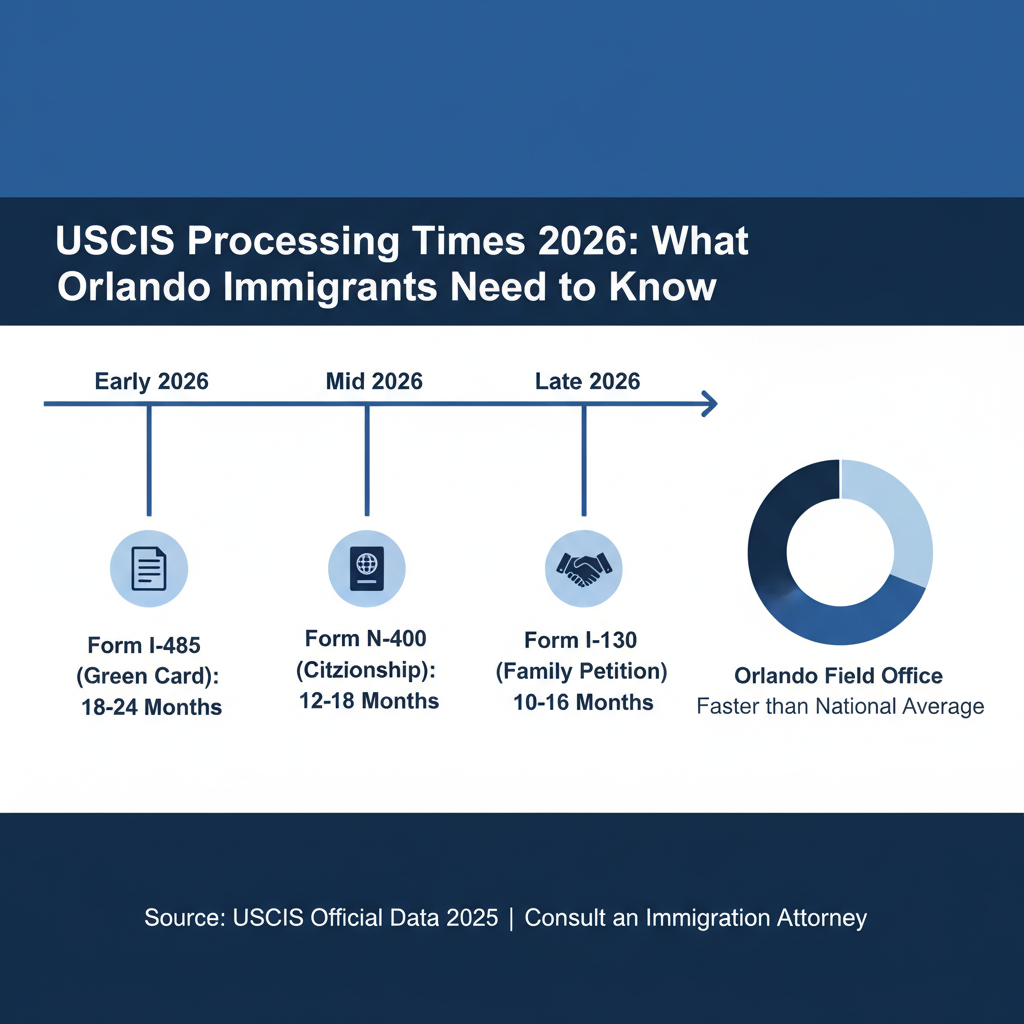
What This News Means for Immigrants in Orlando and Across Florida
For individuals and families navigating the U.S. immigration system, few things are as critical—or as anxiety-inducing—as USCIS processing times. These fluctuating timelines dictate how long you might wait for a work permit, a green card, or even U.S. citizenship. As we move further into 2026, the U.S. Citizenship and Immigration Services (USCIS) continues to update its processing time data, reflecting shifts in application volumes, staffing levels, and policy adjustments. For immigrants in Orlando, Central Florida, and throughout the nation, understanding these updates is paramount to planning your future.
Why this news is showing up now
USCIS regularly publishes and updates its processing times for various forms and application types. These updates are a routine part of the agency's transparency efforts, providing applicants with an estimate of how long it might take for their cases to be adjudicated. The "news" surrounding these updates often emerges when there are significant shifts—either improvements or deteriorations—in the expected waiting periods for popular application categories. Factors contributing to these shifts in 2026 include:
- Post-Pandemic Backlog Recovery: While significant progress has been made since the peak of the COVID-19 pandemic, some lingering backlogs continue to affect certain application types.
- Increased Filings: Economic and geopolitical factors can lead to surges in specific application types, such as employment-based petitions or asylum claims, which in turn impact processing times.
- Staffing and Resource Allocation: USCIS's ability to process cases efficiently is directly tied to its funding, staffing levels, and technological infrastructure. Changes in these areas can have a direct impact.
- Policy Changes: New immigration policies or directives can sometimes alter processing procedures, leading to temporary slowdowns or, conversely, expedited paths for certain cases.
- System Modernization: USCIS is continually working to modernize its systems, including expanding online filing options. While beneficial long-term, these transitions can sometimes cause short-term adjustments in processing.
These ongoing adjustments mean that what was true for processing times a few months ago might not be accurate today, underscoring the need for constant vigilance and up-to-date information.
How it can affect Florida residents
While USCIS processing times are federal, their impact is deeply felt at the local level. For residents of Orlando, Kissimmee, Sanford, and the wider Central Florida region, these updates have specific implications:
- Orlando USCIS Field Office: Many family-based interviews, naturalization interviews, and adjustment of status applications for those living in Orange, Osceola, Seminole, and surrounding counties are handled by the Orlando USCIS Field Office. Fluctuations in processing times directly affect how quickly these local appointments are scheduled and adjudicated.
- Economic Impact: Delays in work permits (Form I-765, Employment Authorization Document or EAD) can significantly impact an immigrant's ability to work and contribute to Florida's economy, especially in key sectors like tourism, hospitality, and agriculture along the I-4 corridor.
- Family Unity: For families seeking to "Keep Families Together" (our tagline at Imigrar), long waits for family-based visas (Form I-130, Petition for Alien Relative) can mean prolonged separation, causing immense emotional and financial strain.
- Travel Restrictions: Delays in travel documents (Form I-131, Application for Travel Document, including Advance Parole) can prevent individuals from visiting family abroad, attending critical events, or conducting urgent business.
- Naturalization Delays: Aspiring U.S. citizens in Florida, including those who have been lawful permanent residents for years, may face extended waits for their naturalization applications (Form N-400) to be processed, impacting their ability to vote or obtain a U.S. passport.
Understanding these impacts is the first step toward strategically managing your immigration journey. At Imigrar, we are deeply familiar with the nuances of processing times affecting our Orlando and Florida clients, and we are here to provide timely, accurate guidance.
Need Help? Our Orlando immigration team is ready to assist. Call +1 786-791-3106 for a free consultation, or message us online. Se Habla Español.
What USCIS Processing Times Are (and Why They Matter)
USCIS processing times are perhaps the most frequently checked metric by immigration applicants. They represent the estimated period USCIS needs to process a specific type of application or petition from the date of receipt until a decision is made. These times are not guarantees but rather averages based on historical data.
A plain-English definition
Think of USCIS processing times like the wait time at a busy restaurant. When you order food, the restaurant tells you it will be "approximately 20-30 minutes." This isn't an exact promise, but an estimate based on how many orders are ahead of you, how complex your order is, and how busy the kitchen is. Similarly, USCIS provides an estimated range for how long it will take to process your immigration application. This range accounts for the volume of applications, the complexity of the case, and the resources available at the specific service center or field office handling your file.
These times are crucial because they allow you to set expectations, plan your life, and understand when it might be appropriate to inquire about a delayed case. Without this information, the immigration process would feel even more opaque and uncertain.
Key terms you need to know
To effectively understand and navigate USCIS processing times, familiarize yourself with these essential terms:
- Receipt Date: This is the date USCIS officially receives your application. It's usually stamped on your Form I-797C, Notice of Action, and it's the date from which your processing time starts counting.
- Priority Date: For certain preference-based immigration categories (like some family-based and employment-based green cards), this is the date your petition (often Form I-130 or Form I-140) was properly filed with USCIS. It determines your place in line for a visa number according to the Visa Bulletin. Your green card application (Form I-485, Adjustment of Status) cannot be approved until your priority date becomes current.
- Processing Time Range: USCIS typically displays processing times as a range (e.g., "7.5 to 12.5 months"). This range represents the time it took to complete 80% of cases for that form type at a specific service center or field office over the past six months. Your case is considered "outside normal processing times" if it has been pending longer than the upper end of this range.
- Service Center: USCIS has several service centers (e.g., California, Nebraska, Texas, Vermont) that process mail-in applications and petitions. The specific service center depends on the type of application and your geographic location.
- Field Office: These are local USCIS offices (like the Orlando USCIS Field Office) that handle interviews, biometric appointments, and some final adjudications for applicants residing in their jurisdiction.
- Backlog: This refers to a large number of pending applications that USCIS has not yet processed, often leading to extended waiting periods.
- Case Status Online: A tool on the USCIS website where you can enter your receipt number to check the current status of your application.
- E-Request: An online tool to submit an inquiry to USCIS if your case is outside normal processing times or if you need to report an address change.
Important: Understanding these terms empowers you to track your application accurately and know when to seek further assistance. Don't just look at the number; understand what it represents.
Current Immigration Law: The Foundation
The framework for USCIS processing times is rooted in federal immigration law, primarily the Immigration and Nationality Act (INA). While the INA doesn't dictate specific processing timelines for every form, it establishes the categories of visas, eligibility requirements, and the general procedural steps that USCIS must follow. These legal mandates, coupled with regulatory provisions, shape how applications are received, reviewed, and adjudicated.
Federal requirements
At its core, federal law requires USCIS to process applications in a fair, consistent, and timely manner, though "timely" is often left to the agency's discretion based on resource availability. Key aspects include:
- Application Filing: The INA outlines which forms are required for different benefits (e.g., Form I-130 for family petitions, Form I-485 for adjustment of status, Form N-400 for naturalization). Proper filing, including all required supporting documents and fees, is a federal prerequisite.
- Eligibility Criteria: Each immigration benefit has specific eligibility criteria defined by law. USCIS must verify that an applicant meets these criteria before approval. Delays can occur if eligibility is complex or requires extensive review.
- Security Checks: Federal law mandates rigorous security and background checks for all applicants to protect national security and public safety. These checks, which involve coordination with various government agencies, are a significant factor in processing times.
- Biometrics: Most applicants are required to attend a biometric services appointment (fingerprints, photos, signature) to facilitate identity verification and background checks. This is a federal requirement, and scheduling can impact overall timelines.
- Adjudication Standards: USCIS officers must adhere to specific legal standards when adjudicating cases, ensuring due process and consistent application of the law.
While the goal is efficiency, the legal complexities and security imperatives often dictate the pace. You can find comprehensive information on all immigration laws and regulations on the USCIS official website and the Executive Office for Immigration Review site.
Florida-specific considerations
While immigration law is federal, its implementation has local nuances. For Florida residents, particularly those in Orlando, several factors are worth noting:
- Orlando Field Office Caseload: The Orlando USCIS Field Office serves a large and growing immigrant population across Central Florida. The volume of applications and interviews handled by this office can influence local processing times for interviews and final adjudications.
- Diverse Immigrant Community: Florida, and Orlando specifically, is home to a highly diverse immigrant population, including significant communities from Latin America, the Caribbean, and other regions. This diversity means a wide range of application types are processed, from family-based petitions to asylum claims and Temporary Protected Status (TPS) applications.
- Legal Support Infrastructure: Florida has a robust network of immigration legal services. However, navigating the system effectively often requires experienced counsel who understand both federal law and local USCIS office practices.
- State-Level Impact: While state laws don't directly control federal immigration processing, state policies (e.g., driver's license requirements for non-citizens, public benefits access) can interact with an immigrant's status and the urgency of their federal application.
For applications like Form I-485 (Adjustment of Status) and Form N-400 (Application for Naturalization), a significant portion of the processing, including interviews, will take place at your local field office. For Central Florida residents, this is typically the Orlando USCIS Field Office.
Stressed about your immigration timeline? Let Imigrar guide you. Our Orlando-based lawyers specialize in navigating complex USCIS processes. Call +1 786-791-3106 for a free consultation. Se Habla Español.
How to Navigate USCIS Processing Times: A Complete Step-by-Step Guide
Understanding processing times isn't just about checking a website; it's about knowing how to track your case, what to do if it's delayed, and how to prepare for eventual action. This guide provides a detailed roadmap.
1) Understand Your Application Type and Form Number
Before you can check anything, you need to know exactly which form you filed and what immigration benefit you are seeking. Different forms have vastly different processing times. Common forms include:
- Form I-130, Petition for Alien Relative (for family-based green cards)
- Form I-485, Application to Register Permanent Residence or Adjust Status (for green cards from within the U.S.)
- Form I-765, Application for Employment Authorization (for work permits)
- Form I-131, Application for Travel Document (for Advance Parole and Reentry Permits)
- Form N-400, Application for Naturalization (for U.S. citizenship)
- Form I-129, Petition for a Nonimmigrant Worker (for H-1B, L-1, O-1, etc.)
- Form I-140, Immigrant Petition for Alien Workers (for employment-based green cards)
Required Documents (for your reference): Keep your Form I-797C, Notice of Action, which confirms the form number, receipt date, and service center/field office.
2) Identify Your Correct Service Center or Field Office
Processing times vary significantly depending on where your application is being processed. This could be one of the four main USCIS Service Centers (California, Nebraska, Texas, Vermont) or a local Field Office (like the Orlando USCIS Field Office). Your Form I-797C, Notice of Action, will indicate which office is handling your case.
- Service Centers: Often process initial petitions (like Form I-130, Form I-140) and certain applications like Form I-765 and Form I-131.
- Field Offices: Typically handle applications that require an interview, such as Form I-485 (Adjustment of Status) and Form N-400 (Naturalization), for applicants residing in their jurisdiction. If you live in Orlando, your interview would be at the Orlando Field Office.
Required Documents (for your reference): Your Form I-797C receipt notice is essential for this step.
3) Check the Official USCIS Processing Times Tool
The most accurate source for processing times is the official USCIS website. Do not rely on third-party websites for this critical information.
Steps:
- Go to the USCIS Processing Times page.
- Select your form number from the dropdown menu (e.g., "I-485, Application to Register Permanent Residence or Adjust Status").
- Select the appropriate field office or service center (e.g., "Orlando Field Office" or "Texas Service Center").
- Click "Get processing time."
Required Documents (for this step): None, but have your form number and office location handy.
4) Interpret the Data: What the Ranges Mean
USCIS displays processing times as a range, indicating the time it took to complete 80% of cases over the past six months. For example, if it says "7.5 to 12.5 months," it means 80% of similar cases were processed within that window. The tool will also tell you the "receipt date for a case inquiry." If your receipt date is earlier than this date, your case is likely outside of normal processing times, and you may be able to submit an inquiry.
Reminder: These are estimates. Some cases may be processed faster, and others may take longer due to individual complexities, Request for Evidence (RFE) responses, or security checks.
5) Monitor Your Case Status Online
Beyond checking the general processing times, you can monitor the specific status of your individual application using your receipt number (a 13-character code starting with three letters, e.g., EAC, WAC, LIN, SRC, MSC, or NBC, followed by 10 numbers).
Steps:
- Visit the USCIS Case Status Online page.
- Enter your 13-character receipt number.
- Click "Check Status."
You can also create a MyUSCIS online account to link your cases, receive updates, and communicate with USCIS more efficiently. This is highly recommended for all applicants.
Required Documents: Your Form I-797C containing your receipt number.
6) When Your Case is Outside Normal Processing Times: What to Do
If your case has been pending longer than the upper end of the displayed processing time range for your specific form and office, you may be able to submit an inquiry. This is often referred to as an "e-request" or "service request."
Steps for an e-Request:
- Go to the USCIS e-Request page.
- Select "Case outside normal processing time."
- Provide your receipt number, personal details, and a description of your inquiry.
- You will receive a confirmation number for your inquiry. USCIS aims to respond within 30 days.
Other Options for Delays:
- Contacting the USCIS Contact Center: You can call 1-800-375-5283, but be prepared for potentially long wait times and limited information.
- Congressional Inquiry: Your U.S. Senator or Representative can submit an inquiry on your behalf. This can sometimes be effective, especially for particularly long delays.
- Mandamus Lawsuit: In extreme cases of unreasonable delay, a mandamus lawsuit may be filed in federal court to compel USCIS to make a decision. This is a complex legal action and should only be pursued with experienced legal counsel.
Required Documents: Your Form I-797C, any prior correspondence from USCIS, and a detailed record of your case history.
Warning: Do not submit multiple inquiries too frequently. This can sometimes slow down the process rather than speed it up. Consult with an attorney before taking aggressive action.
7) Prepare for Potential Next Steps (RFEs, Interviews)
Even while waiting, you should be prepared for potential requests from USCIS. These include:
- Request for Evidence (RFE): USCIS may send an RFE if they need more information or documents to make a decision on your case. Respond promptly and thoroughly.
- Notice of Intent to Deny (NOID): A NOID indicates USCIS intends to deny your application unless you provide specific information to overcome their concerns. This is a serious notice requiring immediate and comprehensive legal attention.
- Interview Notice: For applications like Form I-485 (Adjustment of Status) and Form N-400 (Naturalization), an interview at your local Field Office (e.g., Orlando Field Office) is typically required. Prepare all original documents.
Required Documents: Keep copies of all documents submitted to USCIS. For interviews, gather all original documents, including passports, birth certificates, marriage certificates, financial records, and any other evidence related to your application.
Practical Steps You Can Take Today
Proactive management of your immigration application can significantly reduce stress and help mitigate potential delays. Here are practical steps you can take now:
Actionable Checklist:
- Organize and Keep Copies: Maintain a well-organized file of all documents submitted to USCIS, including copies of forms, supporting evidence, and all receipt notices (Form I-797C) and correspondence.
- Create a MyUSCIS Account: If you haven't already, create an online account to link your paper-filed cases, track status, and receive notifications.
- Subscribe to USCIS Updates: Sign up for email updates on the USCIS website for news related to processing times or policy changes that might affect your case.
- Keep Your Address Updated: If you move, notify USCIS immediately using Form AR-11, Alien's Change of Address Card, and update your address online for any pending applications. Failure to do so can result in missed notices and case abandonment.
- Monitor the Visa Bulletin (if applicable): If your application requires a visa number (e.g., family-preference categories, employment-based green cards), regularly check the U.S. Department of State Visa Bulletin to track your Priority Date.
- Consult with an Immigration Attorney: Especially if your case is complex or experiencing delays, professional legal advice is invaluable. An attorney can interpret processing times, advise on inquiries, and represent you if problems arise.
Document Preparation Guidance:
- Completeness is Key: Ensure every question on every form is answered accurately and completely. Missing information is a leading cause of RFEs and delays.
- Accuracy and Consistency: Double-check all dates, names, and numbers across all documents. Inconsistencies can trigger security reviews.
- Translations: Any document not in English must be accompanied by a certified English translation. The translator must provide a certification that they are competent to translate and that the translation is accurate.
- Financial Documentation: For many applications (e.g., green cards), robust financial documentation (Form I-864, Affidavit of Support) is crucial. Ensure tax returns, bank statements, and employment letters are current and comprehensive.
- Medical Exams: For adjustment of status, a medical examination (Form I-693, Report of Medical Examination and Vaccination Record) is required. Ensure it's completed by a USCIS-approved civil surgeon and sealed properly.
Timeline Expectations:
While USCIS processing times provide estimates, it's vital to maintain realistic expectations:
- Fluctuation is Normal: Processing times are dynamic. They can shorten or lengthen without much warning.
- No Guarantees: The posted times are averages, not maximums or guarantees. Your individual case may take more or less time.
- Be Patient, But Vigilant: Patience is required, but passive waiting is not advisable. Regularly check your case status and be prepared to respond to any USCIS requests promptly.
- Plan for the Long Haul: Many immigration processes, especially for green cards, can take years. Build this reality into your personal and professional planning.

How Imigrar Helps Immigrants in Orlando
At Imigrar, we understand the profound impact that USCIS processing times and delays can have on individuals and families in Orlando and across Florida. Our mission, "Keep Families Together," drives our commitment to providing expert, compassionate legal assistance through every stage of the immigration journey.
Our experience and expertise
Our team of experienced immigration attorneys brings a wealth of knowledge and a deep understanding of U.S. immigration law. We specialize in:
- Accurate Application Preparation: We meticulously prepare and review all forms and supporting documents to ensure completeness and accuracy, minimizing the risk of RFEs and delays.
- Strategic Case Management: We help you understand the specific processing times for your application type and location (including the Orlando USCIS Field Office), and develop a strategy to navigate potential bottlenecks.
- Proactive Monitoring: We monitor your case status, track relevant processing times, and advise you on when and how to submit inquiries if your case falls outside normal processing.
- Responding to RFEs and NOIDs: If USCIS requests additional evidence or issues a Notice of Intent to Deny, we provide comprehensive assistance in preparing a strong and timely response.
- Interview Preparation: We thoroughly prepare you for interviews at the Orlando Field Office


