


The immigration journey is often a path paved with hope, anticipation, and, inevitably, waiting. Understanding the nuances of USCIS processing times is paramount for anyone navigating this complex landscape. As of early 2026, the U.S. Citizenship and Immigration Services (USCIS) continues to update its processing time estimates, reflecting ongoing efforts to manage backlogs, adapt to new policies, and optimize operations. For immigrants and their families in Orlando, across Florida, and nationwide, these updates are not just numbers; they represent the timeline for their dreams to become reality.
At Imigrar, an immigration law firm based in Orlando, Florida, we understand the profound impact that processing delays and uncertainties can have on individuals and families. Our mission, "Keep Families Together," drives us to provide clear, actionable information and expert legal guidance. This comprehensive guide aims to demystify the latest USCIS processing times and updates for 2026, offering practical advice and empowering you to better understand and navigate your immigration case.
The reporting that sparked this guide:
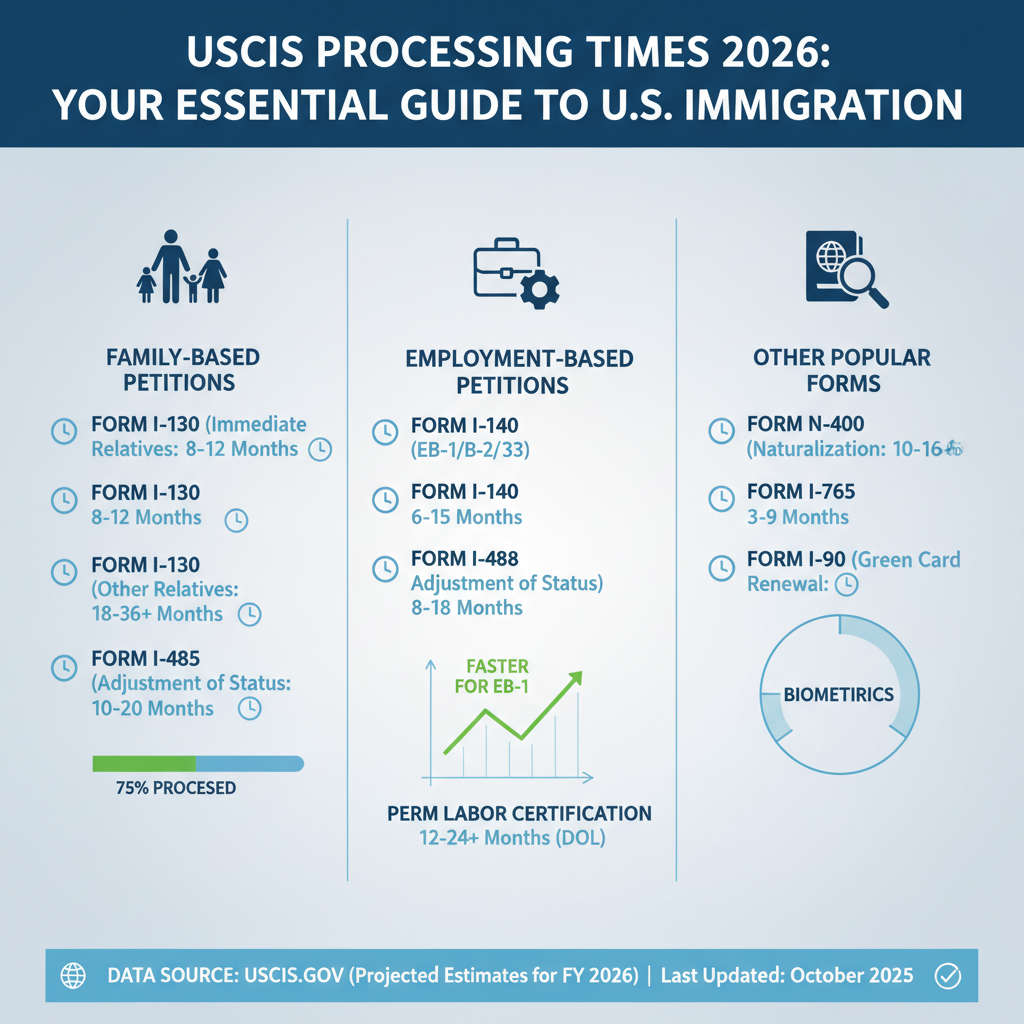
The information for this guide is drawn from the latest official updates and ongoing trends reported by USCIS regarding their application processing timelines. For general news and updates related to immigration law, you can refer to: USCIS Processing Times and Updates for 2026 (USCIS)
What This News Means for Immigrants in Orlando and Across Florida
The continuous evolution of USCIS processing times is a constant topic of discussion in the immigration community. For individuals and families residing in Orlando, Central Florida, and throughout the Sunshine State, staying informed about these updates is not just helpful—it's essential for planning your future, managing expectations, and making critical life decisions.
Why this news is showing up now
USCIS processing times are not static; they are dynamic estimates that reflect a multitude of factors. The "news" around these times is always ongoing because USCIS regularly publishes updates on its website, typically on a monthly basis. These updates for 2026, specifically, are emerging now due to several key reasons:
- Ongoing Backlog Reduction Efforts: Following significant backlogs exacerbated by the COVID-19 pandemic and previous administrative challenges, USCIS has been actively implementing strategies to improve efficiency and reduce case processing times. These efforts involve hiring more staff, optimizing digital processing, and streamlining internal procedures. The 2026 updates reflect the current state and progress of these initiatives.
- Fluctuating Caseloads: The volume of new applications and petitions submitted to USCIS constantly changes. Economic conditions, policy shifts, and global events can all influence the number and type of cases filed, directly impacting how quickly USCIS can process them. As of early 2026, USCIS is recalibrating its estimates based on current and projected intake.
- Resource Allocation: USCIS's ability to process cases is directly tied to its budget and staffing levels. Congressional appropriations, fee revenue, and internal management decisions on how to allocate resources across various service centers and field offices directly influence processing speeds for different form types.
- Policy Changes and Priorities: While less frequent, new immigration policies or shifts in enforcement priorities can sometimes re-route resources or introduce new steps in the adjudication process, which can, in turn, affect processing times. The 2026 updates incorporate any such changes that have come into effect.
- Technological Enhancements: USCIS is continually working to modernize its systems. The rollout of new online filing options or case management tools can initially cause temporary adjustments in processing, but eventually aims to improve efficiency. The 2026 estimates account for the current stage of these technological integrations.
In essence, the "news" is not a single event but a continuous report card on USCIS's operational efficiency, reflecting the most current data available on how long it takes to adjudicate cases.
How it can affect Florida residents
For individuals and families residing in Florida, particularly in a diverse and rapidly growing metropolitan area like Orlando, understanding these processing time updates is critically important:
- Planning for Family Reunification: Many Florida residents are sponsoring family members to immigrate to the U.S. Knowing the estimated processing times for forms like Form I-130 (Petition for Alien Relative) and subsequent Adjustment of Status (Form I-485) or consular processing is vital for families to plan for their loved ones' arrival and reunification. Delays can mean prolonged separation and emotional strain.
- Employment and Economic Stability: For those seeking employment authorization (Form I-765) or employment-based green cards, processing times directly affect their ability to work legally and contribute to Florida's economy. Delays can lead to job loss, financial hardship, and uncertainty for individuals and local businesses.
- Travel and International Plans: If you've applied for a green card or naturalization, your ability to travel internationally might be restricted or require specific travel documents (like Form I-131 for Advance Parole). Long processing times can put international travel plans, family visits abroad, or even critical business trips on hold.
- Peace of Mind and Mental Well-being: The waiting period for an immigration decision can be incredibly stressful. Accurate information about processing times, even if they are long, helps individuals manage their expectations and reduce anxiety, allowing them to plan their lives with greater certainty.
- Impact on Local USCIS Field Office: While many applications are processed by national service centers, cases requiring interviews, such as Adjustment of Status or Naturalization (Form N-400), are handled by local field offices. For Central Florida residents, the Orlando USCIS Field Office plays a crucial role. High caseloads or staffing issues at this office can directly affect interview scheduling and final adjudication times for local applicants. This means that even if national service center times look good, local factors can still cause delays.
- Renewal of Documents: Delays in processing can also impact the timely renewal of existing immigration documents, such as Employment Authorization Documents (EADs) or conditional green cards (Form I-751, Petition to Remove Conditions on Residence), potentially leading to gaps in authorization if not filed proactively.
For Orlando and Florida residents, these 2026 processing time updates are not abstract statistics. They are direct indicators of when you might expect life-changing decisions, emphasizing the need for diligent application preparation and, often, expert legal guidance to navigate potential pitfalls and delays.
Feeling overwhelmed by USCIS processing times? Don't face the wait alone. Our Orlando immigration team at Imigrar has the expertise to help you understand your case timeline and strategize effectively. Call +1 786-791-3106 for a free consultation, or message us online. Se Habla Español.
What USCIS Processing Times Are (and Why It Matters)
Understanding what USCIS processing times truly represent is the first step in managing your expectations and effectively navigating your immigration journey. These times are often a source of anxiety and confusion for applicants, but with clarity, you can approach the waiting period with greater confidence.
A plain-English definition
Simply put, USCIS processing times are the estimated durations that USCIS takes to process a specific petition or application, from the moment they receive it until they make a final decision. Think of it as the average time it takes for USCIS to move a case through all its stages: initial receipt, data entry, background checks, biometrics appointments, requests for evidence (RFEs), interviews, and final adjudication. These times are not guarantees but rather a historical average, usually reflecting the time it took to complete 80% of cases of a particular type at a specific service center or field office over a recent period.
It's crucial to understand that these are estimates. Your individual case might be processed faster or slower than the posted times due to various factors unique to your situation or the operational demands of USCIS at any given moment.
Key terms you need to know
To fully grasp the implications of USCIS processing times, familiarize yourself with these essential terms:
- Processing Timeframes: These are the estimated ranges published by USCIS for different forms and office locations. They are updated regularly and are crucial for understanding the general waiting period for your application. You can find them on the official USCIS website.
- Case Status Online: This is an online tool provided by USCIS where you can enter your Receipt Number to check the most recent updates on your specific case. While it doesn't provide a precise timeline, it tells you where your case stands in the process (e.g., "Case Was Received," "Biometrics Appointment Was Scheduled," "Card Was Mailed to Me").
- Receipt Date: This is the date USCIS officially received your application or petition. It's typically stamped on your Form I-797C, Notice of Action, and is the starting point for calculating your processing time.
- Priority Date: This term is critical for family-sponsored and employment-based immigrant visa categories that are numerically limited by law. The Priority Date is established when a qualifying petition (e.g., Form I-130 or Form I-140) is properly filed with USCIS. For you to proceed with an Adjustment of Status (Form I-485) or consular processing, your Priority Date must be "current" according to the U.S. Department of State Visa Bulletin. This date determines your place in the waiting line for an available visa number, which is distinct from how long USCIS takes to process your application once it's actively being reviewed.
- Service Center: USCIS has several service centers (e.g., California, Nebraska, Texas, Vermont) that process applications from across the country based on the type of form. The service center handling your case will impact its processing time.
- Field Office: These are local USCIS offices (like the Orlando USCIS Field Office) that handle in-person services, interviews (e.g., for Adjustment of Status, Naturalization), and some specific applications for residents in their geographical area.
- Biometrics Appointment: This is an appointment at an Application Support Center (ASC) where USCIS collects your fingerprints, photograph, and signature for background and security checks. This is a mandatory step for many applications.
- Request for Evidence (RFE): If USCIS determines that your application is missing required information or needs further documentation to make a decision, they will send an RFE. Responding promptly and thoroughly to an RFE is critical to avoid delays or even denial.
- Notice of Intent to Deny (NOID): A NOID is issued when USCIS intends to deny your application but is giving you a final opportunity to submit additional evidence or arguments to overcome the grounds for denial. This is a serious notice requiring immediate and expert attention.
- Adjustment of Status (AOS): This is the process for eligible individuals already in the United States to apply for lawful permanent resident status (a Green Card) without having to return to their home country. This typically involves filing Form I-485.
- Consular Processing: This is the process for individuals outside the United States to apply for an immigrant visa at a U.S. embassy or consulate in their home country. Once approved, they can enter the U.S. as a lawful permanent resident.
Understanding these terms empowers you to interpret USCIS communications, track your case effectively, and make informed decisions throughout your immigration journey.
Current Immigration Law: The Foundation of Processing Times
While USCIS processing times are operational estimates, they are fundamentally rooted in U.S. immigration law and regulations. The Immigration and Nationality Act (INA), along with various federal regulations and policy directives, dictates how applications are processed, which forms are required, and the criteria for eligibility. These legal frameworks indirectly influence processing times by establishing the complexity of the adjudication process and the volume of cases that must be reviewed.
Federal requirements
The core of U.S. immigration law is the Immigration and Nationality Act (INA). This extensive statute, codified in Title 8 of the U.S. Code, outlines who is eligible to immigrate, the different visa categories, and the procedures for gaining legal status. Specific sections of the INA are particularly relevant to the types of applications that USCIS processes and, consequently, their processing times:
- INA § 201-204 (Family-Sponsored and Employment-Based Preferences): These sections establish the categories for family-sponsored (e.g., immediate relatives of U.S. citizens, preference categories F1, F2A, F2B, F3, F4) and employment-based immigrants, as well as the annual numerical limits for many of these categories. The existence of these limits directly creates the need for Priority Dates and the sometimes lengthy waiting periods for visa availability, which are distinct from USCIS's internal processing speed but contribute to the overall time an applicant waits for a green card.
- INA § 245 (Adjustment of Status): This section details the eligibility requirements for individuals physically present in the United States to adjust their status to lawful permanent resident. The complexity of determining eligibility under INA § 245, including issues like unlawful presence or prior violations, can significantly impact the review time for Form I-485.
- INA § 316 (Naturalization): This section sets forth the general requirements for naturalization, including continuous residence, physical presence, good moral character, and English/civics knowledge. The need for comprehensive background checks and interviews for Form N-400 applications contributes to their processing times.
Beyond the INA, the Code of Federal Regulations (CFR) provides detailed rules for implementing the INA. These regulations specify the required evidence for each application type, the procedures for filing, and the standards for adjudication. Any changes to these regulations or new policy memos issued by USCIS can alter the steps involved in processing, thereby affecting timelines.
Important: USCIS is legally obligated to process applications fairly and efficiently, but there is no specific statutory deadline for most application types. This absence of a strict legal mandate allows for the variability in processing times that applicants often experience. Factors such as national security checks, inter-agency coordination, and the sheer volume of applications all contribute to the duration.
Florida-specific considerations
While immigration law is federal, its implementation and the resulting processing times can have localized impacts. For Florida residents, especially those in high-population centers like Orlando, Miami, and Tampa, several factors come into play:
- Orlando USCIS Field Office: The Orlando Field Office handles interviews for Adjustment of Status, Naturalization, and other local services for applicants residing in Orange County and the surrounding Central Florida region. The workload, staffing levels, and efficiency of this specific office directly affect how quickly local cases move through the interview stage. High demand in a rapidly growing area like the I-4 corridor can lead to longer interview backlogs.
- Volume of Applications: Florida is a major hub for immigration, attracting individuals from diverse backgrounds. The sheer volume of applications originating from Florida can place a greater strain on both national service centers and local field offices, potentially leading to longer processing times compared to states with lower immigration rates.
- Diverse Caseload: Florida's immigrant population includes a wide array of visa types – family-based, employment-based, asylum seekers, and temporary visa holders. This diversity means the Orlando Field Office and associated service centers must process a broad spectrum of complex cases, each with unique legal requirements and processing pathways.
For individuals in Florida, navigating the federal requirements means understanding that the journey can be influenced by local operational realities. Always refer to the official USCIS official website for the most accurate information on forms and requirements. Common forms you might encounter include:
- Form I-130, Petition for Alien Relative
- Form I-485, Application to Register Permanent Residence or Adjust Status
- Form I-765, Application for Employment Authorization
- Form I-131, Application for Travel Document
- Form N-400, Application for Naturalization
- Form I-751, Petition to Remove Conditions on Residence
Each of these forms has its own set of legal requirements and processing queues, making expert legal guidance invaluable.

How to Navigate USCIS Processing Times: A Complete Step-by-Step Guide
Understanding USCIS processing times is one thing; actively managing your case within those timelines is another. This step-by-step guide provides practical actions you can take to monitor your application, respond to USCIS requests, and proactively address potential delays.
1) Understand Your Application Type and Category
Before you even begin tracking, you must have a clear understanding of the specific immigration application you've filed and its associated category. Different forms are processed by different USCIS service centers or field offices, and each has its own estimated processing timeframe.
- Explanation: For instance, a Form I-130 (Petition for Alien Relative) for an immediate relative of a U.S. citizen will have a different processing queue than a Form I-130 for a preference category (e.g., F2A, spouse of a Green Card holder), which is subject to visa bulletin availability. Similarly, an Adjustment of Status (Form I-485) application might be processed by a national service center for initial review, but the interview will be scheduled at your local Orlando USCIS Field Office. Knowing your form number (e.g., Form I-130, Form I-485, Form N-400), visa category, and your Priority Date (if applicable) is foundational.


