What This News Means for Immigrants in Orlando and Across Florida
Why this news is showing up now
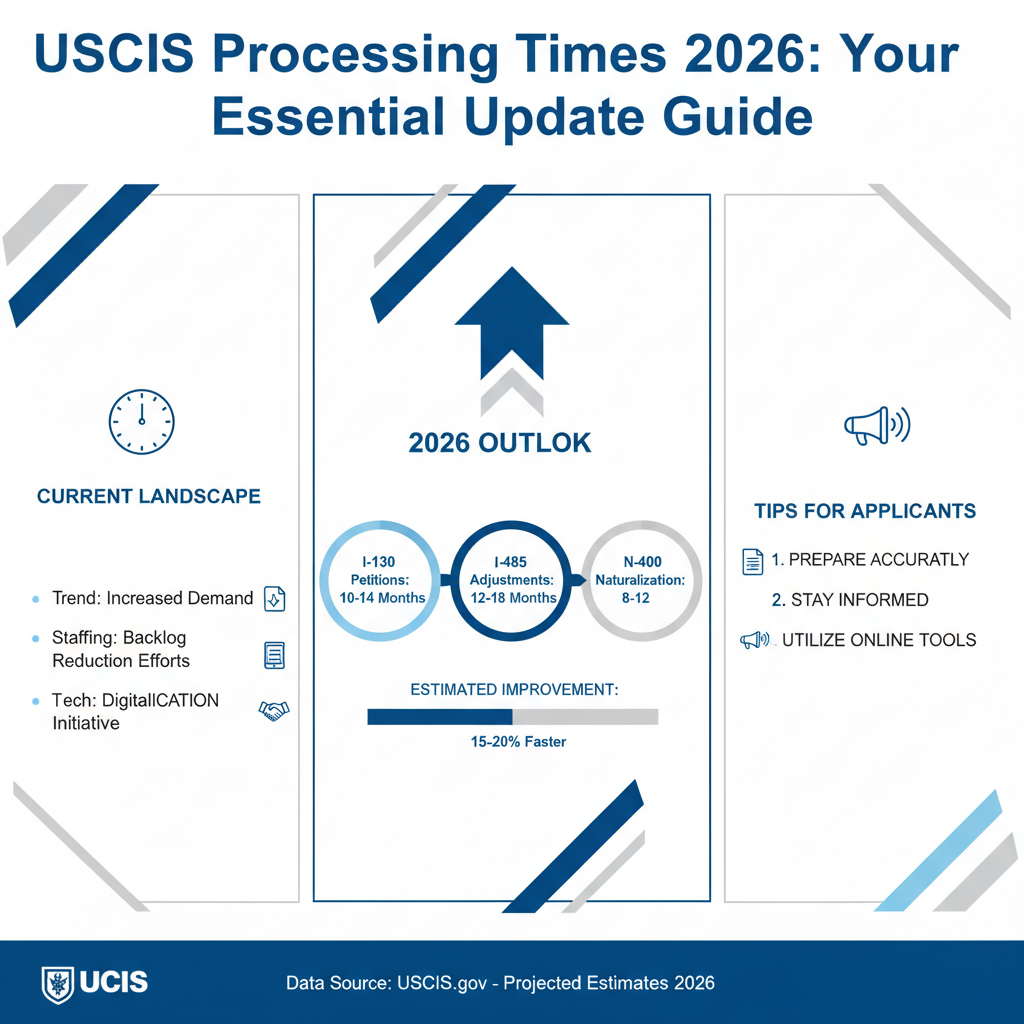
USCIS processing times are dynamic, constantly fluctuating based on a multitude of factors. These updates typically surface for several key reasons: * **Workload Fluctuations:** USCIS service centers and field offices experience varying levels of incoming applications. Spikes in certain application types (e.g., family-based petitions, employment-based visas, naturalization applications) can lead to increased backlogs and longer processing times. * **Staffing and Resources:** The availability of USCIS officers, adjudicators, and support staff directly affects how quickly cases can be reviewed and decided. Budget allocations and hiring initiatives play a significant role. * **Policy Changes:** New immigration policies, executive orders, or changes in regulatory interpretations can introduce additional review steps, require new forms, or alter eligibility criteria, all of which can slow down processing. * **Technological Improvements (or Lack Thereof):** While USCIS is working towards modernization, the implementation of new digital systems can sometimes cause temporary slowdowns or, conversely, may eventually streamline certain processes. * **Adjudication Priorities:** USCIS may shift its focus to prioritize certain types of applications (e.g., humanitarian cases, national security cases), which can inadvertently lengthen times for others. As we are in 2026, these factors continue to evolve, making regular monitoring of USCIS updates essential for anyone involved in the immigration process.How it can affect Florida residents
Florida is one of the most diverse states in the U.S., home to a vibrant immigrant community, particularly in Central Florida and the Orlando area. For residents here, changes in USCIS processing times have very tangible effects: * **Family Reunification Delays:** Many families in Orange County and surrounding areas rely on family-based petitions (like **Form I-130**) to bring loved ones to the U.S. or adjust their status. Longer processing times mean extended periods of separation or uncertainty. * **Employment Authorization and Travel:** For individuals awaiting **Adjustment of Status** (**Form I-485**), delays can mean longer waits for work permits (**Form I-765**) and travel documents (**Form I-131**), impacting their ability to work and visit family abroad. * **Naturalization Timeline:** Those on the path to U.S. citizenship via **Form N-400** may experience delays in interviews and oath ceremonies at the Orlando USCIS Field Office, affecting their civic participation. * **Local Economy:** Delays in immigration processes can indirectly impact Florida’s economy, as new immigrants contribute to the workforce, start businesses, and consume goods and services. * **Increased Stress and Uncertainty:** Perhaps the most profound impact is the emotional toll. Extended waits create significant anxiety for individuals and families who are trying to build stable lives in Florida. * **Need for Local Expertise:** The Orlando USCIS Field Office handles many interviews and local adjudications. Understanding its specific workload and procedures is vital, making local legal counsel from firms like Imigrar particularly valuable for Central Florida residents. Understanding these implications underscores the importance of staying informed and seeking professional guidance to navigate these complex waters effectively.Need Help? Our Orlando immigration team is ready to assist. Call +1 786-791-3106 for a free consultation, or message us online. Se Habla Español.
What USCIS Processing Times Are (and Why They Matter)
USCIS processing times are more than just numbers; they are a critical indicator for anyone involved in the U.S. immigration system. They provide an estimate of how long it will take for USCIS to process a particular immigration benefit request, from the date of receipt to a final decision.A plain-English definition
Simply put, USCIS processing times tell you roughly how long other people who filed the same type of application at the same office have waited for a decision. USCIS calculates these times based on historical data – specifically, how long it took to complete 80% of cases over the past six months. It's an *estimate*, not a guarantee. Your individual case could be faster or slower depending on its complexity, how well you prepared your application, and whether USCIS needs more information from you.Key terms you need to know
Navigating USCIS processing times requires understanding several key terms: * **Priority Date:** For family-sponsored and employment-based visas, this is the date USCIS received your petition. It determines your place in the visa queue. You can only move forward with your **Adjustment of Status** or **Consular Processing** once your **Priority Date** becomes current according to the Visa Bulletin published by the U.S. Department of State. * **Receipt Date:** This is the date USCIS officially receives your application. It's usually found on your **Form I-797C**, Notice of Action. Processing times are typically measured from this date. * **Service Center:** USCIS has several service centers (e.g., California, Nebraska, Texas, Vermont) that process different types of applications. The processing time can vary significantly between centers. * **Field Office:** Local USCIS offices (like the Orlando USCIS Field Office) handle interviews for certain applications, such as **Adjustment of Status** (**Form I-485**) and **Naturalization** (**Form N-400**). Their workload impacts local processing times. * **Visa Bulletin:** A monthly publication by the U.S. Department of State that lists when immigrant visas are available for various categories and countries. Your **Priority Date** must be "current" in the **Visa Bulletin** for you to proceed with your application for a Green Card. * **Adjustment of Status (AOS):** The process of applying for a Green Card (permanent residency) from *within* the United States. This typically involves filing **Form I-485**. * **Consular Processing:** The process of applying for an immigrant visa at a U.S. embassy or consulate *outside* the United States. * **Request for Evidence (RFE):** A notice from USCIS asking for additional documents or information to support your application. Failing to respond by the deadline can lead to denial. * **Notice of Intent to Deny (NOID):** A notice from USCIS indicating their intention to deny your application and giving you a chance to respond with additional evidence or explanation before a final decision is made. * **Beyond Normal Processing Times:** This is when your application has been pending longer than the estimated processing time posted on the USCIS website. This is the point at which you can typically make an inquiry. Understanding these terms is crucial because they directly influence how you track your case, interpret delays, and strategically plan your immigration journey. USCIS processing times matter because they dictate your ability to live, work, and build a future in the U.S. They affect everything from employment opportunities to family unity, making accurate information and proactive management indispensable.Current Immigration Law: The Foundation
U.S. immigration law is primarily federal, meaning it applies uniformly across all states, including Florida. The bedrock of this legal framework is the **Immigration and Nationality Act (INA)**, which governs virtually all aspects of immigration, from who can enter the U.S. to how they can become permanent residents or citizens.Federal requirements
The INA, along with regulations published in the Code of Federal Regulations (CFR), dictates the eligibility criteria, application processes, and adjudicatory standards for all immigration benefits. Key areas include: * **Family-Based Immigration:** Governed by INA sections 201(b), 203(a), and 204. This allows U.S. citizens and lawful permanent residents to petition for certain family members. Common forms include **Form I-130**, Petition for Alien Relative. Eligibility depends on the petitioner's status (citizen vs. LPR) and the relationship (e.g., spouse, child, parent, sibling). * **Employment-Based Immigration:** Governed by INA section 203(b). This category is for individuals seeking to immigrate based on their employment skills or investment. It ranges from individuals with extraordinary ability to skilled workers and investors. Petitions often start with **Form I-140**, Immigrant Petition for Alien Worker. * **Humanitarian Relief:** Includes asylum, refugee status, U visas for victims of crime, and T visas for victims of human trafficking. These are critical protections for vulnerable individuals. * **Adjustment of Status (AOS):** Outlined in INA section 245. This process allows eligible individuals already present in the U.S. to apply for lawful permanent resident status without having to return to their home country. The primary application is **Form I-485**, Application to Register Permanent Residence or Adjust Status. * **Naturalization:** Governed by INA section 310 et seq. This is the process by which lawful permanent residents can become U.S. citizens after meeting specific residency and moral character requirements. The application for this is **Form N-400**, Application for Naturalization. All these processes are overseen by USCIS, an agency within the U.S. Department of Homeland Security (DHS). USCIS is responsible for adjudicating petitions and applications, conducting interviews, and issuing immigration benefits. Their official website (USCIS official website) is the primary source for forms, instructions, and policy updates.Florida-specific considerations
While immigration law itself is federal, how it intersects with daily life for Florida residents has unique aspects: * **Local USCIS Field Offices:** The Orlando USCIS Field Office serves a wide area of Central Florida, including Orange County, Osceola County, Seminole County, and others along the I-4 corridor. This office handles interviews for **Form I-485** and **Form N-400**, among other services. Its specific workload and scheduling practices directly influence local processing times for these applications. * **State-Level Laws and Resources:** Florida does not have its own immigration laws that grant or deny immigration benefits, as this is a federal domain. However, state laws can affect immigrants' lives, such as access to driver's licenses, professional licenses, and social services. It's crucial for immigrants in Florida to be aware of state-specific regulations that might impact their daily lives, even if they don't directly control their immigration status. * **Community Resources:** Florida, particularly Orlando, has a robust network of community organizations that provide support services to immigrants. While these don't affect federal processing times, they can be invaluable resources during long waiting periods. * **Legal Representation:** Given Florida's large and diverse immigrant population, there is a strong need for experienced immigration attorneys who understand both the federal legal framework and the local nuances of interacting with the Orlando USCIS Field Office and related agencies. Understanding the federal foundation of immigration law and its specific manifestations in Florida is essential for anyone navigating the system. The correct forms, such as **Form I-130**, **Form I-485**, **Form I-765**, **Form I-131**, and **Form N-400**, must be filed accurately and completely to avoid delays.Need Help? Our Orlando immigration team is ready to assist. Call +1 786-791-3106 for a free consultation, or message us online. Se Habla Español.
How to Navigate USCIS Processing Times: A Complete Step-by-Step Guide
Successfully managing your expectations and actions during the immigration process, especially concerning processing times, requires a strategic approach. This guide outlines the key steps to effectively navigate the wait.1) Understand Your Application Type and Relevant Processing Times
Before you do anything else, know exactly what you've filed or plan to file. Different forms, like **Form I-130** (family petition), **Form I-485** (Adjustment of Status), or **Form N-400** (Naturalization), have distinct processing pathways and timelines. * **Locate Your Service Center/Field Office:** Your **Form I-797C** Receipt Notice will indicate which USCIS Service Center (e.g., Texas, Nebraska) is handling your petition, or if your case will be processed by a local Field Office (like the Orlando USCIS Field Office for interviews). * **Check Official USCIS Processing Times:** Regularly visit the official USCIS Processing Times page. You’ll need to select your form type and the specific service center or field office. * **Interpret the Data:** Understand that the times displayed are estimates. They show the time it took USCIS to complete 80% of cases within the last six months. Your case might be faster or slower. **Required Information for Checking Times:** * Specific **Form Number** (e.g., **Form I-130**, **Form I-485**) * Application **Category** (e.g., "Immediate Relative of U.S. Citizen," "Employment-Based First Preference") * Your assigned **Service Center** or **Field Office**2) File a Complete and Accurate Application
This is the single most critical step to avoid unnecessary delays. Many processing delays stem from errors or omissions in the initial filing. * **Follow Instructions Meticulously:** Read the instructions for your specific form (available on USCIS Forms) several times. USCIS provides detailed guidance for every question and document. * **Gather All Required Documents:** Ensure you have every supporting document listed. This includes birth certificates, marriage certificates, passports, photos, financial documents (**Form I-864** Affidavit of Support, if applicable), medical exam results (**Form I-693**), and more. * **Provide Certified Translations:** If any document is not in English, it must be accompanied by a complete and accurate English translation certified by a competent translator. * **Organize Your Submission:** USCIS appreciates organized filings. Use fasteners, tabbed dividers, and cover letters to make your package easy to review. * **Pay Correct Fees:** Double-check the current filing fees on the USCIS website. Incorrect payments can lead to your application being rejected and returned, causing significant delays. **Bullet List of General Required Documents (Varies by Case):** * Completed and signed USCIS forms * Passport-style photographs * Birth certificates (applicant and petitioner/beneficiary) * Marriage certificates (if applicable) * Divorce decrees or death certificates (for previous marriages, if applicable) * Proof of U.S. citizenship or lawful permanent residency (for petitioner) * Affidavits of Support (**Form I-864**) and financial documents (tax returns, W-2s) * Medical examination results (**Form I-693**) * Police clearances/criminal records (if applicable) * Proof of bona fide relationship (for family petitions) * Certified English translations for all non-English documents3) Monitor Your Case Status Online
Once you've filed, you'll receive a **Form I-797C**, Notice of Action, with a 13-digit receipt number. This number is your key to tracking your case. * **Use the USCIS Case Status Tool:** Enter your receipt number into the USCIS Case Status Online tool. * **Understand Status Updates:** Common updates include "Case Was Received," "Biometrics Appointment Was Scheduled," "Request for Evidence Was Sent," "Interview Was Scheduled," and "Card Was Produced." * **Sign Up for Email/SMS Alerts:** USCIS allows you to register for automatic notifications when your case status changes. **Bullet List of What to Look For:** * Confirmation of **Receipt Date** * Biometrics appointment notices * Notices for **Requests for Evidence (RFEs)** * Interview scheduling notices (especially for Orlando residents interacting with the Orlando USCIS Field Office) * Approval or denial notifications4) Respond Promptly to Requests for Evidence (RFEs) or Notices
If USCIS needs more information, they will send an **RFE** or a **Notice of Intent to Deny (NOID)**. * **Warning:** These notices come with strict deadlines (often **30 to 90 days**). Missing the deadline almost always leads to a denial. * **Read Carefully:** Understand exactly what USCIS is asking for. * **Gather Evidence:** Collect all requested documents. If you cannot provide something, explain why and offer alternative evidence. * **Consult Your Attorney:** If you receive an RFE or NOID, it is highly advisable to consult with an immigration attorney immediately. They can help you understand the request and formulate a strong, timely response. * **Submit on Time:** Send your response well before the deadline, keeping proof of mailing. **Bullet List of How to Respond:** * Gather all specific documents requested. * Write a cover letter clearly addressing each point of the RFE/NOID. * Submit all documents in an organized manner. * Keep copies of everything you send to USCIS. * Consider using certified mail with a return receipt for proof of delivery.5) Know When and How to Inquire About Your Case (Outside Normal Processing Times)
Exercising patience is important, but there comes a point when inquiries are appropriate. * **Verify "Beyond Normal":** Only inquire if your case has been pending longer than the *latest* posted processing times for your specific form and service center/field office. Do not inquire prematurely, as it will not speed up your case and can burden the system. * **Use the USCIS e-Request Tool:** If your case is genuinely outside normal processing times, you can submit an "e-Request" online through the USCIS website for an "Outside Normal Processing Time" inquiry. * **Contact the USCIS Contact Center:** You can call the USCIS Contact Center at 1-800-375-5283. Be prepared with your receipt number and case details. * **Congressional Inquiry:** In some prolonged delay cases, your U.S. Senator or Representative can make an inquiry on your behalf. This is usually pursued after other avenues have been exhausted. * **Seek Legal Intervention:** An attorney can often make inquiries or even file a Writ of Mandamus in federal court if delays are excessive and without justification. **Bullet List of Inquiry Methods:** * USCIS e-Request for "Outside Normal Processing Time" * USCIS Contact Center (1-800-375-5283) * Congressional inquiry (via your elected representative) * Attorney intervention6) Prepare for Interviews and Next Steps
Many applications, especially **Form I-485** and **Form N-400**, require an interview at a local USCIS Field Office, such as the Orlando USCIS Field Office. * **Gather Originals:** Bring all original documents that you submitted copies of with your application. * **Review Your Application:** Be thoroughly familiar with all the information you provided in your forms. * **Practice Answers:** Be prepared to answer questions about your application, personal history, relationships, and eligibility. * **Attend with an Attorney:** An attorney can accompany you to the interview, provide legal advice, and ensure the process is fair. **Bullet List of Interview Preparation:** * Bring your interview notice. * Bring original copies of all documents submitted with your application. * Bring any additional documents requested in the interview notice. * Review your entire application package. * Consider bringing an attorney for support and guidance.7) Consult with an Experienced Immigration Attorney
While you can file many applications yourself, the complexity of immigration law and the impact of processing times make legal counsel invaluable. * **Guidance and Strategy:** An attorney can advise you on the best immigration strategy, identify potential issues, and help you prepare a strong application. * **Troubleshooting Delays:** If your case is delayed beyond normal processing times, an attorney can make effective inquiries, escalate issues, and explore legal remedies. * **RFE/NOID Response:** They can help you craft compelling and legally sound responses to **RFEs** or **NOIDs**, significantly increasing your chances of approval. * **Interview Preparation:** An attorney can prepare you thoroughly for interviews and even attend with you, providing crucial support. * **Appeals and Motions:** If your case is denied, an attorney can help you understand your options for appeal or motions to reopen/reconsider. For Central Florida residents, a local immigration law firm like Imigrar understands the specific procedures and common issues faced at the Orlando USCIS Field Office.