


The journey to a new life in the United States, whether for yourself or a loved one, is often marked by anticipation and, at times, significant waiting periods. Understanding the U.S. Citizenship and Immigration Services (USCIS) processing times is paramount for anyone navigating the complex immigration system. As we move through 2026, USCIS continues to adapt its operations, leading to dynamic changes in how long it takes to process various applications.
At Imigrar, an immigration law firm based in Orlando, Florida, we understand that these processing times are not just numbers; they represent the lives, dreams, and futures of individuals and families. Our commitment is to "Keep Families Together," and staying informed about the latest USCIS updates is a crucial part of that mission. This comprehensive guide will break down the current landscape of USCIS processing times in 2026, offering practical advice, timelines, and actionable steps for immigrants in Orlando, across Florida, and nationwide.
The reporting that sparked this guide: USCIS Processing Times and Updates for 2026 (USCIS)
What This News Means for Immigrants in Orlando and Across Florida
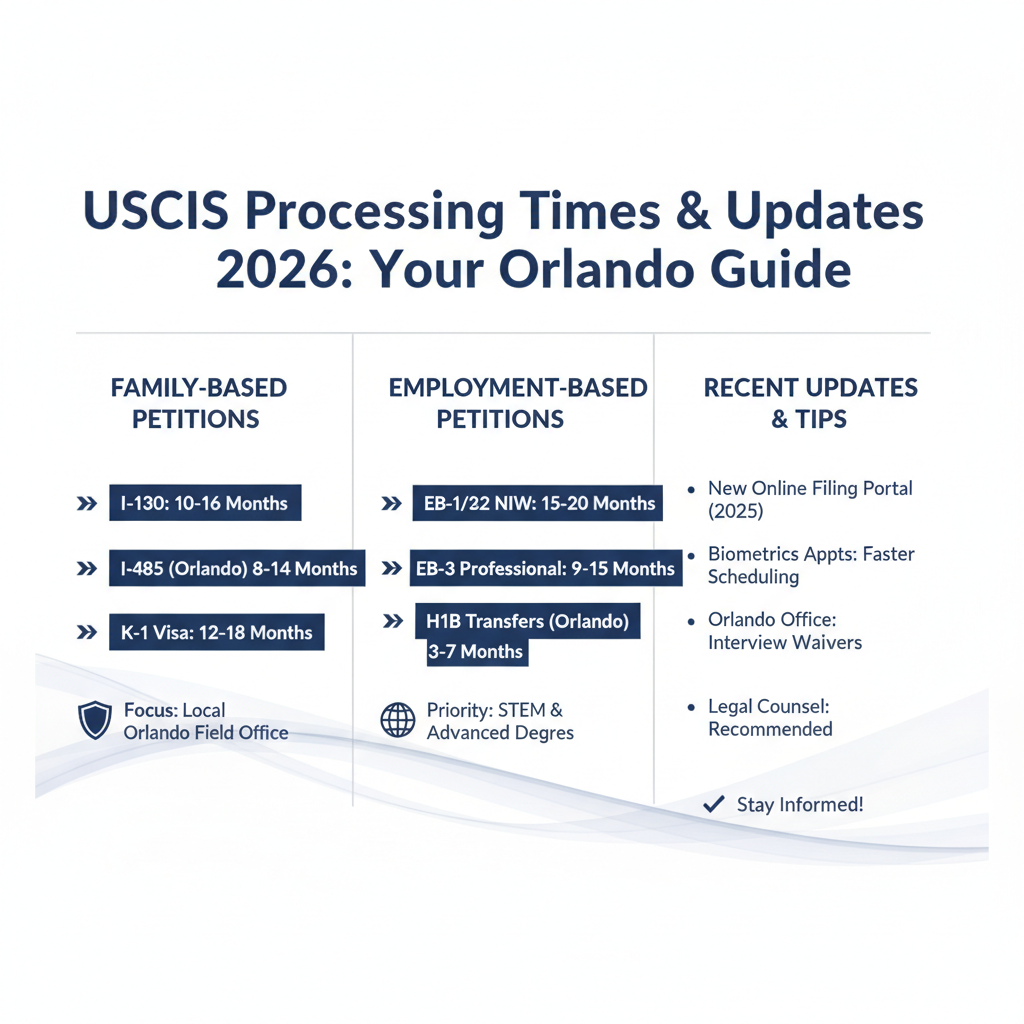
Why this news is showing up now
USCIS processing times are a constantly evolving metric, influenced by a myriad of factors including application volume, staffing levels, budget allocations, technological advancements, and shifts in immigration policy. The reason you're seeing ongoing news and updates about processing times in 2026 is multifaceted:
- Post-Pandemic Backlog Recovery: While significant progress has been made since the peak of the COVID-19 pandemic, USCIS continues to grapple with and reduce inherited backlogs across various application types. The agency has implemented new strategies, including increased staffing and digital processing initiatives, but the impact is ongoing and requires continuous monitoring.
- Policy Adjustments: Changes in presidential administrations or congressional mandates often lead to shifts in processing priorities. For instance, new directives might prioritize certain types of humanitarian cases or family reunification efforts, which can inadvertently affect the timelines for other application categories.
- Technological Enhancements: USCIS is actively investing in modernizing its systems, moving towards more digital processing and online filing options. While these efforts are designed to improve efficiency in the long run, the transition phases can sometimes lead to temporary adjustments in processing times as new systems are integrated and staff are trained.
- Budget and Resources: USCIS is primarily funded by application fees. Fluctuations in fee revenue, combined with congressional appropriations, directly impact the agency's ability to hire and retain staff, invest in technology, and manage its caseload effectively. Regular budget cycles mean that resource availability is a recurring factor in processing efficiency.
- Public Scrutiny and Advocacy: There is consistent public and congressional pressure on USCIS to improve processing times, especially given the human impact of delays. This ongoing scrutiny means the agency frequently reports on its progress and adjusts its strategies, generating regular news and updates for the public.
How it can affect Florida residents
Florida, particularly Central Florida and the Orlando metropolitan area, is a vibrant hub for immigrants from around the globe. This unique demographic composition means that USCIS processing times have a particularly significant impact on our local communities:
- Orlando Field Office Caseload: The Orlando USCIS Field Office serves a vast and diverse population, including residents of Orange County, Seminole County, Osceola County, and beyond. High volumes of applications, especially for Adjustment of Status (Form I-485), Naturalization (Form N-400), and family-based petitions (Form I-130) processed here, mean that local processing times can sometimes differ from national averages. For Central Florida residents, understanding these local nuances is critical.
- Diverse Immigrant Communities: Florida is home to large populations of immigrants from Latin America, the Caribbean, and other regions. Specific processing delays can disproportionately affect these communities, impacting family reunification efforts, employment opportunities, and long-term stability. For example, delays in green card processing can mean families remain separated longer, or individuals face prolonged uncertainty regarding their status along the I-4 corridor.
- Economic Impact: Immigrants play a vital role in Florida's economy, contributing to various sectors from hospitality to agriculture and technology. Prolonged processing times for employment authorization documents (Form I-765) or employment-based green cards can hinder economic growth, prevent individuals from starting businesses, or delay critical staffing for local companies in Orlando and surrounding areas.
- Local Legal Resources: The demand for experienced immigration legal counsel in Orlando is consistently high due to these factors. Imigrar, strategically located in Orlando, is uniquely positioned to assist local residents in navigating these complexities. Our team is intimately familiar with the specific challenges and opportunities that arise for immigrants in Florida.
- State-Specific Policies (Indirect Influence): While USCIS is a federal agency, state-level discussions and policies regarding immigrants can sometimes create additional layers of concern or confusion for Florida residents. While these don't directly impact federal processing times, they can add to the overall stress and urgency for applicants seeking stable immigration status.
Need Help? Our Orlando immigration team is ready to assist. Call +1 786-791-3106 for a free consultation, or message us online. Se Habla Español.
What USCIS Processing Times Are (and Why They Matter So Much)
A plain-English definition
Simply put, USCIS Processing Times refer to the amount of time it takes for U.S. Citizenship and Immigration Services to process an immigration application or petition from the moment they receive it until they make a final decision. This includes everything from initial data entry and background checks to interviews and final approval or denial.
These times are typically displayed on the USCIS Processing Times page and are calculated based on the majority of cases completed over a recent period. For example, if USCIS states that Form I-130 (Petition for Alien Relative) processing time is 12-18 months at a specific service center, it means that 80% of those forms were completed within that timeframe. Your individual case might fall outside this range, but it gives you a general expectation.
Understanding these times is critical because they dictate when you can expect a decision on your case, when you can apply for ancillary benefits like work authorization (Form I-765) or travel permits (Form I-131), and when you might be eligible for an interview at the Orlando Field Office or another local USCIS office.
Key terms you need to know
Navigating the USCIS system requires familiarity with several important terms:
- Receipt Date: This is the date USCIS officially receives your application or petition. It's usually printed on your Form I-797C, Notice of Action, and is the starting point for calculating your processing time.
- Priority Date: Primarily relevant for family-sponsored and employment-based green card categories that are subject to annual numerical limits. The Priority Date is established when your petition (e.g., Form I-130 or Form I-140) is properly filed. You cannot finalize your green card process (through Adjustment of Status or Consular Processing) until your Priority Date becomes current according to the Visa Bulletin published by the U.S. Department of State.
- Notice Date: The date printed on your official USCIS notices, such as receipt notices, Requests for Evidence (RFEs), or approval notices.
- Normal Processing Time: The estimated range of time USCIS expects to take to process a particular form at a specific service center or field office. This is what you see on the USCIS processing times page.
- Case Status Online: The online tool on the USCIS website where you can enter your Receipt Number to track the progress of your application. This is your primary resource for real-time (or near real-time) updates.
- Service Request (e-Request): An online inquiry you can submit to USCIS if your case is outside of normal processing times, if you haven't received a notice, or for other specific issues.
- Outside Normal Processing Time: When your application's Receipt Date is earlier than the "receipt date for a case inquiry" listed on the USCIS processing times page for your form and service center/field office. This is generally when you are eligible to make an inquiry.
- Request for Evidence (RFE): A letter from USCIS asking for additional documents or information to support your application. Responding promptly and accurately to an RFE is crucial.
- Notice of Intent to Deny (NOID): A notice from USCIS indicating their intent to deny your application unless you provide specific additional information or arguments within a given timeframe.
- Adjudication: The process by which USCIS reviews an application or petition and makes a decision.
Current Immigration Law: The Foundation of Processing Times
While processing times themselves are administrative metrics, they are deeply rooted in the statutory and regulatory framework of U.S. immigration law. The Immigration and Nationality Act (INA) is the bedrock of this system, establishing the categories of visas, eligibility requirements, and the fundamental processes that USCIS administers.
Federal requirements
The INA, along with subsequent amendments and regulations published in the Code of Federal Regulations (CFR), dictates the legal requirements for every immigration benefit. For example:
- Family-Based Immigration: Sections 201 and 203 of the INA establish the categories for family-sponsored visas (e.g., immediate relatives of U.S. citizens, preference categories) and the annual numerical limits for most of these categories. Processing for forms like Form I-130, Petition for Alien Relative, and subsequent Form I-485, Application to Register Permanent Residence or Adjust Status, is governed by these provisions.
- Employment-Based Immigration: INA Section 203(b) outlines the five preference categories for employment-based immigrants, each with its own requirements and numerical limits. Forms such as Form I-140, Immigrant Petition for Alien Worker, fall under this section.
- Adjustment of Status: INA Section 245 details the eligibility criteria for individuals to adjust their status to lawful permanent resident while remaining in the United States. This is a critical process for many immigrants in Orlando seeking their green card without leaving the country.
- Naturalization: INA Section 316 sets forth the general requirements for naturalization, including continuous residence, physical presence, good moral character, and English language/civics knowledge. The processing of Form N-400, Application for Naturalization, is directly tied to these legal mandates.
USCIS, as an agency under the Department of Homeland Security, is responsible for adjudicating these applications in accordance with these federal laws and regulations. While the laws define *who* is eligible and *what* they need to provide, the processing times reflect the administrative burden and operational efficiency of the agency in applying these laws.
You can find official forms and detailed instructions on the USCIS Forms page.
Florida-specific considerations
While immigration law is federal, its implementation and impact vary regionally. For Florida residents, especially those in the Orlando area, several factors indirectly influence their experience with USCIS processing:
- High Volume of Filings: Florida is a major destination for immigrants, leading to a consistently high volume of applications filed with USCIS service centers and processed by the Orlando Field Office. This high demand can contribute to localized processing times that might be longer than in areas with lower immigration populations.
- Local Resources and Support: The concentration of immigrant communities in Orlando and across Florida means there's a robust network of non-profit organizations, community groups, and legal aid services. These resources can be invaluable for applicants navigating complex processing delays, though they do not directly influence USCIS processing.
- Economic Migration Patterns: Florida's robust tourism, agriculture, and service industries attract many immigrants seeking work. This can lead to a higher prevalence of certain visa types (e.g., H-2B visas, or employment-based green cards) that might have specific processing bottlenecks or seasonal demands.
- Language Access: With a significant Spanish-speaking population, Florida applicants often require resources and services in Spanish. Imigrar prides itself on being bilingual (Se Habla Español) to ensure clear communication and support for all our clients.
Understanding these federal requirements and how they manifest locally is key to managing expectations and strategically planning your immigration journey. Always refer to the USCIS official website for the most current information and forms.
How to Navigate USCIS Processing Times: A Complete Step-by-Step Guide
Managing the waiting period for your immigration application can be stressful. Here’s a comprehensive guide to understanding and navigating USCIS processing times effectively.
1) Understand Your Application and Its Typical Timeline
Before you even submit your application, or certainly once you have, it's crucial to identify exactly what you've filed and where it will be processed. USCIS has multiple Service Centers (e.g., California, Nebraska, Texas, Vermont) that handle mail-in applications for certain forms, and Field Offices (like the Orlando Field Office) that handle interviews and some localized adjudications.
- Identify Your Form: Know the specific USCIS form number you filed (e.g., Form I-130, Form I-485, Form N-400).
- Determine Your Processing Location: Your Form I-797C, Notice of Action, will indicate which Service Center or Field Office is handling your case. This is vital because processing times vary significantly by location.
- Check USCIS Processing Times Page: Regularly visit the USCIS Processing Times tool. Select your form type and the relevant Service Center or Field Office to see the current estimated range.
- Required Documents:
- Your Form I-797C (Notice of Action)
- The specific USCIS form number you filed
- Your Receipt Number (typically starts with EAC, WAC, LIN, SRC, IOE, or MSC)
- Required Documents:
2) Monitor Your Case Status Regularly
The USCIS online Case Status Online tool is your primary resource for updates. While it doesn't always show immediate progress, it will notify you of significant actions.
- Access the Tool: Go to the USCIS website and find the "Check Your Case Status" link.
- Enter Your Receipt Number: Input the 13-character Receipt Number from your Form I-797C.
- Understand Status Updates:
- "Case Was Received": Initial confirmation.
- "Biometrics Appointment Was Scheduled": For fingerprinting.
- "Fingerprint Review Was Completed": Your biometrics have been processed.
- "Request for Evidence Was Sent": You need to respond to an RFE.
- "Interview Was Scheduled": For cases requiring an interview (common for Form I-485, Form N-400 at the Orlando Field Office).
- "Case Was Approved/Denied": The final decision.
- Set Up Email/Text Notifications: You can create an account on the USCIS website to receive automatic updates.
- Required Documents:
- Your Receipt Number
- Access to the email address or phone number you wish to receive alerts on
- Required Documents:
3) Know When Your Case is "Outside Normal Processing Time"
This is a critical threshold. You generally cannot make an inquiry about your case until it falls outside the normal processing window.
- Compare Your Receipt Date: On the USCIS Processing Times page, find the "receipt date for a case inquiry" for your specific form and processing location.
- The Rule: If your Receipt Date is *earlier* than the "receipt date for a case inquiry," then your case is officially "outside normal processing time," and you are eligible to submit an inquiry.
- Example: If the USCIS site says "receipt date for a case inquiry" is January 1, 2025, and your Receipt Date is December 15, 2024, your case is outside normal processing time.
- Important: Do not make an inquiry before your case is outside this window, as it will likely be rejected or simply add to USCIS's workload without expediting your case.
- Required Documents:
- Your Form I-797C (Notice of Action) with your Receipt Date
- A screenshot or printout of the current USCIS processing times for your form and location
- Required Documents:
4) Submitting an "e-Request" or Service Request
Once your case is outside normal processing time, or if you have specific issues (e.g., missing a receipt notice, EAD card not delivered), you can submit an online inquiry.
- Navigate to the e-Request Page: On the USCIS website, find the "Tools" section and select "e-Request."
- Choose Your Inquiry Type:
- "Case outside normal processing time"
- "Did not receive a card"
- "Did not receive a notice"
- "Typographical error"
- "Expedite Request" (for urgent situations, requires strong justification)
- Provide Details: Fill in all requested information accurately, including your Receipt Number, A-Number (if applicable), and contact details. Describe your issue clearly.
- Keep Records: You will receive a confirmation number for your e-Request. Save it and any subsequent correspondence from USCIS.
- Required Documents:
- Your Receipt Number and A-Number (if applicable)
- All personal identifying information (name, date of birth, address)
- Details of the issue you are inquiring about
- Required Documents:
5) Contacting USCIS Directly (Tier 1 & Tier 2 Officers)
If online inquiries don't yield results or if your situation requires more direct communication, you can call the USCIS Contact Center.
- Call the Main Number: 1-800-375-5283 (TDD for the hearing impaired: 1-800-767-1833). Have your Receipt Number and all relevant case information ready.
- Speak to a Tier 1 Officer: These officers can provide general information, check basic case status, and sometimes submit an inquiry on your behalf. They are often the first point of contact.
- Request a Tier 2 Officer: If a Tier 1 officer cannot resolve your issue or provide sufficient information, you can request to speak with a Tier 2 officer. These officers have access to more detailed case information and can sometimes offer more specific insights or actions.
- Reminder: Tier 2 officers typically call back within a few days, so be prepared to answer your phone.
- Document Everything: Note the date, time, name of the officer (if provided), and the content of your conversation for your records.
- Required Documents:
- Your Receipt Number, A-Number, and all personal details
- Any previous e-Request confirmation numbers
- A detailed log of all prior communications with USCIS
- Required Documents:
6) Congressional Inquiries and Ombudsman Assistance
For persistent delays or complex issues, you may need to escalate your inquiry.
- Contact Your Congressional Representative: Your U.S. Senator or Representative can submit an inquiry on your behalf to USCIS. This can sometimes prompt a review of your case.
- How to: Visit your representative's official website, find the "constituent services" or "help with a federal agency" section, and follow their instructions to submit an inquiry. You will need to provide a privacy release form.
- For Orlando/Central Florida residents: Identify your specific congressional district and representative.
- Office of the Citizenship and Immigration Services Ombudsman: The Ombudsman's office assists individuals and employers in resolving problems with USCIS. They act as a neutral party to facilitate communication and address systemic issues or individual case problems.
- How to: Visit the DHS Ombudsman website and follow their instructions for submitting a request for assistance. This is often recommended after you have exhausted USCIS's own inquiry channels.
- Warning: The Ombudsman's office is not a substitute for


