


The reporting that sparked this guide
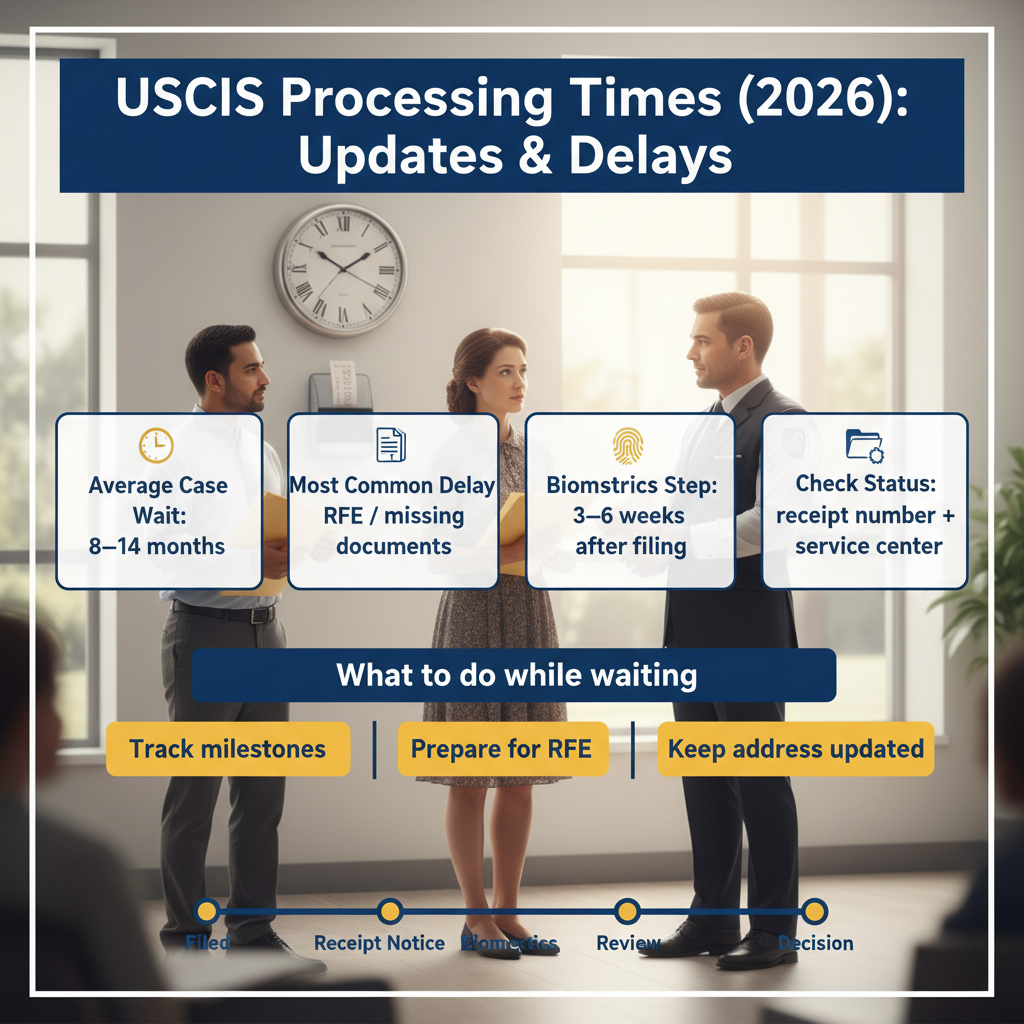
The reporting that sparked this guide: USCIS Processing Times and Updates for 2026 (USCIS)
Need Help? Our Orlando immigration team is ready to assist. Call +1 786-791-3106 for a free consultation, or message us online. Se Habla Español.
What This News Means for Immigrants in Orlando and Across Florida
Why this news is showing up now
USCIS processing times are trending in 2026 because more applicants are checking case timelines in real time—and because delays can affect work authorization, travel plans, and family unity. USCIS publishes tools and updates that help the public understand how long certain applications are taking, but the numbers can change quickly based on staffing, filing surges, policy shifts, security checks, and workload differences between service centers and field offices.
Important: “Processing time” is not a guarantee. It is a statistical estimate based on recent completions. A case can move faster or slower depending on its facts, the evidence submitted, and whether USCIS issues a Request for Evidence (RFE), schedules an interview, or needs additional background checks.
In 2026, many families are also watching timelines closely because delays can impact when someone becomes eligible for benefits tied to status—like renewing a driver’s license, extending work authorization, or filing for Adjustment of Status through Form I-485.
How it can affect Florida residents
For Central Florida residents—especially along the I-4 corridor (Orlando, Kissimmee, Sanford, Deltona, Daytona)—USCIS processing times matter because the local workload and interview capacity can influence how quickly cases move from “filed” to “approved.” If your case is in Orlando, the timing of your interview at the Orlando USCIS Field Office can be a major milestone for family-based green cards, naturalization, and certain humanitarian cases.
Here are common Florida-specific ways processing times can affect you:
- Work authorization gaps: If an EAD renewal is delayed, your job and income may be at risk.
- Travel risks: If Form I-131 (Advance Parole) is pending, travel may be unsafe or impossible.
- Family separation: Delays in Form I-130 can postpone consular processing for spouses, parents, and children.
- Interview scheduling: Field office backlogs can push interviews out, affecting Adjustment of Status timelines.
- School and benefits planning: Families often plan around status milestones (e.g., green card approval, naturalization eligibility).
Reminder: If you move within Florida (for example, from Orange County to Osceola County) or out of state, you must update your address promptly. A missed notice can create major delays or even a denial.
What USCIS Processing Times and Updates for 2026 Is (and Why It Matters)
A plain-English definition
“USCIS processing times” are USCIS’s published estimates of how long it takes to decide a specific type of immigration application (a “form”) at a specific office (service center or field office). USCIS updates these estimates regularly and provides tools to:
- Check typical timelines for your form and office
- See a “case inquiry date” (the date when you can ask USCIS about a case that is taking longer than normal)
- Track whether USCIS is meeting its own internal goals
In practical terms, these updates matter because the difference between “6 months” and “14 months” can affect: employment, travel, family planning, eligibility for benefits, and legal strategy.
Key terms you need to know
- Receipt Notice: The USCIS notice confirming they received your filing (often starts with IOE, LIN, WAC, SRC, MSC, or EAC).
- Biometrics: Fingerprints/photo appointment used for identity and security checks.
- RFE (Request for Evidence): USCIS asks for more documents; this almost always adds time.
- NOID (Notice of Intent to Deny): A warning that USCIS plans to deny unless you respond strongly and on time.
- Interview: Required for many cases, especially Form I-485 and Form N-400.
- Priority Date: The place in line for certain immigrant visa categories (especially family preference and employment-based).
- Visa Bulletin: Department of State chart that controls when certain applicants can move forward based on the Priority Date.
- Case Inquiry Date: The date after which you can submit a “case outside normal processing time” request.
- Premium Processing: Faster processing for certain employment filings (not available for most family cases).
Warning: Social media “timeline predictions” can be misleading. The most reliable baseline is the official USCIS tool: USCIS Processing Times.
Current Immigration Law: The Foundation
Processing times are an administrative reality, but your eligibility is governed by statutes, regulations, and agency guidance. Understanding the legal framework helps you avoid mistakes that cause delays—or denials.
Federal requirements
Key legal authorities that commonly apply to family-based and adjustment cases include:
-
The Immigration and Nationality Act (INA), including:
- INA § 201–203 (immigrant visa categories and numerical limits)
- INA § 204 (family- and employment-based petition procedures, including Form I-130)
- INA § 245 (eligibility for Adjustment of Status using Form I-485)
- INA § 212 (grounds of inadmissibility that can trigger denials or require waivers)
- INA § 316 and § 319 (naturalization requirements for Form N-400)
- Federal regulations in 8 C.F.R. that govern filing, evidence, interviews, and adjudications (including biometrics and RFEs).
- Agency policy guidance (USCIS Policy Manual), which affects how officers apply the law in day-to-day decisions.
USCIS forms commonly impacted by 2026 processing trends include: Form I-130 (family petition), Form I-485 (green card application), Form I-765 (work permit), Form I-131 (travel document), Form N-400 (naturalization), and Form I-751 (remove conditions). Always confirm current editions and instructions at the USCIS official website and USCIS Forms.
Important: Some timelines are also influenced by the Department of State (consular processing and the Visa Bulletin). See U.S. Department of State.
Florida-specific considerations
Immigration law is federal, but Florida residents face practical, local issues that can affect timing and outcomes:
- Local interview capacity: The Orlando area’s growth can increase demand for interviews at the Orlando USCIS Field Office.
- Address changes and mail reliability: Moves within Orange County or along the I-4 corridor can lead to missed USCIS notices if addresses are not updated.
- State-level documentation needs: Driver’s license renewals, employment onboarding, and school enrollment may require updated immigration documents while a case is pending.
- Travel through Florida airports: If you have a pending Adjustment of Status, travel without Advance Parole may abandon your Form I-485 in many cases.
Reminder: If your case touches immigration court, timelines are separate from USCIS processing times. Court schedules and proceedings are managed by EOIR: Executive Office for Immigration Review.
Need Help? Our Orlando immigration team is ready to assist. Call +1 786-791-3106 for a free consultation, or message us online. Se Habla Español.
How to Check and Respond to USCIS Processing Times in 2026: A Complete Step-by-Step Guide
This step-by-step guide helps you use USCIS’s tools correctly, avoid common traps, and take the right action at the right time—without accidentally creating delays.
1) Identify your exact form, category, and the office handling your case
Processing times depend on three things: the form type, the specific category (for example, family relationship or eligibility basis), and the office (service center or field office). Two people with the same form can have different timelines if their cases are routed to different locations.
What to do:
- Find your receipt number and receipt notice (Form I-797C).
- Confirm the form: Form I-130, Form I-485, Form N-400, etc.
- Confirm your category (e.g., spouse of U.S. citizen, parent of U.S. citizen, F2A, employment-based, asylum-based, etc.).
- Confirm the “office” shown in the USCIS processing times tool (service center or field office).
Documents to gather:
- Receipt Notice(s) (Form I-797C) for each pending application
- A copy of the full filing package you submitted (recommended)
- Government-issued photo ID
2) Check official processing times and the “case inquiry date”
Use the official tool to check how long USCIS is taking and when you are allowed to submit a case inquiry. Go to USCIS Processing Times.
What to do:
- Select your form type.
- Select your category (if prompted).
- Select the office listed for your case.
- Record the posted processing range and the “receipt date for a case inquiry.”
Important: If you file multiple forms together (common with Adjustment of Status), you may have separate timelines for Form I-485, Form I-765, and Form I-131.
Documents to gather:
- Receipt number(s)
- Office information (service center/field office)
- Any USCIS notices showing transfers between offices
3) Track your case status and set up account alerts
Case status updates can be sporadic, but they matter. Sometimes USCIS will show “Case Was Updated to Show Fingerprints Were Taken” or “Interview Was Scheduled” before you receive mail.
What to do:
- Create or log in to your USCIS online account (if eligible for your receipt type).
- Enable email/text alerts.
- Check your mailing address is correct and consistent across filings.
Documents to gather:
- USCIS online account login details
- Copies of any notices already received
- Proof of current address (lease, utility bill) in case you need to update
4) Prepare for the most common delay triggers (RFE, biometrics, interview)
Many “processing time” issues are actually evidence issues. A well-prepared filing reduces the risk of an RFE, which can add weeks or months. In 2026, USCIS continues to scrutinize completeness, translations, and consistency across forms.
What to do:
- Review what you filed for missing signatures, missing pages, or outdated form editions.
- Organize civil documents (birth/marriage/divorce certificates) and certified translations.
- For marriage cases, prepare strong bona fide marriage evidence for interview.
- For Form I-485, ensure the medical exam (Form I-693) strategy is correct (timing matters).
Documents to gather (examples):
- Birth certificates (long-form if available), with certified English translations if needed
- Marriage certificate and divorce decrees/annulments (if any)
- Passport biographic page, visas, I-94 record
- Joint documents (lease, bank, insurance, tax returns) for marriage-based cases
- Any prior immigration records, notices, or court documents (if applicable)
5) Take the correct action when your case is delayed (without creating new delays)
If your case is beyond the “case inquiry date,” you can generally request help through USCIS channels. The best option depends on what is pending and why it matters (work, travel, family emergency).
What to do (common options):
- Submit a “Case outside normal processing time” inquiry (when eligible).
- Request a callback or appointment if USCIS offers it for your situation.
- If you have an urgent need (such as imminent travel or severe financial loss), evaluate whether an expedite request is appropriate.
- If you are represented, coordinate communications through counsel to avoid inconsistent statements.
Warning: Expedite requests are discretionary and require evidence. Filing repeated or unsupported requests can waste time and may not help.
Documents to gather (for possible expedite):
- Employer letter describing job loss risk or urgent business need
- Medical records for urgent humanitarian reasons
- Evidence of financial loss (eviction notice, past-due bills, termination letter)
- Travel itinerary and proof of emergency (if applicable)
6) Plan around dependent timelines: EAD/AP, Visa Bulletin, and interview scheduling
Many families assume the green card timeline is the only one that matters. In reality, several “connected” timelines can affect your life: work permits, travel documents, and visa availability based on your Priority Date.
What to do:
- Track Form I-765 and Form I-131 timelines separately from Form I-485.
- For preference categories, monitor the Visa Bulletin on U.S. Department of State.
- Prepare early for interview notices—many interviews are scheduled with limited lead time.
Documents to gather:
- All receipt notices for each form filed
- Copies of EAD card(s) and prior approvals
- Updated relationship evidence (new lease, new child’s birth certificate, updated insurance)
7) If denied or stuck, evaluate appeal/reopen options and next steps
Not every delay ends with an approval. Some cases receive an RFE, a NOID, or a denial. The right response depends on the form and the reason. Sometimes you can file a motion to reopen/reconsider; other times, refiling is the better strategy.
What to do:
- Read the decision carefully and note deadlines.
- Preserve evidence of timely filing and delivery.
- Consult an immigration attorney before refiling if unlawful presence, inadmissibility, or prior denials are involved.
Documents to gather:
- Denial notice (full copy)
- RFE/NOID and your response (if any)
- Complete copy of the original filing
- Any new evidence that cures the stated deficiency
Practical Steps You Can Take Today
If you are worried about USCIS processing times in 2026, the best approach is proactive: build a clean, well-documented case and track deadlines so you don’t lose time to avoidable issues.
Actionable checklist
- Check your office and category in the official tool: USCIS Processing Times.
- Create a “USCIS binder” (digital + paper): receipts, filings, notices, evidence, and translations.
- Calendar key dates: filing dates, biometrics, interview, and the “case inquiry date.”
- Prepare for RFEs: keep updated proof of relationship, employment, and residence.
- Plan renewals early: if you have an EAD, don’t wait until the last minute. Some categories have automatic extensions; others do not.
- Update your address immediately after moving to avoid missed notices and delays.
- Don’t travel without planning if you have a pending Adjustment of Status. Travel can be risky without Advance Parole.
Document preparation guidance
The fastest cases are often the most organized. USCIS delays frequently come from missing items, unclear copies, inconsistent dates, or incomplete translations. Consider these best practices:
- Use clear, legible scans; keep originals safe.
- Ensure names and dates match across passports, birth certificates, and forms (or explain discrepancies).
- Include certified translations when documents are not in English.
- For family cases, provide strong “real-life” evidence (shared address, shared finances, shared responsibilities).
Reminder: Always download the latest form edition from USCIS Forms before filing. Using the wrong edition can lead to rejection.
Timeline expectations (real-world planning)
Because processing times vary by form and office, the best planning method is to treat posted USCIS times as a range and build buffers. As a practical rule:
- Expect biometrics within weeks to a few months (varies widely).
- Expect RFEs to add additional weeks or months depending on response quality and USCIS workload.
- Expect interviews to depend heavily on field office capacity—especially if your case is in Orlando.
Warning: If you have a critical deadline (employment start date, travel emergency, or aging-out child), speak with counsel early. Waiting until the last 90-day window before an event can limit options.
Need Help? Our Orlando immigration team is ready to assist. Call +1 786-791-3106 for a free consultation, or message us online. Se Habla Español.
How Imigrar Helps Immigrants in Orlando
At Imigrar, we help individuals and families navigate USCIS processing delays with a strategy built around strong filings, clear evidence, and proactive case management. Our mission is simple: Keep Families Together.
If your case is in Orlando—or you live anywhere in Florida or the U.S.—we can help you:
- Choose the correct filing path for your family or employment situation
- Prepare a complete, organized packet to reduce RFEs and avoid preventable delays
- Track milestones and respond quickly to USCIS notices
- Prepare for interviews at the Orlando USCIS Field Office
- Evaluate expedite options when truly appropriate and well-supported
- Address complex issues like unlawful presence, prior denials, inadmissibility concerns, or immigration court overlap
We offer a free consultation. Call +1 786-791-3106 or message us online. Se Habla Español.
Frequently Asked Questions
Q: How do I know if I’m eligible to ask USCIS about a delayed case?
A: Check the “receipt date for a case inquiry” in the official tool at USCIS Processing Times. If your receipt date is earlier than the inquiry date shown, you can usually submit a “case outside normal processing time” request. Important: Being eligible to inquire does not guarantee USCIS will resolve the case immediately, but it can prompt review.
Q: Will checking processing times or contacting USCIS hurt my immigration status?
A: No. Checking processing times and making a proper inquiry does not harm your case by itself. The risk comes from submitting inconsistent information, missing deadlines, or traveling improperly while a case is pending. Reminder: If you have a pending Form I-485, do not travel internationally without legal advice and, in many cases, an approved Advance Parole document.
Q: How long will my Form I-130 or Form I-485 take in 2026?
A: Timelines depend on your category (immediate relative vs. preference), your office, whether an interview is required, and whether USCIS issues an RFE. The best baseline is the official USCIS estimate for your form and office. If your case is in Orlando, interview scheduling at the Orlando USCIS Field Office can be a key factor for Adjustment of Status cases.
Q: What documents most often cause delays or RFEs?
A: Common RFE triggers include missing civil documents (birth/marriage/divorce records), weak relationship evidence in marriage cases, missing signatures, unclear copies, and missing translations. For Form I-485, issues can also include incomplete medical exams (Form I-693) or unanswered inadmissibility questions. A well-organized filing and consistent records can reduce delays significantly.
Q: What does it cost to file, and can delays increase the total cost?
A: USCIS filing fees vary by form and can change. Always verify current fees and instructions on the USCIS official website. Delays can increase indirect costs (lost wages if an EAD is delayed, extra medical exams if timing expires, additional document requests, and legal fees if a case becomes complicated). Planning early and filing correctly can reduce the risk of added expenses.
Q: What happens if my case is denied after a long wait?
A: The next step depends on the form and the reason for denial. Some denials allow a motion to reopen or reconsider, while others are best addressed by refiling with corrected evidence. Warning: If the denial involves unlawful presence, misrepresentation, or other inadmissibility findings, the consequences can be serious and may affect future filings. Speak with an immigration attorney promptly to protect your options and meet deadlines—some responses must be filed within strict time limits, and missing them can be costly.
Q: Can I expedite my case in 2026 because processing times are long?
A: Sometimes, but not just because you are frustrated by delays. Expedite is discretionary and typically requires strong evidence of severe financial loss, urgent humanitarian reasons, compelling U.S. government interests, or other qualifying factors. If you are considering expedite for Form I-765 or Form I-131, gather documentation (employer letters, medical records, proof of emergency) and consider legal guidance to present a coherent request.
Common Mistakes (and How to Avoid Them)
Mistake #1: Assuming all USCIS offices have the same timeline
Processing times vary by office. A case handled by one service center may move faster than another, and field office interview backlogs can change quickly. How to avoid it: Always select the correct office and category in the official USCIS Processing Times tool and keep records of transfers.
Mistake #2: Waiting too long to prepare for an RFE or interview
Many families scramble only after a notice arrives. That can lead to rushed, incomplete responses. How to avoid it: Build your evidence file from day one—especially for marriage-based Form I-485 interviews. If your case is in Orlando, prepare early because interview scheduling can move quickly once you are in the queue.
Mistake #3: Traveling or changing plans without understanding the impact on pending applications
International travel can be risky for applicants with pending Adjustment of Status. Moving addresses without updating USCIS can cause missed appointments and denials. How to avoid it: Get legal advice before travel, keep copies of all receipts, and update your address promptly to prevent lost notices.
Need Help? Our Orlando immigration team is ready to assist. Call +1 786-791-3106 for a free consultation, or message us online. Se Habla Español.

Closing: Get a Clear Strategy for USCIS Processing Delays in 2026
USCIS processing times in 2026 can feel unpredictable—but you are not powerless. The strongest way to protect your case is to file correctly, track your timelines using official tools, respond quickly to notices, and avoid decisions (like travel or missed address updates) that can create preventable setbacks.
If your case is in Orlando, if you live in Orange County, or if you’re anywhere along the I-4 corridor and need help understanding what these processing time updates mean for your family, Imigrar is ready to help.
Call +1 786-791-3106 for a free consultation or message us online. Se Habla Español. Our mission is to Keep Families Together.


