


The journey to a new life in the United States is often marked by hope, determination, and, for many, a significant amount of waiting. Understanding USCIS processing times is not just about checking a website; it's about managing expectations, planning your future, and preparing for every eventuality. As we move through 2026, the United States Citizenship and Immigration Services (USCIS) continues to navigate evolving caseloads, policy changes, and technological advancements that directly impact how long it takes for your application to be processed.
At Imigrar, an immigration law firm based in Orlando, Florida, we understand the anxiety and uncertainty that come with these waiting periods. Our mission is to "Keep Families Together," and that means providing clear, accurate, and actionable information to help you navigate the complexities of immigration law. This comprehensive guide will break down the latest insights into USCIS processing times and updates for 2026, offering practical advice for immigrants in Orlando, across Florida, and nationwide.
Today, 2026-05-07, we reflect on the current landscape and what it means for your immigration journey.
Need Help? Our Orlando immigration team is ready to assist. Call +1 786-791-3106 for a free consultation, or message us online. Se Habla Español.
The reporting that sparked this guide:
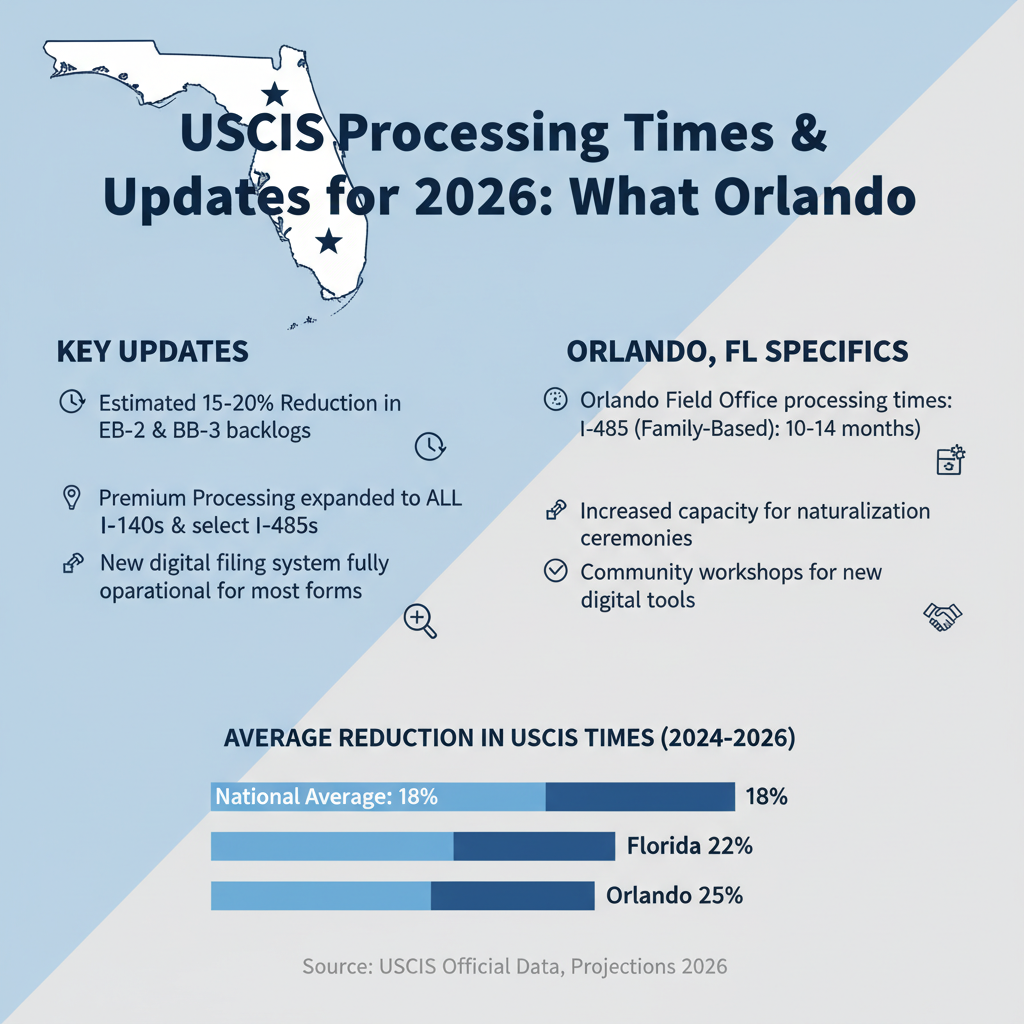
USCIS Processing Times and Updates for 2026 (USCIS)
What This News Means for Immigrants in Orlando and Across Florida
The constant stream of updates regarding USCIS processing times is more than just administrative news; it’s directly tied to the lives and futures of millions. For immigrants living in Orlando and throughout Florida, these updates dictate everything from when families can reunite to when individuals can start new jobs or obtain permanent residency.
Why this news is showing up now
The continuous reporting on USCIS processing times is a reflection of several persistent factors that make this a perpetually "trending" topic in immigration. USCIS, like any large government agency, faces ongoing challenges that influence its efficiency and speed:
- Backlogs and Demand: Post-pandemic, USCIS has grappled with significant backlogs across various application types. While efforts have been made to reduce these, new applications continue to pour in, often outpacing the agency's processing capacity. This is particularly true for popular categories like family-based petitions and employment authorizations.
- Policy Changes: Shifting immigration policies, whether related to border security, visa categories, or expedited processing options, can dramatically impact resource allocation and processing priorities within USCIS. Each policy adjustment can create ripple effects on wait times for different forms.
- Budget and Staffing: USCIS is primarily funded by application fees. Fluctuations in fee revenue, coupled with staffing levels and technological infrastructure, directly affect the agency's ability to hire and train personnel, and implement efficient processing systems. When resources are strained, processing times often increase.
- Technological Modernization: USCIS is continuously working to modernize its systems, transitioning from paper-based to digital processes. While intended to improve efficiency long-term, these transitions can sometimes cause short-term disruptions or require significant adjustments that affect current processing speeds.
- Increased Scrutiny: There is ongoing public and congressional scrutiny regarding USCIS efficiency and transparency. This pressure often leads to more frequent reporting and public statements about processing goals and challenges.
For these reasons, USCIS processing times are not static; they are a dynamic reflection of a complex system under constant pressure and evolution. Staying informed, as provided by sources like the USCIS Processing Times page, is crucial.
How it can affect Florida residents
Florida, a vibrant and diverse state, is home to a large immigrant population. For residents in Orlando and the broader Central Florida region, fluctuating USCIS processing times have specific and profound implications:
- Family Reunification: Many Orlando families rely on family-based petitions (like Form I-130, Petition for Alien Relative) to bring loved ones to the U.S. Longer processing times can mean extended periods of separation, causing emotional and financial strain.
- Employment Opportunities: For those seeking work authorization (Form I-765, Application for Employment Authorization) or employment-based green cards, delays can mean missed job opportunities, loss of income, or uncertainty about career progression in industries vital to Florida's economy, such as tourism, agriculture, and healthcare.
- Adjustment of Status: Individuals in Florida applying for Adjustment of Status (Form I-485) to become permanent residents often face interviews at local field offices. The Orlando USCIS Field Office, like others, can experience varying backlogs, impacting interview scheduling and final decisions.
- Travel Restrictions: Delays in obtaining Advance Parole (Form I-131, Application for Travel Document) can prevent immigrants from traveling internationally to visit family or for business without jeopardizing their pending immigration applications.
- Local Economy: The immigrant community contributes significantly to Florida's economy. Delays in processing can impact local businesses reliant on immigrant labor or entrepreneurship, and affect consumer spending.
- Community Planning: For cities like Orlando and counties like Orange County, demographic shifts and population growth are influenced by immigration. Predictable processing times allow for better community planning and resource allocation.
Understanding these impacts is the first step toward effective planning. At Imigrar, we specialize in guiding Florida residents through these challenges, helping to mitigate the stress of prolonged waits and ensuring applications are as strong as possible.
What USCIS Processing Times Are (and Why It Matters)
When you submit an immigration application to USCIS, one of the first questions that comes to mind is, "How long will this take?" The answer lies in understanding USCIS processing times. These times are not merely statistics; they are a critical indicator of when you can expect a decision on your case, directly impacting your ability to work, travel, and live freely in the United States.
A plain-English definition
In simple terms, USCIS processing times represent the average amount of time it takes for USCIS to process a specific type of application or petition from the date they receive it to the date they make a decision. These times are published on the USCIS website and are usually displayed as a range (e.g., "6 months to 10 months") or as the time it takes to process 80% of cases. They are calculated based on historical data of completed cases at a particular service center or field office for a specific form type and case category.
Important: Processing times are estimates, not guarantees. Your individual case might be processed faster or slower than the posted times due to various factors unique to your application.
Key terms you need to know
Navigating the world of immigration processing requires familiarity with certain terminology. Here are some key terms that will help you understand your situation better:
- Receipt Date: This is the date USCIS physically receives your application or petition. It's crucial because processing times usually start counting from this date. Always keep your Form I-797C, Notice of Action, which confirms your receipt date and receipt number.
- Priority Date: Primarily relevant for preference immigrant categories (certain family-based and most employment-based visas), the Priority Date is the date your petition (usually Form I-130 or Form I-140) was properly filed with USCIS. It determines your place in the visa queue, as there are annual limits on the number of visas available in these categories. Your Priority Date must be "current" according to the U.S. Department of State's Visa Bulletin before you can apply for an immigrant visa or Adjustment of Status.
- National Benefits Center (NBC): One of several centralized processing facilities for certain types of applications, particularly those involving Adjustment of Status (Form I-485) and related forms like Form I-765 (Employment Authorization) and Form I-131 (Travel Document). The NBC often handles initial processing before cases are sent to a local field office for interviews.
- Field Office: These are local USCIS offices (like the Orlando USCIS Field Office) where interviews for certain applications (e.g., Adjustment of Status, Naturalization) are conducted. The processing times for cases requiring interviews are often influenced by the specific field office's caseload.
- Service Center: These are large processing centers (e.g., California, Nebraska, Texas, Vermont) that handle specific types of applications from specific geographic regions. Many petitions and applications are adjudicated entirely at a service center without the need for a field office interview.
- Adjustment of Status (AOS): This is the process of applying for lawful permanent resident status (a Green Card) while physically present in the United States. It involves filing Form I-485 and typically requires an interview.
- Consular Processing: This is the process of applying for an immigrant visa at a U.S. embassy or consulate abroad. It's for individuals who are outside the U.S. and cannot adjust their status domestically.
- Request for Evidence (RFE): A notice from USCIS requesting additional information or documentation to support your application. Responding promptly and thoroughly to an RFE is crucial to avoid delays or denials.
Understanding these terms empowers you to better interpret the information provided by USCIS and to communicate more effectively with your legal counsel at Imigrar.
Feeling overwhelmed by immigration jargon? Our team at Imigrar can clarify every term and guide you through your case. Call +1 786-791-3106 for expert assistance. Se Habla Español.
Current Immigration Law: The Foundation of Processing
The entire framework of USCIS processing times is built upon the intricate foundation of U.S. immigration law. While processing times themselves are administrative, they are directly influenced by the statutes, regulations, and policies that govern who can immigrate, under what conditions, and in what order. Understanding this legal backdrop helps demystify why certain applications take longer than others.
The primary body of law governing immigration in the United States is the Immigration and Nationality Act (INA). This act, along with subsequent amendments and regulations, establishes the various categories of visas, eligibility requirements, and the procedures for obtaining immigration benefits.
Federal requirements
Every immigration application, regardless of its type, must meet specific federal requirements laid out in the INA and its corresponding regulations. These requirements are the fundamental criteria USCIS adjudicators use to determine eligibility. Some key areas include:
- Eligibility Criteria: Each visa category (e.g., family-sponsored, employment-based, refugee/asylum) has strict eligibility requirements. For instance, a U.S. citizen filing for a spouse must prove a bona fide marriage (INA § 201(b)(2)(A)(i)). An employment-based petitioner must demonstrate a qualifying job offer and often a labor certification (INA § 203(b)).
- Documentation: Applicants must submit comprehensive documentation to prove their eligibility. This includes birth certificates, marriage certificates, financial records, educational credentials, and police clearances. Incomplete or incorrect documentation is a major cause of delays and Requests for Evidence (RFEs).
- Admissibility: All applicants for immigration benefits must be admissible to the U.S., meaning they must not fall under any grounds of inadmissibility, such as certain criminal convictions, health issues, or past immigration violations (INA § 212). Waivers may be available in some cases.
- Numerical Limits: Many immigrant visa categories are subject to annual numerical limitations (INA § 201, § 203). This creates a waiting list, determined by one's Priority Date and the Visa Bulletin. Even if an application is fully processed by USCIS, the final green card cannot be issued until a visa number becomes available.
Common USCIS forms directly tied to these federal requirements include:
- Form I-130, Petition for Alien Relative: Used by U.S. citizens or lawful permanent residents to establish a qualifying family relationship with an eligible immigrant.
- Form I-485, Application to Register Permanent Residence or Adjust Status: The primary form for individuals seeking a Green Card while in the U.S.
- Form I-765, Application for Employment Authorization: Allows eligible non-citizens to request permission to work in the U.S.
- Form I-131, Application for Travel Document: Used to apply for a Reentry Permit, Refugee Travel Document, or Advance Parole.
- Form N-400, Application for Naturalization: The form for eligible lawful permanent residents to apply for U.S. citizenship.
You can find all official forms and instructions on the USCIS Forms page.
Florida-specific considerations
While U.S. immigration law is federal, its application and impact often have localized nuances. Florida does not have its own immigration laws that override federal statutes; however, the large immigrant population and specific operational aspects of USCIS in Florida mean certain considerations are particularly relevant:
- Orlando USCIS Field Office: For many Central Florida residents, interviews for Adjustment of Status (Form I-485) and Naturalization (Form N-400) are conducted at the Orlando USCIS Field Office. The caseload and staffing at this particular office directly influence local processing times for interview-based applications.
- High Volume of Cases: Florida is a major destination for immigrants from various parts of the world, leading to a consistently high volume of applications filed from the state. This sustained demand can contribute to longer processing times compared to regions with lower immigrant populations.
- Asylum Seekers: Florida, especially South Florida, sees a significant number of asylum seekers. These cases often involve complex legal processes and can also contribute to the overall workload of USCIS and the Executive Office for Immigration Review (EOIR) courts.
- Local Legal Expertise: Given the complexities of federal immigration law and the specific operational dynamics in Florida, having an experienced local immigration attorney, like those at Imigrar in Orlando, is invaluable. We are familiar with the practices of the Orlando Field Office and can provide tailored advice for residents across Orange County and the I-4 corridor.
Understanding the interplay between federal law and local realities is key to navigating your immigration journey effectively in Florida.
How to Navigate USCIS Processing Times: A Complete Step-by-Step Guide
Managing expectations and staying informed about your immigration case requires a proactive approach, especially when dealing with dynamic USCIS processing times. This guide outlines the essential steps to help you navigate your journey effectively.
1) Understand Your Application Type and Category
Before you can track anything, you must know precisely what you've filed and under which category. Different forms and categories have vastly different processing times.
- Identify Your Form Number: Is it Form I-130, Form I-485, Form I-765, or another?
- Determine Your Case Category: For family-based petitions, are you an immediate relative (spouse, minor child, parent of a U.S. citizen) or a preference category (e.g., adult child, sibling)? For employment-based, which preference category (EB-1, EB-2, EB-3)?
- Know Your Service Center/Field Office: The initial filing location (e.g., Texas Service Center) and the eventual interview location (e.g., Orlando Field Office) will determine which processing times apply to your case.
Required Information to Keep Handy:
- Copy of your filed application/petition.
- Form I-797C, Notice of Action (Receipt Notice).
- Names of petitioner and beneficiary.
2) Locate Your Specific Processing Time Information
USCIS provides an online tool to check current processing times. This is your primary resource.
- Visit the Official USCIS Website: Go to the USCIS Processing Times page.
- Select Your Form: Choose the specific form you filed (e.g., I-485).
- Select Your Form Category: Be precise here, as categories within a single form can have different times (e.g., I-485 based on family petition vs. employment petition).
- Select Your Field Office or Service Center: Crucially, select the specific office handling your case. If your receipt notice shows a service center (e.g., NBC, Texas Service Center), choose that. If your case is slated for an interview, you might need to check your local field office (e.g., Orlando Field Office) as well.
- Interpret the Times: The tool will show an estimated range. Understand that if your case falls outside the "normal processing time" listed, you might be eligible to make an inquiry.
Required Information to Keep Handy:
- Your Form I-797C receipt notice (contains receipt number and service center).
- Knowledge of your specific form and category.
3) Monitor Your Case Status Online
Beyond processing times, USCIS offers an online "Case Status Online" tool to track the progress of your individual application.
- Access the Tool: Visit the USCIS Case Status Online page.
- Enter Your Receipt Number: This 13-character code (e.g., EAC, WAC, LIN, SRC, MSC, IOE followed by 10 numbers) is found on your Form I-797C.
- Review Updates: The system will show the latest action taken on your case (e.g., "Case Was Received," "Request for Evidence Was Sent," "Card Was Produced").
- Sign Up for Alerts: Create a USCIS online account to receive email and text notifications about changes to your case status.
Required Information to Keep Handy:
- Your Receipt Number.
- USCIS online account login (if you have one).
4) Know When and How to Inquire About Your Case
If your case falls outside the posted processing times, or if you haven't seen any updates for an unusually long period, you may be able to make an inquiry.
- Check Eligibility: First, confirm your case is truly outside the "normal processing time" range listed for your specific form, category, and office.
- Submit an E-Request: The easiest way to inquire is often through the USCIS online e-Request tool. You can submit inquiries for cases outside normal processing times or if you haven't received a notice.
- Call USCIS Contact Center: You can call the USCIS Contact Center at 1-800-375-5283. Be prepared for potentially long wait times.
- Contact the USCIS Ombudsman: If you've tried traditional channels without success, the DHS Ombudsman's Office can assist with resolving problems with USCIS.
- Congressional Inquiry: In some cases, your U.S. Senator or Representative can submit an inquiry on your behalf. This is often pursued with the assistance of an attorney.
Required Information to Keep Handy:
- Your Receipt Number, filing date, and all relevant personal information.
- Copies of all communications with USCIS.
- Detailed timeline of your case.
5) Prepare for Potential Delays and RFEs
Delays are common, and preparing for them can reduce stress. Also, be ready to respond to any additional requests from USCIS.
- Maintain Copies: Keep an organized copy of every document you submit to USCIS, as well as every notice or communication you receive.
- Respond Promptly to RFEs: If you receive a Request for Evidence (RFE), read it carefully and respond thoroughly and on time. Failing to do so can lead to denial or significant delays.
- Address Changes: If you move, promptly update your address with USCIS using their online tool and ensure all pending applications reflect your new address. Failure to do so can result in missed notices.


