


Navigating the U.S. immigration system can often feel like a journey through a labyrinth, with one of the most significant challenges being the unpredictable and often lengthy processing times for various applications. As we move through 2026, updates from U.S. Citizenship and Immigration Services (USCIS) continue to shape the expectations and realities for immigrants and their families nationwide, including here in Orlando and throughout Florida.
At Imigrar, we understand the anxiety and uncertainty that come with waiting. Our mission is to "Keep Families Together," and a key part of that is providing clear, actionable information and steadfast legal support through every stage of your immigration process.
Feeling overwhelmed by USCIS delays? Don't face the waiting game alone. Our experienced Orlando immigration team at Imigrar is here to help you understand your options and advocate for your case. Call +1 786-791-3106 for a free consultation today, or message us online. Se Habla Español.
The reporting that sparked this guide
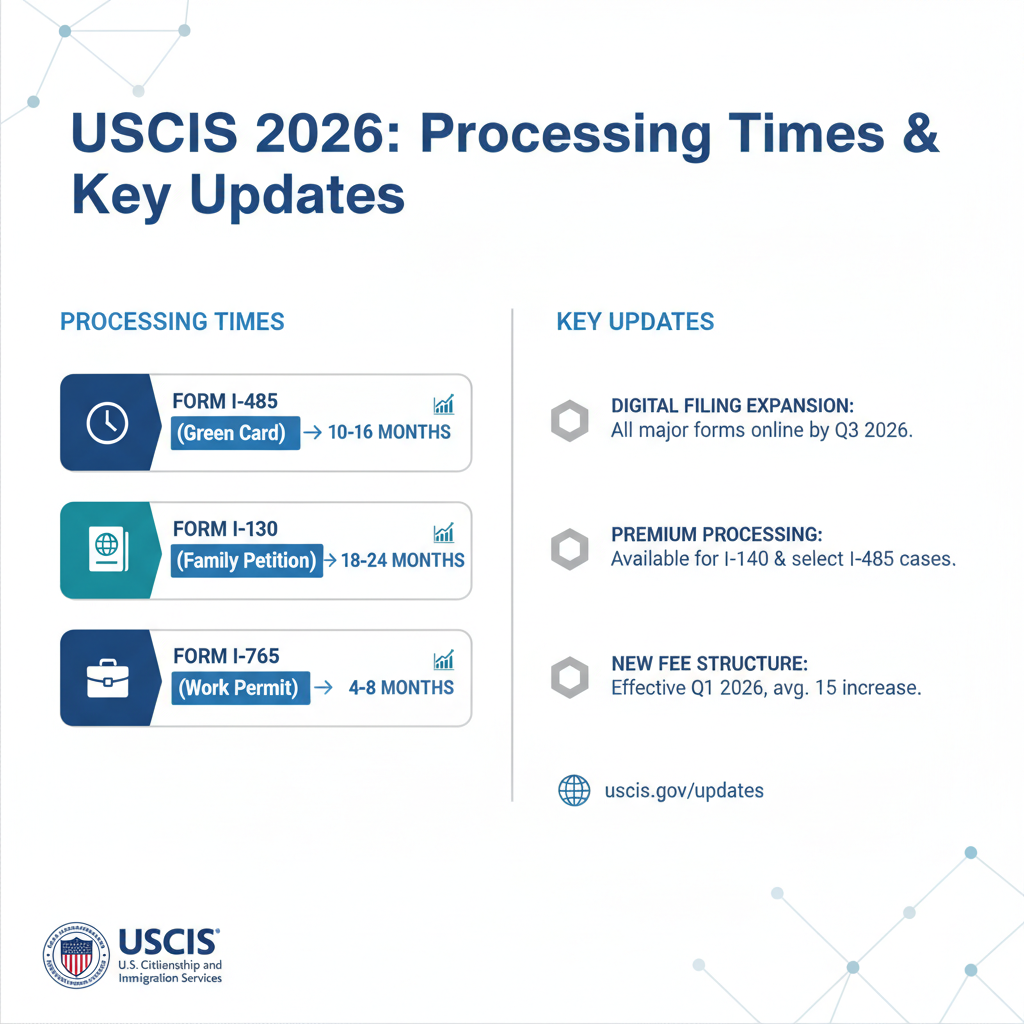
The information and insights presented in this comprehensive guide are informed by ongoing updates and discussions surrounding USCIS operations and processing metrics, as highlighted by sources like: USCIS Processing Times and Updates for 2026 (USCIS).
What This News Means for Immigrants in Orlando and Across Florida
The latest USCIS processing time updates for 2026 are not just abstract numbers; they represent the real-world impact on individuals, families, and businesses striving to achieve their immigration goals. For those residing in Orlando, Central Florida, and across the Sunshine State, these updates carry particular weight due to our diverse population and the significant presence of immigrant communities.
Why this news is showing up now
Discussions and updates about USCIS processing times are a perennial topic for several reasons, and 2026 is no exception:
- Persistent Backlogs: The immigration system has faced significant backlogs for years, exacerbated by factors like increased application volumes, resource constraints, and operational adjustments during global events. While USCIS has made efforts to reduce these backlogs, they remain a significant challenge.
- Operational Adjustments: USCIS frequently implements new policies, technologies, and staffing strategies to improve efficiency. These changes, while intended to help, can sometimes cause temporary fluctuations in processing times as new systems are integrated or staff are trained.
- Policy Changes: Shifts in immigration policy, legislative priorities, or judicial rulings can also influence how USCIS processes applications, leading to re-prioritization of certain case types or changes in adjudication standards.
- Increased Demand: The consistent demand for various immigration benefits, from family petitions and employment visas to naturalization, means USCIS is always managing a high volume of cases, making processing times a constantly moving target.
- Public Scrutiny and Transparency: Immigrant advocates, legal professionals, and the public consistently call for greater transparency and efficiency from USCIS. This ongoing scrutiny often leads to regular reporting and analysis of processing times.
The updates for 2026 reflect USCIS's ongoing efforts to adapt to these challenges, striving to balance efficiency with thoroughness, though the journey is far from over.
How it can affect Florida residents
For immigrants living in Florida, especially in and around the Orlando metropolitan area, these processing time updates have direct and tangible effects:
- Family Separation and Reunification: Longer processing times for petitions like Form I-130, Petition for Alien Relative, mean extended periods of separation for families. This can be particularly heartbreaking for those awaiting spouses, children, or parents. Orlando, a hub for diverse communities, sees many families impacted by these delays.
- Economic Impact: Delays in employment-based visas (e.g., Form I-140, Immigrant Petition for Alien Worker) or work authorization (Form I-765, Application for Employment Authorization) can hinder individuals from taking jobs, starting businesses, and contributing to Florida's economy. This impacts not only the individual but also employers in sectors like tourism, agriculture, and technology that rely on immigrant labor.
- Uncertainty and Stress: The prolonged waiting periods create immense stress and uncertainty. Immigrants might delay life decisions such as buying a home in Orange County, planning for education, or even traveling, due to the unknown status of their application.
- Impact on Local USCIS Offices: The Orlando USCIS Field Office, like others across the country, manages a significant caseload. While many applications are processed at service centers, interviews and some local adjustments of status happen at field offices. Delays at these local offices can mean longer waits for critical steps like biometrics appointments or interviews for Adjustment of Status.
- Travel Restrictions: For those who have applied for Adjustment of Status (Form I-485), delays in obtaining advance parole (Form I-131, Application for Travel Document) can mean being unable to travel internationally, even for emergencies, without risking their application.
- Driving and Licenses: Immigration status directly affects eligibility for Florida driver's licenses and state IDs. Prolonged processing times can mean individuals are left in limbo, unable to renew essential documents, affecting their ability to commute along the I-4 corridor or perform daily tasks.
Understanding these impacts is the first step toward strategically navigating the system. Imigrar is deeply familiar with the challenges faced by Florida residents and stands ready to provide localized and effective legal assistance.
Need clarity on your specific case's processing time? Our Orlando immigration attorneys can provide personalized insights and strategies. Contact Imigrar at +1 786-791-3106 for a free consultation. Se Habla Español.
What USCIS Processing Times Are (and Why They Matter)
When you submit an immigration application to USCIS, one of the most pressing questions on your mind is, "How long will this take?" The answer lies in understanding USCIS processing times – a critical, yet often complex, aspect of the immigration journey.
A plain-English definition
Simply put, USCIS processing times refer to the estimated duration it takes for USCIS to process and make a decision on a particular immigration form or application. These times are not guarantees but rather estimates based on how long it has taken USCIS to complete similar cases in the recent past. They are calculated by looking at the time it took to complete 80% of adjudicated cases over the past six months for a specific form type at a particular service center or field office. For example, if 80% of Form I-130 petitions at the Nebraska Service Center were processed within 12-18 months, that range would be displayed as the current processing time.
These estimates are updated regularly on the USCIS Processing Times page and can fluctuate significantly due to various factors, including the volume of applications, staffing levels, policy changes, and the complexity of individual cases.
Key terms you need to know
To effectively understand and track your application, familiarity with these terms is essential:
- Receipt Date: This is the date USCIS officially receives your application. It is crucial because processing times are typically measured from this date. You'll find this date on your Form I-797C, Notice of Action (Receipt Notice).
- Priority Date: Primarily relevant for preference categories in family-based and employment-based immigration, the Priority Date is the date your petition (e.g., Form I-130 or Form I-140) was properly filed with USCIS. It determines your place in the visa queue and when you become eligible to file for Adjustment of Status or have your immigrant visa processed by the U.S. Department of State. You can check visa bulletin updates at U.S. Department of State.
- Case Status Online: USCIS provides an online tool where you can enter your receipt number to check the current status of your application. This is your primary way to see if your case has been received, if an RFE has been issued, or if a decision has been made.
- Service Request: If your application has been pending longer than the posted processing times for your specific form and office, you may be eligible to submit an "Outside Normal Processing Times" service request with USCIS.
- Request for Evidence (RFE): A letter from USCIS asking for additional documents or information to support your application. Responding promptly and thoroughly is critical to avoid delays or denial.
- Notice of Intent to Deny (NOID): A letter from USCIS indicating their intention to deny your application and giving you an opportunity to submit further evidence to overcome the grounds for denial. This is a serious notice requiring immediate and expert attention.
- Biometrics Appointment: An appointment at an Application Support Center (ASC) where USCIS collects your fingerprints, photograph, and signature for background checks.
- Interview: For many applications, particularly Adjustment of Status (Form I-485) and naturalization (Form N-400, Application for Naturalization), an interview with a USCIS officer is required.
- Adjudication: The process by which USCIS reviews an application and makes a decision (approval, denial, RFE, etc.).
Understanding these terms empowers you to track your application more effectively and understand communications from USCIS. Delays can be frustrating, but being informed is your best defense against prolonged uncertainty.
Current Immigration Law: The Foundation of Processing
USCIS processing times are not arbitrary; they are deeply rooted in the complex framework of U.S. immigration law. The Immigration and Nationality Act (INA) and subsequent regulations dictate who is eligible for what benefits, the documentation required, and the procedural steps USCIS must follow. Understanding this legal foundation helps demystify why certain processes take longer than others.
Federal requirements
The vast majority of immigration laws are federal, meaning they apply uniformly across the United States. Key federal requirements that influence processing times include:
- Visa Quotas and Categories: The INA establishes annual limits (quotas) on the number of immigrant visas available for certain categories, such as family-sponsored preference categories (e.g., INA § 203(a)) and employment-based categories (e.g., INA § 203(b)). When demand exceeds supply, a waiting list forms, leading to long waits based on the Priority Date, as seen in the Visa Bulletin.
- Eligibility Criteria: Each immigration benefit (e.g., green card, visa, naturalization) has specific eligibility requirements outlined in the INA. USCIS officers must thoroughly review all submitted evidence to ensure an applicant meets these criteria. This meticulous review process contributes to processing times. For example, to adjust status under INA § 245, an applicant must be admissible and have maintained lawful status (with some exceptions).
- Security Checks: All applicants for permanent residency or naturalization undergo rigorous background and security checks. These checks involve multiple federal agencies and can sometimes take an unpredictable amount of time, contributing significantly to overall processing delays.
- Documentation Standards: Federal regulations specify the types of documents required for each form. Incomplete applications, missing evidence, or discrepancies in documentation (even minor ones) can lead to Requests for Evidence (RFEs) or Notices of Intent to Deny (NOIDs), which inevitably extend processing times.
- Adjudication Standards: USCIS officers must adhere to specific legal standards and policy guidance when adjudicating cases. This ensures fairness and consistency but also means each case must be thoroughly reviewed against these complex standards.
- Forms and Fees: The use of specific, correctly completed forms (e.g., Form I-130, Form I-485, Form I-765, Form I-131, Form N-400) and payment of the correct fees are federal requirements. Errors here can lead to rejection and significant delays. You can find all official forms and their instructions on the USCIS Forms page.
Florida-specific considerations
While immigration law is federal, certain state-level factors can indirectly influence or be affected by federal processing times:
- Local Field Office Caseloads: The Orlando USCIS Field Office and other Florida offices handle local interviews and some adjudications. The workload at these offices can directly impact the wait times for interviews for Adjustment of Status or naturalization for Central Florida residents. If the Orlando office experiences a surge in applications or staffing shortages, local processing times may lengthen.
- State-level Documentation: While not immigration law, state laws govern access to driver's licenses, professional licenses, and state benefits, often requiring proof of valid federal immigration status. Delays in obtaining or extending federal immigration benefits directly impact an immigrant's ability to maintain these state-level privileges in Florida.
- Local Legal Resources: The availability and expertise of immigration attorneys in areas like Orlando can impact how efficiently and accurately applications are filed, potentially reducing the likelihood of RFEs and subsequent delays. Imigrar prides itself on being a leading resource in this regard.
- Economic and Demographic Factors: Florida's growing economy and diverse population mean a constant influx of immigrants seeking various benefits. This high demand can contribute to the overall volume of applications processed by USCIS, indirectly affecting processing times for all applicants, including those on the I-4 corridor.
It's crucial to remember that state laws cannot override federal immigration law. However, understanding the interplay between federal processing and state-level impacts is vital for comprehensive planning. Staying informed through the USCIS official website is always recommended.
Confused by the legal jargon or federal requirements? Our team at Imigrar simplifies the complex. Schedule your free consultation with an Orlando immigration lawyer by calling +1 786-791-3106. We are fluent in English and Spanish. Se Habla Español.
How to Navigate USCIS Processing Times: A Complete Step-by-Step Guide
Navigating USCIS processing times effectively requires a proactive and informed approach. While you cannot directly control how fast USCIS processes your case, you can take strategic steps to monitor its progress, respond to requests, and address undue delays. This guide outlines how to manage your application journey.
1) Understand Your Specific Application Process and Expected Timeline
Before you even file, or as soon as you have, familiarize yourself with the typical process for your specific application type. Different forms (e.g., Form I-130 for family petitions, Form I-485 for Adjustment of Status, Form N-400 for naturalization) have distinct steps and processing nuances.
- Research: Use the USCIS Forms page to download instructions for your form. These instructions often outline the general process.
- Identify Relevant Forms: For a family-based green card, this might involve Form I-130, then Form I-485 (if adjusting status in the U.S.) or consular processing abroad. If adjusting status, you might also file Form I-765 for work authorization and Form I-131 for travel authorization concurrently.
- Consult the Visa Bulletin: If your application is in a preference category, regularly check the U.S. Department of State Visa Bulletin to understand when your Priority Date may become current. This is a critical timeline factor that USCIS processing times don't reflect.
- Typical Documents:
- Original Receipt Notice (Form I-797C)
- Copy of application/petition filed
- Proof of identity
- Relevant statutory references (e.g., INA sections)
2) Regularly Check Current Processing Times Online
USCIS updates its processing times tool monthly. This is your primary resource for understanding the current estimates for your application.
- Visit the Official Page: Go to the USCIS Processing Times page.
- Select Your Form: Choose the specific form you filed (e.g., Form I-485).
- Select Your Field Office or Service Center: The processing time will vary based on where your application is being processed. For many initial petitions (e.g., Form I-130), it's a Service Center (e.g., California, Nebraska, Texas, Vermont). For interviews related to Adjustment of Status or naturalization for Central Florida residents, it's often the Orlando USCIS Field Office.
- Compare: Note the range provided. If your Receipt Date falls outside the "processing time for 80% of cases," you may be eligible to inquire further.
- Documents Needed:
- Your Receipt Number (from Form I-797C)
- Knowledge of the form type and filing location.
3) Monitor Your Case Status Online Consistently
Beyond processing times, the "Case Status Online" tool provides real-time updates on your individual application's progress.
- Access the Tool: Visit the USCIS Case Status Online page.
- Enter Your Receipt Number: Input the 13-character receipt number found on your Form I-797C.
- Review Status: This will show you the latest action taken on your case (e.g., "Case Was Received," "Request for Evidence Was Sent," "Interview Was Scheduled," "Card Was Mailed").
- Sign Up for Alerts: Consider signing up for email and text message notifications to receive automatic updates whenever your case status changes.
- Documents Needed:
- Your Receipt Number.
- Email address for alerts.
4) Respond to Requests for Evidence (RFEs) or Notices of Intent to Deny (NOIDs) Promptly and Thoroughly
Receiving an RFE or NOID can be stressful, but it's a critical opportunity to strengthen your case and prevent denial. Delays in responding, or incomplete responses, will significantly prolong your processing time.
- Read Carefully: Understand exactly what additional information or documents USCIS is requesting.
- Gather Evidence: Collect all requested documents. If you cannot provide a specific document, explain why and offer alternative evidence.
- Consult an Attorney: This is an ideal time to engage an immigration attorney, especially for NOIDs, as they often indicate a significant issue. An attorney can help you formulate a comprehensive and legally sound response.
- Submit on Time: Adhere strictly to the deadline provided in the RFE/NOID letter (often 30-90 days).
- Keep Copies: Always keep a complete copy of your response, including all submitted documents, before mailing it to USCIS.
- Documents for Response:
- Original RFE/NOID letter
- All requested documents (originals or certified copies as specified)
- Detailed cover letter explaining the submission
- Proof of mailing (e.g., Certified Mail with Return Receipt)
5) Submit a Service Request (If Eligible)
If your case is pending beyond the "normal processing times" listed on the USCIS website for your specific form and office, you may submit a service request.
- Check Eligibility: Confirm your Receipt Date is older than the "processing time for 80% of cases" shown on the USCIS Processing Times page.
- Online Submission: You can submit an "Outside Normal Processing Times" request through your USCIS online account or by calling the USCIS Contact Center.
- Provide Details: Be prepared to provide your receipt number, application type, and filing date.
- Wait for Response: USCIS will typically respond within 15-30 days, indicating if your case is indeed delayed and what steps they are taking.
- Documents Needed:
- Your Receipt Number.
- Details of the application and filing date.
- Records of previous inquiries (if any).
6) Seek Assistance from the USCIS Ombudsman or Congressional Office (Last Resort)
If you've exhausted other avenues and your case remains unduly delayed without explanation, these options can be considered, but they should generally be a last resort.
- USCIS Ombudsman: The Office of the Citizenship and Immigration Services Ombudsman acts as a neutral party to assist individuals and employers with specific problems with USCIS. They can review your case if it meets specific criteria for delay or error. More information can be found at DHS Office of the Citizenship and Immigration Services Ombudsman.
- Congressional Inquiry: Your U.S. Senator or Representative's office can make an inquiry on your behalf. While they cannot influence a decision, they can request status updates and explanations for delays. Many Florida residents in Orlando and surrounding areas have utilized this avenue.
- Important: These are not for expediting cases but for resolving excessive delays or systemic issues.
- Documents Needed:
- Detailed chronology of your case.
- All previous USCIS correspondence (receipt notices, RFEs, service request responses).
- Privacy waiver (required for congressional inquiries).
7) Consult an Experienced Immigration Attorney
This step is crucial and can be beneficial at any point in the process, not just as a last resort.
- Expert Guidance: An attorney can help you understand complex legal requirements, identify potential issues before they arise, and ensure your application is complete and accurate from the start.
- Strategic Advice: They can advise on the best course of action for delays, including when and how to submit service requests, respond to RFEs, or pursue other remedies like a Writ of Mandamus if delays become extreme.
- Representation: An attorney can represent you in communications with USCIS, at interviews at the Orlando USCIS Field Office, and in federal court if necessary.
- Peace of Mind: Having an expert advocate on your side can significantly reduce stress and increase your confidence in the process.
- Documents Needed:
- All immigration documents you possess.
- Copies of all applications filed.
- Any USCIS correspondence.
Don't let processing delays derail your immigration dreams. Imigrar's Orlando-based attorneys are experts in navigating complex USCIS procedures. Contact us for a free consultation at +1 786-791-3106. Se Habla Español.

Practical Steps You Can Take Today
While USCIS processing times can be frustratingly long and unpredictable, there are concrete, proactive steps you can take to manage your application effectively and potentially mitigate delays. These actions empower you and ensure you're prepared for whatever comes next.
Actionable Checklist for Managing Your Application:
- Maintain Meticulous Records: Keep a well-organized file of every single document related to your immigration case. This includes copies of all forms submitted, every Form I-797C, Notice of Action, RFEs, NOIDs, and any correspondence from USCIS or your attorney. Date everything!
- Keep Copies of Everything: Before mailing any document to USCIS, make a complete copy for your records. This includes your initial application, supporting documents, and RFE responses.
- Update Your Address Promptly: If you move, even within Orlando or to another part of Florida, immediately update your address with USCIS using the USCIS Online Change of Address tool and for any pending applications. Failure to do so can result in missed notices, RFEs, or interview appointments, leading to significant delays or even denial.
- Monitor USCIS Case Status and Processing Times: Make it a habit to check your Case Status Online and the USCIS Processing Times page at least once a month. Sign up for email and text alerts.
- Budget for Legal Fees and Application Costs: Plan financially for application fees, biometrics fees, and potential legal fees. USCIS fees can change, so always check the latest fees before filing on the USCIS official website.


