


White House Expands U.S. Travel Ban: New Restrictions on Entry from 5 Additional Countries
On December 16, 2025, the White House issued a new presidential proclamation significantly expanding U.S. entry restrictions, adding five countries—Burkina Faso, Mali, Niger, South Sudan, and Syria—to full bans on immigrant and nonimmigrant visas for their nationals. This builds directly on Presidential Proclamation 10949 from June 4, 2025, which already restricted 19 high-risk countries including Afghanistan, Iran, Haiti, and Venezuela due to vetting deficiencies, security risks, and high overstay rates.[3][6]
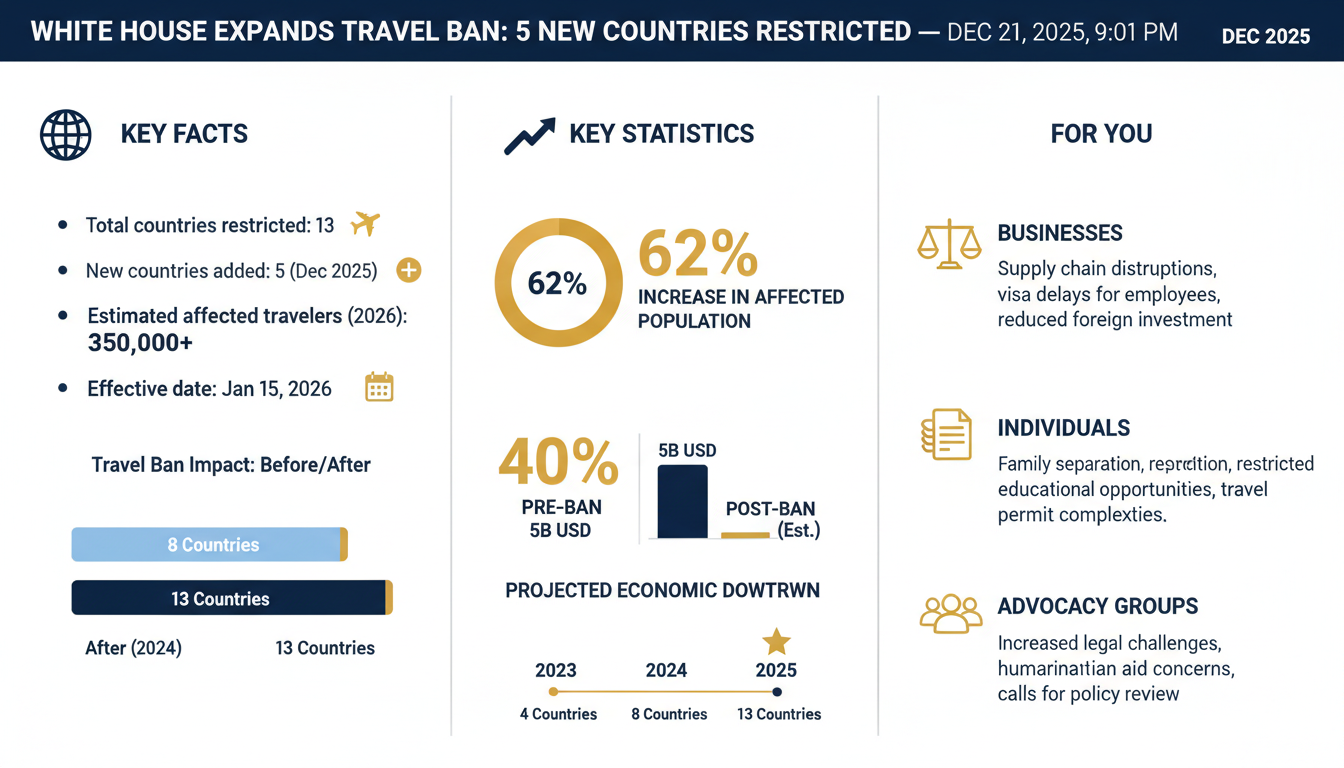
These measures, rooted in national security concerns following incidents like the November 26, 2025, shooting of National Guard members in Washington, DC, represent the most sweeping immigration policy shift in recent weeks. Coupled with USCIS's December 2, 2025, policy memorandum suspending all pending asylum applications (Form I-589) and benefit requests from these nations, the changes pause adjudications across green cards, H-1B visas, naturalizations, and more.[1][2]
Key Details of the Expanded Restrictions
The December 16 proclamation enhances limitations by addressing "persistent, chronic vetting deficiencies" in civil documentation, law enforcement cooperation, and terrorist activity data from the newly added countries. Full restrictions now apply to 24 nations total, prohibiting entry via most visa categories.[3][6]
- Original 19 Countries (Proclamation 10949): Afghanistan, Myanmar (Burma), Chad, Republic of the Congo, Equatorial Guinea, Eritrea, Haiti, Iran, Libya, Somalia, Sudan, Yemen, Burundi, Cuba, Laos, Sierra Leone, Togo, Turkmenistan, Venezuela.[1][2]
- New Additions: Burkina Faso, Mali, Niger, South Sudan, Syria—subject to full entry bans based on updated overstay data and security assessments.[3]
- Impacted Processes: Immigrant visas, nonimmigrant visas (e.g., H-1B, H-4), adjustment of status, asylum claims, and naturalization oaths are suspended or under enhanced review.[1][2]
Exceptions are narrow: U.S. lawful permanent residents (LPRs), valid pre-proclamation visa holders, diplomats, athletes, and rare national interest cases qualify. Family-based immigrant visas lose broad exceptions to curb fraud risks, with case-by-case waivers possible but limited.[3][6]
Recent USCIS and DOS Actions Amplifying the Impact
Preceding the proclamation, USCIS issued guidance on November 27, 2025, allowing officers to weigh "negative, country-specific factors" for applicants from the 19 countries during any benefit adjudication. This was followed by a December 2 Policy Memorandum directing:
- Suspension of all pending Form I-589 asylum applications, regardless of nationality, pending comprehensive review.[1]
- Pause on all USCIS benefits (approvals/denials) for nationals of the 19 countries, including adjustment of status interviews and naturalization ceremonies.[2]
- Rereview of approved benefits for entrants post-January 20, 2021, from high-risk nations.[1]
The Department of State added enhanced vetting for all H-1B and H-4 applicants effective December 15, 2025, scrutinizing ties to restricted countries.[1] Attorneys report real-world effects: canceled naturalization oaths for Venezuelans, Iranians, and Afghans; halted green card interviews; and stalled H-1B decisions.[2]
Legal Implications for Visa Applications, Green Cards, and Citizenship
These policies integrate national security into every immigration stage, creating widespread delays and denials. For visa applicants, full restrictions block issuance for most categories from the 24 countries, overriding prior approvals unless waived.[3][6]
Green card seekers (adjustment of status via Form I-485) face indefinite holds if from restricted nations. USCIS's pause applies to all form types, potentially leading to revocations upon rereview.[1][2] Family reunification parole programs for Cuba, Haiti, and others were terminated December 12, 2025, eliminating a key pathway while visas pend.[4]
Citizenship applicants encounter paused oath ceremonies, as seen in recent cancellations. Even advanced cases risk derailment if country-specific factors trigger discretionary denial.[2]
Broader context includes USCIS's November 19, 2025, proposed rule to rescind 2022 public charge regulations, granting officers wider discretion to deem applicants inadmissible based on benefit use predictions. Comments close 30 days post-publication, heightening uncertainty.[2][4] Additionally, shortened Employment Authorization Document (EAD) validity—now 18 months for refugees/asylees (post-December 5, 2025) and TPS/parolees per H.R. 1—complicates work authorization amid delays.[7]
December 2025 Visa Bulletin shows retrogression in certain religious worker categories (February 15, 2021 cutoff), extended temporarily to January 30, 2026, via H.R. 5371, but no issuances post-deadline.[5]
Deportation Defense Risks and Asylum Suspensions
The asylum suspension mandates holding all I-589s for review, with high-risk nationals facing heightened scrutiny or pretermission without hearings. FY2025 saw 831,000 defensive asylum filings and 2.4 million pending, exacerbated by policies allowing deficient claim dismissals.[4]
For those in removal proceedings, country-specific factors could influence bond, withholding, or relief grants. DHS's termination of TPS for Haiti and Burma (blocked for Syria by federal judge) adds deportation exposure for hundreds of thousands.[2]
Actionable Guidance: What Affected Individuals Should Do Now
If you or a client hail from a restricted country, act swiftly with experienced counsel. Imigrar, Orlando's trusted immigration firm, urges these steps:
Immediate Assessment
- Check Eligibility: Confirm nationality against the 24-country list. LPRs and pre-proclamation visa holders are generally exempt—verify status via USCIS Case Status Online.[1][3]
- Review Pending Filings: Contact USCIS (800-375-5283) or your attorney for hold status. Expect delays; do not refile without advice.[2]
Strategic Filing Options
- Explore Waivers: Apply for case-by-case waivers proving no security threat and U.S. national interest (e.g., unique skills). Success rates are low; substantiate with evidence.[3][6]
- Alternative Pathways: Dual nationals or those eligible for TPS (e.g., Syria extension) should renew EADs before December 5 changes. Consider non-restricted country consulates for processing if viable.[2][7]
- Public Charge Prep: Submit comments on the NPRM via regulations.gov; gather affidavits of support (Form I-864) showing financial independence.[2][4]
Deportation Defense Tactics
- Seek Stay Requests: File motions to administratively close cases citing policy holds. For asylum, supplement with country conditions reports post-review resumption.[1][4]
- Document Hardships: Compile U.S. ties (family, employment) for prosecutorial discretion or cancellation of removal.[2]
Compliance and Renewal Urgency
- Expedite EADs: File renewals early; new 18-month cap applies to pending post-12/5/25 apps. TPS holders note H.R. 1 mandates.[7]
- Monitor Updates: Track USCIS Policy Alerts, Visa Bulletin, and Federal Register. Imigrar newsletters deliver real-time analysis.
- Consult Experts: Schedule a free consultation at Imigrar (Orlando, FL) for personalized strategy. Avoid DIY filings amid flux.
These restrictions signal a tightening regime, but exceptions exist. Proactive legal partnership maximizes outcomes—delays compound risks.
Why This Matters: Long-Term Immigration Landscape
The integrated approach—proclamations, USCIS memos, DOS vetting—prioritizes security over volume, potentially backlog millions. GAO's December 5 report critiques EAD auto-extensions' removal as a major rule, inviting Congressional Review Act challenges.[4] CRS notes asylum trends worsening with pretermission policies.[4]
For Florida's diverse communities (heavy Venezuelan, Haitian inflows), impacts are acute. Imigrar stands ready to navigate: from H-1B defenses to deportation halts. Contact us today.
Disclaimer: This article synthesizes public sources as of December 2025; policies evolve rapidly. Seek tailored advice from licensed attorneys.


