

The journey to obtaining a Green Card, also known as lawful permanent residency, is a pivotal moment for countless individuals and families in the United States. While the application process itself can be lengthy and complex, the Green Card interview stands as a critical juncture, often determining the outcome of years of waiting and effort. For many, this interview can be a source of significant anxiety, but with the right preparation and guidance, it can be a smooth and successful step towards a new life.
At Imigrar, an immigration law firm based in Orlando, Florida, we understand the stakes involved. Our mission is to "Keep Families Together," and that means equipping you with the knowledge and support needed to confidently face your Green Card interview, whether you're in Orlando, elsewhere in Florida, or across the nation. Today, we're diving deep into the essentials of Green Card interview preparation, providing you with a comprehensive guide to ensure you're ready for every question and every document.
The reporting that sparked this guide: Green Card Interview Preparation Tips (Immigration Law)
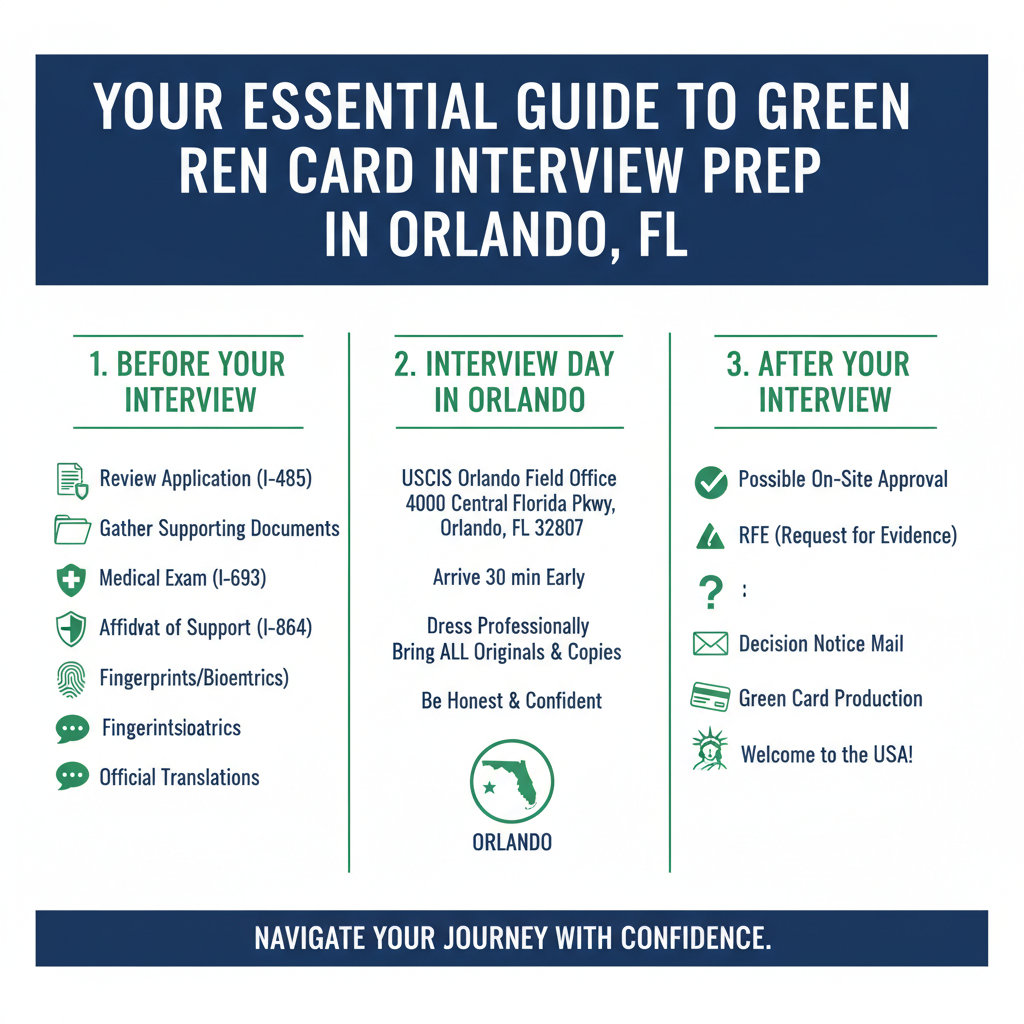
What This News Means for Immigrants in Orlando and Across Florida
The topic of Green Card interview preparation is perennially relevant in immigration law, but its prominence in recent news reflects an ongoing need for clarity and guidance for applicants. For those seeking to establish permanent residency in the U.S., the interview is a make-or-break moment, and understanding how to navigate it is more crucial than ever.
Why this news is showing up now
While the Green Card interview itself is not a new phenomenon, the emphasis on preparation tips is surging for several reasons. Firstly, USCIS (U.S. Citizenship and Immigration Services) continues to refine its interview processes and focus areas, often with increased scrutiny on specific types of applications, such as marriage-based Green Cards, to detect potential fraud. Secondly, evolving immigration policies and enforcement priorities can subtly shift the types of questions asked or the evidence required, making up-to-date preparation indispensable. The sheer volume of applications also means that officers are often pressed for time, making a well-prepared applicant's interview much smoother and more efficient. Finally, as processing times fluctuate and can extend over many months or even years, applicants might find themselves facing an interview long after they initially filed their application, necessitating a fresh review of their entire case and situation.
How it can affect Florida residents
For immigrants residing in Florida, particularly in the vibrant and diverse Orlando area, the importance of thorough interview preparation cannot be overstated. Florida is home to a vast immigrant population, leading to a high volume of Green Card applications processed through local USCIS field offices, such as the Orlando USCIS Field Office. This means several things:
- High Volume, High Scrutiny: The Orlando Field Office, like others in major immigration hubs, handles a significant caseload. While officers are professional, they are also trained to identify inconsistencies or red flags. Being meticulously prepared helps your case stand out positively.
- Diverse Caseload: Florida's diverse population means the Orlando office sees a wide array of Green Card applications – from family-based petitions (spouses, parents, children) to employment-based and asylum-related adjustments. Each type requires specific preparation tailored to its unique legal framework.
- Local Resources: Central Florida's immigrant communities benefit from numerous support networks, but navigating the legal complexities often requires expert legal counsel familiar with local procedures and common issues. Imigrar, located in Orlando, provides precisely this local expertise.
- Travel and Logistics: For those living along the I-4 corridor or in surrounding counties like Orange, Osceola, Seminole, and Polk, understanding the logistics of getting to the Orlando Field Office on time and prepared is a practical concern.
Understanding these dynamics helps Florida residents appreciate why comprehensive Green Card interview preparation is not just recommended, but essential for a successful outcome.
Need Expert Guidance for Your Green Card Interview? Don't face your interview unprepared. Our Orlando immigration team at Imigrar has extensive experience helping clients across Florida and nationwide. Call +1 786-791-3106 for a free consultation to discuss your specific case, or message us online. Se Habla Español.
What the Green Card Interview Is (and Why It Matters)
The Green Card interview is a mandatory step for most individuals seeking to become lawful permanent residents of the United States. It's your opportunity to personally present your case to a USCIS immigration officer and verify all the information you've submitted in your application. It is a critical step because it allows the government to confirm your eligibility, assess your admissibility, and ensure the veracity of your claims.
A plain-English definition
Simply put, a Green Card interview is a meeting with an immigration officer who will review your application for permanent residency, ask you questions about your eligibility, and examine your supporting documents. The main goal is for the officer to determine if you meet all legal requirements to become a lawful permanent resident and if there are any reasons why you should not be granted a Green Card (known as grounds of inadmissibility). This interview is a crucial step in both the Adjustment of Status process (for those applying from within the U.S.) and Consular Processing (for those applying from outside the U.S., typically at a U.S. embassy or consulate).
Key terms you need to know
To navigate the Green Card process successfully, understanding the following key terms is vital:
- Green Card: The common term for a Lawful Permanent Resident Card, which grants you official immigration status to live and work permanently in the United States.
- Adjustment of Status (AOS): The process of applying for a Green Card while physically present in the United States. This typically involves filing Form I-485, Application to Register Permanent Residence or Adjust Status.
- Consular Processing: The process of applying for a Green Card through a U.S. embassy or consulate abroad. This applies if you are outside the U.S. or are ineligible for Adjustment of Status.
- Petitioner: The U.S. citizen or lawful permanent resident who files an immigration petition (e.g., Form I-130, Petition for Alien Relative) on behalf of an eligible foreign national.
- Beneficiary: The foreign national for whom an immigration petition is filed and who is seeking a Green Card.
- Priority Date: The date USCIS receives your immigration petition (e.g., Form I-130). This date determines your place in line for a visa, especially for categories with annual limits. You can only proceed with your Green Card application (Form I-485) when your Priority Date becomes current according to the Visa Bulletin.
- Affidavit of Support (Form I-864): A legally binding contract signed by a sponsor (usually the petitioner) who promises to financially support the immigrant and ensure they do not become a public charge. This form is almost always required for family-based Green Cards.
- Public Charge Rule: A long-standing provision in immigration law that allows the U.S. government to deny Green Cards or visas to individuals who are deemed likely to become primarily dependent on government assistance for subsistence. While recent administrations have had differing interpretations, the underlying principle remains.
- Grounds of Inadmissibility: Specific reasons under U.S. immigration law that can prevent an individual from being granted a Green Card, such as certain criminal convictions, health issues, immigration violations, or security risks.
Current Immigration Law: The Foundation for Your Green Card Interview
The Green Card interview is not an arbitrary process; it is firmly rooted in U.S. immigration law, primarily the Immigration and Nationality Act (INA). Understanding the legal framework helps demystify the interview and highlights why certain questions are asked and documents requested.
Federal requirements
The authority for granting Green Cards and conducting interviews stems from federal law. Key sections of the INA that are particularly relevant to Green Card interviews include:
- INA § 204: Petitions for Alien Relatives and Workers: This section outlines who can file a petition for an immigrant (e.g., a U.S. citizen petitioning a spouse or parent). The approval of an underlying petition (like Form I-130) is the first step towards a Green Card.
- INA § 245: Adjustment of Status of Nonimmigrant to That of Person Admitted for Permanent Residence: This is the primary statute governing the Adjustment of Status process, allowing eligible individuals already in the U.S. to obtain a Green Card without leaving the country. The interview is a direct requirement of this process.
- INA § 212: General Classes of Aliens Ineligible to Receive Visas and Ineligible for Admission: This crucial section details the various grounds of inadmissibility. During your interview, the officer will assess whether any of these grounds apply to you. These can include health-related grounds, criminal grounds, security and related grounds, public charge, illegal entry and immigration violations, and more.
- INA § 213A: Requirements for Sponsorship and Financial Support: This section mandates the Affidavit of Support (Form I-864) to ensure that immigrants do not become a financial burden on the U.S. government. The officer will review your sponsor's financial documents during the interview.
The interview serves as the officer's opportunity to ensure that all these legal requirements are met, that the applicant is indeed eligible, and that no grounds of inadmissibility exist. It's a comprehensive review of your entire immigration history and personal circumstances.
For more detailed information on these laws and regulations, always refer to the USCIS official website.
Florida-specific considerations
While immigration law is federal, the practical application often has local nuances. For those residing in Florida, particularly in areas served by the Orlando USCIS Field Office, here are some considerations:
- Orlando Field Office Procedures: Each USCIS field office might have slight variations in how they conduct interviews or how they prefer documents to be organized. While the core questions remain the same, local attorneys like Imigrar can offer insights into the specific practices of the Orlando office.
- Diverse Case Types: The Orlando office processes a wide range of cases reflecting Florida's diverse population. This includes a high number of family-based petitions for spouses, parents, and children, as well as cases for individuals from various countries, each potentially with unique cultural considerations or documentation challenges.
- Bilingual Services: Given Florida's large Spanish-speaking population, the ability to communicate effectively, often with the assistance of a bilingual attorney or interpreter, is vital. Imigrar proudly offers services in both English and Spanish (Se Habla Español).
It's important to remember that the interview is not just a formality; it's a substantive legal process designed to uphold immigration laws.
Feeling Overwhelmed by Immigration Law? Imigrar's experienced attorneys simplify complex legal requirements. Whether you're in Orlando, Central Florida, or anywhere nationwide, we're here to help. Contact us for a free consultation: +1 786-791-3106. Se Habla Español.
How to Prepare for Your Green Card Interview: A Complete Step-by-Step Guide
Preparation is the single most important factor in a successful Green Card interview. This detailed guide breaks down the process into manageable steps, ensuring you cover all your bases.
1) Understand Your Case and Review All Submitted Applications
Before anything else, you must be intimately familiar with every detail of your own immigration history and the applications you have submitted. This includes:
- Review All Forms: Go through every single form you (or your petitioner) filed, especially Form I-130 (Petition for Alien Relative), Form I-485 (Application to Register Permanent Residence or Adjust Status), Form I-864 (Affidavit of Support), and Form I-693 (Report of Medical Examination and Vaccination Record). Understand the answers you provided.
- Know Your Story: Be able to articulate your personal history, how you met your spouse (if applicable), your employment history, and your reasons for seeking permanent residency. Ensure consistency with your written application.
- Understand Your Eligibility Category: Whether it's marriage to a U.S. citizen, a family preference category, or an employment-based petition, know the specific requirements for your category.
Required Documents for this Step:
- Copies of all previously submitted immigration forms (e.g., Form I-130, Form I-485, Form I-864, Form I-765, Form I-131).
- Copies of all supporting evidence submitted with your application (e.g., birth certificates, marriage certificates, previous divorce decrees, photos).
- Your personal immigration file, if you have been represented by an attorney.
2) Gather All Required Documents (Originals and Copies)
This is arguably the most critical step. You must bring *all* original documents that were submitted with your application, plus copies. Even documents you think are minor can be requested. USCIS prefers clear, legible copies along with the originals for verification. Do not assume the officer has access to everything electronically.
Important: Always bring original documents. If your originals are in a foreign language, you *must* provide a certified English translation along with the original document.
Required Documents (Comprehensive List for Family-Based AOS, adjust as per your case):
- Official Interview Notice: The letter from USCIS scheduling your interview.
- Passports: Your current passport and any expired passports (especially those with previous visas or entry stamps).
- Birth Certificates: Your original birth certificate and your spouse's/petitioner's original birth certificate (with certified translations if applicable).
- Marriage Certificate: Your original marriage certificate (if applicable, with certified translation).
- Divorce Decrees/Death Certificates: Originals of any previous marriage terminations for both you and your spouse/petitioner.
- Identity Documents: State ID, driver's license (especially if you live in Florida and obtained it here).
- Medical Exam (Form I-693): A sealed envelope containing your medical examination results, if not already submitted or if it has expired. Warning: Do NOT open this envelope.
- Financial Documents (for Form I-864 sponsor):
- Originals of the sponsor's most recent federal income tax returns (e.g., IRS tax transcripts or copies of Form 1040 and all supporting schedules/W2s).
- Proof of sponsor's current employment and income (e.g., recent pay stubs, employment verification letter).
- Proof of assets (bank statements, property deeds, etc.) if income alone is insufficient.
- Proof of Relationship (for marriage-based cases): This is crucial. Bring as much evidence as possible to prove your marriage is bona fide (real and not just for immigration purposes).
- Joint bank statements, credit card statements.
- Joint utility bills (electricity, water, internet), lease agreements, mortgage statements.
- Joint health, life, or auto insurance policies.
- Birth certificates of any children you have together.
- Photos of your wedding, honeymoon, family events, vacations, and daily life together (with dates/descriptions).
- Affidavits from friends and family testifying to your relationship (optional, but can be helpful).
- Travel itineraries, flight tickets showing joint trips.
- Correspondence (emails, texts, social media posts) that demonstrate an ongoing relationship.
- Any other documents showing commingling of financial assets or shared responsibilities.
- Criminal Records: If you have any arrests or convictions, bring original certified court dispositions for every incident, even if charges were dismissed or expunged.
- Proof of Lawful Entry and Status: Your I-94 arrival/departure record, previous visa stamps, I-20s (for students), I-797 approval notices (e.g., for H1B, L1 visas).
- Employment Documents (if applicable): Letters from employers, pay stubs, W-2s, 1099s.
- Passport-Style Photos: Two recent, identical U.S. passport-style photos.
This list is extensive, but it's better to be over-prepared than under-prepared. If your case is in Orlando, the officer will expect these documents to be readily available.
3) Organize Your Documents Thoroughly
A well-organized set of documents makes a positive impression and helps the interview proceed smoothly. Officers appreciate when they can quickly find what they need.
- Binders and Dividers: Use a binder with clear plastic sleeves and tabbed dividers for different categories (e.g., "Personal Documents," "Relationship Evidence," "Financials," "Medical," "Copies of Filed Applications").
- Chronological Order: Arrange documents within each category chronologically, usually with the most recent on top.
- Copies for the Officer: Have a separate, identical set of copies ready to hand to the officer if they request them. Do not offer originals unless specifically asked.
4) Practice Answering Questions
While you should never memorize answers word-for-word, practicing helps you articulate your responses clearly and confidently. The officer is looking for consistency and honesty.
- Review Common Questions:
- "How did you meet your spouse?" (for marriage cases)
- "When and where did you get married?"
- "Describe your wedding day."
- "What is your spouse's date of birth/parents' names/job?"
- "Where do you live? Who lives with you?"
- "What are your daily routines?"
- "Have you ever been arrested or convicted of a crime?"
- "Have you ever violated immigration laws?"
- "Do you have any children?"
- "What are your intentions in the U.S.?"
- Role-Play: Practice with your spouse, a friend, or your attorney. Have them ask you challenging questions or follow-up questions.
- Be Truthful and Consistent: Your answers must align with your application forms and supporting documents. Inconsistencies can lead to delays or denials.
- If You Don't Understand: It's okay to ask the officer to repeat or rephrase a question. Do not guess an answer.
5) Prepare for the Interview Day
The day of the interview requires careful planning to ensure you arrive calm and ready.
- Dress Appropriately: Dress in business casual or professional attire. This shows respect for the process and the officer.
- Arrive Early: Plan to arrive at the Orlando USCIS Field Office (or your designated location) at least 30-45 minutes before your scheduled time. This accounts for security checks, parking, and finding the correct waiting area. Being late can lead to rescheduling or even denial.
- What to Bring:
- Your organized binder of original documents and copies.
- Your interview notice.
- Photo ID (passport, driver's license).
- Any required interpreter (if you did not request one from USCIS and cannot speak English fluently).
- A pen and notepad (optional, for taking notes).
- No prohibited items (check USCIS guidelines for field office security).
- Eat and Hydrate: Interviews can be lengthy, and waiting times unpredictable. Be comfortable.
6) During the Interview
Your demeanor and responses during the interview are just as important as your documents.
- Be Polite and Respectful: Address the officer respectfully.
- Answer Truthfully and Concisely: Answer only the question asked. Do not volunteer extra information unless it directly clarifies an answer. If a "yes" or "no" suffices, provide it.
- Maintain Eye Contact: This conveys honesty and confidence.
- Spousal Interviews: In marriage-based cases, both spouses will be interviewed. Sometimes, you may be interviewed together; other times, the officer may interview you separately to verify the authenticity of your relationship. Be prepared for both scenarios. If interviewed separately, your answers should be consistent.
- Don't Argue: If you disagree with a question or statement, remain calm and explain your perspective respectfully.
- Your Attorney's Role: If you bring an attorney (highly recommended, especially for complex cases), their role is primarily to observe, clarify questions, and address legal issues. They cannot answer questions for you.
7) After the Interview
The outcome of your interview is not always immediate.
- Immediate Decision: Sometimes, the officer might approve your case on the spot, or tell you that it's approved pending background checks.
- Request for Evidence (RFE): If the officer needs more information or documents, they will issue an RFE. You will have a specific deadline to respond.
- Notice of Intent to Deny (NOID): If the officer believes your case should be denied, they may issue a NOID, giving you a chance to rebut their findings.
- Decision by Mail: Most often, you will receive a decision notice in the mail within a few weeks or months. You can check your case status online using your receipt number on the USCIS official website.
- Green Card Issuance: If approved, you will typically receive your Green Card in the mail shortly thereafter.

Practical Steps You Can Take Today for a Successful Green Card Interview
The path to a Green Card can be long, but proactive preparation for your interview can significantly reduce stress and increase your chances of success. Here’s an actionable checklist you can start on today:
- Review Your Entire Application Package: Pull out copies of all forms (Form I-130, Form I-485, Form I-864, etc.) you submitted. Read through every question and your answers. Highlight any areas where you might need to provide further explanation or clarification.
- Gather *All* Original Documents and Copies: Start collecting every original document mentioned in Step 2. Don't wait until the last minute. Make high-quality copies of everything. Ensure all foreign language documents have certified English translations.
- Organize Documents Systematically: Invest in a


