


The reporting that sparked this guide: Green Card Interview Preparation Tips (Immigration Law)
What This News Means for Immigrants in Orlando and Across Florida
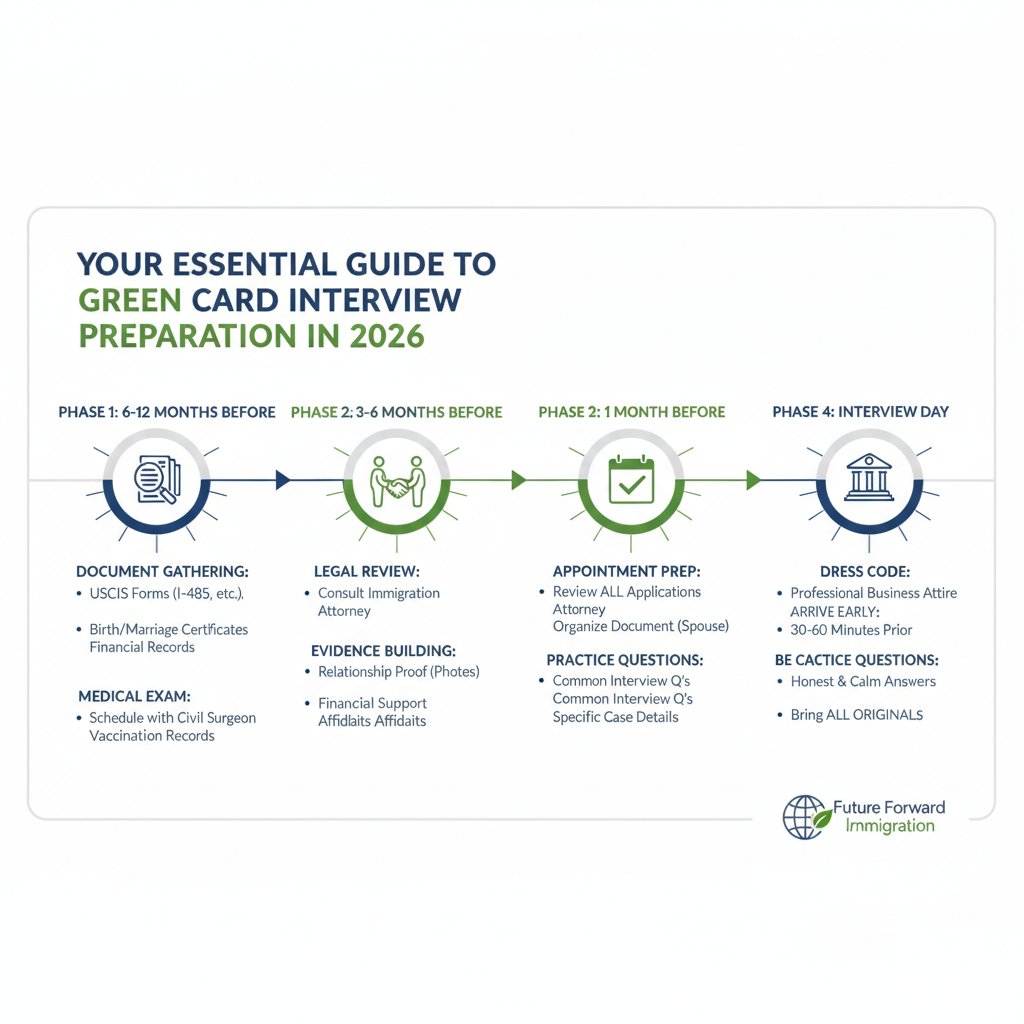
The journey to obtaining a Green Card, or lawful permanent residency in the United States, is a significant milestone for countless individuals and families. A critical step in this process for many applicants is the Green Card interview. Recent trends in immigration law and processing, highlighted by continuous discussions in immigration news, underscore the increasing importance of thorough preparation for this interview.
Why this news is showing up now
The focus on Green Card interview preparation is perennially relevant, but its prominence tends to fluctuate with changes in immigration policy, processing backlogs, and USCIS operational shifts. As of mid-2026, we're seeing sustained efforts by USCIS to clear backlogs that accumulated during previous years, leading to a higher volume of interviews being scheduled. Furthermore, with evolving national security considerations and a renewed emphasis on the integrity of the immigration system, interview officers are often conducting more detailed examinations of applications. This means that applicants must be more prepared than ever to present a clear, consistent, and well-supported case.
For those pursuing Adjustment of Status within the U.S., particularly for family-based petitions, the interview is the primary opportunity for a USCIS officer to verify the information in your application, confirm your eligibility, and assess the bona fides of your relationship (if applicable). The news reflects a consistent message: preparation is not just recommended; it's essential for a smooth and successful outcome.
How it can affect Florida residents
For immigrants residing in Florida, particularly those in the Orlando area, these national trends have direct local implications. The Orlando USCIS Field Office, located at 6680 Corporate Centre Blvd, Orlando, FL 32822, handles a substantial volume of Green Card interviews for applicants across Central Florida, including Orange County, Seminole County, and those along the I-4 corridor. Increased interview scheduling and enhanced scrutiny mean that applicants in this region need to be exceptionally well-prepared.
Florida is a melting pot, home to diverse immigrant communities. Whether you are applying through a family petition, employment-based category, or asylum, understanding the nuances of the interview process and having all your documentation in order is paramount. Local factors, such as specific interview officer tendencies or regional processing times, can also play a role, making localized, expert advice invaluable. At Imigrar, we understand the specific challenges and opportunities for Florida residents navigating the Green Card process.
Need Help? Our Orlando immigration team is ready to assist. Call +1 786-791-3106 for a free consultation, or message us online. Se Habla Español.
What Green Card Interview Preparation Is (and Why It Matters)
The Green Card interview is a pivotal moment in your immigration journey. It’s your opportunity to meet face-to-face with a USCIS (U.S. Citizenship and Immigration Services) officer who will review your application, ask questions, and determine your eligibility for permanent residency. Proper preparation is not merely about showing up; it's about strategically organizing your documents, understanding your application, and being ready to articulate your case clearly and confidently.
A plain-English definition
Simply put, Green Card interview preparation involves everything you do to get ready for your meeting with an immigration officer. This includes gathering every required document (originals and copies), reviewing all the forms you’ve submitted (especially Form I-485, Application to Register Permanent Residence or Adjust Status, and Form I-130, Petition for Alien Relative, if applicable), practicing answers to common questions, and understanding the purpose of the interview. The goal is to ensure you can present a consistent, truthful, and complete picture of your eligibility to the USCIS officer.
For family-based petitions, particularly marriage-based Green Cards, the interview serves to confirm the "bona fides" of your marriage – meaning, to ensure your marriage is real and not entered into solely for immigration purposes. For other categories, it's about verifying your qualifications and ensuring you meet all legal requirements.
Key terms you need to know
- Green Card: Official document allowing an individual to live permanently in the U.S.
- USCIS (U.S. Citizenship and Immigration Services): The government agency responsible for overseeing lawful immigration to the United States.
- Adjustment of Status (AOS): The process of applying for a Green Card while physically present in the United States. This is contrasted with Consular Processing, where the interview takes place at a U.S. embassy or consulate abroad.
- Interview Officer: The USCIS official who conducts your Green Card interview and makes a recommendation on your case.
- Petitioner: The U.S. citizen or lawful permanent resident who files an immigration petition (e.g., Form I-130) on behalf of an immigrant.
- Beneficiary: The immigrant who is being petitioned for a Green Card.
- Bona Fide Marriage: A marriage entered into for love and companionship, not primarily for immigration benefits. Proving this is crucial for marriage-based Green Cards.
- Affidavit of Support (Form I-864): A legally binding document filed by the petitioner (and sometimes a joint sponsor) to show they can financially support the immigrant, ensuring the immigrant will not become a "public charge."
- Notice of Interview (Form I-797C): The official letter from USCIS informing you of your interview date, time, and location, along with required documents.
- Priority Date: The date your immigration petition (e.g., Form I-130) was filed. This date determines when your Green Card application can move forward, especially for preference categories with visa quotas.
- Grounds of Inadmissibility: Specific reasons under U.S. immigration law (e.g., certain criminal convictions, health issues, immigration violations) that can prevent someone from getting a Green Card.
Current Immigration Law: The Foundation
The legal framework for Green Card eligibility and the interview process is primarily governed by the Immigration and Nationality Act (INA). This extensive body of law sets out the requirements for various immigration categories, the grounds for inadmissibility, and the procedures USCIS must follow.
Federal requirements
Under the INA, particularly sections related to Adjustment of Status (INA § 245) and specific visa categories (e.g., family-sponsored INA § 201-203, employment-based INA § 203(b)), applicants must meet stringent criteria. Key federal requirements include:
- Lawful Entry and Maintenance of Status: Generally, to adjust status in the U.S., you must have entered the U.S. lawfully and maintained your immigration status, though there are exceptions for immediate relatives of U.S. citizens.
- Approved Petition: For most Green Card categories, an underlying petition (e.g., Form I-130 for family, Form I-140 for employment) must be filed and approved by USCIS.
- Admissibility: You must not be inadmissible to the U.S. under any of the grounds of inadmissibility, which include health-related issues, criminal records, security risks, public charge concerns, and prior immigration violations. Waivers may be available for some grounds.
- Financial Support: The petitioner (and potentially a joint sponsor) must demonstrate sufficient financial means to support the applicant through an Affidavit of Support (Form I-864), preventing the applicant from becoming a "public charge."
- Medical Examination: Applicants must undergo a medical examination by a USCIS-approved civil surgeon to ensure they meet health-related standards. The results are submitted on Form I-693, Report of Medical Examination and Vaccination Record.
Florida-specific considerations
While immigration law is federal, and the requirements for a Green Card are uniform across the U.S., the practical experience can vary slightly by location. In Florida, particularly the Orlando area, applicants will interact with the Orlando USCIS Field Office. Understanding local office procedures, common interview scheduling patterns, and typical processing times for the Orlando office can be beneficial. While Florida does not have its own immigration laws that override federal statutes, the high volume of diverse cases handled by the Orlando office means that officers are well-versed in a wide array of cultural backgrounds and types of relationships. This underscores the importance of clear communication and comprehensive documentation tailored to your specific case.
Important: Always refer to the USCIS official website for the most up-to-date forms, instructions, and policy guidance. Immigration laws and procedures can change, so staying informed is crucial.
Need Help? Our Orlando immigration team is ready to assist. Call +1 786-791-3106 for a free consultation, or message us online. Se Habla Español.
How to Prepare for Your Green Card Interview: A Complete Step-by-Step Guide
The Green Card interview is the culmination of months, if not years, of preparation. Approaching it systematically can significantly increase your chances of success. Here's a detailed step-by-step guide:
1) Understand the Interview's Purpose and Format
Before diving into document gathering, understand what the interview aims to achieve. The USCIS officer needs to verify your identity, confirm the information on your application forms, assess your eligibility for the Green Card category you applied under, and ensure you are not inadmissible to the U.S. For marriage-based Green Cards, the interview heavily focuses on confirming the legitimacy of your marriage.
- Who attends: Typically, both the petitioner and beneficiary must attend. If you have an attorney, they will also attend and represent you.
- Location: For Adjustment of Status, it will be at a USCIS Field Office (e.g., the Orlando USCIS Field Office for Central Florida residents). For Consular Processing, it's at a U.S. Embassy or Consulate abroad.
- Duration: Interviews can range from 15 minutes to over an hour, depending on the complexity of the case.
- Types of questions: Expect questions about your application forms, personal history, how you met your spouse (for marriage-based), financial stability, and more.
2) Gather and Organize All Required Documents
This is arguably the most critical step. USCIS will send you a Notice of Interview (Form I-797C), which lists documents you must bring. However, it's always wise to bring more than just the listed items. Organize your documents in a clear, accessible manner (e.g., in a binder with dividers).
- Originals and Copies: Bring both original documents and a complete set of photocopies for everything. The officer may keep the copies and return the originals.
- Your Interview Notice: The official letter from USCIS.
- Identification: Valid passport, driver’s license, or state ID.
- Travel Documents: All passports (current and expired), visas, travel history records (Form I-94, Arrival/Departure Record).
- Birth Certificates: Original birth certificates for both applicant and petitioner (if applicable).
- Marriage Certificate (if applicable): Original marriage certificate.
- Divorce Decrees/Death Certificates (if applicable): For any previous marriages of either spouse.
- Medical Examination Records (Form I-693): If not already submitted, bring the sealed envelope from the civil surgeon.
- Affidavit of Support (Form I-864) and Supporting Financial Documents:
- Most recent federal income tax returns (Form 1040, W-2s, 1099s).
- Proof of assets (bank statements, property deeds).
- Employment verification letter, recent pay stubs.
- Evidence of Bona Fide Marriage (for marriage-based Green Cards):
- Joint bank accounts statements.
- Joint lease agreements or mortgage statements.
- Utility bills in both names.
- Health, life, or auto insurance policies showing each other as beneficiaries.
- Photos together (dating, engagement, wedding, trips, family events).
- Birth certificates of children born to the marriage.
- Affidavits from friends/family attesting to the marriage.
- Correspondence (texts, emails, cards) between spouses.
- Police Certificates/Court Records: If you have any arrests or convictions, bring certified copies of all court dispositions, even if charges were dismissed.
- Previous Immigration Filings: Copies of all forms you have ever submitted to USCIS (e.g., Form I-130, Form I-485, Form I-765, Form I-131).
- Translated Documents: Any document not in English must be accompanied by a certified English translation.
3) Review Your Application Forms Thoroughly
The officer will primarily refer to the forms you submitted (e.g., Form I-130, Form I-485, Form I-864). You must be intimately familiar with every answer you provided. Read through your entire application package multiple times. Highlight any areas where you might have forgotten details or where questions could arise. Ensure consistency between your verbal answers and the written information.
- Know your dates: Dates of birth, marriage, entry into the U.S., previous addresses, employment history.
- Know your names: All names used, including maiden names or previous married names.
- Understand the questions: Be prepared to explain any "yes" answers to questions about criminal history, health issues, or immigration violations.
4) Practice Answering Potential Questions
While you cannot predict every question, many common themes arise. Practice answering these questions out loud with a friend, family member, or your attorney. This builds confidence and helps you articulate your answers clearly.
- General questions:
- "What is your full name and date of birth?"
- "What is your current address?"
- "When did you enter the U.S.?"
- "Have you ever been arrested or convicted of a crime?"
- "Do you have any children?"
- Marriage-based questions (for both spouses):
- "How and when did you meet?"
- "When did you get married?"
- "Where do you live?"
- "What are your spouse's parents' names?"
- "What did you do for your last anniversary?"
- "Who pays the bills?"
- "Describe a typical day together."
- "What are your future plans as a couple?"
- Employment-based questions:
- "What is your job title and duties?"
- "What company do you work for?"
- "What is your educational background?"
- Be prepared for difficult questions: The officer might ask questions designed to test the truthfulness of your statements or the legitimacy of your relationship. Remain calm and truthful.
5) Dress Professionally and Arrive Early
First impressions matter. While there's no strict dress code, dressing professionally (business casual or formal) demonstrates respect for the process and the officer. Plan your journey to the Orlando USCIS Field Office (or your designated location) well in advance. Account for traffic, parking, and security screening. Aim to arrive at least 30-45 minutes before your scheduled appointment time. Being late can lead to rescheduling, which significantly delays your case.
- Dress code: Clean, neat, and conservative attire.
- Logistics: Confirm the address, parking options, and public transport routes.
- Security: Be aware of prohibited items (e.g., weapons, certain electronic devices) at federal buildings.
6) During the Interview: Be Honest, Calm, and Respectful
The interview itself is a formal proceeding. How you conduct yourself can impact the officer's perception of your credibility.
- Be honest and truthful: Always tell the truth. Inconsistencies or dishonesty can lead to serious consequences, including denial and accusations of immigration fraud.
- Answer clearly and concisely: Listen carefully to each question. Answer directly and avoid rambling. If you don't understand a question, politely ask for clarification.
- Do not volunteer information: Answer only the question asked. Do not offer unsolicited information unless it directly clarifies an answer.
- Remain calm and polite: Even if questions feel intrusive or repetitive, maintain a respectful demeanor. Address the officer as "officer."
- Refer to your attorney: If you have an attorney present, they can clarify questions or interject if necessary. You can also politely ask to consult with your attorney before answering a complex question.
- Provide documents when asked: Do not offer documents unless specifically requested by the officer. Have them organized and ready to present.
- Take an interpreter if needed: If you are not fluent in English, bring a certified interpreter. Your attorney or a family member cannot interpret for you unless they are also a certified interpreter. Imigrar can help arrange this, and remember, Se Habla Español.
7) After the Interview: Follow Up and Next Steps
The officer may make a decision on the spot, or they may tell you that a decision will be mailed. Sometimes, they may issue a Request for Evidence (RFE) if they need additional documents or clarification. This is not necessarily a negative sign, but it requires prompt attention.
- If approved: Congratulations! You will typically receive your Green Card by mail within a few weeks.
- If RFE is issued: Respond promptly and thoroughly with the requested information.
- If denied: Consult with your immigration attorney immediately to understand the reasons for denial and discuss potential options, such as filing a motion to reconsider, an appeal, or a new application.
- Keep copies: Always keep copies of everything you submit to USCIS.
Practical Steps You Can Take Today
Don't wait until the last minute to prepare for your Green Card interview. Here’s an actionable checklist to get started:
- Review Your Entire Application Package: Pull out copies of Form I-130, Form I-485, Form I-864, and all supporting documents you submitted. Read every page.
- Start Gathering Originals: Begin collecting all original birth certificates, marriage certificates, divorce decrees, passports, and any other vital records. Make high-quality photocopies of everything.
- Organize Your Evidence: Create a binder or folder system. Label sections clearly (e.g., "Identification," "Marriage Evidence," "Financial Documents"). This will make it easy to present documents during the interview.
- Collect New Evidence (Especially for Marriage-Based Cases): Continue to gather evidence of your ongoing relationship. Recent photos, joint bank statements, utility bills, and correspondence from the time of your application until the interview date are all valuable.
- Check USCIS Processing Times: Use the USCIS Processing Times tool online to get an estimate of how long similar cases are taking at the Orlando USCIS Field Office. This helps manage expectations.
- Practice Potential Questions: Sit down with your spouse (if applicable) and go through common interview questions. Ensure your answers are consistent and truthful.
- Consult an Immigration Attorney: This is perhaps the most crucial step. An experienced attorney can review your entire case, identify potential issues, help you gather and organize documents, and prepare you thoroughly for the specific questions you might face.
Document preparation guidance
- Keep a Checklist: Create a personalized checklist based on your case and the interview notice.
- Separate Originals and Copies: Have two distinct sets. The originals are for inspection, copies are for the officer to keep.
- Translations: Ensure all non-English documents have certified English translations, complete with the translator's certification and signature.
- Photos: For marriage cases, print a diverse selection of photos (15-20) from different times and events. Label them on the back with dates and names.
Timeline expectations
- Interview Notice: Typically received 3-6 weeks before the actual interview date.
- Interview Day: Arrive early, expect security checks, and plan for the interview itself to last 20-60 minutes.
- Decision: Some officers give a decision on the spot. More commonly, you'll receive a decision notice by mail within a few days to a few weeks. If an RFE is issued, you usually have 87 days to respond.
- Green Card Delivery: Once approved, the physical Green Card is usually mailed within 2-4 weeks.
How Imigrar Helps Immigrants in Orlando
At Imigrar, we understand that the Green Card interview can be one of the most stressful parts of the immigration process. Our mission is to "Keep Families Together" by providing expert legal guidance and support every step of the way. With our office conveniently located in Orlando, Florida, we are uniquely positioned to serve individuals and families throughout Central Florida, including Orange County, Seminole County, and beyond, while also serving clients nationwide.
Our experienced immigration attorneys have a deep understanding of USCIS procedures and the specific requirements of the Orlando USCIS Field Office. We pride ourselves on our meticulous approach to case preparation and our compassionate client service.
- Comprehensive Case Review: We thoroughly review your entire Green Card application package, identifying any potential weaknesses or areas that require additional documentation.
- Document Organization and Submission: We assist you in gathering, organizing, and preparing all necessary documents, ensuring they meet USCIS standards and are ready for the interview.
- Personalized Interview Preparation: We conduct mock interviews, asking targeted questions based on your specific case, helping you feel confident and prepared for the officer's inquiries.
- Attorney Representation at the Interview: An Imigrar attorney can accompany you to your interview, providing legal support, clarifying questions, and advocating on your behalf. This presence can significantly reduce stress and ensure your rights are protected.
- Response to RFEs or Denials: Should USCIS issue a Request for Evidence or, in rare cases, a denial, we provide strategic legal counsel and representation to address the issue effectively.
We believe that every immigrant deserves clear, honest, and expert legal representation. Don't navigate this complex process alone. Let Imigrar be your trusted partner.
Se Habla Español. Our bilingual team is ready to assist our Spanish-speaking clients with clarity and cultural understanding.
Need Help? Our Orlando immigration team is ready to assist. Call +1 786-791-3106 for a free consultation, or message us online. Se Habla Español.

Frequently Asked Questions
Q: What if I have minor criminal history? Will it affect my Green Card interview?
A: Any criminal history, no matter how minor, must be disclosed on your application forms and at the interview. Failing to disclose can lead to severe consequences. While some minor offenses may not automatically make you inadmissible, others can. It is crucial to bring certified court dispositions


