

What This News Means for Immigrants in Orlando and Across Florida
Why this news is showing up now
The focus on Green Card interview preparation is not new, but it consistently resurfaces as a critical topic because it remains a universal and often decisive stage in the immigration process. Each year, hundreds of thousands of individuals attend these interviews, and their outcomes significantly impact lives. USCIS (U.S. Citizenship and Immigration Services) continually refines its interview procedures, and applicants’ experiences vary, making up-to-date, practical advice invaluable. Furthermore, with evolving immigration policies and processing times, the need for clear, actionable guidance on how to navigate this essential step is ever-present. This ongoing emphasis underscores the fact that while the interview might seem like a final hurdle, it’s an opportunity to affirm your eligibility and present your case clearly and confidently.How it can affect Florida residents
For immigrants residing in Florida, particularly those in the bustling Orlando area, understanding and preparing for the Green Card interview is paramount. Florida is home to a vast and diverse immigrant population, and many of these individuals will undergo their interviews at one of the state's USCIS Field Offices, such as the **Orlando USCIS Field Office** located at 5449 Forbes Pl, Orlando, FL 32812. The specific procedures and wait times can sometimes vary by field office, making local expertise incredibly beneficial. Whether you are seeking **Adjustment of Status** from within the U.S. or are preparing for a consular interview abroad, the principles of preparation remain similar. For Central Florida residents, local knowledge about the Orlando office’s typical operations, parking, and general environment can reduce stress on interview day. Moreover, the high volume of immigration cases in Florida means that USCIS officers are experienced and thorough. Being well-prepared is not just about meeting federal requirements; it’s about presenting your best self in a high-stakes environment. Our team at Imigrar, based right here in Orlando, is intimately familiar with the local landscape and dedicated to helping our neighbors through this process.What Green Card Interviews Are (and Why They Matter)
A Green Card interview is a mandatory step for most individuals seeking lawful permanent residency in the United States. It is a formal meeting with a USCIS officer (or a Consular Officer if you are applying from outside the U.S. through **Consular Processing**) designed to verify the information provided in your application, confirm your eligibility, and ensure that you meet all legal requirements for a Green Card. This interview is often the final substantive review of your case before a decision is made.A plain-English definition
Think of the Green Card interview as your opportunity to personally present your case to the government. It’s where an immigration officer will ask you questions about your application, your background, and your relationship (if applicable, for family-based petitions) to ensure everything is truthful and aligns with immigration law. It’s not meant to trick you, but to confirm the details and address any potential concerns or discrepancies in your submitted documentation. For family-based petitions, especially marriage-based ones, the interview aims to confirm the legitimacy of your relationship. For employment-based petitions, it verifies your qualifications and the job offer.Key terms you need to know
Navigating the immigration process requires understanding specific terminology. Here are some key terms related to your Green Card interview: * **Green Card:** Also known as a Permanent Resident Card, it is proof of your authorization to live and work permanently in the United States. * **Adjustment of Status (AOS):** The process of applying for a Green Card while physically present in the United States. If you are applying through AOS, your interview will be at a USCIS Field Office. * **Consular Processing:** The process of applying for a Green Card through a U.S. embassy or consulate in your home country (or another country if eligible). If you are applying through Consular Processing, your interview will be at the consulate. * **USCIS (U.S. Citizenship and Immigration Services):** The federal agency that oversees lawful immigration to the United States. They conduct Green Card interviews for AOS applicants. * **Department of State (DOS):** The federal agency responsible for U.S. foreign policy, which includes U.S. embassies and consulates abroad that conduct Consular Processing interviews. * **Petitioner:** The U.S. citizen or lawful permanent resident who files an immigration petition on behalf of a foreign national (e.g., a U.S. citizen spouse filing **Form I-130** for their foreign national spouse). * **Beneficiary:** The foreign national for whom an immigration petition is filed (i.e., the person seeking the Green Card). * **Affidavit of Support:** A legally enforceable contract, typically **Form I-864**, signed by a **Petitioner** (and sometimes a joint sponsor) to accept financial responsibility for the **Beneficiary** to ensure they do not become a "public charge." This is a critical document for most family-based and some employment-based Green Cards. * **Priority Date:** The date your immigration petition (**Form I-130**, **Form I-140**, etc.) was properly filed with USCIS. This date determines your place in line for a Green Card if you are subject to visa availability (e.g., for certain family preference categories or employment-based categories). * **Inadmissibility:** Legal grounds under which a person can be denied entry into the U.S. or denied a Green Card, even if they otherwise qualify. These can include health, criminal, security, or public charge grounds. * **Request for Evidence (RFE):** A letter from USCIS asking for additional documents or information to support your application. Failing to respond fully or on time can delay or deny your case.Need Expert Guidance for Your Interview? The complexities of immigration law can be overwhelming. Let Imigrar guide you through every step of your Green Card interview preparation. Call our Orlando immigration team at +1 786-791-3106 for a free consultation. Se Habla Español.
Current Immigration Law: The Foundation for Your Green Card Interview
The Green Card interview process is deeply rooted in federal immigration law, primarily the Immigration and Nationality Act (INA). Understanding the legal framework is crucial for appreciating why certain questions are asked and why specific documents are required.Federal requirements
The core legal requirements for a Green Card interview stem from various sections of the INA. For most family-based petitions, the **Petitioner** files **Form I-130, Petition for Alien Relative**, establishing the qualifying relationship. The **Beneficiary** then typically files **Form I-485, Application to Register Permanent Residence or Adjust Status**, if they are in the U.S., or proceeds with **Consular Processing** if abroad. Key legal provisions include: * **INA Section 245 (Adjustment of Status):** This section outlines the eligibility criteria for adjusting status to lawful permanent resident from within the United States. Generally, an applicant must have been inspected and admitted or paroled into the U.S., be eligible for an immigrant visa, and be admissible to the U.S. * **INA Section 212 (General Classes of Aliens Ineligible to Receive Visas and Ineligible for Admission):** This is a critical section that lists various grounds of **inadmissibility**, such as health-related grounds, criminal grounds, security and related grounds, public charge grounds, and misrepresentation. During your interview, the officer will assess if any of these grounds apply to you. You must demonstrate that you are not inadmissible or that you qualify for a waiver of inadmissibility. * **INA Section 201 (Numerical Limitations):** This section defines the categories of immigrants, including immediate relatives (spouses, unmarried children under 21, and parents of U.S. citizens 21 or older) who are not subject to numerical quotas, and family preference categories, which are subject to annual limits and visa bulletin wait times based on your **Priority Date**. * **INA Section 203 (Allocation of Immigrant Visas):** This outlines the preference categories and per-country limits for immigrant visas. The burden of proof during the interview rests on the applicant. You must demonstrate, through testimony and documentation, that you meet all eligibility requirements and are not subject to any grounds of **inadmissibility**.Florida-specific considerations
While the federal laws are uniform nationwide, the practical application can have nuances depending on your location. If your Green Card interview is in Florida, it will likely be conducted at one of the USCIS Field Offices in the state, such as Orlando, Miami, or Tampa. Each office has its own scheduling patterns and specific instructions for visitors. * **Orlando USCIS Field Office:** This office serves a large area of Central Florida, including Orange County, Seminole County, and surrounding regions. Interview experiences here are generally consistent with national standards, but understanding local logistics (e.g., parking, typical wait times in the lobby) can be helpful. * **Local Protocols:** While the law is federal, officers in different field offices might have slight variations in their interviewing styles or areas of focus, often influenced by common local issues or types of cases prevalent in that region. For instance, offices near major tourist hubs might be more attuned to certain types of visa overstays. **Important:** Always refer to official government sources for the most accurate and up-to-date information. * USCIS official website: The primary source for all immigration forms, instructions, and policy updates. * U.S. Department of State: Essential for **Consular Processing** information, including visa bulletin updates. **USCIS forms you might encounter:** * Form I-130, Petition for Alien Relative * Form I-485, Application to Register Permanent Residence or Adjust Status * Form I-864, Affidavit of Support Under Section 213A of the INA * Form I-765, Application for Employment Authorization (often filed concurrently with I-485) * Form I-131, Application for Travel Document (often filed concurrently with I-485 for Advance Parole) * Form I-693, Report of Medical Examination and Vaccination RecordOverwhelmed by Forms and Regulations? Don't navigate the complex legal landscape alone. Imigrar's experienced attorneys are here to ensure your application is flawless. Contact us today at +1 786-791-3106 for a free consultation. Se Habla Español.
How to Prepare for Your Green Card Interview: A Complete Step-by-Step Guide
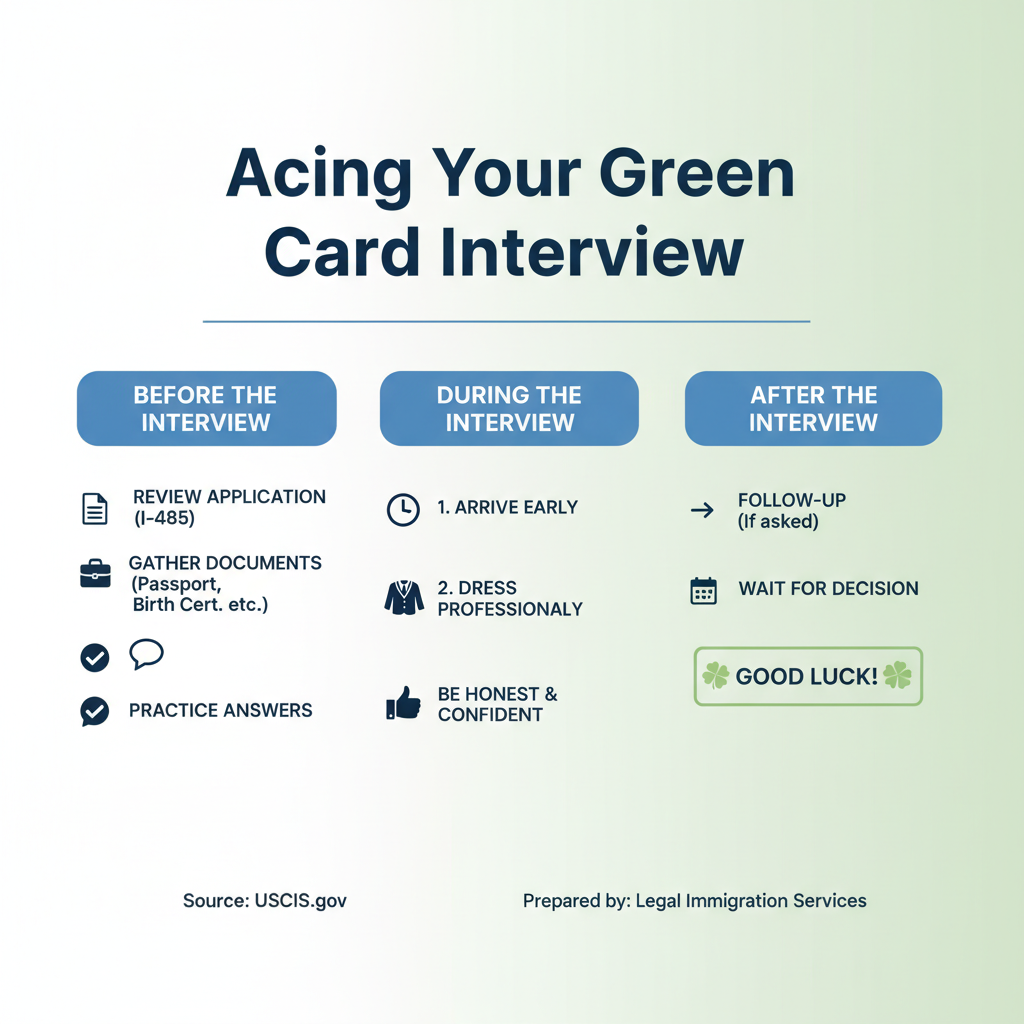
The Green Card interview is a critical juncture in your immigration journey. Proper preparation can significantly increase your chances of a smooth and successful outcome. This comprehensive guide will walk you through the essential steps.1) Understand Your Interview Notice (Form I-797C, Notice of Action)
Once your Green Card application (**Form I-485** or consular petition) is processed, USCIS (or the National Visa Center for consular cases) will send you an interview notice. This document is paramount. * **Review all details:** Check the date, time, and location of your interview. For **Adjustment of Status** cases in Central Florida, this will likely be the **Orlando USCIS Field Office**. * **Identify required documents:** The notice will list specific documents you must bring. This is not an exhaustive list; you should always bring all original documents related to your application. * **Who must attend:** The notice will specify who needs to attend. For family-based petitions, both the **Petitioner** and **Beneficiary** typically attend. For employment-based, usually just the **Beneficiary**. * **Rescheduling:** If you absolutely cannot attend, follow the instructions on the notice immediately to request a reschedule. Be aware that rescheduling can significantly delay your case. **Documents to review:** * Your interview notice (Form I-797C) * A copy of your entire Green Card application package (all forms and supporting documents you submitted)2) Gather and Organize All Required Documents
This is arguably the most crucial step. A well-organized set of documents will make the interview process smoother for both you and the officer. * **Originals and Copies:** You must bring all *original* documents that you submitted as copies, along with new *copies* for the officer to keep. This includes birth certificates, marriage certificates, divorce decrees, passports, visas, I-94 records, and any other official records. * **Translate Foreign Documents:** Any document not in English must be accompanied by a certified English translation. The translator must attest that they are competent to translate and that the translation is accurate. * **Affidavit of Support (Form I-864):** Ensure your **Petitioner** (and any joint sponsor) brings their original, signed **Form I-864** with all supporting financial documents (tax returns, W-2s, pay stubs, employment verification letters). * **Medical Exam (Form I-693):** If you haven't already submitted it, bring your sealed **Form I-693** from a USCIS-approved civil surgeon. Do NOT open the sealed envelope. * **Proof of Relationship (Family-Based):** * Marriage-based: Joint bank accounts, joint utility bills, joint leases/mortgages, shared insurance policies, photos together (over time, with family/friends), affidavits from friends/family attesting to the marriage, travel itineraries together, children's birth certificates. * Parent/Child: Birth certificates showing parentage, school records, medical records, photos. * **Proof of Employment (Employment-Based):** Original job offer letter, employer verification letter, educational degrees, professional licenses, previous employment records, detailed resume. * **Criminal Records:** If you have any arrests or convictions, bring certified court dispositions for every incident, even if charges were dropped or expunged. Consult an attorney if you have a criminal history. * **Travel History:** Passports with all entry/exit stamps, previous visas, I-94 records (print latest from CBP website). * **Financial Documents:** Pay stubs, bank statements, tax returns (for both **Petitioner** and **Beneficiary** if applicable). * **Identification:** Valid passport, driver's license, state ID. * **Photos:** Passport-style photos if instructed by the notice, or additional photos for marriage cases. **Organization Tip:** Use folders or binders to categorize your documents. Label each section clearly (e.g., "Original Birth Certificate," "Marriage Evidence," "Financial Documents"). This makes it easy to retrieve specific items quickly.3) Prepare Your Answers and Practice
While you should always be truthful, knowing what to expect can help you articulate your answers clearly and confidently. * **Review Your Application:** Go through every single form you submitted. You will be asked questions based on the information provided in these forms. Ensure your answers are consistent with what you wrote. * **Anticipate Questions:** * Personal background: Name, date of birth, place of birth, parents' names, addresses, marital history. * Immigration history: How and when you entered the U.S., previous visas, past applications, travel history. * Relationship (if applicable): How you met, when you married, daily life, shared responsibilities, future plans. * Criminal history: Any arrests, citations, or convictions. * Grounds of inadmissibility: Questions designed to ensure you are not inadmissible (e.g., "Have you ever been involved in genocide?"). * **Practice with a Friend or Attorney:** Rehearse answering questions aloud. Practice speaking clearly and directly. * **Be Honest:** This is paramount. Never lie or try to mislead the officer. If you don't know an answer, say so. If you don't understand a question, politely ask the officer to repeat or rephrase it. * **Your Attorney's Role:** If you have an attorney, they will review your case with you, prepare you for potential questions, and can attend the interview with you. This can provide immense peace of mind and ensure your rights are protected.4) Dress Appropriately and Arrive Early
First impressions matter, even in a formal setting like a USCIS interview. * **Dress Professionally:** Choose clean, modest, and professional attire, as you would for a job interview. This shows respect for the process and the officer. * **Arrive Early:** Aim to arrive at the **Orlando USCIS Field Office** (or other location) at least 30-45 minutes before your scheduled appointment. This accounts for traffic (especially on the I-4 corridor in Orlando), parking, security checks, and finding the correct waiting area. Being late can lead to automatic rescheduling or even denial. * **What to Bring (Beyond Documents):** * Your interview notice. * All organized documents. * A pen and a small notepad (optional). * A bottle of water. * A book or magazine, as wait times can be unpredictable. * Your attorney, if applicable.5) During the Interview: Be Honest and Respectful
This is your moment to shine and present your case. * **Be Truthful:** As mentioned, honesty is the best policy. Inconsistencies or deliberate falsehoods can lead to severe consequences, including denial and a bar from future immigration benefits. * **Listen Carefully:** Pay close attention to each question. If you don't understand, ask for clarification. * **Answer Directly:** Provide concise, direct answers. Avoid volunteering information that wasn't asked, but be prepared to elaborate if requested. * **Maintain Composure:** The officer's demeanor might vary. Remain calm, polite, and respectful throughout. * **Oath:** You will be sworn in, affirming that your testimony will be truthful. Take this seriously. * **Signatures:** You may be asked to review and sign various forms or updated information. Read carefully before signing. * **Attorney's Role:** If your attorney is present, they will observe the interview, clarify questions, object to inappropriate questions, and ensure the process is fair. They cannot answer for you, but they are there to protect your rights.6) After the Interview: What to Expect
The interview is often not the final step, but it brings you closer to a decision. * **Immediate Decision:** In some straightforward cases, the officer might tell you on the spot that your application is approved or that a decision will follow shortly. * **Request for Evidence (RFE):** If the officer needs more information or documentation, they will issue an **RFE**. Respond promptly and thoroughly by the deadline. * **Notice of Intent to Deny (NOID):** If the officer believes you are not eligible, they may issue a **NOID**, giving you a chance to rebut their findings. This is a serious notice and requires immediate legal consultation. * **Decision by Mail:** Most decisions are mailed to you within a few weeks to a few months. You can check your case status online using your receipt number on the USCIS Case Status website. * **Green Card Delivery:** If approved, your Green Card will be mailed to your address. Ensure your address on file with USCIS is current. **Important:** If you receive an **RFE** or **NOID**, contact an immigration attorney immediately. These notices often have strict deadlines and require precise legal responses.Feeling Anxious About Your Interview? Let Imigrar provide the peace of mind you need. Our Orlando-based lawyers specialize in Green Card interviews. Call +1 786-791-3106 for your free consultation today. Se Habla Español.
Practical Steps You Can Take Today for Interview Success
Proactive preparation is key to a successful Green Card interview. Here's a checklist of actionable steps you can start taking right now. * **Review Your Entire Application:** Pull out every form you submitted (**Form I-130**, **Form I-485**, **Form I-864**, etc.) and read through them carefully. Highlight any areas where you might anticipate questions or where information could be unclear. * **Create a Master Document Checklist:** Based on your interview notice and the general requirements, create a detailed list of every single original document and copy you need to bring. Check off items as you gather them. * **Verify All Personal Information:** Double-check names, dates of birth, addresses, and employment history on all documents against your application forms for consistency. Any discrepancies, no matter how minor, should be noted and explained truthfully if asked. * **Organize Your Documents Systematically:** Use a binder with tabbed dividers. Label each section clearly (e.g., "Birth Certificates," "Marriage Evidence," "Financial," "Passports/I-94s," "Medical Exam"). Place originals in one section and copies in another, or clearly distinguish them. * **Practice Answering Questions Aloud:** Ask a trusted friend or family member to play the role of the immigration officer. Practice answering questions about your application, your relationship (if applicable), and your immigration history. Focus on clarity and consistency. * **Consult with an Immigration Attorney:** Even if you prepared your initial application yourself, a consultation with an experienced immigration lawyer can be invaluable for interview preparation. An attorney can spot potential issues, advise on how to address them, and provide specific guidance tailored to your case. For Central Florida residents, our Imigrar team is ready to help. * **Check USCIS Processing Times:** While not directly for interview preparation, understanding the general timeline can help manage expectations. Visit USCIS Processing Times and select your form type and field office (e.g., **Orlando USCIS Field Office**) to see estimated timelines. * **Update Your Address with USCIS:** If you have moved since filing your application, ensure your address is updated immediately using **Form AR-11, Alien's Change of Address Card**, or through your USCIS online account. Missing an interview notice or decision letter can jeopardize your case. **Document Preparation Guidance:** * **Originals are paramount:** Always bring the *original* of every document you submitted as a copy, plus a new copy for the officer. If you submit a certified copy of a court document, bring that original certified copy. * **Translations:** Ensure all foreign language documents are translated by a competent translator, with a certification that the translation is accurate and complete. * **Photos:** For marriage-based cases, bring a variety of photos showing your relationship over time, with family and friends. Organize them chronologically and consider adding captions. * **Evidence of Joint Life (for marriage-based):** Gather as much evidence as possible that shows you and your spouse have intertwined your lives. This could include: joint bank statements, joint utility bills, joint leases or mortgage statements, shared insurance policies (health, auto, life), joint tax returns, children’s birth certificates (if applicable), travel itineraries, and affidavits from friends/family. **Timeline Expectations:** * **Interview Notice:** Typically received several weeks to a few months after your application is considered "ready for interview." * **Interview Duration:** Most interviews last between 20 minutes to an hour, though complex cases can take longer. * **Decision:** You might receive a decision on the spot, or it could take weeks to several months. **Important:** Do not contact USCIS for a status update unless the processing time for your specific form and field office (e.g., **Orlando USCIS Field Office**) has exceeded the posted average on the USCIS Processing Times website. * **Green Card Delivery:** Once approved, your Green Card is usually mailed within a **180 days** after approval.How Imigrar Helps Immigrants in Orlando and Beyond
At Imigrar, our mission is to "Keep Families Together." We understand that the Green Card interview is a high-stakes moment, and navigating it without expert guidance can be incredibly stressful. Our Orlando-based immigration law firm is dedicated to providing comprehensive, compassionate, and effective legal representation to immigrants and their families throughout Central Florida and nationwide. **Our experience and expertise:** Our team of skilled immigration attorneys has extensive experience with all types of Green Card applications, including family-based, employment-based, and humanitarian cases. We are intimately familiar with USCIS procedures, interview protocols, and the specific nuances of the **Orlando USCIS Field Office**. We have successfully guided countless clients through their interviews, helping them present strong, compelling cases. **How we assist with your Green Card interview preparation:** * **Thorough Application Review:** We meticulously review your entire application package to ensure consistency and identify any potential issues before your interview. * **Personalized Interview Preparation:** We conduct mock interviews, preparing you for the types of questions you'll face, how to answer them truthfully and effectively, and how to present your documents confidently. * **Document Organization:** We help you organize your supporting evidence, ensuring you have all necessary originals and copies, including crucial documents like the **Affidavit of Support (Form I-864)** and medical exam (Form I-693). * **Attendance at Interview:** Our attorneys can attend the interview with you, providing legal counsel, clarifying questions, and protecting your rights throughout the process. This presence can significantly reduce anxiety and prevent misunderstandings. * **Response to RFEs and NOIDs:** Should USCIS issue a **Request for Evidence (RFE)** or a **Notice of Intent to Deny (NOID)**, we are prepared to craft a robust and timely legal response. * **Post-Interview Follow-up:** We continue to monitor your case and advise you on the next steps until a final decision is reached. We pride ourselves on offering personalized service, understanding that every client's situation is unique. Our commitment to accuracy, professionalism, and client success makes us a trusted partner in your immigration journey. **Free consultation offer:** We invite you to take advantage of a **free consultation** with one of our experienced immigration attorneys. This is an opportunity to discuss your specific case, understand the interview process, and learn how Imigrar can support you. There’s no obligation, just clear, honest legal advice. **Se Habla Español:** We are proud to serve the diverse communities of Florida and across the nation. Our team is fully bilingual, ensuring that you can communicate comfortably and effectively in both English and Spanish. "Keep Families Together" is not just our tagline; it's our guiding principle. Let us help you achieve your dream of permanent residency. Call us today!
Frequently Asked Questions About Green Card Interviews
Q: What if I don't understand a question during the interview?
A: If you don't understand a question, do not guess or provide an answer you're unsure about. Politely ask the officer to repeat the question or rephrase it. You can also state, "I don't understand the question, can you please explain?" If you are represented by an attorney, they can also ask for clarification on your behalf. It is crucial to ensure you fully comprehend what is being asked to provide an accurate response. Misunderstanding a question and providing an incorrect answer can lead to unintended complications.
Q: How will the Green Card interview impact my current immigration status or travel plans?
A: The interview itself does not immediately change your current immigration status. You remain in the status you were in prior to the interview (e.g., H-1


