

At Imigrar, we understand that nothing is more important than family. For many, the dream of reuniting with loved ones in the United States is a powerful motivator. Family-based immigration provides a pathway for U.S. citizens and lawful permanent residents (LPRs) to sponsor eligible relatives for a Green Card, allowing them to live and work permanently in the U.S. This process, while incredibly rewarding, is also notoriously complex, involving numerous forms, strict deadlines, and specific legal requirements. That’s why we’ve created this comprehensive guide: to demystify the family petition process and help you navigate it with confidence.
Need Help? Our Orlando immigration team is ready to assist. Call +1 786-791-3106 for a free consultation, or message us online. Se Habla Español.
The reporting that sparked this guide
The continuous conversation around immigration law and family reunification is a constant in news cycles. The intricacies of family-based petitions are frequently discussed, highlighting both the successes and the challenges faced by families seeking to come together. This ongoing dialogue underscores the critical need for clear, accurate, and actionable information for those directly impacted by these laws. For anyone looking to understand the core mechanisms of bringing family to the U.S., a detailed guide to family petitions remains a fundamental resource. You can find more general immigration news and updates by following sources like: Family-Based Immigration Petition Guide (Immigration).
What This News Means for Immigrants in Orlando and Across Florida
For individuals and families living in Orlando, Central Florida, and throughout the Sunshine State, the topic of family-based immigration is not abstract; it’s deeply personal. Florida is one of the most diverse states in the nation, home to vibrant immigrant communities from Latin America, the Caribbean, Europe, and Asia. This diversity means that countless families are either actively engaged in or considering the family petition process to bring their loved ones to the U.S.
Why this news is showing up now
While the concept of family-based immigration isn't "new," its relevance is perpetual. Immigration policies are always evolving, and even subtle changes in processing times, form requirements, or interpretation of existing laws can have significant impacts. News outlets frequently report on these changes, as well as on the experiences of families navigating the system. Furthermore, with constant updates from USCIS official website and the U.S. Department of State, there's always a fresh angle to discuss. As of 2026, there's a consistent focus on streamlining processes where possible, but also on ensuring the integrity of the system. This creates a continuous need for up-to-date guides that reflect current realities and offer practical advice.
How it can affect Florida residents
Florida's unique demographic landscape means that family-based immigration is a cornerstone of many communities. For residents in Orlando and surrounding areas like Kissimmee, Sanford, and Lakeland, understanding the family petition process is crucial. The impact can range from:
- Reuniting Families: The most direct impact is the ability to bring spouses, children, parents, and siblings to live permanently in Florida. This strengthens families and enriches communities.
- Economic Contributions: New immigrants contribute significantly to Florida's economy, filling labor gaps, starting businesses, and paying taxes.
- Community Growth: Family reunification often leads to the growth of cultural communities, bringing diverse traditions, foods, and languages to cities like Orlando.
- Local USCIS Office Engagement: Florida residents frequently interact with local USCIS field offices, including the Orlando USCIS Field Office, for interviews, biometrics, and other appointments related to their petitions. Understanding the process helps prepare for these interactions.
- Legal Complexities: Florida's large immigrant population means there's a higher demand for experienced immigration attorneys who can help navigate the specific challenges that may arise, whether it's a complex marriage petition or a sibling petition with long wait times.
For those along the I-4 corridor and across Orange County, knowing the steps, requirements, and potential pitfalls can mean the difference between a successful petition and a delayed or denied application. This guide aims to equip you with that knowledge.
What Family-Based Immigration Is (and Why It Matters)
Family-based immigration is the primary way for U.S. citizens and lawful permanent residents (Green Card holders) to sponsor certain eligible family members to immigrate to the United States. The underlying principle is "Keep Families Together," a sentiment deeply shared by Imigrar.
A plain-English definition
In simple terms, family-based immigration is a legal process where a U.S. citizen or a Green Card holder (the Petitioner) asks the U.S. government to allow a close family member (the Beneficiary) to come to or remain in the U.S. permanently. If approved, the beneficiary receives a Green Card, granting them lawful permanent resident status. This process is governed by strict rules regarding who can be sponsored, how the application must be filed, and the order in which visas are issued.
Key terms you need to know
Navigating immigration law requires understanding specific terminology. Here are some key terms vital to family-based petitions:
- Petitioner: The U.S. citizen or lawful permanent resident who files the immigration petition on behalf of their relative.
- Beneficiary: The foreign national relative for whom the petition is filed, seeking to immigrate to the U.S.
- Form I-130, Petition for Alien Relative: The initial form filed by the petitioner with USCIS to establish the qualifying relationship between the petitioner and the beneficiary.
- Green Card: An identification card issued to lawful permanent residents of the United States, granting them permission to live and work permanently in the country.
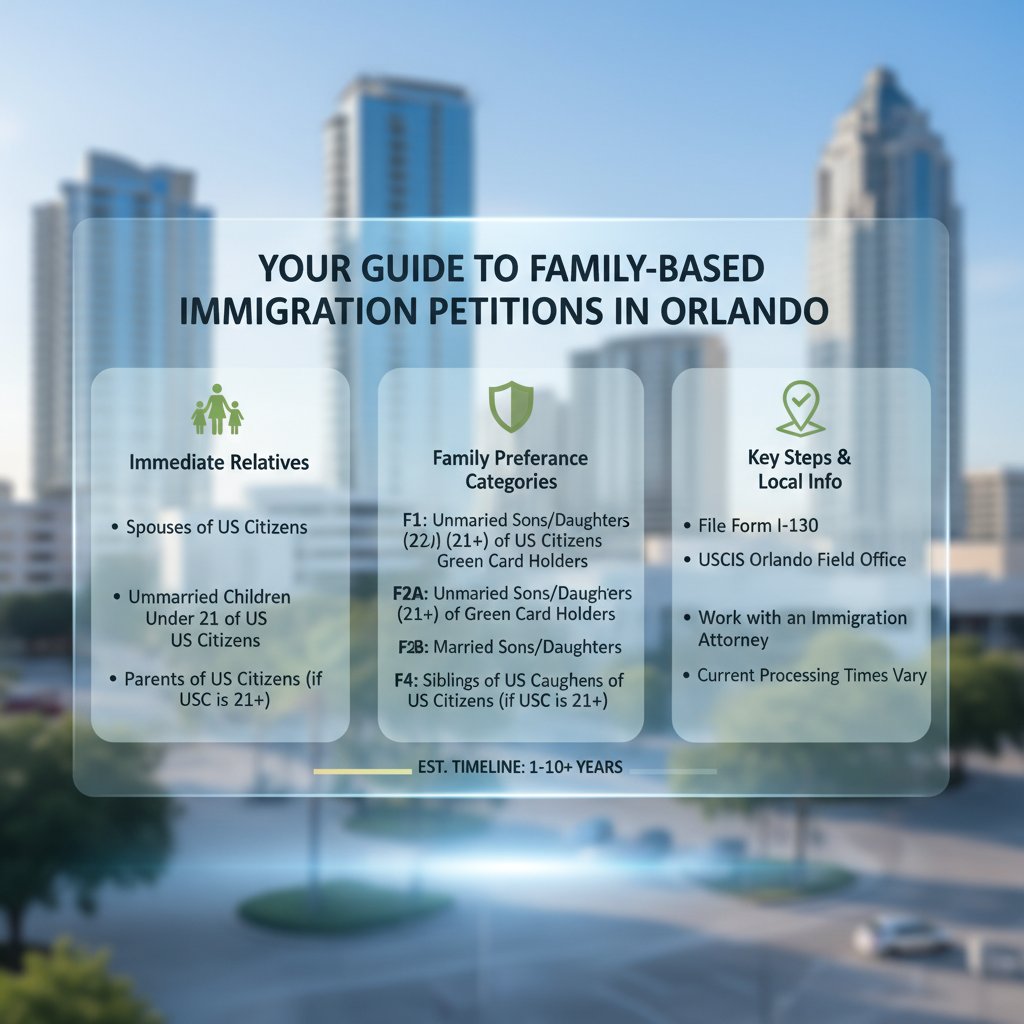
- Immediate Relatives: This category includes spouses of U.S. citizens, unmarried children under 21 of U.S. citizens, and parents of U.S. citizens (if the U.S. citizen is at least 21 years old). There are an unlimited number of visas available for Immediate Relatives, meaning they do not have to wait for a visa to become available based on a Priority Date.
- Family Preference Categories: These categories are for specific, more distant family relationships or for relatives of Green Card holders. They have annual limits on the number of visas issued, leading to waiting lists. Categories include:
- First Preference (F1): Unmarried sons and daughters (21 years of age or older) of U.S. citizens.
- Second Preference (F2A): Spouses and children (unmarried, under 21) of lawful permanent residents.
- Second Preference (F2B): Unmarried sons and daughters (21 years of age or older) of lawful permanent residents.
- Third Preference (F3): Married sons and daughters of U.S. citizens.
- Fourth Preference (F4): Brothers and sisters of U.S. citizens (if the U.S. citizen is at least 21 years old).
- Priority Date: The date USCIS receives your Form I-130 petition. This date determines your place in the waiting line for a visa in the Family Preference Categories.
- Visa Bulletin: A monthly publication by the U.S. Department of State that lists the Priority Dates for when immigrant visas become available to applicants in the Family Preference Categories. You can check the latest Visa Bulletin on the U.S. Department of State website.
- Adjustment of Status (AOS): The process of applying for a Green Card from within the United States if the beneficiary is already present in the U.S. and meets eligibility requirements. This typically involves filing Form I-485.
- Consular Processing: The process of applying for an immigrant visa through a U.S. embassy or consulate in the beneficiary's home country if the beneficiary is living outside the U.S. This typically involves filing Form DS-260.
- Affidavit of Support (Form I-864): A legally binding document filed by the petitioner (or a joint sponsor) to demonstrate that they can financially support the beneficiary(ies) and ensure they will not become a public charge in the U.S.
Current Immigration Law: The Foundation
Family-based immigration is primarily governed by the Immigration and Nationality Act (INA), specifically Sections 201, 203, and 204. These sections establish who is eligible to petition, who can be petitioned for, and the numerical limitations for certain categories. Understanding these foundational laws is crucial.
Federal requirements
At the federal level, the requirements for family-based petitions are stringent and apply nationwide. Key federal requirements include:
- Petitioner Status: The petitioner must be a U.S. citizen or a lawful permanent resident (Green Card holder). Proof of this status (e.g., U.S. birth certificate, naturalization certificate, U.S. passport, or Green Card) is essential.
- Bona Fide Relationship: The relationship between the petitioner and the beneficiary must be genuine and legally recognized. For example, in marriage petitions, extensive evidence of a valid, ongoing marriage is required.
- Financial Sponsorship: The petitioner must demonstrate the financial ability to support the beneficiary at 125% of the federal poverty guidelines by filing Form I-864, Affidavit of Support. If the petitioner's income is insufficient, a joint sponsor may be required. This is a critical component to prevent the beneficiary from becoming a "public charge."
- Admissibility: The beneficiary must be admissible to the U.S., meaning they must not have certain criminal records, communicable diseases, or other grounds of inadmissibility. Waivers may be available in some cases.
- Proper Documentation: All required forms must be correctly filled out, signed, and submitted with all necessary supporting documents, including birth certificates, marriage certificates, divorce decrees, passports, and photographs.
The primary agency overseeing these petitions is U.S. Citizenship and Immigration Services (USCIS). All forms and detailed instructions can be found on the USCIS official website.
Florida-specific considerations
While federal law dictates the core requirements, Florida residents may encounter specific local considerations:
- Orlando USCIS Field Office: If you are pursuing Adjustment of Status in Central Florida, your interview may be scheduled at the Orlando USCIS Field Office. Familiarity with this office's procedures and typical interview questions can be beneficial.
- Demand for Services: Due to Florida's large immigrant population, there can sometimes be higher volumes of applications, potentially affecting local processing times for certain steps. However, USCIS Processing Times are generally standardized nationally, with local variations mainly impacting interview scheduling.
- Access to Legal Aid and Resources: Central Florida, including Orlando, has a robust network of immigration legal service providers. Imigrar is proud to be a part of this community, offering expert guidance tailored to the needs of local residents.
- Language Access: Given the diverse linguistic landscape of Florida, particularly with a significant Spanish-speaking population, services like those offered by Imigrar (Se Habla Español) are vital for clear communication and understanding.
Overwhelmed by forms? Don't risk costly mistakes. Let Imigrar's experienced team handle your family petition with precision. Call +1 786-791-3106 for your free consultation today. Se Habla Español.
How to File a Family-Based Immigration Petition: A Complete Step-by-Step Guide
The family-based immigration process can be broken down into several key stages. Here’s a detailed guide to help you understand each step.
1) Determine Eligibility and Relationship Category
Before you even fill out a form, you need to confirm that you, as the petitioner, are eligible to sponsor your relative (the beneficiary), and which immigration category they fall under. This is the foundational step.
Petitioner Eligibility: You must be either a U.S. citizen or a lawful permanent resident (Green Card holder).
Beneficiary Eligibility & Relationship Categories:
- Immediate Relatives of U.S. Citizens: Spouses, unmarried children under 21, and parents (if the U.S. citizen is 21 or older). These typically have no visa waiting line.
- Family Preference Categories:
- F1: Unmarried sons and daughters (21 or older) of U.S. citizens.
- F2A: Spouses and unmarried children (under 21) of lawful permanent residents.
- F2B: Unmarried sons and daughters (21 or older) of lawful permanent residents.
- F3: Married sons and daughters of U.S. citizens.
- F4: Brothers and sisters of U.S. citizens (if the U.S. citizen is 21 or older).
Required Documents for Eligibility Assessment:
- Proof of Petitioner's U.S. Citizenship (e.g., U.S. birth certificate, naturalization certificate, U.S. passport) OR Lawful Permanent Resident Status (Green Card).
- Proof of relationship to the beneficiary (e.g., birth certificates, marriage certificates, adoption decrees).
- Proof of legal termination of any prior marriages for both petitioner and beneficiary (e.g., divorce decrees, death certificates).
2) File Form I-130, Petition for Alien Relative
This is the first formal step in the immigration process. The U.S. citizen or LPR (petitioner) files Form I-130 with USCIS to establish the qualifying relationship with the foreign relative (beneficiary). This form initiates the process and, once approved, establishes the Priority Date for preference categories.
Key Considerations:
- Accuracy: Fill out the form completely and accurately. Any discrepancies can cause delays or even denial.
- Supporting Documents: Attach all required supporting evidence to prove the relationship. For spouses, this includes extensive evidence of a bona fide marriage.
- Filing Fee: Pay the current USCIS filing fee. Check the USCIS Forms page for the most up-to-date fees.
Required Documents for Form I-130:
- Completed and signed Form I-130.
- Copy of Petitioner's proof of U.S. citizenship or Green Card.
- Copy of Beneficiary's birth certificate.
- Copy of marriage certificate (if petitioning for a spouse).
- Copies of divorce decrees or death certificates for any prior marriages of both petitioner and beneficiary.
- Passport-style photos of both petitioner and beneficiary (if required by the specific form instructions).
- For spouse petitions: Extensive evidence of a bona fide marriage (e.g., joint bank accounts, joint leases/mortgages, utility bills in both names, photos together, affidavits from friends/family, birth certificates of shared children).
- For parent/child petitions: Petitioner's birth certificate listing parent as beneficiary, or beneficiary's birth certificate listing petitioner as child.
- Any other specific documents requested based on the relationship.
Important: Ensure all foreign language documents are accompanied by a certified English translation.
3) Await Petition Approval and Priority Date
After filing Form I-130, you will receive a receipt notice from USCIS (Form I-797C, Notice of Action). This notice will contain your Priority Date. If your beneficiary is an Immediate Relative of a U.S. citizen, they do not have a visa waiting period once the I-130 is approved, and their visa is considered immediately available.
However, if your beneficiary is in a Family Preference Category, they must wait for their Priority Date to become "current" according to the monthly Visa Bulletin issued by the U.S. Department of State. This waiting period can range from a few years to over two decades, depending on the category and the beneficiary's country of origin.
What to do while waiting:
- Keep all receipt notices and approval notices.
- Monitor the U.S. Department of State Visa Bulletin monthly.
- Notify USCIS of any change of address (Form AR-11) for both petitioner and beneficiary.
- Gather additional supporting documents for the next stage.
4) Apply for Green Card (Adjustment of Status or Consular Processing)
Once the Form I-130 is approved and a visa is available (or immediately available for Immediate Relatives), the beneficiary can apply for their Green Card. The method depends on whether the beneficiary is currently in the U.S. or abroad.
Option A: Adjustment of Status (If Beneficiary is in the U.S.)
If the beneficiary is physically present in the U.S. and entered legally (or is otherwise eligible to adjust status), they can apply for a Green Card without leaving the country. This process typically involves filing Form I-485, Application to Register Permanent Residence or Adjust Status, concurrently with Form I-130 for Immediate Relatives, or after I-130 approval for preference categories when the Priority Date is current.
Required Documents for Adjustment of Status (Form I-485 package):
- Completed and signed Form I-485.
- Copies of Form I-130 approval notice (if filed separately).
- Copy of beneficiary's birth certificate.
- Copy of beneficiary's passport identity page and visa page (if applicable).
- Copy of Form I-94, Arrival/Departure Record (front and back).
- Passport-style photographs of the beneficiary.
- Form I-864, Affidavit of Support, from the petitioner (and any joint sponsor, if applicable), with supporting financial documents (tax returns, W-2s, employment verification letters).
- Form I-693, Report of Medical Examination and Vaccination Record, completed by a USCIS-approved civil surgeon.
- Form I-765, Application for Employment Authorization (optional, allows beneficiary to work while I-485 is pending).
- Form I-131, Application for Travel Document (optional, allows beneficiary to travel internationally while I-485 is pending).
- Certified copies of any criminal records, if applicable.
- Applicable filing fees.
Option B: Consular Processing (If Beneficiary is Outside the U.S.)
If the beneficiary is living outside the U.S., or is not eligible for Adjustment of Status, they will go through Consular Processing. Once the Form I-130 is approved and the Priority Date is current, USCIS sends the approved petition to the National Visa Center (NVC), which then coordinates with the U.S. embassy or consulate in the beneficiary's home country.
Required Documents for Consular Processing (NVC stage and Interview):
- Form I-130 approval notice.
- Form DS-260, Immigrant Visa Application (completed online by beneficiary).
- Form I-864, Affidavit of Support, from the petitioner (and any joint sponsor), with supporting financial documents.
- Beneficiary's valid passport.
- Beneficiary's birth certificate.
- Marriage certificate (if applicable).
- Police certificates from all countries where the beneficiary has lived.
- Military records (if applicable).
- Court and prison records (if applicable).
- Medical examination results from a panel physician approved by the U.S. embassy/consulate.
- Passport-style photographs of the beneficiary.
- Any other civil documents requested by the NVC or the consulate.
- Applicable filing fees (NVC fees, immigrant visa fee).
Reminder: The NVC will provide a detailed list of required documents and instructions via mail or email.
5) Attend Biometrics Appointment and Interview
Whether pursuing Adjustment of Status or Consular Processing, the beneficiary will typically need to attend two crucial appointments:
- Biometrics Appointment: USCIS will send a notice for a biometrics appointment (fingerprints, photos, signature) at an Application Support Center (ASC). This data is used for background and security checks. For Central Florida residents, this might be at the Orlando ASC.
- Interview:
- For Adjustment of Status: The beneficiary (and usually the petitioner, especially for marriage-based petitions) will attend an interview at a USCIS field office, such as the Orlando USCIS Field Office. An officer will review the application and supporting documents, and ask questions to confirm eligibility and the bona fides of the relationship.
- For Consular Processing: The beneficiary will attend an interview at the U.S. embassy or consulate in their home country. A consular officer will review the application and determine if the beneficiary is eligible for an immigrant visa.
Preparation is Key: Bring all original documents, copies of all submitted forms, and any additional evidence requested or that you believe strengthens your case.
6) Receive Decision and Green Card
If the interview is successful and all requirements are met:
- For Adjustment of Status: USCIS will notify the beneficiary of approval, and the Green Card will be mailed to their address.
- For Consular Processing: The consular officer will approve the immigrant visa. The beneficiary will receive a visa stamp in their passport and a sealed immigrant visa packet. They must enter the U.S. before the visa expires (usually within 6 months). Upon entry, the Green Card will be mailed to their U.S. address.
Congratulations! Receiving the Green Card is the culmination of this often long and challenging journey, marking the beginning of a new chapter in the U.S. as a lawful permanent resident.
Practical Steps You Can Take Today
Starting early and staying organized are crucial for a successful family-based immigration petition. Here are actionable steps you can take:
Actionable Checklist:
- Verify Eligibility: Double-check the relationship category and ensure both petitioner and beneficiary meet all basic eligibility criteria.
- Gather Core Documents: Start collecting birth certificates, marriage certificates, divorce decrees, passports, and proof of petitioner's status. Obtain certified copies and English translations for foreign documents.
- Assess Financial Sponsorship: Review the USCIS Poverty Guidelines to determine if the petitioner meets the income requirements for Form I-864. If not, identify a potential joint sponsor.
- Organize Records: Create a dedicated binder or digital folder for all immigration documents. Keep originals safe and submit copies unless explicitly requested otherwise.
- Consult with an Immigration Attorney: This is arguably the most important step. An expert can assess your specific situation, identify potential issues, and guide you through the entire process, minimizing errors and delays. For Central Florida residents, Imigrar offers free consultations.
- Review USCIS Resources: Familiarize yourself with the USCIS official website, especially the USCIS Forms page for the latest versions and instructions.
Document Preparation Guidance
- Originals vs. Copies: Always keep your original documents. Submit photocopies unless USCIS specifically requests an original. For the interview, bring all originals.
- Translations: Any document not in English must be accompanied by a complete and accurate English translation, certified by the translator as competent to translate and that the translation is accurate.
- Organization: Arrange documents in the order listed on the USCIS instructions. Use tabs or dividers for easy navigation.
- Evidence of Bona Fide Relationship: For marriage petitions, collect a wide array of evidence: joint bank statements, joint utility bills, shared lease/mortgage, photos, letters from friends/family, and any other proof of commingling lives.
Timeline Expectations
Understanding processing times is crucial for managing expectations.
Immediate Relatives: While there's no visa waiting line, the entire process from filing Form I-130 to receiving a Green Card can still take 10-18 months, or even longer depending on the specific USCIS field office (e.g., Orlando USCIS Field Office) and service center workloads.
Family Preference Categories: These involve significant waiting times based on the Visa Bulletin. Waiting periods can range from 2 years for some F2A beneficiaries to over 20 years for F4 beneficiaries from certain countries.
You can check current estimated processing times for various forms on the USCIS Processing Times website. These times are estimates and can fluctuate.
Ready to start your family's immigration journey? Imigrar provides compassionate and expert legal support. Contact us at +1 786-791-3106 for a no-obligation consultation. Se Habla Español.


